
.svg)






The CSRD - Corporate Sustainability Reporting Directive will come into effect from 2024, thereby requiring more and more companies to produce demanding annual non-financial reports regarding their environmental and social impact, as well as their governance mechanisms (ESG).
The concept of "double materiality" is at the heart of the political philosophy driven by Europe, which gave rise to the CSRD. "Political philosophy" because the emergence of new international ESG reporting standards reveals a clash between European and American visions. While Europeans and Americans are generally aligned on the need to standardize corporate ESG reporting, the "double materiality" requirement is the main point of disagreement between the institutions driving standardization projects on both sides of the Atlantic, namely theInternational Sustainability Standards Board (ISSB) in the United States and the Taskforce of theEuropean Financial Reporting Advisory Group (EFRAG) for the European Union.
What is the "Materiality" of Information?
Before delving deeper into "double materiality" and what it implies for companies, it is important to first understand the concept of "materiality." "Materiality" is a concept originating from the financial world that is now being applied to the field of CSR with the systematization and standardization of non-financial reporting.
The French word "matérialité" is a direct translation of the English word "materiality", a term historically used in financial auditing and now employed in CSR to denote the relevance or level of importance of information or data regarding its potential impact on a company's performance and associated decision-making.
An ESG issue, and the information associated with it, is considered "material" for a given company when it is likely to have a significant impact on its ability to create financial and non-financial value for itself and its internal or external stakeholders, and thus influence the decisions of economic actors and various stakeholders regarding the company in question: investors, credit institutions, public authorities, partners, etc.
The progressive alignment of requirements between financial and non-financial reporting implies a new consideration of non-financial factors, particularly ESG factors, regarding their importance for the sustainable performance of an activity.
What is "double materiality"?
In the context of an ESG approach or reporting, "simple" or "financial" materiality involves considering the potential impacts of ESG factors on a company's financial performance. This is akin to an analysis of non-financial risks for the company. Example: Is my company's activity exposed to certain types of natural disasters?
The principle of double materiality complements this "simple" or "financial" materiality with "impact materiality," which considers the effects of the company's activities on its environment, nature, and society.

- Financial materiality following an "outside-in" logic: The impact of ESG factors on an organization's financial performance. This materiality analysis will specifically highlight the company's exposure to climate change-related risks through potential financial consequences.
- ESG Materiality or "Impact Materiality" following an "inside-out" logic : The impact of the organization's activities on the environment, society, and governance.
- Double Materiality: Consideration, within the ESG strategy and data integrated into non-financial reports, of the environmental and social risks to which the company is exposed, on the one hand, and the impact of the company's activities on the planet and society, on the other hand.
Why is the single materiality approach not sufficient for an ambitious ESG strategy?
When a company settles for a "single materiality" approach, certain social or environmental information, potentially important for the sustainability of life on Earth, may not be considered material and therefore not integrated into the company's future strategy and performance analysis.
A historical example of this type of information is "the quantity of greenhouse gases emitted by the company." In absolute terms, an increase in a company's carbon footprint from one year to the next will not impact its financial performance, or may even be a "logical" consequence of a thriving business. However, today we can no longer ignore the weight of corporate activity in total emissions of GHG which accelerate climate change, and the fact that this climate change poses numerous risks to all individuals and businesses, particularly to the activities of the companies responsible for it.
The double materiality approach is important because it precisely links a company's impacts on the environment to their consequences for the company's direct and indirect ecosystems and ultimately to the potentially considerable risks weighing on the company's financial performance.
The main idea behind the "double materiality" approach is thatFrom a business perspective, there is a deep interconnection between the risks companies face and the sources of those risks. To put it another way, more simply, single materiality views companies as 'potential victims and/or beneficiaries,' while double materiality views companies as 'potential victims and/or beneficiaries' AND as 'potentially responsible' for impacts, whether positive or negative.
For a company, adopting a double materiality ESG approach will enable it to identify new opportunities, gain a better understanding and proactive management of risks, and ultimately accelerate its transition towards a sustainable business model.
What is a 'Double Materiality Analysis'?
The objective of a 'double materiality analysis' is simply to determine, for a company, which ESG issues are 'material' to it, meaning they are likely to affect its strategy and sustainability. The materiality analysis will also aim to prioritize these issues and define indicators that reliably report the company's position regarding each issue, or how it and its stakeholders may be affected by each issue.
Example: Is the quantity of greenhouse gases emitted by the company important information for decision-making regarding the sustainability of its operations?
Beyond the upcoming legal obligation under the CSRD to conduct a recurring double materiality analysis for its business, this analysis will enable each company to identify its priority ESG issues, mobilize resources towards the most critical challenges for its internal and external stakeholders, and identify the data to be integrated and shared in the company's non-financial reports.
What is a materiality matrix?
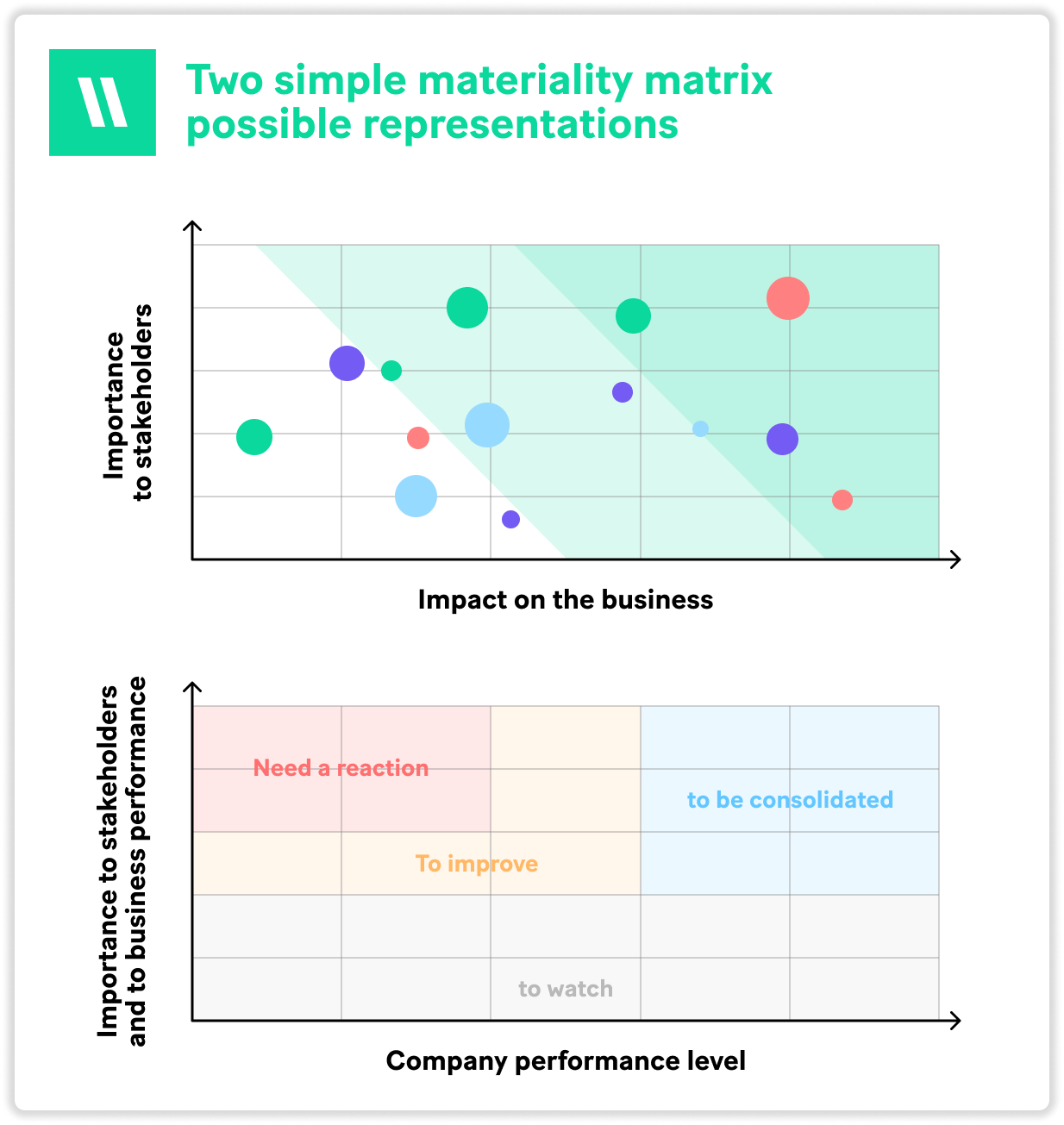
A visual deliverable of a materiality analysis can be a 'materiality matrix'. A materiality matrix allows for graphically prioritizing a company's ESG issues to quickly identify 'material' issues, and thus those on which the company should focus its efforts, prioritize its actions, and provide accurate reporting.
A 'simple' materiality matrix is typically represented in two dimensions: one axis showing the importance of ESG issues for the company's business, and the other their importance for internal and external stakeholders: employees, unions, shareholders, investors and rating agencies, customers, suppliers, public authorities, NGOs, academia… A matrix can also include a representation of the nature of the issues: social, societal, environmental, governance, financial, business…
Another way to present a simple materiality analysis is to supplement the information on the importance of a CSR issue with the company's current performance level regarding that issue. to naturally develop a CSR action plan by visualizing the issues on which the company must maintain or increase its efforts.
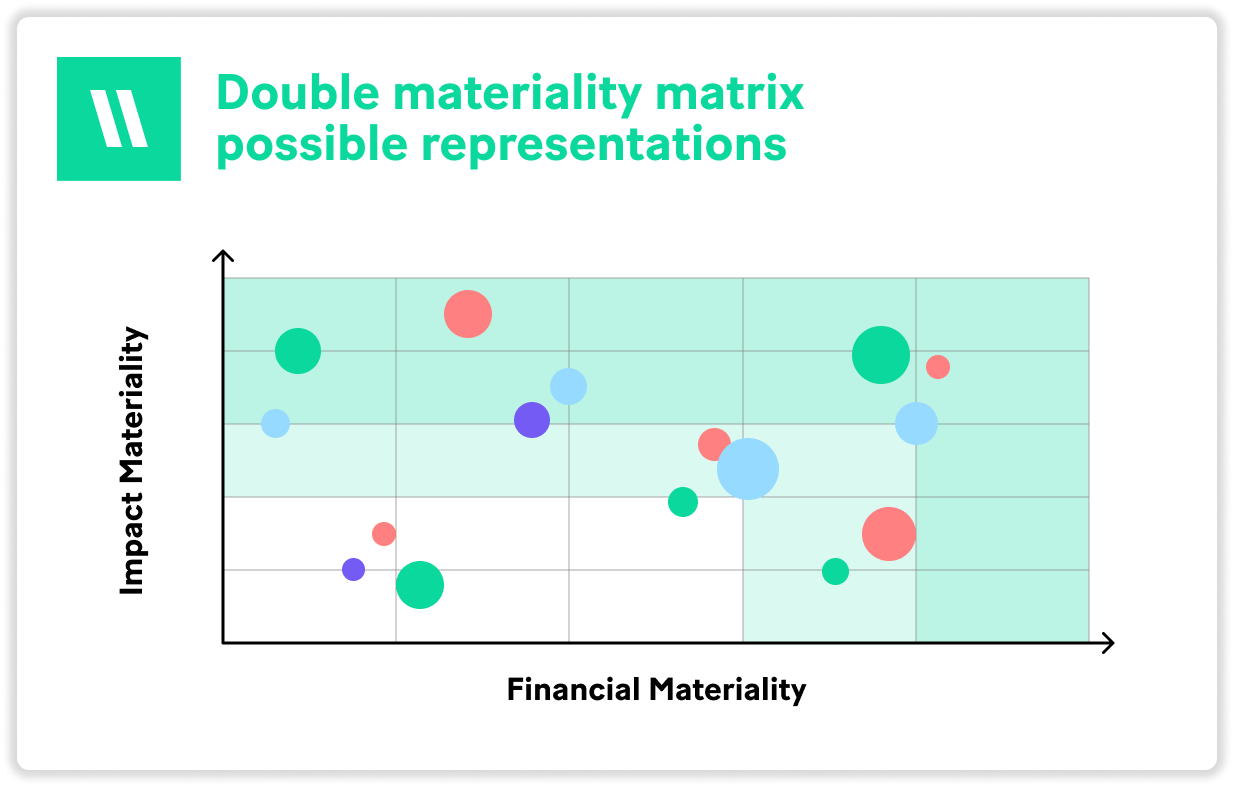
A double materiality matrix will generally represent financial materiality—that is, the importance of the issue for the company and its combined stakeholders—on the x-axis, and impact materiality on the y-axis. In this case, material ESG issues will normally be those that maximize financial materiality OR impact materiality.
Revisiting the ideological opposition between ISSB and EFRAG regarding materiality
In the context of the emergence of new non-financial reporting standards, the ISSB advocates for a single materiality approach to accounting and reporting, following the example of the TNFD on the biodiversity aspect. Single materiality is primarily aimed at an investor audience, whereas EFRAG advocates for a double materiality approach with data disclosure intended for multi-stakeholder use.
Accounting, whether financial or non-financial, and its reporting and auditing standards, "influence the understanding and management of business activities, and therefore potentially the direction of the entire economy." (Maurice Levy).
The differences in approach between the ISSB and EFRAG, and the debates these differences generate, reveal two worldviews that will greatly influence the evolution of business models, their environmental impact, and ultimately, the achievement or failure to achieve crucial environmental and social objectives for all life on Earth.
The financial materiality approach, as the sole obligation for companies, advocates for a worldview where nature is at the disposal of economic activities and the profitability generated for shareholders, without the company having any responsibility or accountability towards nature.
Thus, at Tennaxia, beyond offering our clients an ESG software to comply with CSRD, facilitating the collection, analysis, and reporting of all their ESG data, we firmly believe in the importance of requiring companies to adopt a double materiality approach for their non-financial reporting, to foster the emergence of sustainable business models.