
.svg)





.webp)


While companies and financial actors today have a wide range of frameworks and reporting methodologies for issues related to greenhouse gas emissions and their impact, those related to biodiversity and nature in general suffer from a relative lack of resources. However, this topic is gaining increasing importance, as demonstrated by the new Nature Restoration Law adopted by the European Union.
It is to address this gap that the Taskforce on Nature-related Financial Disclosures (TNFD), a global initiative that aims to encourage companies and financial institutions to assess, manage, and disclose their impact on nature as well as their exposure to biodiversity-related risks. It is intended to complement existing environmental transparency guidelines and is based on the model of the Taskforce on Climate-related Financial Disclosures (TCFD).
The TNFD focuses on reducing biodiversity loss by integrating methodologies specific to natural ecosystems into the risk analysis and management processes of companies and investors. The objective is twofold: to promote sustainable practices while strengthening transparency and stakeholder information.
Context and History of the TNFD
The creation of the TNFD stems from a global context of biodiversity degradation. Accelerated species extinction, loss of natural lands, and threats to essential ecosystems give rise to significant economic risks. These dangers include supply chain disruptions, increased raw material costs, and losses for many economic sectors dependent on nature, starting with agriculture and fishing, which are essential for global food security.
Added to this is a growing awareness among investors and companies: nature-related risks must be integrated into financial management, just like climate risks. By offering companies a common framework for measuring and reporting their impact and dependence on nature, the TNFD should therefore enable, like climate-focused reporting frameworks, better identification of nature-related risks while highlighting opportunities for conservation and sustainable innovation.
The TNFD was therefore launched in July 2020, supported by four major international organizations: the UNDP (United Nations Development Programme), UNEP FI (United Nations Environment Programme Finance Initiative), the World Wide Fund for Nature (WWF), and Global Canopy.
These four actors established a working group initially comprising 75 members, including 8 governments, 18 consortia, and 49 representatives from companies and financial institutions (banks, insurance companies, investment funds, etc.) active worldwide. The purpose of this initial working group was to:
- Raise awareness among companies and investors of the importance of biodiversity-related risks.
- Establish standards and indicators to facilitate the assessment of these risks.
- Encourage informed decision-making on sustainability to support biodiversity preservation.
- Promote economic opportunities in ecological restoration and nature-based solutions.
The initiative was then taken over in 2021 by a new group of 40 members, primarily private sector players representing international financial institutions, transnational corporations, and service providers who collectively manage $20.6 billion in assets worldwide. Their primary objective was to develop a clear and accessible framework enabling companies and financial institutions to assess, disclose, and mitigate their impacts and dependencies on nature. To achieve this, they collaborate with numerous public and institutional stakeholders and environmental specialists such as the International Union for Conservation of Nature, the CDP, theISSB, EFRAG, and UNSD.
After a long period of work and consultations, the final framework was published by the organization in September 2023.
TNFD Working Methods and Disclosure Framework
The TNFD offers a set of structured recommendations to help companies and financial service providers transparently disclose their impacts and dependencies on nature. These 14 recommendations are grouped around four main pillars and are based on a structured analytical framework, the LEAP approach, designed to standardize the assessment of nature-related risks and opportunities.
A methodology based on 7 core principles
The TNFD recommendations are based on seven key principles aimed at making the framework both accessible, scientifically robust, and adaptable to the diverse challenges and regions of the world.
1- Market Usability : The TNFD designed its recommendations to be directly usable by market participants, including businesses, financial institutions, and policymakers, ensuring the framework is both accessible and operational for practical application.
2 - Science-based : The information provided must be based on established or emerging scientific evidence. This solid scientific foundation ensures the relevance of assessments and shared information.
3 - Nature-related Risks : The TNFD emphasizes the importance of considering nature-related risks, including not only immediate financial and material risks but also those related to the dependence of organizations and society on ecosystems.
4 - Purpose-driven : The framework aims to reduce risks to nature and increase positive impact actions, using the minimum necessary level of granularity to achieve its objective.
5 - Integrated and Adaptable : The TNFD framework is designed to easily integrate and adapt to existing environmental norms and non-financial standards.
6 - Climate-Nature Link : Recognizing the interdependence between nature and climate, the framework established by the TNFD aims to encourage an integrated approach, promoting nature-based solutions and strengthening the links between climate issues and those related to biodiversity.
7 - Global Inclusivity : Finally, the TNFD is committed to ensuring its framework is relevant and accessible globally, for both emerging markets and developed countries, to guarantee broad and inclusive adoption.
The 4 Pillars of the Taskforce on Nature-related Financial Disclosures
The TNFD recommendations are structured around four pillars inspired by those of the Taskforce on Climate-related Financial Disclosures (TCFD), but adapted to the specific challenges of nature and biodiversity. These pillars serve as a framework to guide companies in their disclosure of nature-related information.

1 - Governance
This pillar describes how boards of directors oversee, assess, and manage nature-related impacts, risks, and opportunities. It also describes the commitments made by management to local communities, indigenous populations, and other stakeholders directly impacted by decisions made and the policy for managing these risks and opportunities.
2 - Strategy
Organizations must describe the nature-related dependencies, impacts, risks, and opportunities they have identified as potentially affecting their strategies, business model, and financial planning. This pillar helps understand how nature influences operations, supply chains, and medium- to long-term plans, as well as the company's resilience capacity in the face of different scenarios.
3 - Risk and Impact Management
This pillar focuses on the processes established to identify, assess, and manage nature-related dependencies, impacts, risks, and opportunities. It aims to ensure that companies rigorously evaluate their exposure to biodiversity loss and integrate these risks into their overall risk management system. This description must cover both the company's direct operations and its upstream and downstream value chain.
4 - Metrics and Targets
In this section, organizations must detail the metrics they have chosen to measure to assess nature-related dependencies, impacts, risks, and opportunities. They must also state the targets and objectives they have set and their current performance level against them.
The TNFD General Requirements
In addition to these 14 recommendations, the TNFD has issued 6 general requirements that complement the general obligations of ISSB's IFRS-1 standard. These apply to all four pillars to ensure the quality and consistency of information disclosed in organizations' reports. Organizations stating they disclose information according to the TNFD framework must necessarily take these requirements into account.
For each of the pillars, organizations must therefore consider:
- Application of the Materiality Principle
- Scope of Disclosure
- Location of Nature-Related Issues
- Integration with Other Sustainability Disclosures
- Time Horizons Considered
- Engagement of Indigenous Peoples, Local Communities, and Affected Stakeholders in identifying and analyzing the organization's nature-related issues
The LEAP Approach: The TNFD's Preferred Analytical Framework
To guide companies in their analysis of nature-related risks, the TNFD has developed the LEAP. This working method, which is intended to be universal and iterative, allows for a systematic examination of the links between economic activities and natural ecosystems.
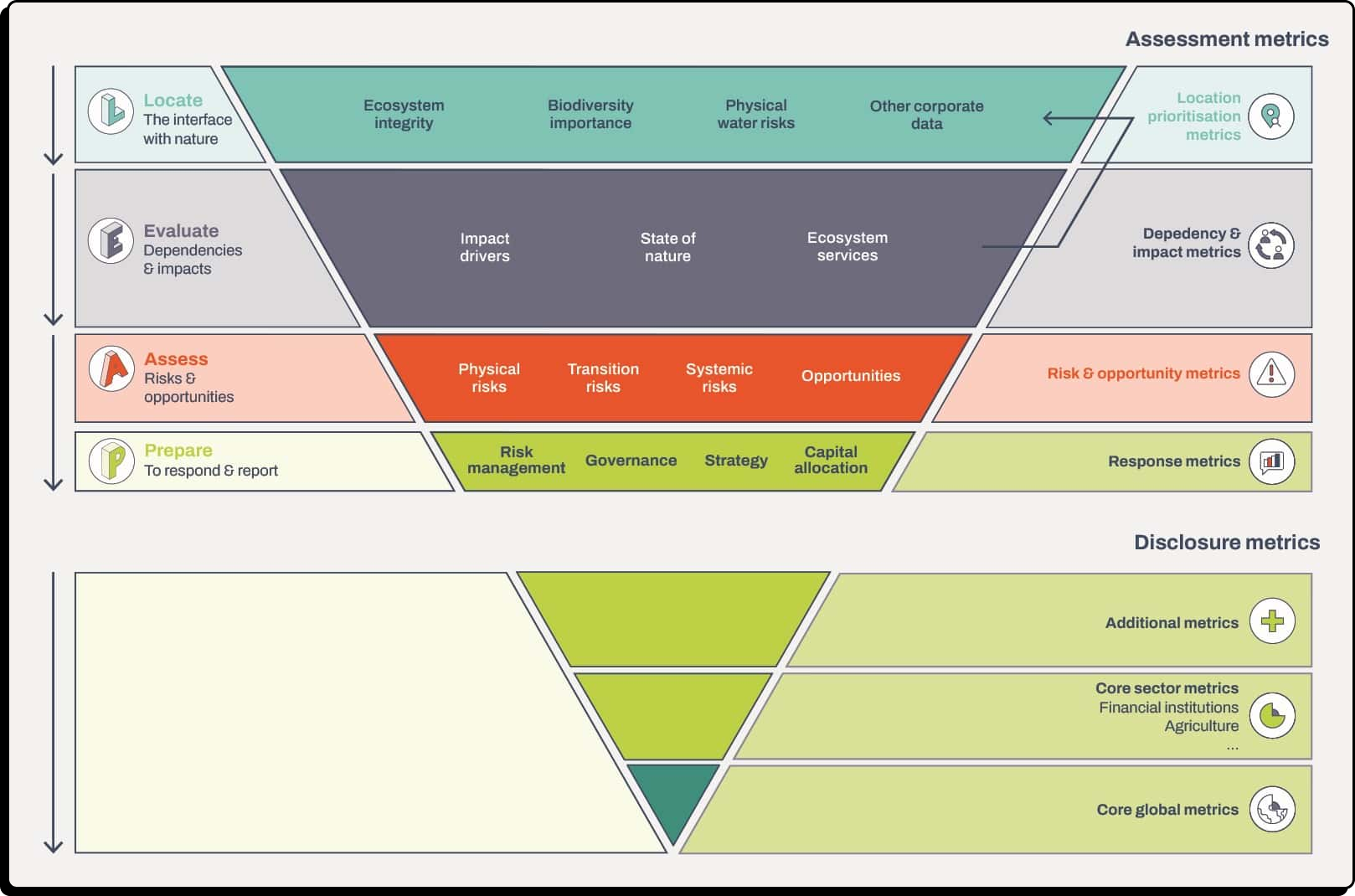
The LEAP method consists of four steps:
1 - Locate
The first step involves accurately mapping its activities and those of its value chain to then identify specific sites that interact with nature, impact it, or depend on it to a moderate or high degree. This step helps pinpoint risk areas and impact zones within specific biomes.
2 - Assess
The second step involves conducting a materiality analysis and analyzing the company's dependencies and impacts on nature in the identified areas, including the ecosystem services the company benefits from at each of its sites. This includes an assessment of the company's and its value chain's impact on and dependence on biodiversity, and an initial measurement of the severity of this impact.
3 - Analyze
In this third step, the organization must measure the extent of risks and opportunities associated with the previously identified impacts and dependencies. It will also involve prioritizing these risks and opportunities based on their potential impact. Finally, the company will analyze adjustment measures already taken to mitigate risks and will adjust these measures based on the initial results obtained.
4 - Prepare
This final part involves establishing a strategy for action and information disclosure. This will require defining indicators and objectives to track the company's performance. It also involves considering the disclosure format and the data that will be publicly released. This final step ensures that the company is ready to communicate its interactions with nature effectively and transparently.
The LEAP approach is a structuring tool for companies wishing to align their practices with TNFD recommendations. It helps highlight the company's specific interactions with nature and adjust strategies accordingly. It is designed to be adaptable not only to all organizations, regardless of their sector, but also aims to be a reference method for responding to other reporting formats, including the CSRD.
Sector-specific and biome-specific recommendations
In addition to general recommendations, the TNFD also offers specific recommendations by sector and by biome. The diversity of economic activities and natural environments indeed requires a differentiated approach to ensure adequate management of biodiversity-related risks. Thus, the TNFD has developed:
Sector-specific recommendations
Certain sectors, such as agriculture, mining, and forestry, have a direct and significant impact on nature that warrants distinct analysis. Other sectors, such as the financial sector, are indirectly exposed to biodiversity-related risks through their investments in high-impact industries and therefore also require differentiated analyses. The TNFD offers tailored guidelines for each of these sectors to enable accurate and relevant risk assessment and disclosure.
To date, the TNFD has published specific recommendations for 9 sectors:
- Metals and Mining
- Electric Utilities and Power Producers
- Financial Institutions
- Chemicals
- Food and Agriculture
- Oil and Gas
- Forestry, Pulp and Paper
- Aquaculture
- Biotechnology and Pharmaceuticals
Recommendations for 5 other sectors are still under development:
- Fisheries
- Engineering, Construction and Real Estate
- Construction Materials
- Beverages
- Apparel, Accessories and Footwear
Biome-specific recommendations
The nature and intensity of nature-related risks vary depending on the types of ecosystems (tropical forests, wetlands, coral reefs, etc.). The TNFD has therefore also defined specific guidance for companies operating in or highly dependent on sensitive biomes, taking into account the ecological specificities and risks associated with the degradation of each habitat type.
These recommendations currently cover 6 biomes, divided into 3 categories:
- Land
- Tropical and subtropical forests
- Savannas and grasslands
- Intensive land-use systems
- Urban and industrial ecosystems
- Freshwater
- Rivers and streams
- Oceans
- Continental shelf
These recommendations provide a mapping of highly related sectors and activities, as well as a description of the ecosystem services provided by these biomes. They also include a precise analytical framework for identifying and managing the impacts, dependencies, risks, and opportunities associated with each biome.
What interoperability with CSRD and other international standards?
In accordance with its established principles, the Taskforce on Nature-related Financial Disclosure has structured its recommendations and methodology so that they can be used as a reference method for information disclosure for most international non-financial reporting standards.
The methodological framework proposed by the TNFD, and particularly the LEAP approach, is designed to meet the requirements specified inESRS-E4 (biodiversity and ecosystems) of the CSRD particularly regarding the disclosure of information on anticipating and estimating the financial effects of nature-related risks and opportunities.
Furthermore, EFRAG and TNFD have already published a mapping table between their two approaches, illustrating the high level of interoperability between TNFD recommendations and the European non-financial reporting framework.
However, a significant divergence must be taken into account. While the CSRD has decided to apply the principle of double materiality as a prerequisite for any analysis, the TNFD, for its part, relies on single materiality. This difference may lead companies relying on the framework proposed by the TNFD to underestimate the amount of information they will need to disclose in their CSRD reporting.
The TNFD also works closely with the ISSB to expand on the work already done on IFRS S1 and IFRS S2 standards dedicated to climate issues. The goal is to publish new reporting standards focused this time on biodiversity issues. The two organizations are very close, especially since the TCFD was absorbed by the IFRS Foundation in December 2023.
A methodology and approach called into question
The TNFD has been the subject of a complaint from several NGOs targeting its approach based solely on financial materiality.
These organizations criticize the TNFD, as well as other creators of non-financial reporting standards, for only considering the impact that nature and climate-related risks can have on a company's financial performance and operations. Conversely, the principle of double materiality encourages organizations to consider not only the financial impact but also the impact of their activities on nature.
According to many economic and associative stakeholders, limiting the analysis to single materiality harms essential environmental transparency today. Indeed, this approach allows companies to restrict the scope of disclosure of their ecological impacts, thereby creating a risk of greenwashing. By aligning with TNFD recommendations, companies can claim to act in favor of biodiversity without fully assessing the direct and indirect effects of their activities on ecosystems.
This question of materiality also represents a major and often debated point of divergence between the CSRD and GRI, which advocate a double materiality approach, and the ISSB, which favors a vision focused solely on financial materiality.
Conclusion
In conclusion, the TNFD represents a major step forward for integrating biodiversity and nature issues into the strategies of companies and financial institutions. Its methodological framework offers concrete recommendations for assessing and managing ecosystem-related risks, and promotes increased transparency.
However, its approach based on financial materiality is criticized for potentially limiting the scope of disclosed information, with some observers fearing a risk of greenwashing. The divergence from double materiality, adopted by standards like the CSRD, highlights an essential debate for the future of sustainable finance. Is it simply about anticipating environmental disruptions or acting to limit their impact?
Despite these challenges, the TNFD lays the groundwork for structured reporting and helps raise companies' awareness of their role in biodiversity preservation.
Sources:
- “COP16: TNFD Accused by NGOs of Being the ‘New Frontier of Greenwashing’,” Novethic, 29/10/2024
- “How to Develop a Biodiversity Strategy? The TNFD Practical Guide” Axa Climate and BL Evolution, October 2024
- “TNFD and EFRAG publish correspondence mapping”, EFRAG, 20/06/2024
- “TNFD welcomes the ISSB’s decision to commence work on nature-related issues”, TNFD, April 2024
- “Guidance on the identification and assessment of nature-related issues: The LEAP approach”, TNFD, October 2023
- “Final TNFD Framework Launched: The Biodiversity Reporting Revolution Is Here!”, BL Evolution, 19/09/2023
- “Taskforce on Nature-related Financial Disclosures (TNFD) Recommendations”, TNFD, September 2023
- “TNFD, Taskforce on Nature-related Financial Disclosures: Definition and Challenges”, Youmatter, 19/04/2023
- “What is the TNFD, the mission for assessing and disclosing nature-related financial risks?”, French Development Agency, 26/10/2021
- “Taskforce on Nature-related Financial Disclosure (TNFD)”, One Planet Summit
- “Nature-related Finance”, Global Canopy