
.svg)





.webp)


The CSRD has paved the way for the harmonization of ESG reporting at the European level. The NFRD, which already required a limited number of European companies to produce non-financial reports, provided very little guidance on the format and content of these sustainability information reports.
From now on, the CSRD, which will eventually cover 50,000 European and non-European companies, includes strict reporting standards: the ESRS, or European Sustainability Reporting Standards.
What are the ESRS?
The CSRD (Corporate Sustainability Reporting Directive) will require companies to produce annual reports on environmental, social, and governance issues. They will therefore need to collect thousands of data points each year that represent their activities and the impact of those activities on a set of indicators, as well as provide an assessment of the measures they have taken to mitigate the negative impact of their operations on these indicators.
The ESRS standards come into play in this context. The European Commission mandated EFRAG (European Financial Reporting Advisory Group) to work on the standards that will govern CSRD reporting.
The delegated act detailing the first 12 ESRS published by EFRAG was adopted by the European Commission on July 31, 2023. They will establish an initial framework for ESG reporting, with implementation beginning on January 1, 2024.
These reporting standards have several objectives:
- provide companies with a framework that will allow them to better understand the expectations set by this new reporting format
- harmonize all corporate sustainability reports within the European Union to simplify their reading and analysis by various stakeholders
- enable the automated processing of published data through the use of digital tools
How do they work?
CSRD reports will contain quantitative and qualitative data provided by companies on environmental, social, and governance topics.
For every company, this will represent hundreds or even thousands of data points that must be collected from numerous internal and external stakeholders. Regarding the environmental aspect, for example, companies will need to report on carbon emissions across their entire value chain. This means collecting data not only from the various sites and departments within their own organization but also from goods suppliers and service providers.
The scale of this analysis, collection, and formatting work requires following a protocol designed to simplify the task for companies by guiding them through the ESG reporting process.
Another issue is, of course, how this data is handled by stakeholders. The primary goal of the CSRD is to increase corporate transparency regarding the impact of business activities and to measure sustainability commitments so that this information is publicly accessible. An underlying objective is to redirect public and private investment toward the most virtuous companies.
ESRS standards are intended to make these highly detailed reports easier to read by providing a common framework for all affected companies.
For each data collection area, they detail all the information that must be gathered, the collection methods, and the associated reporting formats.
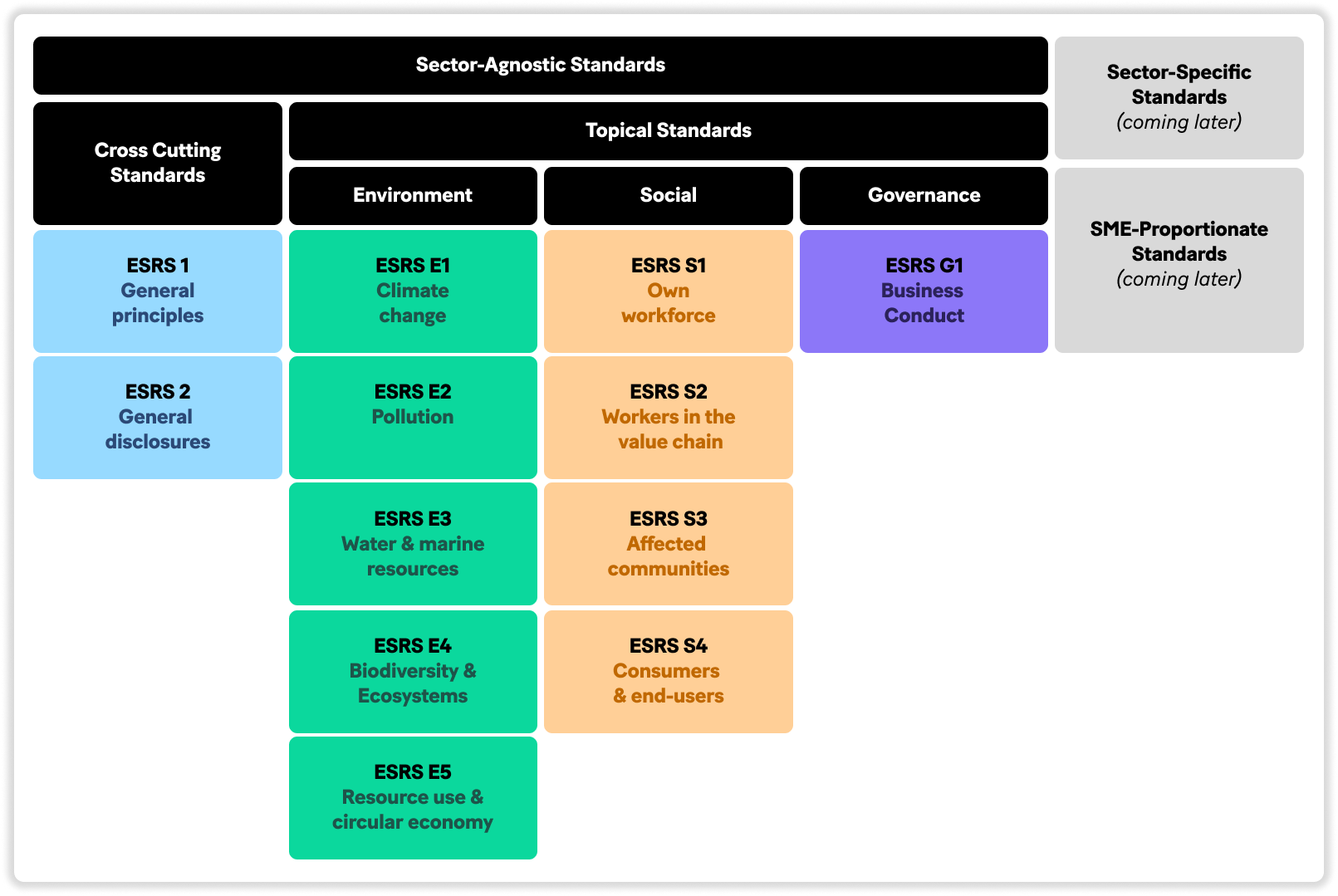
To date, 12 ESRS have been published, divided into 4 main categories:
- general standards (2 ESRS)
- environmental standards (5 ESRS)
- social standards (4 ESRS)
- governance standards (1 ESRS)
Disclosure Requirements
The ESRS structure the information to be collected into Disclosure Requirements, which correspond to each category of data needed to complete the report.
The one on biodiversity, for example, contains 8 disclosure requirements that help distinguish between the company's current policy on the matter, the actions taken and resources mobilized, the goals set by the company, and the anticipated financial effects related to biodiversity impact. Each of these topics corresponds to a different DR.
These Disclosure Requirements can be supplemented by Application Requirements. The latter detail how information for each Disclosure Requirement should be collected and the format in which it must be published.
Double materiality assessment
The major innovation of the CSRD is the double materiality assessment. For each ESRS, companies must conduct an ESG impact analysis. In practical terms, this involves first measuring the impact that the topic covered by the ESRS has and will have on their business—financial materiality—and then the impact that their business has and will have on that topic—impact materiality.
Based on the results of this double materiality assessment, the company may or may not complete the corresponding ESRS. It must set materiality thresholds below which it decides not to disclose information regarding the sustainability topic in question. Consequently, it will only report on thematic ESRS whose issues have been deemed material according to the established thresholds.
However, ESRS E1, which relates to climate change, is treated specifically due to its importance in CSRD reporting. If a company determines that its materiality assessment does not justify completing this ESRS, it must detail the analysis that led to this conclusion and justify its decision. Furthermore, it must conduct a forward-looking analysis of the conditions that could lead it to conclude in the future that climate change is a material topic.
The first 12 ESRS in detail
The first ESRS adopted by the European Commission on July 31, 2023, correspond to the ESRS applicable to all companies and those specific to each major pillar of the CSRD.
There are currently 12 of these standards—2 cross-cutting and 10 thematic—which will be supplemented by new ESRS specific to certain companies based on their size and business sector.
General requirements
The two ESRS standards in this section serve as an introduction to all subsequent reporting and apply de facto to all other ESRS.
General requirements
This primarily informative ESRS aims to outline the architecture and functioning of the ESRS. It presents the general requirements for the preparation and presentation of information to be published in CSRD reports.
This ESRS also defines the key concepts used in the preparation of ESG reports, including the notions of double materiality, value chain, and due diligence.
It details how materiality assessments must be conducted for each of the following ESRS.
General disclosure
This ESRS provides information on the disclosure obligations that apply to all companies, regardless of their business sector. These cross-cutting standards apply to all topics covered in the environmental, social, and governance sections of the CSRD.
This ESRS defines two types of Disclosure Requirements:
- Disclosure requirements: information and data that are cross-cutting and must be reported. These are published in ESRS 2.
- Minimum disclosure requirements: information and data regarding policies, actions, metrics, and targets that must at a minimum be published when the topic covered is considered material for the reporting company. These must be published in the ESRS corresponding to the topic covered.
The environmental section
This section can be considered the core of the CSRD. It consists of 5 ESRS covering various environmental topics and is currently the one requiring the most commitment from the company, particularly through ESRS E1.
Climate change
This ESRS consists of 9 Disclosure Requirements. Particularly comprehensive, it is the only ESRS that is almost impossible to consider immaterial.
As mentioned previously, any company that believes it does not need to complete it must justify this reason and detail the analysis that led to this decision.
In this ESRS, companies will need to assess their impact on the climate by accurately and scientifically accounting for their carbon emissions across their entire value chain.
They will also need to set carbon footprint reduction targets and specify the strategy they have implemented to achieve these goals by aligning them with those set by the 2015 Paris Agreement.
Finally, they will need to conduct an analysis of the financial impact of their climate transition plan as well as the impact of global warming on their operations.
To learn more aboutESRS E1, you can read our dedicated article on the subject.
Pollution
This ESRS consists of 6 Disclosure Requirements.
In this section, companies must indicate the measures they have taken to combat air, water, and soil pollution.
They must also specify which polluting substances may be part of their production process.
Finally, they must model the financial impact of pollution effects on their business.
Water and marine resources
This ESRS consists of 5 Disclosure Requirements.
In this ESRS, companies must indicate their policy regarding the preservation of water resources.
They will provide an overview of the actions taken and the objectives they have set for themselves.
Finally, they will conduct a financial analysis of the impact related to water resources on their business in terms of risks and opportunities.
Biodiversity and ecosystems
This ESRS consists of 6 Disclosure Requirements.
Like the previous ESRS on water resources, this one focuses on the objectives set and actions taken for the preservation of biodiversity and ecosystems.
It similarly requires a financial analysis of the impact, risks, and opportunities related to biodiversity and ecosystems concerning the company's activities.
Resource use and circular economy
This ESRS standard contains 6 Disclosure Requirements.
In this ESRS, companies must indicate whether they have an existing strategy, objectives, and measures implemented to reuse resources and/or contribute to a circular economy project as part of their operations.
They must provide details on the inflows and outflows of the resources concerned and, once again, conduct a financial analysis of the implementation of resource reuse and circular economy projects.
The social pillar
This pillar, consisting of 4 ESRS, covers HR topics as well as the company's impact on stakeholders within its value chain.
Own workforce
This ESRS consists of 17 (!) Disclosure Requirements.
Primarily focused on the company's HR dimension, it addresses a wide variety of topics:
- social dialogue
- diversity
- training policy
- work-life balance
- social protection
- salary scales
- social inclusion
- incident management
- …
The objective of this ESRS standard, which is primarily quantitative and declarative, is to provide a comprehensive overview of the company's policy regarding the well-being of its employees and non-employee workers.
It aggregates a wide range of indicators to assess the actions taken by the company and the goals it has set to protect its employees and improve the work environment.
Workers in the value chain
This ESRS consists of 5 Disclosure Requirements.
In this report, the company must indicate the processes it has implemented to assess the impact of its activities on employees within its value chain and how it manages this impact in terms of risks and opportunities.
Affected communities
This ESRS standard consists of 5 Disclosure Requirements.
To continue addressing all of its stakeholders, the company must, in this report, assess the impacts generated by its activities on the various communities that could be affected, whether positively or negatively.
It must also detail the measures taken to manage these impacts and the objectives it has set for itself in this regard.
Consumers and end-users
This ESRS contains 5 Disclosure Requirements.
By focusing on the consumers and end-users of the company's products and/or services, this ESRS completes the analysis of the value chain.
As with the previous reports, the company must analyze the potential impact of its activities on consumers and end-users, describe the actions it has implemented to manage material impacts, risks, and opportunities related to its activities, and the objectives it has set for itself in this area.
The governance component
Business conduct
This final ESRS, consisting of 6 Disclosure Requirements, aims to provide a comprehensive view of the company's governance across a range of topics, including:
- the role of administrative, supervisory, and management bodies
- the processes for identifying and assessing impacts, risks, and opportunities
- corporate culture
- supplier relationship management
- prevention, detection, and management of corruption incidents
- any lobbying activities
- payment practices
New ESRS currently under development
These first 12 ESRS apply to all companies subject to the CSRD. New reporting standards will soon be added, applying more specifically to certain companies based on predefined criteria.
The next standards expected are the ESRS specific to listed SMEs.
Sector-specific ESRS will follow. Based on the same principle as CDP questionnaires, additional reporting requirements will apply to companies operating in sectors considered particularly high-risk or impactful regarding environmental, social, and governance issues. Initially scheduled for June 30, 2024, the European Commission has proposed postponing their publication to June 30, 2026.
ESRS for non-European companies subject to the CSRD due to their substantial operations within the European territory will also be published on this date. These companies will be required to report starting in 2029 based on 2028 data.
Finally, EFRAG is working on building a digital taxonomy. This tool, using an elaborate system of tags associated with each data point in CSRD reports, is intended to enable the automated processing of data and information provided in companies' CSRD reports.
Lastly, in parallel with the ESRS, EFRAG is developing VSRS (Voluntary Sustainability Reporting Standards). These European standards, aimed at non-listed SMEs, are designed to encourage SMEs to report even if they are not required to, and to guide them in managing ESG issues. They also enable them to meet the expectations of their clients and/or stakeholders who are subject to the CSRD. Indeed, the latter must conduct analyses on the scope 1, 2, and 3 emissions of their activities, which encompasses their entire value chain, including their suppliers and service providers.
What is the implementation timeline?
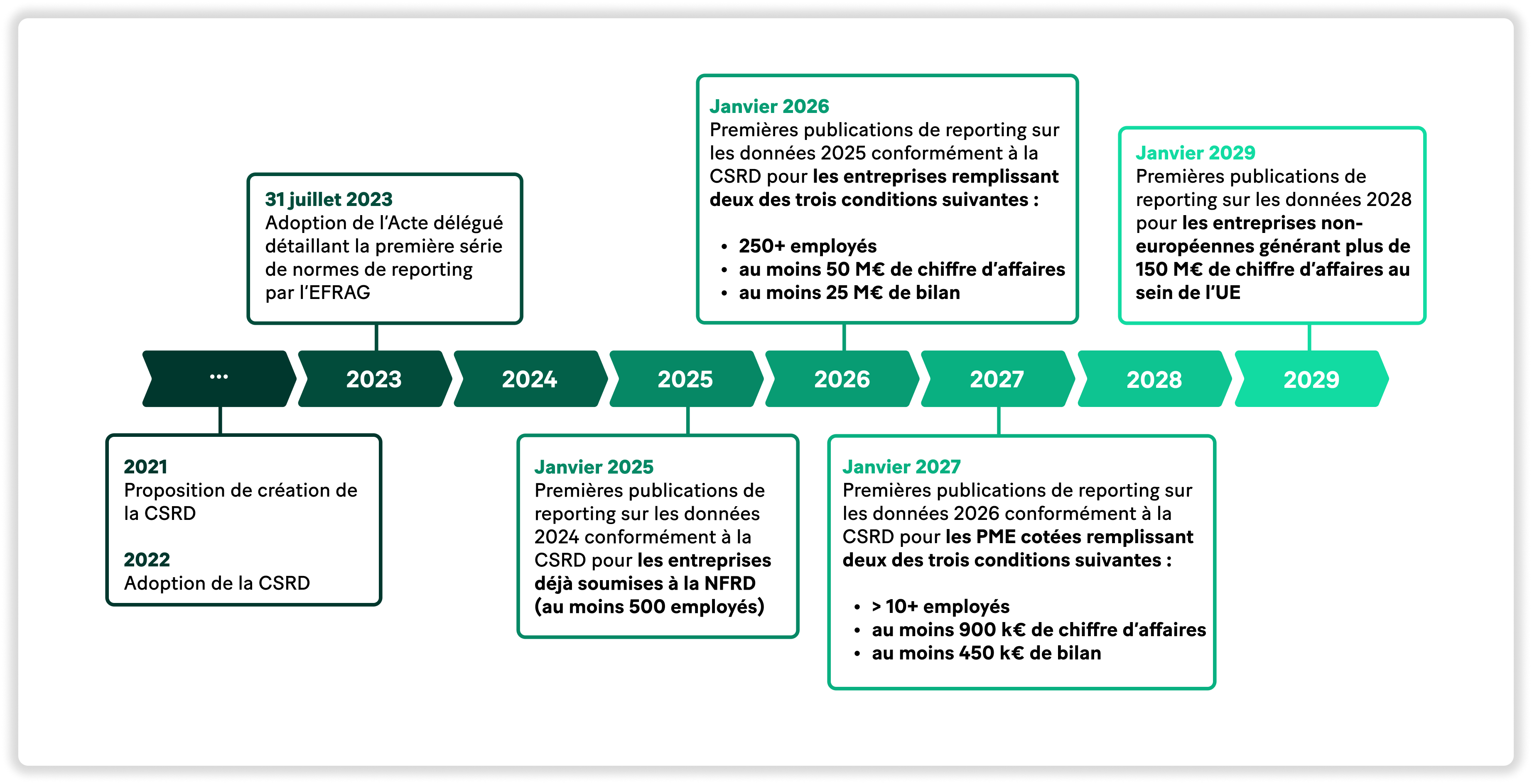
The first CSRD reports must be published in 2025 based on data collected in 2024. The ESRS will first apply to companies already subject to the NFRD.
In 2025, European companies meeting at least two of the following criteria must begin their data collection for a first report in 2026:
- More than 250 employees
- €50 million in revenue or more
- Balance sheet total of €25 million or more
In 2026, it will be the turn of listed SMEs, which will report in 2027. This will apply to companies meeting at least two of the following criteria:
- 10 employees or more
- €900k in revenue or more
- Balance sheet total of €450k or more
Finally, in 2028, the CSRD will apply to non-European companies generating more than €150 million in revenue within the European territory.
A phased implementation
To ensure companies can properly adapt to the process, the European Commission has relaxed certain rules for the first sustainability reports.
Companies with fewer than 750 employees may defer the application of ESRS E4 on biodiversity, as well as ESRS S2, S3, and S4, which measure their impact on their value chain (value chain workers, affected communities, consumers, and end-users), by two years. ESRS S1 may be deferred by one year.
Certain reporting requirements have also been relaxed for the first year of publication, particularly regarding climate-related disclosures.
- companies with fewer than 750 employees may defer the accounting of their Scope 3 greenhouse gas emissions by one year
- all companies may refrain from disclosing the anticipated financial effects of environmental issues (ESRS E1, E2, E3, E4, and E5).
How do these align with international standards?
Given the climate emergency and the need to redirect our economies toward a sustainable development strategy, numerous international standards have emerged in recent years, creating a risk that companies may become overwhelmed by the production of carbon, social, and environmental reports that lack consistency with one another.
For companies, this inevitably represents a significant cost, which may lead to gradual disengagement due to the complexity of the task, both in terms of reporting and the policies implemented regarding ESG criteria. It may also push companies to turn toward less stringent voluntary standard systems.
To avoid this pitfall, the European Commission and EFRAG have ensured the compatibility of ESRS standards with GRI standards (Global Reporting Initiative) as well as the international IFRS S1 and IFRS S2 standards from the ISSB (International Sustainability Standards Board) to ensure global consistency in sustainability reporting requirements.
CDP, for its part, is working on aligning its questionnaires with the ESRS and the IFRS S1 and S2 standards.
From the very beginning of the ESRS development process, EFRAG ensured that a high level of interoperability with the climate standards of theISSB and the GSSB was integrated into the standards' production requirements, allowing companies to create synergies in their reporting processes. They are also working on producing documents to help companies navigate between the two types of standards without having to duplicate their efforts.
Sources:
- “EFRAG-GRI joint statement of interoperability”, GRI, 09/05/2023
- “European Sustainability Reporting Standards - First Set of Standards”, European Commission, 07/31/2023
- “European Commission, EFRAG and ISSB confirm high degree of climate-disclosure alignment”, IFRS, 07/31/2023
- “CSRD sustainability reporting: preparing for new obligations”, AMF, 06/20/2023
- “EU Voluntary Sustainability Reporting Standard for non-listed SMEs that are outside the scope of CSRD”, EFRAG, 11/17/2022
- “Draft European Sustainability Reporting Standards - ESRS E1 Climate Change”, EFRAG, 11/01/2022