
.svg)



Internal Carbon Price
& Financial Management
of Decarbonization
Climate strategy management that considers its financial aspect.
Confidently finalize the validation of your carbon action plan by controlling your costs and funding opportunities.

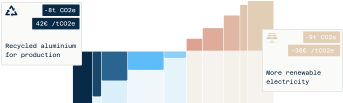

Advanced financial modeling of your decarbonization actions
Model and keep up-to-date the financial impact of your decarbonization actions. Simply get an instant calculation of projected costs.
Precisely model CapEx & OpEx flows as well as the amortization periods for each of your decarbonization levers.
Precisely plan all costs and funding opportunities for your decarbonization
Adjust your ambitions for each of your reduction actions and dynamically visualize marginal costs and financial forecasts for each of them.
Access detailed forecast analysis of cash flows, CapEx, OpEx, and savings generated by your decarbonization plan.


Leverage our dashboards and charts for decision support and financial management
Automatically generate Marginal Abatement Cost (MAC) curves and cost matrices to easily identify high carbon and financial impact actions.
Simply reconcile your financial data
Consolidate your Cash Flow with your carbon emission reductions and prioritize the funding of opportunities in your budget that allow you to achieve your goals.

The most powerful tool to financially manage your decarbonization plan


They trust us




Request information,
Schedule a demo,
Book an appointment
If you would like to send us a request for proposal, please email us at: rfp@tennaxia.com


Answers to your questions about decarbonization


Financial modeling of an emissions reduction action plan is essential for its practical implementation. Without funding, actions cannot materialize, and without financial modeling and planning, it's impossible to make appropriate investment decisions.
The main obstacle preventing many companies from taking concrete action towards carbon neutrality is their ability to answer the question: “how much will it cost to reduce our CO2 emissions?”
This is particularly because, within companies, the financial resources needed for the low-carbon transition come from all stakeholders and departments, not solely from teams responsible for decarbonization, such as CSR, and these stakeholders manage their activities and investment choices based on monetary data.
This is generally the price associated with one tonne of carbon.
There are different types of carbon prices, external or internal to companies: The shadow price, implicit price, and explicit price are internal carbon prices. The price set by the emissions trading market or the price of the Carbon Border Adjustment Mechanism (CBAM) for external.
Currently, there is no uniform carbon price common to all global emissions.
Some companies base their carbon pricing on the market price.Some French companies like LVMH, for example, have implemented an internal carbon tax to collect funds equivalent to the carbon footprint of their activities, in order to finance emission reduction initiatives.
To learn more, read our dedicated article on the topic on our blog.

