
.svg)




CSRD Gap Analysis: Analyze the gap between managed ESG data and ESRS expectations
Once the material issues for your company have been identified through your Double Materiality Analysis, the Gap Analysis allows you to compare the information you already collect with what you will need to collect under the CSRD.


CSRD Gap Analysis: the best experts & the right software
Tennaxia offers its clients an end-to-end experience for their CSRD Gap Analysis. Our ESG experts support you, backed by our platform designed to provide the best CSRD experience.
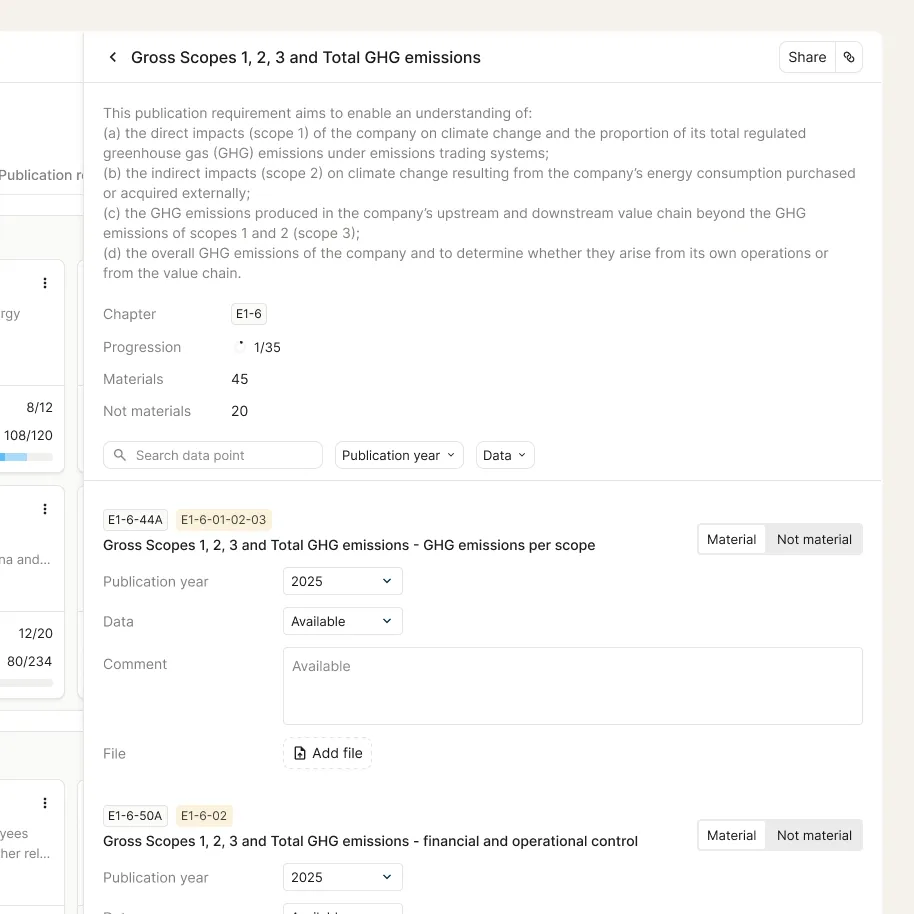
With our CSRD Gap Analysis reporting module, you can easily:
-> Access all texts and data points relevant to the ESRS
-> List those that are material to your company
-> Assess the progress of publishing this information
-> Ensure data auditability by attaching all types of comments, especially for qualitative data points, and supporting documents
-> Simplify your monitoring by visualizing the progress of CSRD implementation.
DMA, Gap Analysis, Action Plan, etc.

Your CSRD Gap Analysis conducted by our ESG experts
Our pragmatic and tailored approach allows you to benefit from the full experience of our experts to conduct a CSRD Gap Analysis that will structure and guide your ESG data management.

Project Scoping and Steering Committee Formation
Validate and present the relevant ESRS in light of your risks, opportunities, and impacts.
Implement appropriate steering rituals and governance, involving representatives from the various relevant functions within the organization.

CSRD Gap Analysis on Quantitative Information
Identify gaps between current indicators and those required by the CSRD. Analyze the various systems and frameworks used to collect and publish quantitative indicators.
Validate the list of indicators to track for CSRD compliance and present the gaps and recommendations to meet CSRD and various reporting needs.

CSRD Gap Analysis on Qualitative Information
Train yourself and your teams on the qualitative aspects of CSRD expectations.
Provide recommendations regarding governance, policies, procedures, and short- to medium-term actions. Establish a high-level roadmap proposal to move towards compliance.
Master your data collection effort with our Reporting CSRD Gap Analysis software module




They trust us




Request information,
Schedule a demo,
Book an appointment
If you would like to send us a request for proposal, please email us at: rfp@tennaxia.com


All about the CSRD Gap Analysis


A gap analysis, or gap analysis, involves comparing a company's current situation with a target objective. In the context of the Corporate Sustainability Reporting Directive, this objective is clear: to produce a sustainability report that complies with the requirements of the directive and the ESRS. The gap analysis therefore helps identify what is already in place and what is still missing to build a CSRD report that is robust, reliable, and well-documented.
Specifically, the exercise involves reviewing information already available within the company: policies, indicators, procedures, governance elements, management tools, and non-financial data. This gap analysis then highlights areas for improvement: uncovered topics, insufficiently tracked information, unverified indicators, or missing evidence. It also helps verify whether internal practices adequately meet the regulatory standards applicable.
A gap analysis is not just for preparing a deliverable. It also helps structure the CSRD project over time. It provides a clear vision of priorities, facilitates coordination between teams, and ensures regulatory compliance. In summary, it's an essential diagnostic step to transform a complex obligation into an operational action plan and prepare a sustainability reporting that is more robust.
A gap analysis typically follows several simple yet structured steps. The first involves defining the scope of work: which entities are concerned, what topics need to be covered, and which CSRD requirements truly apply to the company. This framing is essential to avoid covering too broad a scope or, conversely, overlooking important information.
The second step focuses on the current state. The company inventories existing policies, procedures, indicators, tools, and documents. This allows for an assessment of the current system's maturity level. Next comes the comparison between this current state and the expectations for the future sustainability report. This is where thegap analysis truly demonstrates its value: it highlights missing data, poorly documented areas, and processes that need strengthening.
The third step involves data collection. It is necessary to identify where the information is located, who produces it, how often it is updated, and under what conditions it can be verified. This phase often involves several internal stakeholders : CSR, finance, HR, procurement, legal, or operations.
Finally, the company prioritizes the gaps and builds a roadmap. The objective is to prepare a CSRD report that is credible, compliant, and aligned with upcoming reporting requirements.
Performing an upfront CSRD Gap Analysis provides greater clarity, efficiency, and reliability. Without this preparatory work, producing the CSRD report risks becoming a reactive, rushed exercise, with incomplete or difficult-to-audit information. Conversely, a structured approach allows you to anticipate the directive's requirements, better organize responsibilities, and prepare a sustainability report more consistent report.
This step is also strategically useful. The CSRD doesn't just require publishing data; it encourages companies to link their ESG issues to their CSR strategy, its governance, and its goals for sustainable development. The gap analysis therefore helps to gain perspective. It allows for identifying topics already mastered, but also new initiatives to better meet the expectations of regulators, investors, and other stakeholders.
Another advantage: the method facilitates prioritization. The company knows more precisely where to focus its efforts, which indicators to validate first, and which teams to mobilize. This improves the quality of its future sustainability report while reducing the risk of errors or omissions. In practice, the gap analysis serves to transform regulatory requirements into a structured, progressive, and useful management approach.
I can also provide you with an even more SEO-friendly version, with answers more tailored for a "web page," or a more institutional version.

