
.svg)






What is the CSRD?
The CSRD, or Corporate Sustainability Reporting Directive, is a European directive regarding the publication of corporate non-financial data. It replaces the NFRD, or Non-Financial Reporting Directive, which until now provided a relatively vague framework for corporate CSR reporting obligations.
It aims to strengthen corporate transparency obligations and assess their impact on ESG criteria, as well as their level of commitment to environmental and social issues.
The CSRD significantly clarifies the non-financial reporting expected from companies while expanding the number of organizations subject to these requirements. By leaving less room for interpretation regarding the expected data and its level of precision, the goal of the CSRD is to make publicly disclosed information more comprehensive and reliable, particularly for investors:
- By standardizing non-financial reports through the implementation of European-wide reporting standards, the ESRS, defined by EFRAG. Previously, companies were free to choose which standards they wished to follow. This will facilitate the comparison of reports from different companies through a common language and will also enable automated processing of reports.
- By making the auditing of reports mandatory by the statutory auditor – or by an independent third-party organization, depending on the preference of each EU member state, who will be responsible for verifying the reliability of the published information and reporting formats.
- By expanding the scope of companies involved, which will be five times larger than that of the NFRD. This sustainability reporting will therefore cover more than 50,000 companies.
Launched as part of the European Green Deal, this new directive aims to redirect investment flows toward projects aligned with sustainable development goals defined by the European Union. They are therefore in line with new European standards such as the SFDR (Sustainable Finance Disclosure Regulation) on sustainable finance and the EU taxonomy, which has established a classification system for economic activities.
This reporting work will be mandatory for companies within the scope, and the penalties incurred will be set by each member country by the end of 2023.
Who is affected by the CSRD?
The CSRD will be rolled out gradually, starting in January 2024 for companies currently subject to the NFRD. Eventually, this ESG reporting obligation will be extended to more than 50,000 European and non-European companies active within the EU. Large groups as well as small and medium-sized enterprises are affected.
European companies and the CSRD directive
European entities subject to this new sustainability reporting obligation are those that meet at least two of the following three criteria:
- Employing 250 employees or more.
- Generating 50 million euros in revenue or more.
- Have a balance sheet total of 25 million euros or more.
Also included are SMEs listed on European markets that meet at least two of the following three criteria:
- Employ 10 employees or more,
- Generate 900,000 euros in revenue or more.
- Have a balance sheet total of 450,000 euros or more.
As part of a commitment to transparency, non-listed SMEs may also choose to publish their sustainability data following the same framework.
Non-European companies covered by the CSRD
Like European companies, non-European firms that generate more than 150 million euros in net turnover within the EU will also be required to disclose data on the sustainability of their operations.
What climate change-related information must be included in CSRD reporting?
The EFRAG, the European Financial Reporting Advisory Group, recently published the first set of reporting standards expected under the CSRD. All data is divided into 12 separate documents, the ESRS, each addressing a specific CSR reporting topic, Corporate Social Responsibility:
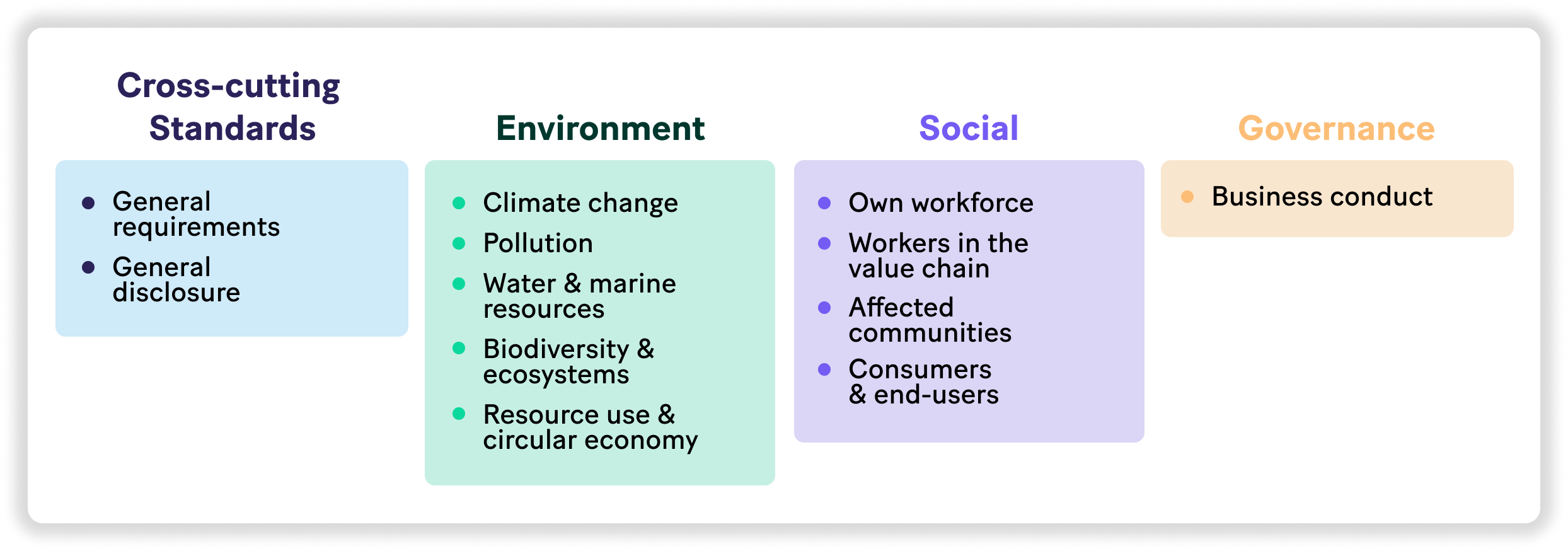
Each document outlines the information and content required in the sustainability report regarding a specific social or environmental topic. This includes both quantitative and qualitative data to assess the current situation and measure the company's present and future commitment to CSR issues. This is analyzed in particular through efforts in governance and the integration of these issues into the company's development strategy.
Below is a summary of the "Climate Change" document and the content likely to be required by the CSRD regarding the specific topic of climate change (climate change mitigation and adaptation):
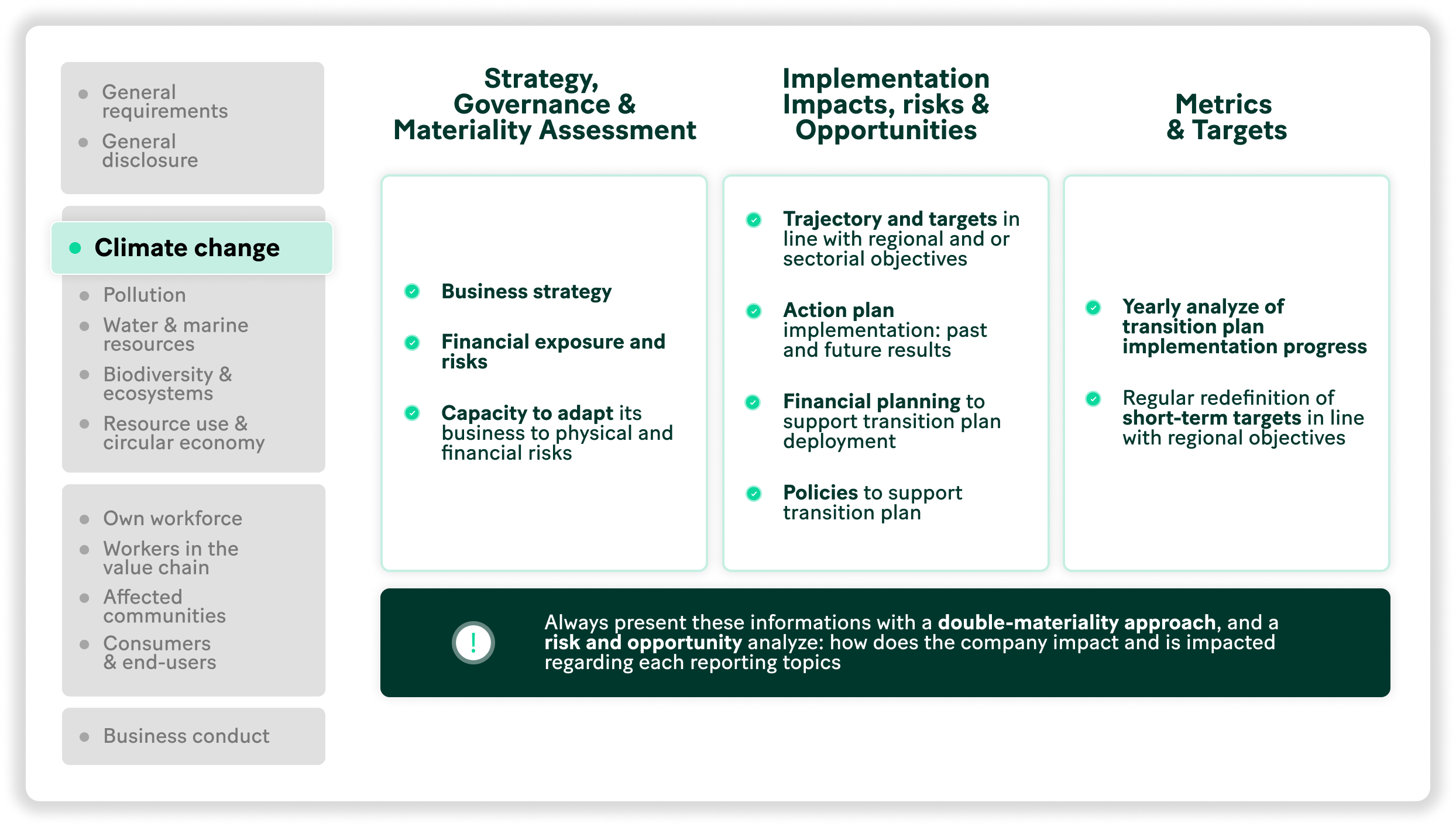
1 - Carbon footprint and transition action plan.
In the climate change section of the CSRD report, the company must present:
- Its impact on the climate, i.e., its carbon footprint. The standard to follow will be the GHG Protocol and GRI 305. Accounting for emissions across the entire value chain is required and must therefore cover scope 1, scope 2, and scope 3.
- Its ability to adapt to climate change as currently projected (+1.5°C), as well as to climate change predicted by less optimistic scenarios. It must specify the company's risks and opportunities (financial and physical) related to climate change.
2 - Objectives, trajectories, and commitments.
Each company must determine a trajectory for reducing its GHG emissions and must also explain how it will achieve its goals. Companies must present:
- A target compatible with a 1.5°C pathway, in accordance with the Paris Agreement, which will be defined by an emissions reduction target, also specifying whether it is science-based, as well as actions implemented (past, present, and future) and their impact (past, present, and future) on the company's emissions.
- A trajectory looking toward 2030, or even 2050 if possible, with a review of the target and a redefinition of the base year every five years starting from 2030.
In its performance statement, each company must also justify the consistency of its transition plan with its business and financial strategy.
3 - Resources allocated to the implementation of the transition plan.
The report must include a comprehensive summary of the transition plan and present the financial means and resources invested in this transition plan, specifically by disclosing the significant volumes of CapEx and OpEx mobilized.
Companies must also report annually on their progress in implementing their transition plan and update the financial information associated with this plan.
4 - Company policies.
To explain how the company is able to implement its climate transition plan, company environmental policies must be presented across five areas:
- Climate change mitigation,
- Climate change adaptation,
- Energy efficiency,
- Renewable energy deployment,
- Miscellaneous for remaining topics.
5 - The company's energy mix.
As part of their reporting obligations, companies will be required to disclose their absolute energy consumption and specify their energy mix. A clear breakdown of energy consumption by source must be provided for companies in high-climate-impact sectors, by reporting:
-> On the one hand, consumption of non-renewable energy,
- Coal,
- Petroleum-based fuels,
- Gas,
- Other fuels,
- Nuclear products,
- Electricity, heat, steam, and cooling from non-renewable sources,
-> On the other hand, consumption of renewable energy,
- Biogas,
- Electricity, heating networks, steam networks, and renewable cooling networks,
- Internal electricity production.
6 - Financing GHG sequestration and climate change mitigation projects.
Companies will also be required to report on the amount of GHG removed from the atmosphere and permanently sequestered. These must be categorized by project type:
- GHG sequestration within the company's value chain,
- GHG sequestration through projects financed outside the company's value chain.
The objective of this directive is to measure a company's ability to contribute to net-zero goals, while also establishing a framework for public communications on the subject to prevent greenwashing.
7 - Internal carbon pricing.
Where applicable, companies that have implemented internal carbon pricing must explain the system in place and its scope: activities and entities covered, quantity of GHG by category (Scope 1, 2, or 3), and calculation methodology.
8 - Double Materiality analysis.
A crucial concept required by the CSRD is the approach to all the points mentioned above through the lens of double materiality, namely impact materiality and financial materiality. Each company must explain in its report how it impacts climate change but also how climate change impacts its business and its transition plan (physical and financial impacts across the company's entire value chain). Consequently, it must present a rigorous analysis of climate-related risks and opportunities and justify its capacity to adapt to climate change. This section of the report will specifically include an analysis of the positive and negative financial impacts related to climate change:
- Potential financial impacts related to physical material risks (e.g., water stress, wildfire risks),
- The potential financial impacts related to inherent transition risks for the company (e.g., changing costs, the introduction of new legislation),
- The ability to seize potential new opportunities related to climate change.
The CSRD timeline: key dates.
The rollout of this new requirement will be phased in until 2026, depending on company size.
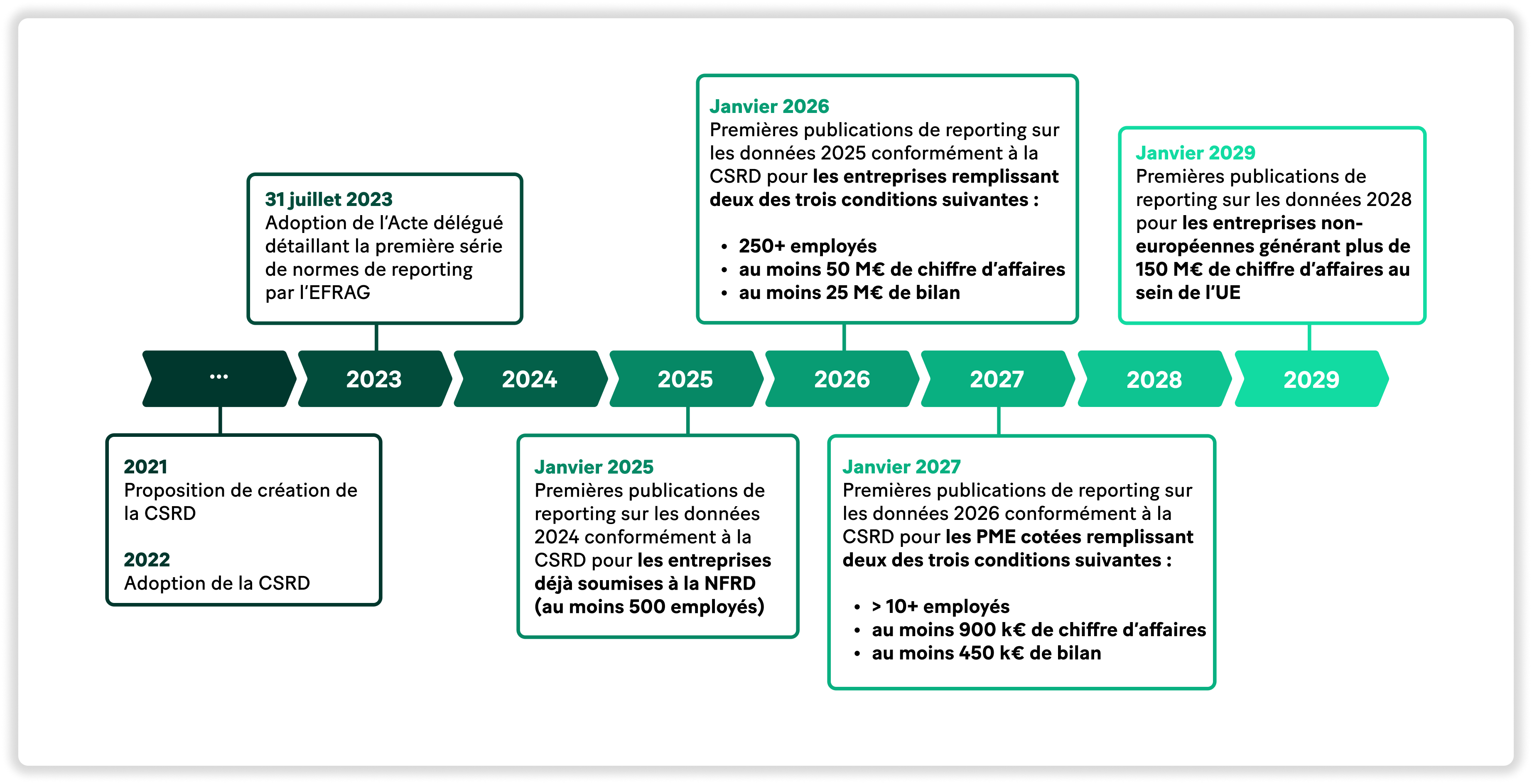
To help companies complete this first reporting exercise, EFRAG plans to publish standards and drafting guidelines in two stages.
- July 31, 2023: publication of the delegated act containing the first 12 cross-cutting ESRS, the CSRD reporting standards
- 2024: publication of guidelines for SMEs, more proportionate to the size of these companies
- 2026: adoption of sector-specific standards (initially scheduled for June 20, 2024)
- 2026: adoption of standards dedicated to non-European companies, which will be required to report in 2029 based on 2028 data
What are the penalties for non-compliance with the CSRD?
Each European Union member state will be responsible for defining the penalties applicable for non-compliance with CSRD obligations when transposing the directive into its national law.
On December 7, 2023, France became the first country to transpose the CSRD directive into its national law via Ordinance No. 2023-1142. This transposition therefore includes the list of penalties faced by companies that fail to comply with their obligations under the CSRD.
Failure to comply with these obligations may result in the following penalties in France:
- Injunctions with penalty payments: any person may apply for an emergency court order to compel the production, disclosure, or transmission of sustainability-related documents or information, subject to penalty payments.
- Exclusion from public procurement contracts for companies that fail to meet their sustainability reporting obligations. This penalty will take effect on January 1, 2026.
- Criminal liability for directors and the company:
- for failure to appoint an auditor or failure to have sustainability information certified (€30,000 fine for the director + 2 years imprisonment and a €150,000 fine for the company)
- for obstructing the verification and auditing of sustainability information or refusing to provide documents necessary for the audit mission (€75,000 fine for the director + 5 years imprisonment and a €375,000 fine for the company)
It should be noted that the implementation by 2026 of the CSDDD, which is currently being adopted by the European Parliament and strengthens corporate due diligence obligations regarding environmental protection and human rights, may expand the scope of potential sanctions for companies. Financial penalties could, similar to those under the GDPR, be based on a percentage of the company's annual turnover.
How can you prepare your company for the CSRD?
If your company was already subject to the NFRD, the major upcoming change for you will be the requirement to report on a CSR strategy focused on impact reduction.
If applicable, you will need to begin collecting ESG data at the start of 2024 in order to report by January 1, 2025. To get ahead and better prepare your company for the CSRD, you can, among other things:
- Reflect on your company's position and the role it can play in the energy and ecological transition,
- Identify risks and impacts related to ESG criteria,
- Collect initial ESG data (such as a carbon footprint assessment),
- Prepare a CSR strategy to reduce your impact.
Anticipate the ESG data collection process
The first phase of preparing your CSRD reports will involve collecting the hundreds or even thousands of data points needed to complete reports, refine your analyses, and build your action plans.
Companies that have already completed a carbon plan know how difficult this exercise can be. The advantage for their teams is that they have already done the heavy lifting. The environmental component, and in particular the ESRS E1 standard, dedicated to climate, is the one that will require the most commitment and involvement from finance and CSR departments.
The difficulty lies not only in the quantity of data to be collected but also in its diversity. ESG information is spread throughout your value chain. Internally, all your company's sites and departments hold information essential to compiling your reports.
The same applies to your suppliers, service providers, and others, who will contribute to measuring your carbon footprint across upstream and downstream Scope 3.
We strongly advise you to rely on CSRD software capable of supporting you through the ESG data collection and processing workflow to simplify and clarify the process.
Prepare your double materiality assessments
As mentioned previously, the materiality assessment will be the foundation of your reporting.
For each of the required reports, You will need to conduct this analysis to measure your impact on the topic in question, as well as the impact it may have on your business, whether physical or financial.
If a topic is considered "non-material" to your business, you will not be required to publish a report on it. However, climate change will be almost unavoidable, as every business has an impact on the climate or can be affected by it in various ways.
If you decide to bypass this reporting, you must be able to justify it with a comprehensive explanation of your analysis methodology.
Building an action plan
The CSRD requires you to implement action plans to reduce your (negative, of course) impact on the various indicators.
Regarding climate change, this is particularly strictly regulated. It must follow a scientific method and be aligned with the 1.5-degree global warming targets set by the Paris Agreement and the European goal of carbon neutrality by 2050.
This action plan is not only highly restrictive, but it will also be scrutinized by financial market participants in a context where the European Union is strongly encouraging investors to redirect their capital toward companies that are virtuous in terms of environmental transition.
An action plan that lacks ambition or credibility will send a negative signal to the market. This is a risk best avoided, lest you find yourself shunned by investors, buyers, consumers, or any other company stakeholder.
Mobilizing resources for long-term action
The CSRD is an annual exercise that requires data collection, impact analysis, and action plan modeling, with year-over-year monitoring.
Performing a carbon footprint assessment sporadically in an Excel file will no longer suffice. You will need to rely on a reliable tool that can support your company over the long term, enabling you to collect and process data, conduct in-depth impact analyses, implement an action plan, and anticipate its effects and costs.
The solution developed by Tennaxia can provide you with all these elements to publish your CSRD reports via a collection module that centralizes and processes all data gathered throughout your value chain. A modeling tool will allow you to define and manage your action plan. You will be able to visualize the performance of your actions on your GHG emission levels, as well as the short-, medium-, and long-term financial impact of each lever you choose to activate.