
.svg)





.webp)


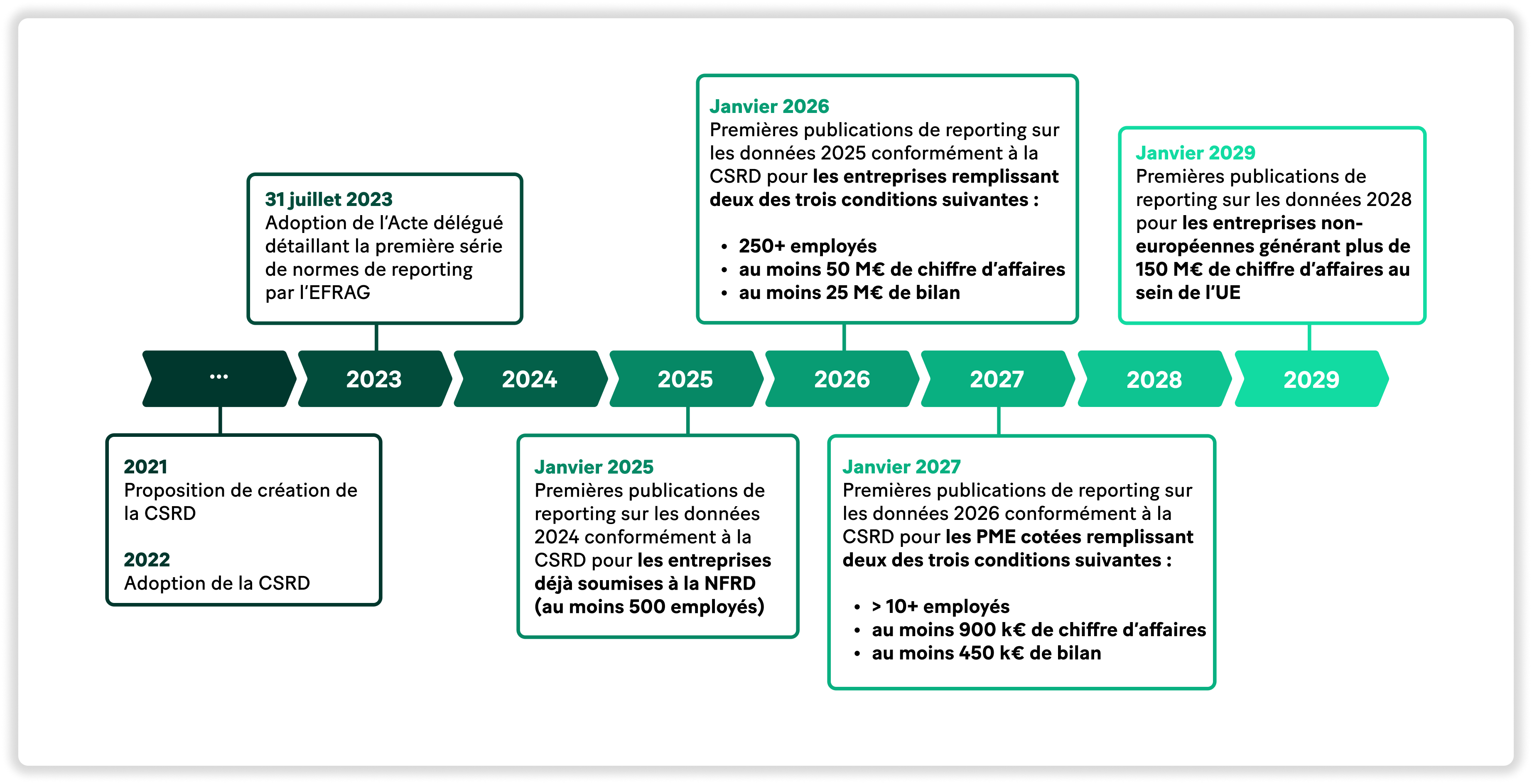
A central element of the European Green Deal, the CSRD (Corporate Sustainability Reporting Directive) will begin its phased implementation in 2024. The first companies affected will be those already subject to the NFRD, which will be required to report on their 2024 ESG data by January 1, 2025.
The application of this new regulation will then expand until 2027 to include European Union companies that meet at least 2 of the following criteria:
- employ 250 or more staff members
- generate a net turnover of €50 million or more
- have a balance sheet total of €25 million or more
Publicly listed SMEs and non-European companies generating more than €150 million in turnover within the EU will also be affected.
Ultimately, this will represent 50,000 companies across the European Union and 75% of the total turnover of all EU companies.
For comparison, the NFRD only applied to listed companies or those with more than 500 employees, representing just over 11,000 companies across the EU.
While some principles of the CSRD are still being finalized, particularly sector-specific reporting standards, it is important for companies to start preparing now.
The first companies affected, already subject to the NFRD, often have an initial data collection structure that will need to be adjusted and expanded. For others starting from scratch, even if the 2026 or 2027 deadline seems far off, they must prepare as soon as possible to avoid being caught off guard by a task that can quickly become overwhelming.
We will therefore provide you with some advice so that you can best prepare for the CSRD and its various deadlines.
Adjusting your governance mechanisms
The first step is to adapt your governance mechanisms to meet the new requirements of this regulation. Following the implementation of the NFRD, many large companies have already begun this process but still need to deepen it.
CSR, the pillar of the CSRD, must be addressed at the highest levels of your company. Thus, EY, in its 2022 Governance Overview, noted that corporate boards have begun to take ESG issues more rigorously into account in their decision-making. In 2022, 34% of them had integrated climate change impact analysis into their work agendas, whereas two years earlier, this figure was close to 0.
Similarly, they noted the growing importance of CSR committees within these boards, with particular attention paid to issues related to climate risks and their impact on company operations.
The current gap lies with audit committees, which are still largely unversed in these issues. They note that only 12% of audit committees in SBF120 companies currently have a member trained in CSR issues. Yet, they are the best positioned to monitor reporting compliance against regulatory requirements.
The ideal governance model would be a CSRD strategy driven by a CSR committee. It would be responsible for defining the broad outlines and objectives for ESG topics.
The audit committee would only intervene at the end of the process. Leveraging its knowledge of the company's structure and operations, it would be responsible for verifying the compliance and quality of the reports.
On the operational side, the most sensible approach is to have a global management team that centralizes the implementation of the collection and analysis plan. This department would be divided into two sub-departments: a financial sub-department responsible for financial performance topics, and a CSR sub-department that monitors environmental performance topics.
It is also necessary for executives and directors to integrate the ESG dimension into their risk management policy. This should constitute a separate category, informed by the double materiality analysis required by the CSRD.
By isolating this dimension in your risk management matrix, you will be able to gain a clear view of the ESG impacts on your company's operations and its value chain. Furthermore, this will allow you to conduct a more in-depth analysis of these topics and the resources you can mobilize to anticipate their consequences on your business, as required by European regulations.
Integrating reporting standards
One of the key points of the CSRD is that it is accompanied by a set of reporting rules developed by the EFRAG (European Financial Reporting Advisory Group) which allows for the harmonization of ESG data interpretation by companies at the European level.
These ESRS (European Sustainability Reporting Standards), some of which are still being developed, must serve as a guiding thread for companies in preparing their CSRD reporting.
.png)
Monitoring these reporting formats therefore requires strong involvement from corporate audit committees, which must be trained on these issues as soon as possible, given the tight schedule for CSRD implementation.
Another new feature of the CSRD is that these reports must be audited by statutory auditors specifically trained in sustainability reporting or by independent third-party organizations accredited by COFRAC.
Mastering your data collection chain
The greatest challenge companies will face is the collection of ESG data. Companies that have already conducted a high-quality carbon footprint assessment—and by that, we mean one based on physical rather than monetary data—already know the scale and complexity of the task.
For these companies, rest assured, the bulk of the work is already done. Analyzing a company's activity data as part of a carbon footprint assessment using a scientific methodology represents the most significant aspect of CSRD data collection.
Mapping your data
The first phase of your work involves identifying all the data you need to collect. Thoroughly study the European Sustainability Reporting Standards (ESRS), which will provide the necessary framework for establishing the list of data you must submit and the required format.
Based on this list, you should divide the data into 3 main categories:
- existing data that can be incorporated into your reporting as is or after processing
- existing data that needs to be supplemented to be processed and/or to deepen your analysis and integrate it into the reporting
- new data to be collected from your various stakeholders
Choosing the right tool
Given the sheer volume of data required to meet the demands of the CSRD, you will need to quickly adopt a tool capable of supporting you not only in the collection process but also in analyzing the data and implementing the levers needed to positively influence your social and environmental impact.
ESG data must be collected throughout your entire value chain. Regarding carbon data, the CSRD applies to your company's Scope 1, 2, and 3 emissions. The chosen tool must therefore allow you to work collaboratively with all stakeholders involved in this process, from your various departments, sites, and employees to your product and service suppliers.
Excel spreadsheets will no longer be sufficient to handle all this data. You must now account for the fact that a single piece of collected data will be analyzed from multiple angles to calculate its impact on various indicators. For example, an action that is beneficial for GHG emissions might prove detrimental to biodiversity indicators.
Your processing system for CSRD software must therefore be advanced enough to account for all the variables listed by the CSRD, allowing you to identify the most relevant levers for making a substantial impact on social and environmental dimensions.
To learn more about best practices for carbon data collection, you can read our article on the subject.
Preparing a double materiality assessment
The double materiality assessment is one of the major innovations of the CSRD.
Whereas you previously only had to report on a list of data points, without any constraints on reporting format or analysis, the CSRD now requires you to consider not only the positive or negative impact that social and environmental changes will have on your business, but also the impact your business has on social and environmental dimensions.

The CSRD requires you to conduct this analysis not only for your direct operations but also across your entire value chain. It is no longer enough to simply analyze the amount of GHG emitted by your suppliers; you must also be able to estimate the impact that climate change could have on them, and consequently, on your business.
The double materiality assessment is a complex subject. It requires the collection of high-quality data as well as the ability to maintain a short-, medium-, and long-term view of your development. Finally, you must be able to estimate the potential social and environmental impacts associated with your future growth.
Do not hesitate to consult with experts to conduct an initial assessment of the subject and map out all the implications that social and environmental changes may have on every aspect of your business, and vice versa.
Tracking CSRD regulatory developments
The CSRD is the latest regulation under the European Green Deal, which aims to make the European Union carbon neutral by 2050.
One of the key objectives is to redirect investments toward companies that have taken initiatives to implement so-called "sustainable" growth.
For financial players, the SFDR and the green taxonomy aim to increase the transparency of investment strategies and financial placements for investors.
Regarding non-financial aspects, the CSRD, which replaces the NFRD regulation, informs the general public and, of course, financial stakeholders about how companies account for ESG criteria and their vulnerability or resilience to anticipated social and environmental changes.
This legislation is constantly evolving, being supplemented and refined year after year at an extremely rapid pace. It is therefore necessary to maintain constant vigilance regarding new regulations.
While the generic ESRS have already been published by the EFRAG (European Financial Reporting Advisory Group), about ten sector-specific ESRS are still being developed, with more expected to follow. The EU Taxonomy and the SFDR are also set to evolve in the coming months to better align with the CSRD.
What about transposition into French law?
The government had until December 9, 2023, to transpose the CSRD into French law, which was completed on December 7 via Ordinance No. 2023-1142. This transposition provided clarification on the implementation of the regulation for French companies, particularly regarding risks and levels of sanctions in the event of non-compliance with reporting obligations.
As part of this transposition, the French government also defined the individuals authorized to audit CSRD reports and the authority that will oversee these auditors. Statutory auditors and independent assurance service providers (IASPs) accredited by the H2A will be the only ones authorized to conduct these audits after completing 90 hours of specific training on sustainability issues and ESG criteria.
The High Council for Statutory Auditors, now the High Authority for Audit (H2A), will be the authority responsible for the oversight and potential sanctioning of these professionals.
In conclusion, it is essential for companies already subject to the CSRD, or those that will be by 2027, to start preparing now to structurally integrate the changes this regulation entails for reporting.
The task may seem daunting, especially since it requires the involvement of all company stakeholders. You must therefore ensure as soon as possible that you are able to mobilize the human and software resources needed to carry out this exercise successfully.
Tennaxia can support you in this process. To learn more, you can contact us directly via this form.
Sources:
- “First Set of draft ESRS”, EFRAG
- “Corporate Sustainability Reporting Directive”, PwC
- “Statutory auditors, independent third-party organizations, or IASPs... who will be the future players in sustainability auditing?”, compta-online, 09/26/2023
- “ESG reporting: initial steps for transposing the CSRD into French law”, Novethic Essentiel, 09/22/2023
- “CSRD sustainability reporting: preparing for the new requirements”, AMF, 06/20/2023
- “2022 Governance Overview: Accelerating ESG”, EY, 01/26/2023
- “Directive (EU) 2022/2464 of the European Parliament and of the Council of 14 December 2022”, Official Journal of the European Union, 12/16/2022