
.svg)



What is the European Green Deal? In this article, we provide an overview of this new climate policy: objectives, strategy, and obstacles—we cover it all!
What are the main objectives of the European Green Deal?
To meet the challenge of the ecological transition, the European Union presents the European Green Deal (or European Green Deal), a climate plan aimed at making the European economy modern, competitive, and aligned with environmental challenges. To achieve this, the Green Deal is designed to be ambitious and socially fair, through the following objectives:
- Becoming the first climate-neutral continent by 2050 (with an intermediate target of reducing GHG emissions by 55% by 2030 compared to 1990 levels).
- Ensuring economic growth “decoupled from resource use”.
- Ensuring a fair transition by “leaving no one behind”.
To encourage and compel European entities (both private and public) to evolve in this direction, the Green Deal establishes a binding legislative framework, the gradual deployment of which aims to achieve the goals by 2050 through:
- updating certain regulations.
- the introduction of new measures, including the green taxonomy, the CSRD for non-financial reporting, and the CSDDD on corporate due diligence, as well as the SFDR, which aims to promote sustainable finance.
- the rollout of an investment plan leveraging both public and private funds
All economic sectors in the European market are covered by the pact, including transport, energy, agriculture, buildings, and industries such as steel, cement, textiles, chemicals, and finance.
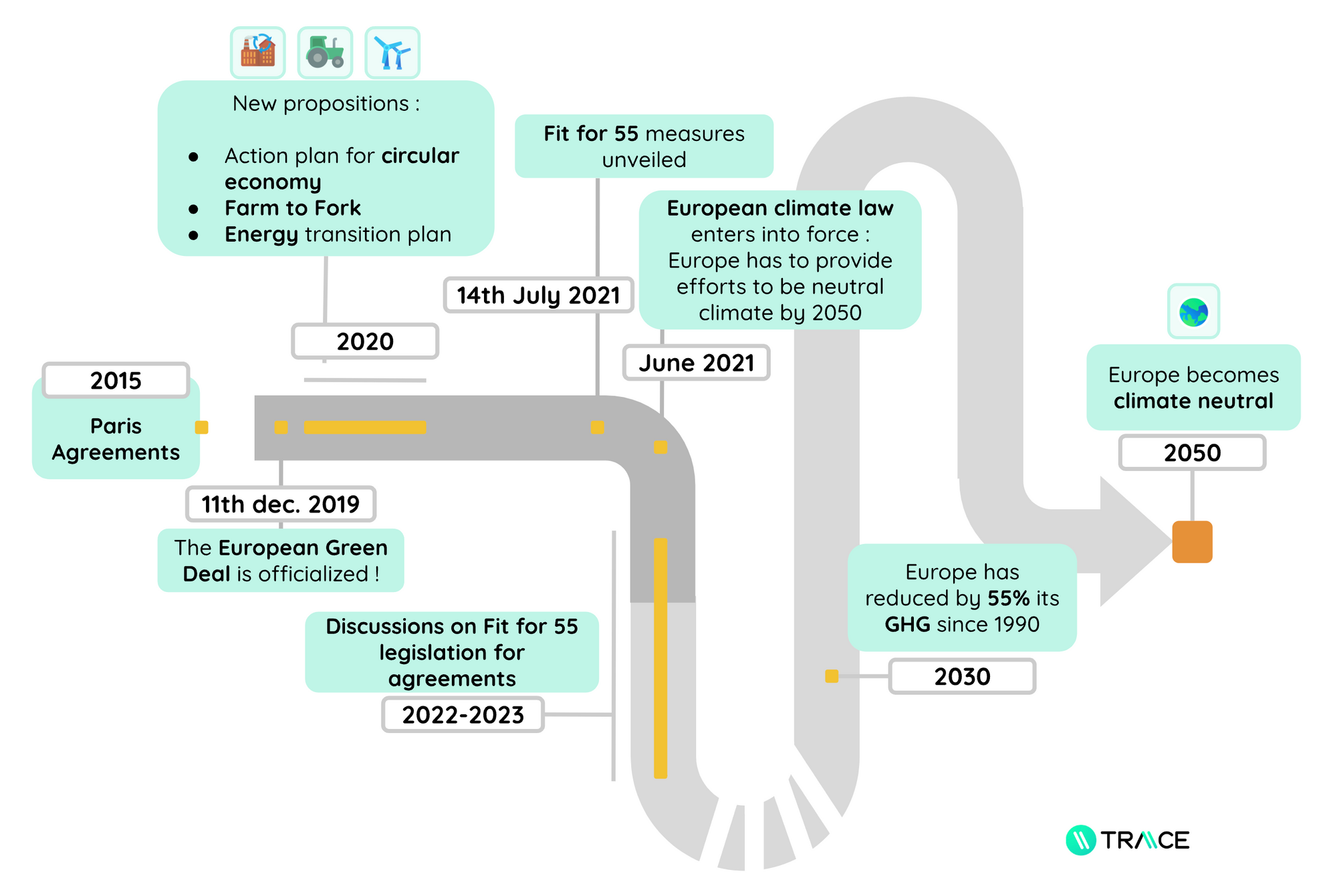
Key dates of the Green Deal
The Green Deal is intended to be a historic milestone for the European continent. It is designed to set the EU on a concrete path toward decarbonization and the preservation of ecosystems!
A quick timeline to remember past key dates and what lies ahead.
However, since the implementation of the CSRD in 2025 and in anticipation of the future rollout of the CS3D, many have raised concerns about the excessive complexity of European green standards, particularly for SMEs. New Omnibus legislation is set to be discussed in 2025, aiming to simplify some of these standards to ensure their implementation does not prove too costly for SMEs and mid-cap companies, or undermine their international competitiveness.
Why the European Green Deal?
To put the Green Deal into context, here is a look back at the key dates of this European policy:
- 1997 : COP3, the Kyoto Protocol is signed. The commitments? To reduce emissions of six greenhouse gases by 5% between 2008 and 2012, compared to 1990 levels. Entry into force: 2005.
- 2015 : COP21, the Paris Agreement is signed. The goals set? To keep the rise in global average temperature well below 2°C compared to pre-industrial levels, and if possible to 1.5°C. It also aims to achieve net-zero global emissions by the second half of the century. Implementation: every country must report every 5 years on the measures taken to reduce their greenhouse gas emissions, with the obligation to present increasingly ambitious actions from one cycle to the next.
- 2019 : Ursula von der Leyen is elected President of the European Commission by the European Parliament. Her commitments? To ensure a mandate focused on the environmental transition. Implementation: before the end of the year, in November 2019, the European Parliament declares a climate emergency.
It is in the continuity of these events that the European Commission makes the European Green Deal official (or European Green Deal) in December 2019. This European pact, promised by Ursula von der Leyen during her campaign, unveils climate goals and an ambitious timeline. It aims to establish a binding legislative framework for Europe, with a view to complying with the Paris Agreement.
Who is funding the European Green Deal?
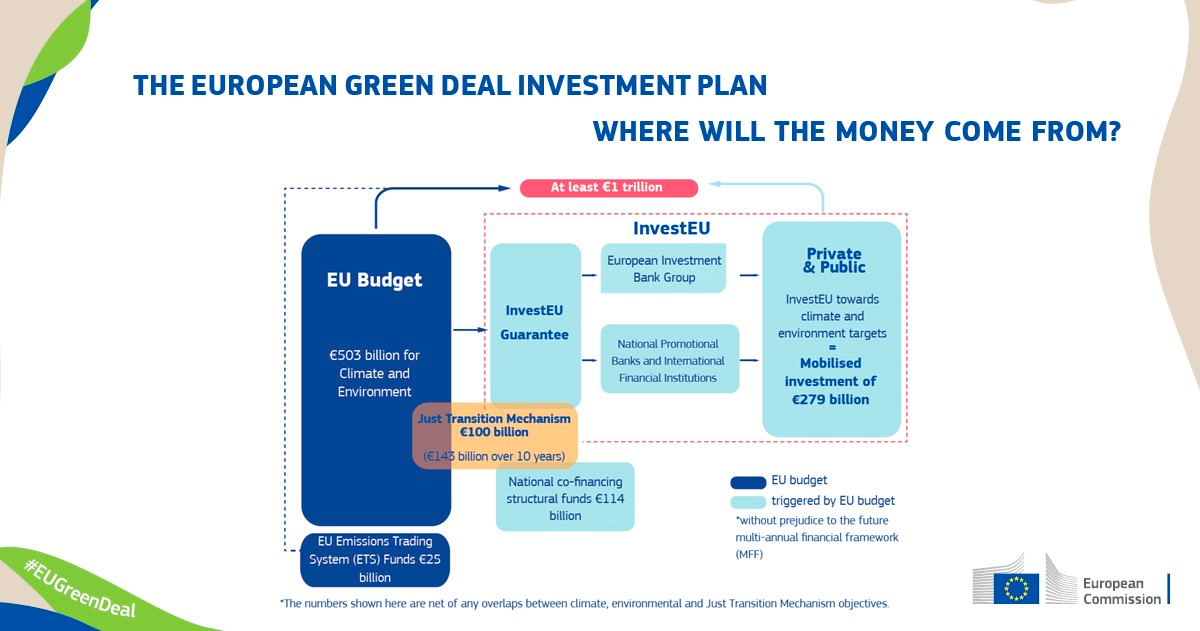
To finance this green transition, which covers all economic sectors, the EU is planning an investment of 1 trillion euros. To mobilize such a budget, the European Union intends to build a financial framework that will facilitate public investments (EU and member state budgets) as well as private investments as part of its Green Deal, using legislation and a taxonomy that is attractive for projects related to sustainable development. For now, the breakdown of the Green Deal funding is as follows:
- EU Budget : 503 billion euros,
- Funds InvestEU : €279 billion (fund launched in 2021 to boost investment in Europe) ,
- ETS Fund : €25 billion (Emissions Trading System, the European carbon market),
- Just Transition Fund : €100 billion (fund designed to support socio-economically vulnerable regions in the face of the ecological transition),
- National co-financing : €114 billion.
Furthermore, to green European finance and leverage new funds for the European transition, the EU presented an action plan in 2018 on the "EU taxonomy". It came into force partially in 2022 and fully in 2023.
This, along with the SFDRregulation, another pillar of the Green Deal, aims to direct investments toward low-carbon activities that are aligned with the ecological transition.
What is the growth strategy of the European Green Deal?

The European climate strategy covers all sectors. Here is a brief, non-exhaustive summary of the measures in this Green Deal for Europe.
Industries: Industrial strategy for a clean and circular economy
"To achieve climate neutrality by 2050, preserve our natural environment, and strengthen our economic competitiveness, our economy must be fully circular. Today, it remains essentially linear, as only 12% of secondary materials and resources are reintroduced into it." - Mr. Frans Timmermans, Executive Vice-President for the European Green Deal
To shift toward a sustainable model, Europe is focusing on a circular economy, which involves implementing the following actions:
- Making products more durable in the EU and setting this as the standard: repairability (adding consumer-facing ratings), reuse, and recycling.
- Reducing waste :
- Recovering waste as secondary resources (for example, in construction, battery manufacturing, second-hand textiles, etc.),
- Eliminating single-use items and replacing plastic with biodegradable materials.
Transport: Sustainable and smart mobility
Today, 25% of the EU's greenhouse gas emissions come from transport. To meet the desired GHG emission reduction trajectory, Europe has set a target of a 90% reduction in transport-related emissions.
How? By promoting rail travel, which is responsible for only 0.5% of transport-related greenhouse gas emissions, with the goal of gradually replacing carbon-intensive modes of transport (planes, cars, road freight, etc.). This translates into the following ambitions:
- Eliminating pollution permits for airlines (permits currently allocated via the EU ETS, a system that will be gradually replaced by the CBAM, the carbon border tax),
- End of sales for internal combustion engine cars by 2035,
- Development of a core network of European rail transport and liberalization of the network:
- Promote rail for journeys under 500 km, and night trains for longer distances,
- Connecting Europe Express: Increase interoperability between existing European networks, i.e., ensuring transfers between 3 types of track gauges (there are currently 3 different rail gauges in Europe),
- Develop sustainable mobility in urban areas.
Energy: Clean, affordable, and secure energy
72% of European primary energy comes from fossil fuels. The energy transition envisioned by the EU relies on replacing these resources with carbon-free energy and on energy sobriety/efficiency policies. Among the defined objectives:
- Make the energy system more circular : for example, recovering waste heat from factories to heat nearby homes.
- Increase the share of renewable energy in the European energy mix: going from 22% in 2018 to 40% green energy by 2030, and 84% by 2050
- Notably by utilizing 3% of available maritime space for offshore wind: increasing current production capacity from 12 GW to 60 GW by 2030, and 300 GW by 2050,
- Increase the share of green hydrogen in the European energy mix (it currently accounts for 2% of European energy consumption).
- Improve energy efficiency (for example, through building insulation): the EU has set a target to reduce its final energy consumption by 1.5% each year between 2024 and 2030,
- Electrify usage, as electricity is a secondary energy source that can be "clean" (for example, thecarbon footprint of an electric car is generally lower than that of a combustion-engine car)
All these efforts should enable Europe to significantly reduce its dependence on fossil fuels and thereby lower its carbon dioxide emissions.
Agriculture: From farm to fork
Agriculture accounted for 10.3% of the European Union's GHG emissions in 2019 (Eurostat). The European strategy for the sector, known as "Farm to Fork," sets several objectives:
- Ensure food security, while respecting planetary boundaries,
- Ensure access to healthy food and promote sustainable consumption,
- Reduce biodiversity loss (pesticides),
- Increase the share of organic farming from 8.5% in 2019 to 25% by 2030,
- Reduce pesticide use by 50% by 2030,
- Reduce chemical fertilizers by 20%.
Since its launch, however, this agricultural policy has faced significant criticism from European agricultural stakeholders, who argue that it undermines the competitiveness of European farming against products from countries with much less stringent environmental regulations. The issue was raised again during debates over the EU-Mercosur trade agreement.
Biodiversity: Preservation and protection of biodiversity
According to World Resources Institute estimates, between 150 and 200 wild species go extinct every day. To curb this decline in biodiversity and preserve the balance of current ecosystems, the EU plans to:
- Expansion of protected areas (Natura 2000) to at least 30% of the EU's land and sea area,
- Reduction of pesticides (see section on agriculture),
- Allocation of a significant budget to monitor and measure progress on biodiversity initiatives,
- Planting three billion trees across Europe by 2030.
Social impact: Just Transition Mechanism
To ensure that "no one is left behind," the European ecological transition includes a fund dedicated to the most vulnerable entities. This involves 5 billion euros over the 2021-2027 period mobilized by the Just Transition Fund. Beneficiaries include:
- Citizens: to access retraining for jobs in lower-carbon sectors and to assist with the energy transition and energy efficiency (home insulation),
- Businesses: to invest in greener technologies and attract investors.
- Regions: to support this transition and create jobs in the green economy.
How can we achieve carbon neutrality? Fit for 55!
Among the elements mentioned above, some are included in the "Fit for 55" climate package unveiled on July 14, 2021, the terms of which are and will be discussed over two years. This set of legislative texts aims to compel Member States to reduce their carbon emissions and/or develop GHG capture. It includes 12 measures to lead Europe toward climate neutrality by 2050 and thus achieve the goals set during the Paris Agreement. Among these (non-exhaustive list):
- Updating regulations for the EU Emissions Trading System:
- Expansion to additional sectors,
- Gradual replacement of free allocation allowances for the most polluting industries with the Carbon Border Adjustment Mechanism,
- Increasing carbon sinks: reforestation through the planting of 3 billion trees,
- Upward revision of renewable energy targets,
- Tax on kerosene for intra-European flights,
- End of sales for internal combustion engine vehicles by 2035,
- Taxing the most carbon-intensive fuels and shifting usage toward more sustainable fuels, for example in aviation and maritime transport.
The challenges of the European Green Deal
The project to make the continent climate-neutral by 2050 is colossal, and Europe is positioning itself as a pioneer in this area, which is very encouraging. Furthermore, this Green Deal paves the way for higher international standards on environmental issues by encouraging partners to align with European ambitions. It is also an opportunity for Europe to revitalize its economy and export an environmentally sustainable model internationally.
While very encouraging, implementing such measures within the allotted timeframe remains a significant challenge, due to the number and diversity of the stakeholders involved.
Inequalities in the initial energy mix
Within the EU, member states are divided. Regarding the energy transition, countries are starting from unequal positions , for example, Poland, whose energy resources rely 70% on coal, or Germany, where the majority of energy is still fossil-fuel based. This division carries over into the negotiation of legislative texts, which are often watered down in terms of ambition, or even result in a refusal to sign the Green Deal (as in the case of Poland).
Socio-economic inequalities: ensuring a green transition that "leaves no one behind"
From a social perspective as well, it will be necessary to ensure that the transition is fair for the most vulnerable households in the face of potential price increases: building renovation, food prices (organic and sustainable), and access to energy (heating, mobility)… We may see social movements arise across Europe, such as the Yellow Vests in France, if households are not properly supported through this environmental transition.
Its funding must therefore enable the implementation of a vast recovery plan, focused in particular on the construction and development of a European green industry. However, it will require strong political initiatives and long-term support for stakeholders.
Heated discussions with lobbyists
Finally, across all sectors, lobbying efforts risk watering down the initial objectives set by the European Union and delaying their implementation. Since their primary argument is exposure to fierce international competition, it will be necessary to hold firm in negotiations to support a European pact that meets current environmental challenges.
Resources:
- 1 trillion euros for the Green Deal
- The European Green Deal Investment Plan and Just Transition Mechanism explained
- Farm to Fork strategy
- Biodiversity strategy
- Energy and Green Deal
- Green Deal and climate package: the EU aims for carbon neutrality by 2050