
.svg)





Carbon markets and taxonomy: where do we stand today?
1. What is the CBAM?
In 2005, Europe established the world's largest carbon market with the goal of controlling and limiting the amount of greenhouse gases emitted: the Emissions Trading System (ETS). Member states set an annual declining cap on the amount of carbon on the market and then allocate it to companies either for free or through auctions, covering approximately 11,000 installations in 31 countries, or about 45% of the GHG emissions in the EU. The system is designed to reward the most virtuous companies, which can sell their assets, and penalize those that emit too much carbon, forcing them to purchase quotas on the market.
Today, the EU is working on a new mechanism intended to complement the ETS: the Carbon Border Adjustment Mechanism (CBAM) or commonly referred to as carbon border tax :
- In March 2022, the European Council reached an agreement on the regulatory text governing it.
- On December 16 and 17, 2022, the EU agreed on new points, notably covering the expansion of impacted sectors and an acceleration of the mechanism's implementation, including more ambitious medium-term targets.
For a quick recap of the framework, the CBAM is part of the “Fit for 55” package proposed as part of the European Green Deal , governed by the European Climate Law. The goal of the pact is to be the first climate-neutral continent by 2050, with an intermediate target of reducing GHG emissions by 55% for Europe by 2030 compared to the 1990 baseline year. In this article, we will look at what the Carbon Border Adjustment Mechanism entails and its close link to the EU ETS.
2. Why a new carbon mechanism?
With the European Green Deal, the EU is demonstrating its strong ambition to become a pioneer in the ecological transition. Consequently, this commitment inevitably comes with highly restrictive regulations that can sometimes be penalizing for businesses within the territory.
The main risk of this asymmetry between the EU and the rest of the world (non-EU zones, the European Economic Area, and Switzerland) is carbon leakage to countries with less stringent environmental standards. Some companies might benefit from relocating their most emission-intensive activities to third countries (to reduce costs), and certain EU products could be replaced by more carbon-intensive imports.
TheThe primary objective of the carbon tax is therefore to prevent carbon leakage from the EU as well as to limit the shifting of responsibility for polluting emissions to these countries when the goods and services produced are intended for Europe. Failing to contain this leakage would significantly undermine the EU's GHG emission reduction efforts, since, from a global perspective, actual local reductions would be offset or even exceeded by the increase in relocated emissions.
Finally, by imposing this Carbon Border Adjustment Mechanism, Europe also hopes to encourage partner countries to implement carbon policies that are just as ambitious as Europe's in order to remain competitive in its market.
3. How does the CBAM work?
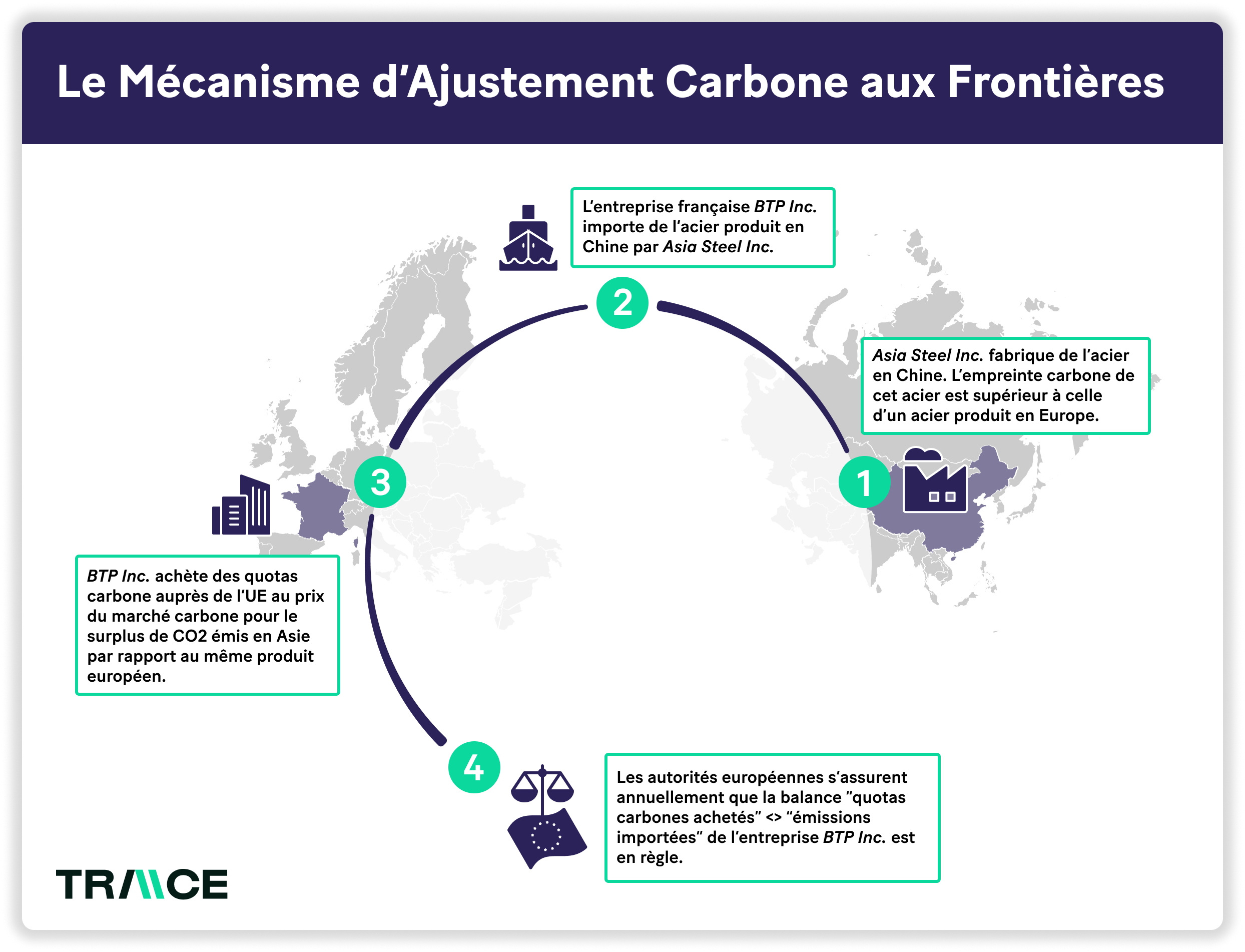
The Carbon Border Adjustment Mechanism will require importing companies to purchase certificates, i.e., carbon quotas at the market price (the amount of which, expressed in €/tonne of CO2, is set weekly by the EU ETS) depending on the imported goods, or to prove that the producer has already paid the corresponding amount.
To be in compliance, importers must declare the goods imported over the previous 12 months by May 31st each year, report the associated carbon volume, and provide proof of their corresponding CBAM certificate purchases. The number of quotas purchased must correspond to the carbon density that the same product would have if manufactured within the EU. Depending on the difference, the balance will be adjusted, with a penalty if the company does not account for enough certificates, and a deduction if it has an excess.
Today, the OECD notes that there is little relocation of carbon generated by the EU ETS. This may eventually change as Europe advances in its decarbonization efforts in line with the Green Deal objectives. Thus, the long-term goal of the CBAM is to replace the current system of free EU ETS quota allocations and to prevent potential carbon leakage. These free pollution permits will be gradually phased out, disappearing completely by 2034. In parallel, the quotas offered on the market will be reduced by 62% by 2030 compared to 2005 levels, as opposed to the 43% reduction target set before this new agreement, with the continued goal of further accelerating the transition to the CBAM.
Regarding the revenue collected by this new carbon tax, 75% will be dedicated to the EU budget to stimulate the European economy and make it more autonomous from other economies.
4. CBAM: who is affected?
To ensure the implementation of the Carbon Border Adjustment Mechanism, the rollout is planned to be gradual across the sectors and emission categories covered (scopes 1, 2, 3). The products involved will therefore evolve over the coming years. For now, the CBAM only covers direct emissions (scope 1) from product manufacturing and concerns five of the most emission-intensive sectors at risk of carbon leakage. The sectors are as follows:
- Cement
- Aluminum
- Fertilizers
- Electricity generation
- Iron and steel
- Hydrogen
In December 2022, the European Union reached an agreement on applying this tax to motor fuel, gas, and heating oil, which will significantly impact households. It also adopted an expansion of the tax's scope, which will subsequently address the maritime sector, emissions from intra-European flights, and waste incineration sites (still under discussion within the EU).
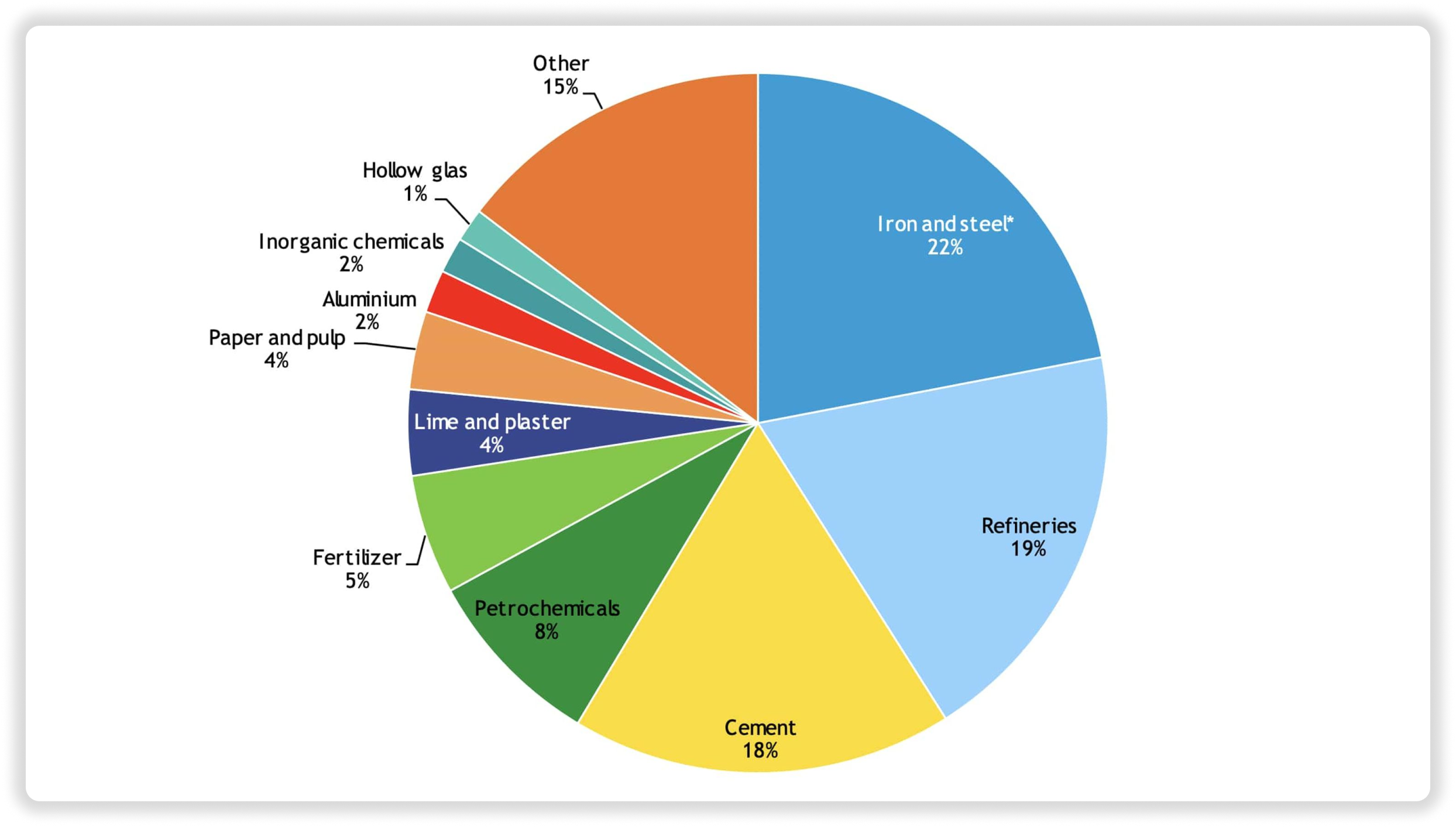
Among the sectors that would be worth including in this CBAM are the paper and cardboard and chemical industries, in particular. Together, they account for 8% of emissions from the European industrial sector.
To date, only primary products are targeted by the CBAM because they are simpler to track from a carbon perspective, unlike the rest of the value chain, where reporting complexity increases with product diversity. The risk of restricting the CBAM to primary products is that it may create carbon leakage further down the production line, thereby limiting the desired emission reduction results. We will have to wait for the second phase of implementation and the results obtained to hope for a revision of the products covered by the CBAM and to push for a decarbonization of the value chain as a whole.
5. What are the next key dates for the CBAM?
Several phases have been defined for the rollout:
- 2023 : Start of reporting for affected companies on emissions related to their imported products,
- 2026 : CBAM becomes operational and coexists with the EU ETS (free carbon quota allocation), with potential updates to the scopes and industries covered,
- 2034 : End of free carbon allowance allocation under the EU ETS and full transition to the CBAM.
6. Some reservations about the CBAM
The complexity in monitoring and establishing the Carbon Border Adjustment Mechanism will lie in several important points, including:
- The difficulty of carbon traceability (for example, specifically for tracking the origin of consumed electricity) and the costs of implementing carbon reporting. The EU is giving companies three years to refine their carbon reporting.
- Dialogue with third countries regarding the measure to avoid potential trade retaliation. We must hope that partner countries will be encouraged to establish a similar carbon pricing system and/or invest in greener production technologies to facilitate trade subject to the CBAM.
- The risk of price increases for both raw materials and finished goods. The impact is already measurable following the agreements reached at the end of 2022, which particularly concern primary fossil fuels still widely consumed by households. The EU will need to justify how it will support the most vulnerable consumers in the face of the added carbon tax through the redistribution of aid from its “Social Climate Fund”.
- The risk of a decline in European export competitiveness, as the CBAM only applies to imports into the EU.
- The current limitation of the first deployment phase to Scope 1 product emissions.
As the planned deployment is gradual and subject to adjustment, the EU will be able, after evaluating the effects during the first deployment phase (reporting of imported emissions starting in 2023), to extend this carbon border tax to several new sectors. It would be interesting and relevant toextend this tax to Scope 2 and 3 product emissions which are not currently taken into account.
Conclusion
The CBAM represents a significant step forward in the European economy's decarbonization plan for a climate-neutral continent by 2050.
While many points will need to be refined and monitored during its rollout, the Carbon Border Adjustment Mechanism is encouraging because it shows that the EU is making progress on the issues ofcorporate carbon accountability, with more ambitious measures that involve actors outside the continent. The goals set by the EU for 2050 are thus integrated into the global economy and could encourage more countries to follow the path of decarbonization commensurate with the challenges of the environmental transition.
Bibliography
1 - Carbon Border Adjustment – Risks and Opportunities for European Industry
3 - Carbon Border Adjustment Mechanism: Questions and Answers
4 - Council agreement on the Carbon Border Adjustment Mechanism (CBAM)