
.svg)




.webp)


🔎 Key takeaways
What is the greenhouse effect?
The greenhouse effect is a natural phenomenon resulting from the atmosphere's influence on the Earth's various thermal flows, contributing to the balance of temperatures at the Earth's surface.
Most of the thermal energy received by the Earth comes from the sun and its radiation. One-third of the sun's rays that reach Earth are reflected back into space. The remaining two-thirds are absorbed by the atmosphere, the soil, and the oceans. The Earth releases some of the energy it receives by radiating it back in the form of infrared thermal radiation. This infrared radiation is then absorbed by the gases present in the lower atmosphere (about 15 km above the ground), preventing some of the reflected heat from escaping into space by trapping it at the Earth's surface.
The greenhouse effect has "historically" kept Earth's average temperature around 15°C. Without it, the average temperature on Earth would be -18°C. The natural greenhouse effect was instrumental in the emergence of life on Earth by creating temperature conditions suitable for the development of organisms.

What is a GHG - Greenhouse Gas?
Greenhouse gases (GHGs) are gaseous components naturally present in the air that originate, for example, from volcanic activity, the decomposition of organic matter, or simply from life on Earth through respiration. These atmospheric gases absorb, among other things, infrared radiation emitted by the Earth and are therefore called GHGs because they contribute to the "greenhouse effect" phenomenon at the Earth's surface.
What is the link between GHGs and global warming?
Human activities, or anthropogenic emissions, lead to an accumulation of GHGs in the atmosphere. GHGs emitted by human activities add to the GHGs naturally present in the atmosphere, causing an increase in the concentration of GHGs in the atmosphere. This increase in GHG concentration generates an additional greenhouse effect that tends to increase the temperature at the Earth's surface and in the lower layers of the atmosphere.
Despite the partial absorption of GHGs by natural sinks (forests, soils, and oceans), the Earth can no longer balance GHG concentrations, reinforcing the additional greenhouse effect and associated global warming year after year.
Need a greenhouse gas emissions assessment ? Contact us to discover our carbon footprint software and receive support from our CSR specialists.
What is the main source of GHG emissions?
GHGs are naturally present in the atmosphere due to their emission by natural phenomena. The well-known carbon dioxide (CO2) is emitted during volcanic eruptions and forest fires. Methane (CH4) is naturally emitted by fermentation processes and microorganisms inhabiting wetlands.
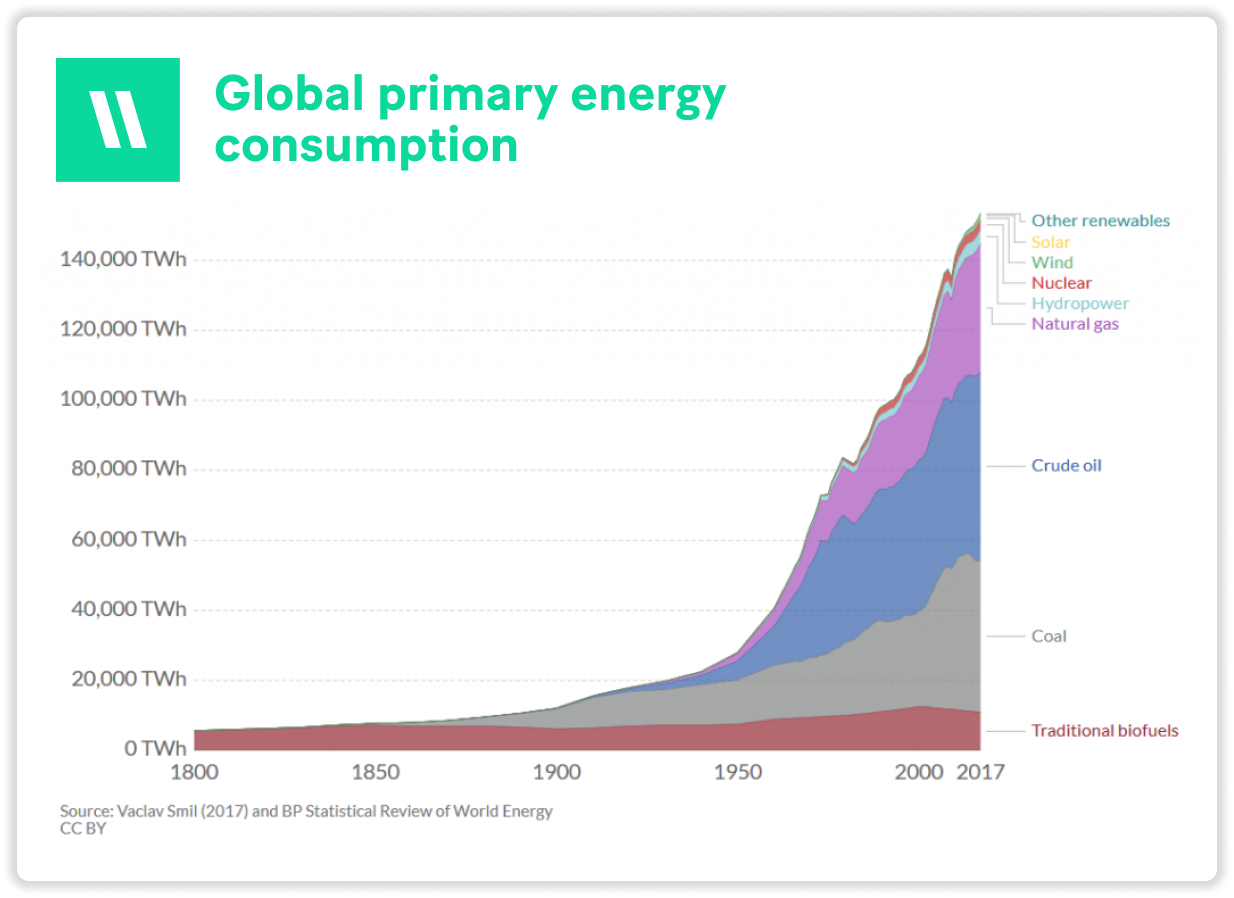
The main non-natural source of GHG emissions over the last two centuries is an increase in energy consumption, which has multiplied by ~10 in 100 years. Fossil fuel consumption in particular has exploded over the last century, and these energy sources are major GHG emitters. They still account for ~80% of the energy mix today.
Carbon Dioxide - CO2
The most well-known GHG is carbon dioxide, also called carbonic gas. Carbon dioxide is an inorganic compound with the chemical formula CO2.
CO2 has always been present in the atmosphere, long before the appearance of humans. It is created by the natural decomposition of animal or plant matter. It is absorbed by plants during the process of photosynthesis: the transformation of CO₂ and water into sugars under the effect of sunlight.
Human activities are unfortunately a source of excessive emissions of this gas into the atmosphere. One human-caused source of CO2 emissions is deforestation and soil tilling. Tilled soils release some of the organic carbon they store, and the removal of vegetation limits the natural capture of CO2, increasing its concentration in the atmosphere.
Industrial processes such as cement and lime production, as well as activities in the petrochemical and steel sectors, are major emitters. All activities requiring the combustion of fossil fuels like oil, coal, or natural gas lead to high carbon dioxide emissions.
In Europe, CO2 accounted for 76% of greenhouse gas emissions in 2022 (official inventory report published by the European Environment Agency). Eurostat estimates for the years 2023 to 2025 confirm this stabilization of the share of CO2 at around 76% of the total European GHG basket. CO2 is now considered the primary driver of the additional greenhouse effect.

Methane - CH4
Methane, also known as "marsh gas," is a greenhouse gas with the chemical formula CH4. It is classified as a hydrocarbon and is the main component of natural gas.
Natural sources of methane emissions are relatively limited. These include wetlands, marshes, termites, and the oceans.
Anthropogenic methane emissions account for slightly more than half of total methane emissions. Agriculture, in particular, plays a very significant role. According to the United Nations Environment Programme, "emissions from livestock, through manure and gastroenteric releases, account for approximately 32% of methane emissions ofhuman origin."
Agricultural methane production can also stem from rice paddies, which must be flooded to grow; this creates conditions favorable to the growth of methane-emitting bacteria by limiting oxygen in the soil. Household waste treatment, such as composting, as well as landfills, also contribute to the release of methane into the atmosphere. Finally, the extraction, distribution, and consumption of natural gas regularly lead to significant methane leaks into the atmosphere.
Methane accounted for 12% of greenhouse gas emissions in Europe in 2019. Europe is the only region where CH4 emissions have decreased over the last 20 years.

Nitrous Oxide - N2O
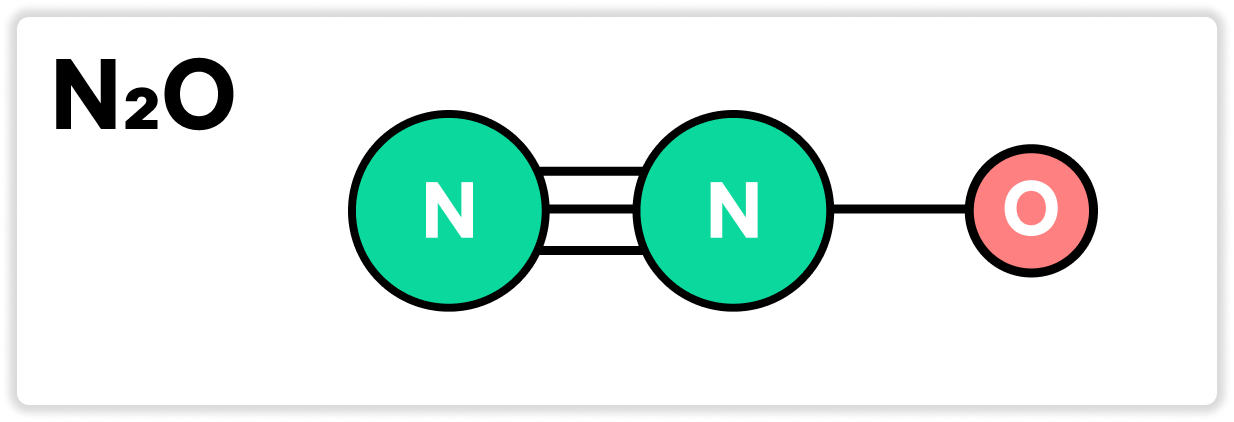
Nitrous oxide, also known as dinitrogen monoxide or "laughing gas," is an oxygenated compound of nitrogen. Its chemical formula is N2O. This gas is considered the third most important greenhouse gas, right after CO2 and CH4.
Nitrous oxide has several emission sources. Microbial processes in cultivated soils, such as nitrification and denitrification, which are linked to the use of mineral nitrogen fertilizers, are the primary source of nitrous oxide emissions into the atmosphere.
Certain industrial processes, such as the manufacturing of glyoxal, adipic, glyoxylic, and nitric acids, or the production of combustion equipment, are sources of N2O emissions. Finally, fossil fuels used for domestic heating and transportation, as well as biomass combustion, are also sources of nitrous oxide emissions.
N2O emissions in Europe in 2019 accounted for 6.8% of total greenhouse gas emissions. Furthermore, nitrous oxide also contributes to the depletion of the ozone layer.
Water vapor - H2O
Water vapor, with the molecule H2O, is the gaseous state of water. It is the most significant GHG in terms of the natural greenhouse effect. The evaporation of water from the Earth's surface and plant evapotranspiration produce the majority of the water vapor present in the atmosphere.
Nevertheless, human activity also plays a role in the concentration of this gas in the atmosphere. Cooling towers at nuclear power plants or aircraft contrails flying for a few hours in the stratosphere are examples of additional H2O emissions generated by human activity. The amount of water vapor induced by human activities remains negligible compared to that induced by natural evaporation and therefore contributes very little to the additional greenhouse effect from H2O.
According to ADEME, water vapor is the most abundant greenhouse gas, accounting for 0.4% to 4% of the atmospheric volume, whereas all other greenhouse gases combined account for less than 0.1%.
Climate change caused by the increased concentration of other GHGs in the atmosphere affects this water cycle. The rise in average temperatures leads to a change in the saturation point at which water condenses, resulting in increased precipitation in some parts of the world and greater drought in others.

Fluorinated gases - HFCs, PFCs, NF3, SF6
Fluorinated gases are considered artificial or industrial because their presence in the atmosphere is due to human activity; unlike the other GHGs previously mentioned, they do not occur naturally in the atmosphere.
There are four distinct types of fluorinated GHGs:
- hydrofluorocarbons (HFCs) which are organic compounds made of carbon, hydrogen, and fluorine.
- perfluorocarbons (PFCs) which are also organic compounds, made solely of carbon and fluorine.
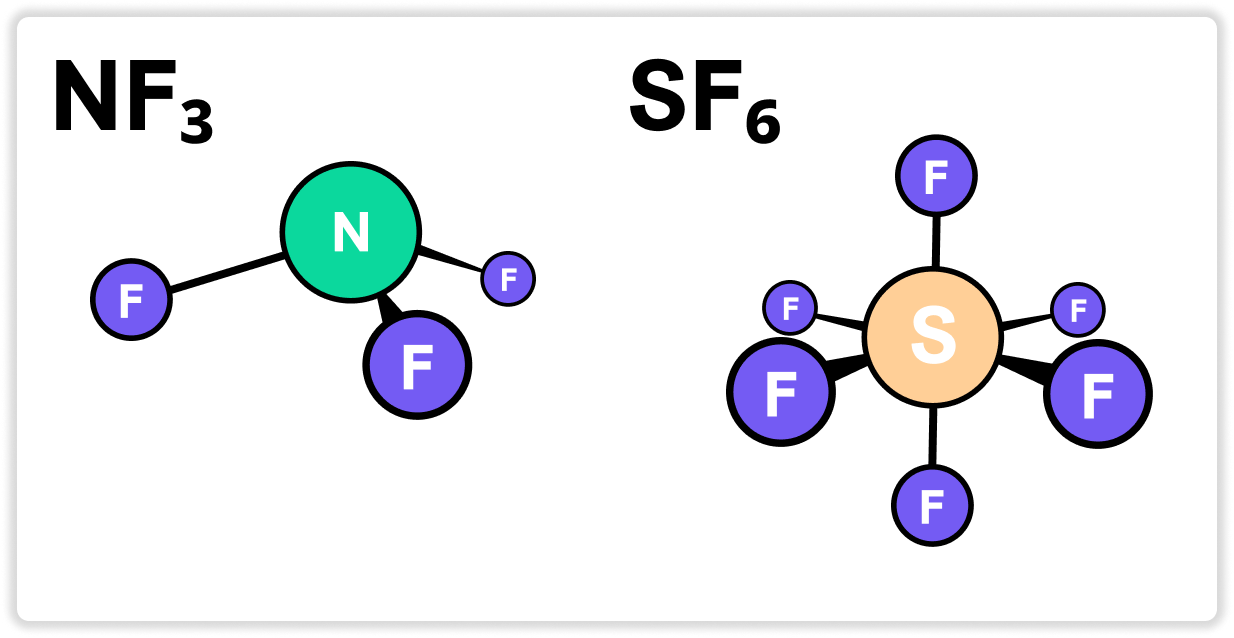
- Nitrogen trifluoride (NF₃) which is an inorganic compound with the chemical formula NF3It is composed of nitrogen and fluorine.
- Sulfur hexafluoride (SF6) which is composed of fluorine and sulfur.
Sources of fluorinated gas emissions are varied. Refrigerants, used in cold chain equipment or air conditioning systems, are responsible for gas emissions throughout their life cycle.
Foams used in the construction industry for insulation produce the majority of fluorinated gas emissions, particularly during their manufacturing.
Fluids released by fire suppression systems, whether through use or leaks, are sources of fluorinated gas emissions.
Aerosol products release fluorinated GHGs during their use as well as during their production.
The main sources of nitrogen trifluoride (NF3 ) emissions are linked to its use in the electronics industry, particularly for the production of solar panels, flat screens, semiconductors, and light-emitting diodes. However, it should be noted that significant emissions come from the destruction of electronic products at the end of their life, as this gas is often used for cleaning electronic equipment before recycling or disposal.
Fluorinated gases (F-gases) were responsible for approximately 2.5% of greenhouse gas emissions produced by Europe in 2019.
What is the Global Warming Potential (GWP) of GHGs?
A gas's ability to trap heat in the atmosphere over a given period is measured by its Global Warming Potential (GWP).
Carbon dioxide (CO₂) is considered the reference and is assigned a value of 1. To compare the effects of different greenhouse gases, their GWPs are converted into CO₂ equivalents over a 100-year period, which is the reference period used by the IPCC. This conversion allows for a ranking of greenhouse gases in terms of their impact on global warming. Global Warming Potential is therefore the warming power of a mass of a GHG relative to the warming power of the same mass of CO₂.
The atmospheric lifetime of different GHGs varies. This factor must also be taken into account when considering the importance of a GHG in the fight against global warming and the strategy to adopt. CO₂ has a long lifespan of over 100 years, whereas methane only lasts about 12 years. Due to its long lifespan, CO₂ accumulates in the atmosphere, making it the primary GHG despite its lower GWP.
Another possible metric is the Global Temperature Potential (GTP). While GWP measures the heat absorbed over a given period due to gas emissions, the GTP measures the temperature change at the end of that period (also relative to CO₂).
Global Warming Potential (GWP) values - IPCC 6th Assessment Report
| # Species | Lifetime (years) | Radiative efficiency (W m-2 ppb-1) | GWP-20 | GWP-100 | GWP-500 | GTP-50 | GTP-100 | CGTP-50 (years) | CGTP-100 (years) |
|---|---|---|---|---|---|---|---|---|---|
| CO2 | Multiple | 1.33 ± 0.16 × 10⁻⁵ | 1. | 1.000 | 1.000 | 1.000 | 1.000 | ||
| CH4-fossil | 11.8 ± 1.8 | 5.7 ± 1.4 × 10⁻⁴ | 82.5 ± 25.8 |
29.8 ± 11 |
10.0 ± 3.8 |
13.2 ± 6.1 |
7.5 ± 2.9 |
2823 ± 1060 |
3531 ± 1385 |
| CH4-non fossil | 11.8 ± 1.8 | 5.7 ± 1.4 × 10⁻⁴ | 80.8 ± 25.8 |
27.2 ± 11 |
7.3 ± 3.8 |
10.3 ± 6.1 |
4.7 ± 2.9 |
2701 ± 1057 |
3254 ± 1364 |
| N2O | 109 ± 10 | 2.8 ± 1.1 × 10⁻³ | 273 ± 118 |
273 ± 130 |
130 ± 64 |
290 ± 140 |
233 ± 110 |
||
| HFC-32 | 5.4 ± 1.1 | 1.1 ± 0.2 × 10⁻¹ | 2693 ± 842 |
771 ± 292 |
220 ± 87 |
181 ± 83 |
142 ± 51 |
78175 ± 29402 |
92888 ± 36534 |
| HFC-134a | 14.0 ± 2.8 | 1.67 ± 0.32 × 10⁻¹ | 4144 ± 1160 |
1526 ± 577 |
436 ± 173 |
733 ± 410 |
306 ± 119 |
146670 ± 53318 |
181408 ± 71365 |
| CFC-11 | 52.0 ± 10.4 | 2.91 ± 0.65 × 10⁻¹ | 8321 ± 2419 |
6226 ± 2297 |
2093 ± 865 |
6351 ± 2342 |
3536 ± 1511 |
||
| PFC-14 | 50000 | 9.89 ± 0.19 × 10⁻² | 5301 ± 1395 |
7380 ± 2430 |
10587 ± 3692 |
7660 ± 2464 |
9055 ± 3128 |
Global Warming Potential (GWP) values - IPCC 6th Assessment Report
Sources:
- https://climat.be/changements-climatiques/causes/gaz-a-effet-de-serre
- https://www.climatewatchdata.org/ghg-emissions
- https://librairie.ademe.fr/cadic/1413/guide-pratique-changement-climatique.pdf
- https://www.actu-environnement.com/ae/dictionnaire_environnement/definition/gaz_a_effet_de_serre_ges.php4
- https://jancovici.com/changement-climatique/gaz-a-effet-de-serre-et-cycle-du-carbone/quels-sont-les-gaz-a-effet-de-serre-quels-sont-leurs-contribution-a-leffet-de-serre/
- https://expertises.ademe.fr/professionnels/entreprises/reduire-impacts/reduire-emissions-polluants/dossier/protoxyde-dazote-n2o/definition-sources-demissions-impacts-protoxyde-dazote
- https://www.ineris.fr/fr/risques/dossiers-thematiques/pollution-atmospherique-ozone-decryptage
- https://meersens.com/ozone-o3-sources-et-impacts-sur-la-sante-et-lenvironnement/#BLOC1
- https://expertises.ademe.fr/professionnels/entreprises/reduire-impacts/reduire-emissions-polluants/dossier/gaz-fluores/gaz-fluores-sources-demissions-impacts