
.svg)





.webp)


🔎 Key takeaways
Given the climate challenges, reducing greenhouse gas emissions and, more generally, our negative or positive impact on the environment and society are issues that concern all sectors of our economy.
However, one of the foundations of any economic activity is its financing. By injecting new momentum into the financial system and encouraging investors to prioritize sectors contributing to the ecological transition and a sustainable growth model, European authorities hope to have a broad impact while holding the financial sector and its contributors accountable.
It is with this in mind that the SFDR was implemented.
SFDR Regulation: what is it?
The SFDR, or Sustainable Finance Disclosure Regulation, is a European regulation aimed at promoting investments in so-called sustainable financial assets and increasing the transparency of these financial products regarding their contribution (or lack thereof) to sustainable development, the reduction of greenhouse gas emissions, and the consideration of social factors.
This regulation notably obliges financial actors to provide greater transparency on the funds they manage or supply, by informing investors about the "sustainability" of the investment products they sell, as well as the impact of climate and social changes on their potential profitability. We therefore see the application of a system of double materiality.
To do this, the SFDR allows investment funds to be classified into different categories according to their social and environmental impacts.
Article 6, 8, and 9 Funds
Funds are thus classified into 3 distinct categories: "Article 6" funds, "Article 8" funds, and "Article 9" funds, which allow investors to make informed decisions regarding the sustainability of the financial product in which they invest.
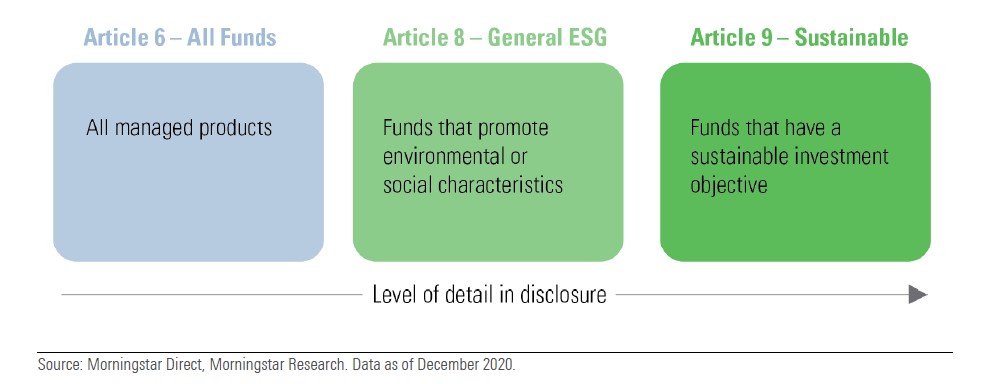
Article 6 funds: These are funds that do not have explicit sustainable investment objectives. They are also known as "non-sustainable objective funds." They are not required to integrate an ESG dimension into their investment processes but must still disclose basic information on sustainability risks.
Article 8 funds: These are funds with sustainability objectives but without particularly stringent rules. They are also known as "sustainability-focused funds." They are designed to promote environmental or social characteristics in their investments. These funds integrate ESG factors into their investment process and define specific sustainability objectives in their investment policy.
Article 9 funds: These are the most advanced funds in terms of sustainability, also known as "super green" or "dark green" funds. They must make a substantial contribution to EU sustainability objectives, such as the Paris Agreement on climate change. These funds are required to significantly integrate ESG factors into their investment decisions. They must have independent verification mechanisms to assess their sustainability impact.
Why do we talk about green finance?
The SFDR is one of the tools implemented to contribute to the development of what is commonly known as "green finance" or "sustainable finance." This primarily involves reorienting investments towards activities with a positive impact on the environment and society, and particularly promoting those engaged in decarbonization projects. Among these tools, we also find instruments such as green bonds and the EU taxonomy.
The stated objective is to better allocate financial resources by considering not only short-term financial performance and profitability criteria, but also weighing in the balance the criterion of sustainability.
The double materiality analysis of financial products introduced by the SFDR and the concept of DNHS (Do Not Significantly Harm) allow for a better consideration of this new balance by prioritizing a long-term vision. Investing in a product based solely on its profitability criterion can become risky if it is likely to be impacted by the consequences of climate change. It is therefore better to invest in less risky products in the medium and long term that promote "sustainable" activities.
What are the main objectives of the SFDR regulation?
The European regulation pursues four main objectives:
Improve transparency: The SFDR aims to increase the transparency of financial products by requiring asset managers, investors, and financial advisors to disclose information on the sustainability of their products and activities, following a double materiality analysis. This should enable investors to make more informed decisions by considering sustainability factors.
Encourage sustainable investment: By obliging financial sector participants to disclose sustainability information, the SFDR aims to encourage investment in projects and companies that have a positive impact on the environment and society. Ultimately, this should foster the transition to a more sustainable economy.
Align investments with EU sustainability objectives: The SFDR contributes to aligning investments with the European Union's sustainability objectives, such as the Paris Agreement on climate change and the United Nations Sustainable Development Goals. It encourages investments in projects and companies that contribute to achieving these objectives.
Prevent greenwashing: The SFDR aims to prevent "greenwashing," which involves misleadingly presenting a financial product as more sustainable than it actually is. By imposing strict disclosure standards for risks and opportunities related to ESG criteria, the regulation seeks to ensure that information provided to investors is accurate and reliable.
Which companies and products are covered by this regulation?
The SFDR applies to two types of profiles:
- financial market participants (asset managers, insurance companies, credit institutions, etc.)
- financial advisors, which includes participants from the first category when they provide investment advisory services
They have a legal obligation to provide information regarding the sustainability of the financial products they advise on and to classify them according to the sustainability criteria established in said regulation (Articles 6, 8, and 9). Fund managers must also provide information justifying their investment decision-making process.
A timeline of the SFDR regulation
The SFDR is a constituent element of the European Green Deal, whose objective is to achieve climate neutrality by 2050 and aims to reduce greenhouse gas emissions in EU countries by 55% by 2030 compared to 1990 emission levels.
This European Green Deal was implemented within the European Union to achieve the objectives set by the Paris Agreement on climate, ratified in 2015.
The SFDR is a European regulation dated November 27, 2019, which has been effective since March 10, 2021. It was enhanced in April 2022 with the adoption of the RTS (Regulatory Technical Standards), effective since January 1, 2023.
The RTS are reporting production standards that financial market participants must adhere to in order to provide information regarding the potential impacts of financial products on sustainability, as well as the pre-contractual information templates and periodic information templates that must be transmitted to investors.
Finally, since September 2023, the European Commission has launched a dual consultation, with the first part aiming to gather feedback on how various stakeholders perceive the regulation's requirements and associated reporting rules.
The second part of the consultation, conducted with a more restricted audience, aims to precisely evaluate the relevance of the regulation and the classification of funds under categories 6, 8, and 9, by proposing alternatives to them.
SFDR Regulation and European Taxonomy: What you need to know
The SFDR should be viewed alongside the European taxonomy, also known as the green taxonomy.
As mentioned previously, the green taxonomy is also one of the tools implemented within the European Union as part of the Green Deal.
The European green taxonomy focuses on the classification of sustainable economic activities, while the SFDR focuses on the disclosure of specific sustainability information in the financial sector.
These two initiatives aim to promote sustainability in the financial sector but with different objectives and approaches.
The European taxonomy is a classification of economic activities that effectively contribute to the EU's environmental sustainability objectives. It defines precise criteria for determining which economic activities are considered sustainable.
The green taxonomy covers six environmental sustainability objectives:
- climate change mitigation
- climate change adaptation
- the sustainable use and protection of water and marine resources,
- the transition to a circular economy
- pollution prevention and control
- the protection and restoration of biodiversity and ecosystems.
It is primarily intended for use by businesses and investors to identify and promote green investments that align with the European Union's sustainability objectives.
The two initiatives are complementary, as the green taxonomy can help financial actors identify investments that align with sustainability objectives, while the SFDR ensures transparency on how these investments are managed and communicated to investors.
Some limitations
Ultimately, what is a sustainable investment?
Since the implementation of the SFDR regulation, there appears to be a lack of clarity regarding the difference between what can be considered an Article 8 fund and an Article 9 fund.
The main challenge lies in defining what constitutes a sustainable investment.
The SFDR specifies that Article 9 funds must incorporate the concept of DNSH (Do no Significant Harm), meaning their objective must not cause significant harm to any of the environmental or social objectives supported by the green taxonomy.
This definition remains relatively vague. Each financial actor can have their own interpretation.
Consequently, the entry into force of the RTS led to a massive reclassification of Article 9 funds to Article 8 at the end of 2022.
The European Commission was asked to provide clarification on the sustainability criteria for defining an Article 9 fund. However, in a letter dated April 14, 2023, it stated that it would not provide an answer to this question and leaves it to the financial sector to decide what they themselves consider a sustainable asset.
A critique of 'super green' funds
Article 9 funds, or Dark Green funds, are in the spotlight.
In 2022, a consortium of journalists, including Follow the Money and Le Monde, published an investigation titled “The great green investment investigation” during which they examined 838 'super Green' funds out of the 1141 existing at the time of their analysis. These 838 funds represented an investment amount of 619 billion euros.
They noted that, despite being classified as Article 9, nearly half of them invested in the aviation and fossil fuel sectors, undermining the classification criteria established by the SFDR.
Similarly, in a study published in March 2023, titled "How Green is Dark Green ?", finance researchers Marc Chesney and Adrien-Paul Lambillon from the University of Zurich closely examined funds labeled "Article 9" and the companies benefiting from them. They observe that, although these Article 9 funds are theoretically considered more sustainable, many assets included in this category are not truly so.
Their findings highlight that investment fund managers appear to favor large multinational corporations, which can mobilize significant resources to improve their "green score" (Net Zero strategy, ESG ratings) without certain violations of key principles of the UN Global Compact or OECD guidelines having a significant impact on this score.
Conversely, smaller companies, which are more environmentally and socially responsible, see their positive impact understated and are therefore less sought after.
Conclusion
To conclude, by establishing the SFDR, the European Union sent a clear signal regarding its commitment to developing an innovative sustainable finance system. The SFDR is a key instrument for reorienting investments towards activities with a positive impact on the environment and society and accelerating their development. It complements tools such as the green taxonomy or the CSRD in the European transition towards a sustainable economy.
While certain limitations have been highlighted, the European Commission appears to have acknowledged them by launching a new consultation aimed, 2 years after its implementation, at taking a critical approach to this regulation and studying alternatives to the classification of various funds, which is currently the main point of contention.
Sources:
- “SFDR: Is the end of Article 8 and 9 funds near?”, Novethic Essentiel, 15/09/2023
- “Sustainable finance: greenwashing risks for SFDR”, Youmatter, 10/07/2023
- “SFDR (Sustainable Finance Disclosure Regulation): definition, explanations, challenges…”, Youmatter, 16/05/2023
- “European Commission decision on the answers to be provided to questions requiring the interpretation of Union law submitted on 9 September 2022 by the ESAs SFDR”, ESMA (European Securities and Market Authority), 05/04/2023
- “How Green is ‘Dark Green’? An Analysis of SFDR Article 9 Funds”, SSRN, 28/02/2023
- “The great green investment investigation”, Follow the Money, 29/11/2022
- “Sustainable finance: understanding the Taxonomy and SFDR regulation to express your preferences”, Financial Markets Authority, 06/10/2022
- “An important step for sustainable finance in Europe: the disclosure requirements established by the SFDR regulation's entry into force”, Prudential Supervision and Resolution Authority (Bank of France), 01/04/2021
- “Sustainability-related disclosure in the financial services sector”, European Commission