
.svg)





Since the first carbon assessments were introduced, companies embarking on this exercise have often faced numerous difficulties during the data collection phase required to calculate their Greenhouse Gas (GHG) emissions.
This involves processing a vast amount of data from extremely diverse sources, often with highly variable levels of reliability.
To obtain an actionable carbon footprint, every company must therefore find a data collection model and structure that fits its size, sector, and business model.Because the subject is unique to each organization, it is complex to address. We are seeing an increase in discussions within dedicated structures such as the APCC or C3D, which aim to share best practices in decarbonization with peers, as well as the ABC, which maintains and evolves the Bilan Carbone methodology over time.
At Tennaxia, we observe that the tools historically used to manage climate strategies in organizations are no longer suited to the scale of the climate challenges they face today, and they hinder their ability to meet the carbon footprint reduction targets they set for themselves.
For several years, we have seen companies creating in-house tools or Excel files that, as the company grows, become overly complicated and require collaboration through endless email chains. The implementation of the CSRD, which will require the collection and processing of new data related to corporate impact, risks making these tools and internal collaboration processes even more complex.
It is therefore necessary to rethink the issue of collecting activity data for measuring carbon impact, to ensure a reliable, sustainable, and efficient system that can keep pace with the company's growth and provide concrete support for its decarbonization plan.
The subject is vast: governance, tools, collaboration processes, data quality, automation of recurring tasks, etc.
The first questions you should ask yourself are therefore as follows.
- Where is the activity data located?
- Who has access to it?
- How can it be collected?
- Where should it be centralized?
- Is it reliable?
- Is it actionable?
Governance: the pillar of data collection
For a carbon footprint reduction strategy to be effective, there must first be a genuine commitment from the company and its leaders to implement a robust data collection system that will subsequently enable concrete actions to be taken.
Defining the collection plan
A carbon footprint assessment needs to be thought out in terms of objectives, organization, budget, tools, and timeline.
Why does the company want to conduct a carbon footprint assessment? This decision will help define the scopes to focus on and determine in advance which data needs to be collected.
The budget (and for now, we are only talking about the budget dedicated to collection) will also help determine the team in charge of the assessment and the tools they can use to optimize this process. The tool is obviously a central element, if not the most important part of data collection.
As for the timeline, it often depends on external factors, particularly legal obligations. However, the company can determine the frequency of collection based on the regulatory and organizational constraints of its structure.
Finally, you will need to think in terms of organization 👇
Identify the right stakeholders
The first step will be to define the team responsible for implementing the corporate carbon footprint assessment and for collecting data, both internally and from stakeholders (suppliers, service providers, etc.), and then to rely on the right tool to centralize information from these various sources.
Internal stakeholders
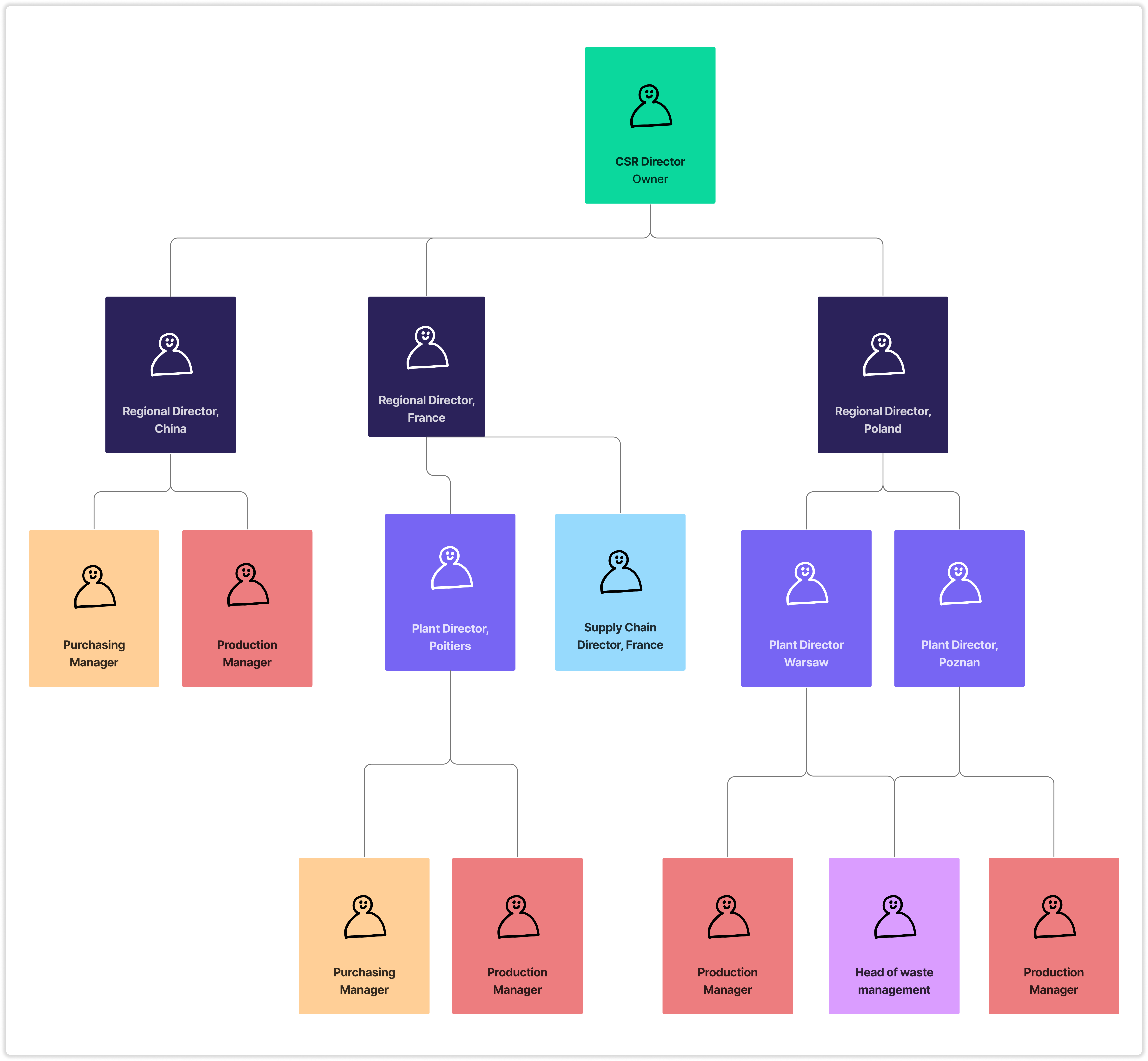
Distributing roles is an essential element. It is a matter of finding the key person—the one who will lead and centralize data collection from all contributors and have a comprehensive view of the collection status at any given time.
In companies already mature in carbon footprint analysis, we often find a CSR director taking on this role. External consulting teams can also take on all or part of this responsibility.
But be careful: as important as this position is, the person designated to lead the project is not omniscient. Once they have established the list of data to be collected, they must identify the right contacts in each department and/or site who are able to provide the information necessary for establishing the carbon footprint.
This step is essential to avoid entering a chain of delegation, which would de facto dilute the responsibility of each actor and inevitably have an impact on the quantity and quality of the data collected.
The ideal tool will allow you to integrate all these contributors into a collaborative platform and call upon them during each new collection cycle using personalized forms distributed directly from the platform. The tool will centralize all data as it is collected and process it in real time.
External stakeholders
This exercise must also be carried out with all stakeholders whose roles influence the company's carbon footprint. This mainly concerns those who have a direct impact on the company's scope 3.
Generally, Scope 3 accounts for the majority of a company's greenhouse gas emissions, often representing over 90% of a carbon footprint. This is particularly true for many Tennaxia clients, for whom engaging their value chain is critical to establishing their carbon accounting. Identifying a reliable contact person among service providers and suppliers makes it easier to collect data and, subsequently, to implement more efficient decarbonization actions.
Similarly, this data will be integrated into Tennaxia ESG, tracked by source, and immediately associated with the corresponding emission factors.
Involving all stakeholders
The role of good governance is also to ensure the involvement of the various stakeholders by explaining the ins and outs of a carbon footprint project in concrete terms.
This involvement is necessary both during the collection phase and in the future deployment of the company's decarbonization projects.
It should never be forgotten that data collection is a project involving many stakeholders for whom data gathering is not their primary responsibility. An informed stakeholder will therefore be more inclined to contribute actively and provide high-quality carbon data.
Data quality: a central element for a sustainable carbon footprint
Identifying data
Needless to say, you shouldn't dive headlong into a carbon footprint project. A long scoping and analysis phase is necessary beforehand. It requires deep, specialized knowledge of how the company operates. Even the most experienced teams call upon specialized consultants, at least for the first time, to support them during this phase.
Depending on the objectives set, the goal is to create an exhaustive list of activity data by scope and associate them with appropriate emission factors, which will allow for precise measurement of the emission quantities generated for each item.
Each piece of data must be linked to a production site, a service provider, etc., which will subsequently make it possible to know who holds the information and is able to contribute to the collection process.
The amount of data to be collected may seem immense, so it is important, first and foremost, to make methodological choices that will allow you to determine the main emission sources you wish to map and the granularity of the activity data you wish to collect.
We recommend adopting an iterative approach. Start by identifying the major data points and subsequently refine the main emission sources by applying a higher level of granularity. You can refine this analysis over the years and through successive carbon footprints to broaden your scope of action. By following this method, you will have a matrix view of your main greenhouse gas emission sources and will be able to activate levers that will have a substantial impact on your carbon footprint.
To facilitate this step, you must, of course, ensure you have a platform capable of supporting you in this mapping and providing the level of granularity essential for utilizing your carbon footprint.
Tools like Tennaxia ESG make it easy to create this list and associate the corresponding emission factor with each piece of collected data. A rich database of emission factors (including that of ADEME) is natively integrated into the tool and updated regularly. It is also possible to import emission factors specific to your industry or custom-created ones.
Collecting quality data
Data is only meaningful if it is actionable. And the primary criterion for data to be actionable is its value.
At Tennaxia, we strongly encourage our users to prioritize a physical approach over a monetary one whenever possible.
The monetary approach involves converting financial source data—such as figures from your balance sheet or energy bills—into carbon emissions using a "monetary" emission factor expressed in kgCO2e/€.
The physical approach, on the other hand, relies on physical data (number of kilometers traveled, tons of materials purchased) to establish GHG emission levels.
The monetary approach may seem simpler. It is much faster to conduct a carbon footprint assessment using only your chart of accounts. However, it is far less reliable. Monetary data does not allow for the identification of precise levers for action. The solution presented to you will be to buy less or buy cheaper, which rarely leads to an actual reduction in emissions. Reducing material purchasing costs does not necessarily mean you have consumed less, especially during periods of inflation. The carbon footprint will track price fluctuations, making it impossible to manage performance over time.
The ABC therefore recommends systematically using physical flow data to limit uncertainties in carbon emission calculations. This method is now a recognized quality standard for conducting a Bilan Carbone.
We also believe that the monetary approach is not inevitable. Thanks to modern tools, we are convinced that it is possible to obtain high-quality physical data that will provide precise and granular levers for action. It is with this goal in mind that we developed the collection module for our ESG software. We have provided all the tools necessary to collect data collaboratively with automated processing, thereby simplifying access to quality data and its utilization.
However, we are well aware that, given the volume of data that must be collected, it is unrealistic to expect it all to be of equal quality. Only in cases where concrete data could not be collected should you resort to extrapolation. Monetary data can then be used when no satisfactory alternative is available.
In this context, we allow you to assign uncertainty levels to your various data points, so you can better identify, during your analysis, which information comes from extrapolated data and is therefore less reliable.
By applying the iterative method we discussed earlier, you can also improve the quality of the data you collect with each new reporting cycle, gradually reducing the level of uncertainty associated with your GHG emissions analysis.
Choosing the right carbon data collection tool
Establishing selection criteria
The tool you use to collect your activity data is a key element in obtaining a reliable and actionable Carbon Footprint without having to dedicate excessive time and energy to it. Its features must enable you to address all the challenges we mentioned earlier.
In short, the perfect tool should allow you to:
- Collaborate effectively with all stakeholders in your carbon plan, including external parties via questionnaires
- Identify the person responsible for data collection within each scope
- Map all of your data sources
- Collect and process data on an ongoing basis
- Determine data quality by assigning an uncertainty level to it
- Associate all data with a corresponding emission factor that is regularly updated
- Weight data using advanced processing rules (bonus/malus)
- Trace collected data to identify its origin and ensure it is auditable
Only under these conditions will you have a carbon database that is rich and high-quality enough to successfully carry out your future decarbonization actions.
It is also worth noting that a good data collection module must be flexible. Your company will evolve. It may incorporate new sites, launch new products, or need to adapt to a new legislative framework. The tool must therefore be able to collect data in euros, kg, kWh, or even adapt to statistical approaches for extrapolation.
Assume that a good module is one that does not know in advance what data it will connect to, yet is still able to adapt to each piece of information.
The Tennaxia collection module
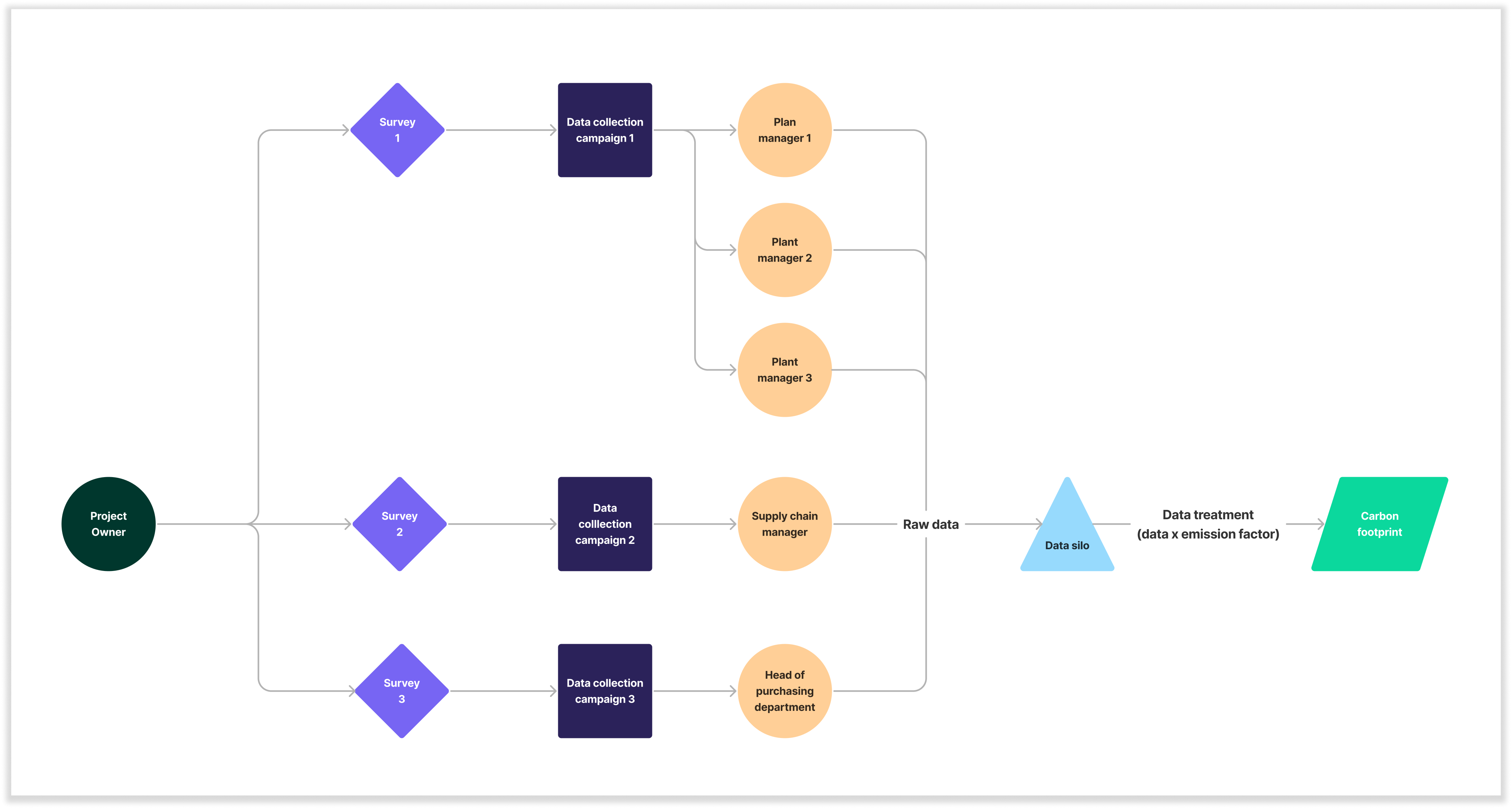
The Tennaxia ESG software collection module allows you to create collection campaigns using customized questionnaires. These are sent to all stakeholders who hold the activity data necessary for establishing your carbon footprint.
A data flow system retrieves the collected data and automatically associates it with the emission factor you have provided to convert the information into generated carbon emissions. All collected data is then centralized in an analysis module, giving you a comprehensive view of your company's GHG emissions.
You also have the ability to trace data by emission site, collection date, product, etc., making your carbon analysis fully auditable.
Finally, the tool allows you to monitor your collection campaigns at a glance and identify any gaps. Contributors will be automatically prompted to provide any missing data.
CSRD and ESG data: a new challenge in data collection
The arrival of the CSRD reinforces the need for companies to collect their data using a dedicated tool. The CSRD and the inclusion of ESG indicators will multiply the amount of data that companies must collect. It will also require the integration of many new conversion factors (impact on biodiversity, land use rates, etc.).
Your carbon accounting Excel file, however powerful it may be, will quickly become unreadable and, more importantly, will not provide you with a clear view of your impact. The effectiveness of your decarbonization or impact reduction actions will therefore be severely hindered.
Measuring your actions effectively can become a real headache when, for example, reducing your carbon emissions might increase your impact on biodiversity. Only a tool with an advanced, powerful, and flexible processing rules engine can actively support you during your collection phase and allow you to leverage the data afterward.
The collection module of the carbon footprint platform from Tennaxia ESG is designed to adapt to all these scenarios. It allows a single data point to be processed from different angles by associating it with multiple conversion factors, effectively simplifying your future analyses and actions aimed at reducing your social and environmental impact.