
.svg)





🔎 Key takeaways
What does carrying out a Corporate Carbon Footprint assessment involve?
A company's carbon footprint reflects the amount of greenhouse gases (GHG) generated by its activities. For simplicity, these GHGs are usually reduced to carbon dioxide (CO2), but there are several other GHGs: methane (CH4), nitrous oxide (N2O), and so on.
A carbon footprint assessment is a diagnostic tool, a methodology, used to measure your company's greenhouse gas emissions, whether direct or indirect. Data collection, measurement, analysis and reporting on a company's CO2 emissions are generally carried out on a yearly basis.
Note that the term Bilan Carbone® is a registered trademark referring to a specific carbon accounting methodology. Today there are various standards and methodologies for measuring companies' carbon footprints, which are nonetheless tending to converge. The Bilan Carbone® methodology is a tool developed and made available by the Association pour la transition Bas Carbone (ABC).
How are greenhouse gas emissions calculated when producing a Corporate Carbon Footprint assessment?
The principle behind calculating a carbon footprint is fairly simple in theory, though potentially tedious in practice:
The activities generated by the company are listed: heating premises, purchasing raw materials, manufacturing goods, employee travel, and so on. Each of the company's activities generally forms what is known as an “emission source”.
- The raw “activity data” associated with each source is collected: energy consumption, quantities purchased, kilometres travelled, etc.
- This raw activity data, each measured in different units, is then multiplied by a conversion factor that expresses its impact in terms of carbon emissions. These conversion factors are known as “emission factors”.
For example, to calculate emissions linked to a company's own electricity consumption, a raw figure such as the “number of kWh of electricity consumed” can be multiplied by an emission factor such as the “weight of CO2 emitted per kWh of electricity”.
However, it is important to match the level of detail of the raw data and the emission factor to the significance of the emission source. In our example, it will be more useful to multiply the “number of kWh per electricity source” by the emission factor associated with each of those electricity sources (nuclear, gas, coal, solar, etc.).
This level of detail is essential in order to have actionable levers that will be reflected in the company's future carbon footprint (e.g. increasing the share of electricity from low-emission sources) and to pragmatically define which data needs to be collected.
- All emissions are then consolidated into a single unit. Emissions from different gases are converted into “CO2 equivalent” (CO2e) in order to have a universal unit of measurement (in the same way that $ and € would be consolidated into a single currency).
For analysis purposes, the various emission sources are generally classified into categories grouped under three scopes, known as scopes 1, 2 and 3.
Which emissions are included in a company's Carbon Footprint assessment?
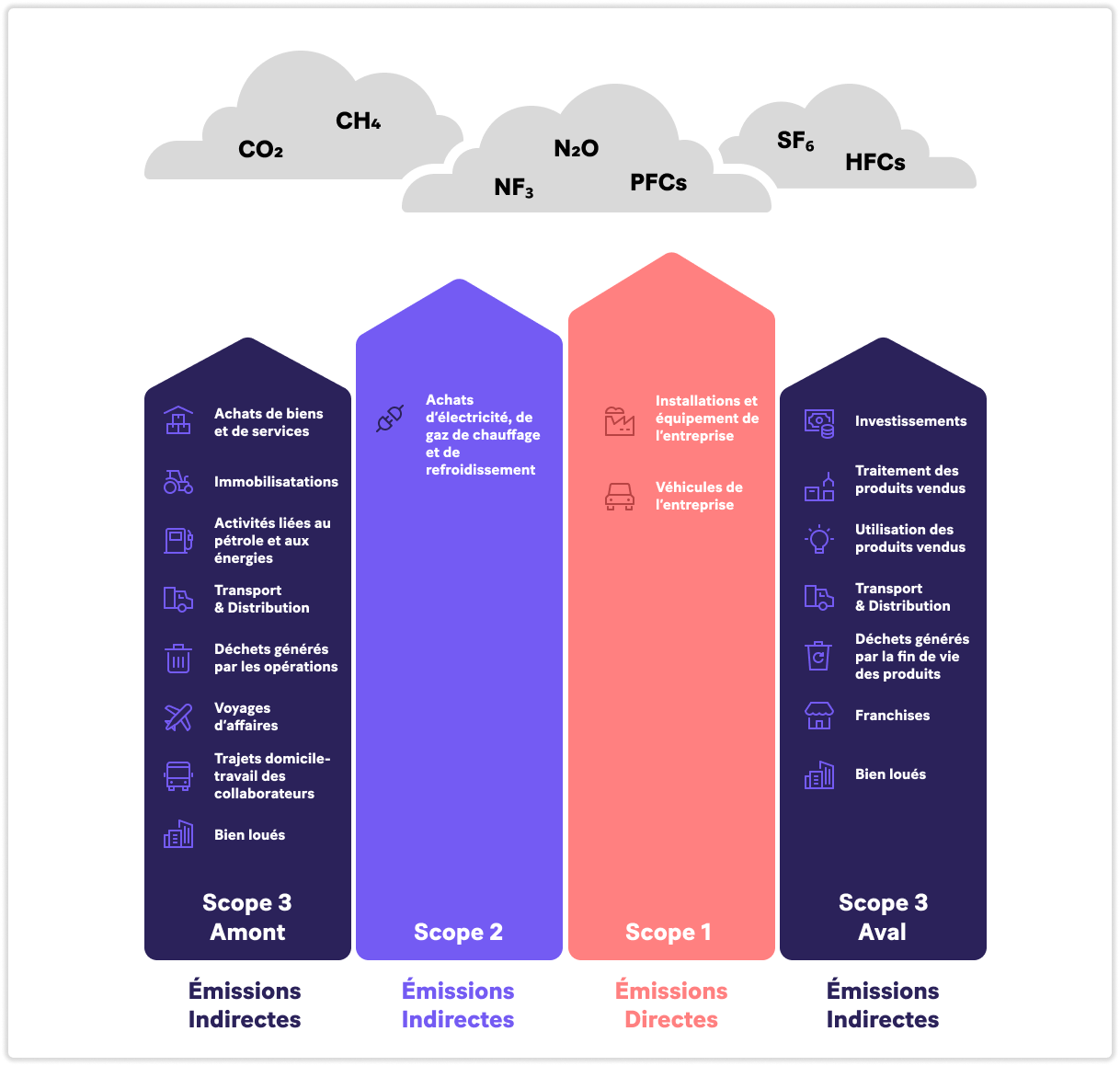
As mentioned, several different greenhouse gases are accounted for when calculating GHG emissions: CO2, N2O, CH4, SF6, HFCs, PFCs, and so on. The Bilan Carbone method, like most other standards and methodologies for measuring direct and indirect emissions, is based on the study of 3 scopes, which are used to carry out the calculation and identify which are the most energy-intensive within your company:
- Scope 1 has the narrowest coverage. It covers direct emissions linked to fuel consumption such as petrol, as well as emissions from your buildings, fixed equipment and biomass.
- Scope 2 concerns indirect emissions linked to the energy consumption of your production process, in the form of heat, cold, steam and electricity.
- Scope 3, meanwhile, focuses on the other greenhouse gas emissions that occur outside your product's production process, such as raw material sourcing, downstream transport of goods, or even the use of your product!
How the different emission categories are taken into account varies according to the different carbon accounting standards that exist today: Bilan Carbone, GHG Protocol, French regulatory GHG assessment, GRI 305, ISO 14064, and so on.
With so many different carbon accounting methods available, there is now an urgent need to hold carbon accounting to standards comparable with those of financial accounting.
Tennaxia therefore anticipates and applies to its carbon footprint assessments the key principles of reliable, genuine carbon accounting: completeness of scope (no half-measures), continuity of methods (changes made only to improve accuracy), and no offsetting (emissions generated, avoided and financed are clearly identified separately).
How do you carry out a corporate Carbon Footprint assessment?
A Bilan Carbone® must produce at least 2 deliverables:
- Measuring the company's carbon footprint.
This is the exercise of accounting for emissions, broken down into significant sources. These figures are usually accompanied by ratios adapted to the company's activity and size – essential for decoupling changes in the carbon footprint from the company's growth.
- The plan to reduce emissions generated by the company's activity.
Hence the importance of having sufficiently precise information on the most significant emission sources in order to define actionable levers, the results of which can then be measured. These levers must then be managed by the people responsible for the relevant departments to ensure they are implemented and to make any necessary adjustments.
Tennaxia provides “experts on demand” to find, at each review, new levers for reducing induced emissions that will help achieve the targets the company has set itself as part of its ecological transition plan.
Why calculate your company's carbon footprint?
Carrying out a corporate Carbon Footprint assessment is a necessary first step, to be repeated annually, as part of a serious commitment to measuring your company's environmental impact. It is a first step because, while it focuses on CO2 emissions, it does not, for example, cover the measurement of environmental impact on biodiversity or water resources.
Carbon accounting makes it possible to analyse your company's main sources of GHG emissions and therefore to identify the levers for action to activate, with the aim of reducing greenhouse gas emissions and contributing to global carbon neutrality.
The motivations for carrying out a Carbon Footprint assessment and starting a low-carbon transition can be varied: legal obligation, improving brand image, optimising spending, anticipating the impact of future climate crises, relationships with investors, and so on.
In France, carrying out and publishing a Carbon Footprint assessment on the ADEME website is a legal obligation for certain companies, in particular all companies with more than 500 employees. Under the CSRD, which comes into force on 1 January 2024, more than 50,000 companies with over 250 employees will be required, among other things, to carry out an annual regulatory GHG assessment across their entire value chain and put in place an emissions-reduction strategy.
On the consumer side, as younger generations become increasingly concerned about the environment and their consumption habits, transparency about your ecological footprint can translate into a genuine competitive advantage for your company by improving its brand image.
Internally, engaging all your employees in achieving carbon emission reduction targets helps create a shared purpose and strengthens cohesion. From a financial perspective, identifying the key emission sources linked to energy consumption can also allow you to make significant savings while accelerating your energy transition.
For stakeholders too, this is an area that is regularly scrutinised. Investors are increasingly concerned about the sustainability of the projects and companies they fund. Transparency requirements are designed in particular to give them the best possible information on the state of your emissions and your company's commitment to a trajectory of reducing emissions and environmental impact more broadly.
Finally, carrying out your company's emissions assessment is a first step in the fight against global warming.
Can a Carbon Footprint assessment be certified?
In recent years, numerous solutions for calculating companies' carbon footprints have been developed to meet growing demand from companies wanting to know their CO2 and other greenhouse gas emissions. Some of these providers promise certified greenhouse gas emissions assessments, which is a misleading claim.
It is important to note that there is no official certification for a Bilan Carbone®, and that a certification is only valuable if it is issued by an independent third party with no conflict of interest. However, in France, the Association pour la transition Bas Carbone (ABC) is responsible for the reference methodology for this measurement.
After being audited and assessed by the ABC in early 2023, Tennaxia was found to comply with the Association Bilan Carbone® methodology.
You can view the list of technology solutions certified by the Association pour la transition Bas Carbone (ABC) and ADEME by following this link.
How much does a carbon footprint assessment cost?
The cost of a company's carbon footprint assessment varies widely and depends on several factors:
- The provider (SaaS software such as Tennaxia, or a consulting firm)
- The scope: does the assessment cover all 3 scopes, or is it partial
- The size of your company (number of employees, revenue)
- Your company's sector (primary, secondary or tertiary)
- The time spent by the provider
What's the price if I go through a consulting firm?
Prices charged for obtaining your company's carbon footprint assessment from a consulting firm are generally as follows:
- €10,000 for an SME covering Scopes 1, 2 and 3 (with the possibility of subsidies if it is your first assessment).
- Between €20,000 and €50,000 if your company is a mid-cap or large company.
- For large international groups such as CAC40 companies, the price can exceed €100,000.
And with SaaS software?
This will depend on the type of SaaS software used!
There are 2 types of SaaS software on the market: those based on physical data and those based on monetary data.
Software based on monetary data: Between €2,000 and €4,000
Software based on monetary data uses data from your bank account or your Accounting Entries File (FEC) to calculate carbon emissions. This software is the cheapest on the market, costing between €2,000 and €4,000 for a Carbon Footprint assessment.
However, this attractive price hides a number of pitfalls:
Monetary data analysis, even if it complies with the Bilan Carbone methodology, is not recommended by ADEME. Your GHG emissions measurement therefore risks becoming invalid as soon as the regulations are next updated.
The level of precision of GHG emissions is very low, with 80% uncertainty. Indeed, with a monetary analysis, a €1,500 Paris → New York plane ticket will emit 3 times more CO2 than the same ticket at €500. Yet it is exactly the same flight, and therefore exactly the same emissions!
Your emissions will rise if prices rise, even if your activity remains exactly the same. During periods of inflation, your efforts may, at least on paper, be wiped out entirely.
The only way to reduce your emissions with a monetary analysis is to spend less, and therefore buy more cheaply. Yet buying more cheaply can prove counterproductive, since low-cost products are often manufactured in developing countries with highly carbon-intensive production methods.
For all these reasons, this software is mainly used by micro-businesses and SMEs wanting to carry out a first, low-cost estimate of their carbon emissions.
Their degree of uncertainty also makes it impossible to identify and act on the levers needed to make a substantial impact on your GHG emissions. You therefore risk facing serious difficulties under regulations requiring the implementation of an emissions-reduction strategy, as required in particular by the CSRD by the 2030 and 2050 horizons.
Software based on physical data: between €8,000 and €25,000
Software based on physical data uses “real” data, such as energy consumption in kWh, kilometres travelled, tonnes of products purchased, and so on.
The cost of this software will be slightly higher than monetary solutions, but the measurement will be much more precise.
The major advantage is that these solutions make it possible to identify effective emission-reduction levers, to concretely measure their impact, and therefore to build a genuine decarbonisation strategy as required by the CSRD.
Finally, analysis based on physical data is the only approach recommended by ADEME and the Association pour la transition Bas Carbone (ABC).
These tools will cost between €8,000 and €25,000 depending on the size of the company. For a large group, deploying a SaaS solution on an international scale can prove more costly.
CSRD-compatible software: between €10,000 and €40,000
Finally, a 3rd category of tools is emerging: carbon footprint platforms compatible with CSRD requirements, such as Tennaxia ESG.
Indeed, the new European regulation significantly raises the level of requirements for carbon footprint assessments. Companies must now measure a Scope 1, 2 and 3 assessment annually, but also provide precise details on the decarbonisation strategy put in place. In addition, there are reporting and impact analysis requirements covering numerous environmental (biodiversity, water resources, etc.), social and governance data points.
The obligation to report on the transition plan brings about major changes:
- It is no longer possible to use monetary data, since it does not allow the impact of GHG emission-reduction actions to be calculated
- The company must now track, every year, changes in this activity data, but also in the emission factors used, the scope, and even methodological changes!
There are still few tools on the market allowing companies to report on all these elements. As the complexity of data processing and analysis is greater, the price of these tools is between €10,000 and €40,000 per year, somewhat higher than “carbon estimation” tools, which do not meet all regulatory requirements and cannot ultimately be used to report on all the data.
How can I get my Corporate Carbon Footprint assessment subsidised?
For French companies, since 1 January 2022, ADEME has replaced the Carbon Footprint subsidy with DIAG Décarbon'action.
This is a programme run jointly with Bpifrance to enable SMEs and mid-caps to carry out a first Carbon Footprint assessment and identify initial emission-reduction opportunities.
How does it work?
For a price of between €4,000 and €6,000, a consultant selected by Bpifrance will carry out your company's Carbon Footprint assessment and action plan.
To be eligible, your company must:
- Have fewer than 500 employees
- Never have previously carried out a carbon footprint assessment
The price varies depending on the size of the company:
- €4,000 if your company has fewer than 250 employees
- €6,000 if your company has between 250 and 499 employees