
.svg)






🔎 Key takeaways
Scope 3, the underutilized lever in your carbon footprint
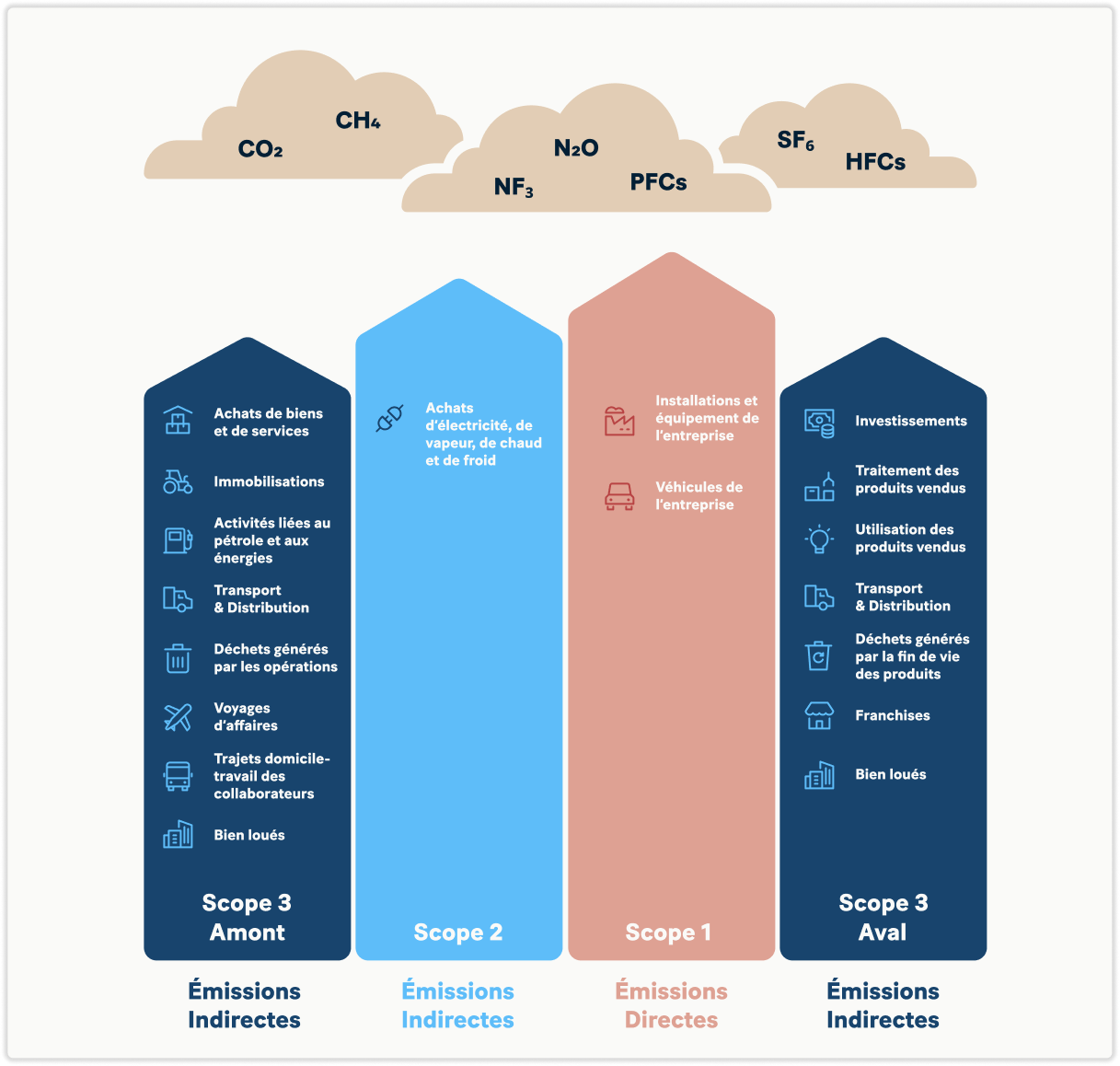
The Scope 3 covers all indirect greenhouse gas emissions of a company, generated across its entire value chain.
It therefore includes emissions…
- upstream: purchases, logistics, business travel
- and downstream: distribution, product use, and end-of-life.
It complements Scope 1 (the company's direct GHG emissions, such as heating premises and vehicle emissions) and Scope 2 (indirect emissions related to purchased energy during the production of a product or service).
Scopes 1, 2 and 3 thus cover all of a company's greenhouse gas emissions.
Scope 3 generally accounts for the majority of a company's total emissions, up to over 98% for some Tennaxia clients.
Even though only Scope 1 and Scope 2 accounting is mandatory under the GHG Protocol methodology, Scope 3 is a major lever in any decarbonization strategy.
The purpose of this article is to guide you through this strategy.
Why are monetary ratios no longer sufficient?
To estimate Scope 3 greenhouse gas emissions, the simplest method is the spend-based or monetary approach.
For many Scope 3 categories, it is difficult to obtain precise physical data (kg of material purchased, km traveled, etc.). However, all companies have accounting data. Monetary ratios therefore allow for a quick estimation based on purchases. They have been very useful in popularizing Scope 3 calculations.
A monetary ratio estimates greenhouse gas emissions based on an amount spent: Estimated Emissions = Expenditure (€) × Monetary Emission Factor (kgCO₂e/€)
For example, if a company spends €100,000 on consulting services and the associated emission factor is 0.05 kgCO₂e/€, then the estimated emissions for this category amount to 5 tCO₂e.
The advantage of these monetary ratios is that they are easy to implement.
But this method quickly shows its limitations.
1- By definition, monetary ratios measure expenditure and not physical reality.
However, the same expense can represent very different realities:
- purchase of €100k of steel produced in a coal-fired blast furnace
- vs. purchase of €100k of steel produced with low-carbon electricity.
The monetary ratio will assign similar emissions, whereas the actual footprint is different.
2- They are sensitive to price fluctuations
In case of a price increase, Scope 3 will mathematically increase, whereas actual emissions remain identical.
3 - They do not reward committed suppliers, nor the tracking of actual reductions
Let's take 2 suppliers:
The monetary ratio will assign the same footprint to both suppliers, without rewarding the one who:
- invests in decarbonization
- uses renewable energy
- or improves its industrial processes
This method therefore obscures what we are trying to measure: the actual decarbonization effort.
This is why the GHG Protocol encourages moving towards supplier-specific data (supplier-specific) for material categories.
The recommendation is to use monetary ratios as a last resort. The preferred order is:
- Supplier-specific data (the most accurate).
- Physical data (kg, km, kWh, etc.).
- And lastly: monetary ratios (€/kgCO₂e or kgCO₂e/€).
CSRD/ESRS, ISSB (IFRS S2), auditors, and rating agencies all currently accept Scope 3 estimates based on monetary ratios, but expect progressive improvement towards primary, traceable, and auditable data.
As for investors, they are primarily focused on the credibility of the procurement decarbonization plan.
To be credible and transform Scope 3 into a tool for value chain decarbonization, everything starts with data collection.
We will now explore this.
Methodology: collecting and validating supplier data
In many cases, the largest portion of Scope 3 emissions comes from purchased goods and services.
You should start by identifying the suppliers accounting for 80% of emissions calculated using the monetary method (Pareto principle): raw materials, industrial components, production subcontracting, and logistics.
For each strategic supplier identified, the goal is to transition from monetary data to physical data:
- quantities of materials purchased in tons or m³,
- actual energy consumption,
- energy mix used in production,
- distances and modes of transport.
These physical data points, multiplied by appropriate emission factors, yield data that is, on average, three times more accurate than with the monetary method.
For suppliers already involved in a carbon accounting process or an SBTi reduction pathway, you can directly collect their Product Carbon Footprint (PCF), which is the verified carbon footprint of their products or services.
Platforms like Tennaxia facilitate the collection of this data with customized questionnaires to centralize, standardize, and ensure the reliability of supplier data, while reducing the administrative burden on both sides.
By integrating them into supplier selection and evaluation criteria (alongside price, quality, and lead times), the collected data will support purchasing decisions.
Thus, a purchasing director who has access to the real carbon profile of their suppliers can make different decisions: accept a higher price from a decarbonized supplier, include carbon progress clauses in contracts, or decide to support a strategic supplier rather than replace them.
This is how Scope 3 ceases to be a reporting exercise and becomes a tool for value chain management.
From calculation to reduction: engaging your supply chain
According to the report published in 2024 by the Carbon Disclosure Project and BCG, a Supplier Engagement Program is one of the most effective levers for reducing Scope 3 emissions.
In this guide, the SBTi recommends a five-step approach:
- Identify the highest-emitting and most strategic suppliers
- Set clear expectations: measure their GHG emissions, establish climate targets, develop a decarbonization roadmap
- Support them with training and resources if needed
- Organize data collection : customized questionnaires, reporting platform. And monitor their progress through reliable indicators and data
- Gradually integrate climate performance into commercial relationships through incentive mechanisms: ESG criteria in tenders, supplier ratings, commercial preferences for committed suppliers, etc.
The central message is that Scope 3 reduction is less about improving calculations than about implementing a sustainable supply chain : transforming the supply chain by encouraging an increasing number of suppliers to adopt emission reduction targets themselves, in line with trajectories aimed at limiting global warming.
However, in practice, buyers have few levers to impose emission reductions on their suppliers.
This is where setting an internal carbon price will be useful to you: it's a tangible way to rationalize the environmental criterion.
The internal carbon price allows for integrating climate into tenders by assigning an economic value to GHG emissions.
Instead of solely comparing offers based on price, quality, and deadlines, you add a fictitious carbon cost that reflects the climate impact of each option.
Thus, a more carbon-intensive offer objectively becomes less competitive, even if its displayed price is lower.
For example, SNCF applied an internal carbon price to rate its suppliers.
This competitiveness mechanism triggers a virtuous cycle by favoring products and services that perform better in terms of GHG emissions. It also helps motivate your strategic suppliers to commit to decarbonizing their processes, using renewable energies, prioritizing recycled materials, and adopting a circular economy, etc.
You co-construct your reduction trajectory by engaging your service providers with you.
From there, this approach reduces exposure to sensitive geographical areas and reliance on fossil fuels while strengthening your relationships with your strategic service providers.
Scope 3 as a lever for value chain resilience.
Scope 3 is therefore much more than just a matter of compliance or reporting.
Mapping and managing Scope 3 means better understanding the dependencies and vulnerabilities of the value chain.
This approach allows for:
- identifying critical dependencies
- anticipating transition risks
- reducing exposure to carbon-intensive resources
- developing suppliers' maturity level
- strengthening ties with strategic providers
- improving transparency and traceability
- preparing the value chain for the consequences of climate change
Thus, Scope 3 is not just a carbon footprint indicator.
It is a major lever for your decarbonization strategy, as well as a risk management and value chain resilience tool.