
.svg)





.webp)


The growing need for information on the environmental impact of companies and the actions they are taking has led to a proliferation of sustainability reporting formats around the world. While commendable, these numerous initiatives do not always promote transparency, preventing stakeholders from having a clear analytical framework and comparing results from one entity to another.
It was based on this observation that the IFRS Foundation, known for its accounting standards, announced the creation of the ISSB (International Sustainability Standards Board), a body tasked with developing an international framework for corporate sustainability reporting, primarily intended for investors and financial market participants.
In a world facing unprecedented environmental and social challenges, the need for concerted action to promote sustainability has become a global priority. In this context, the International Sustainability Standards Board (ISSB) is emerging as a key player in developing global standards to guide companies toward more sustainable and responsible practices.
What is the ISSB (International Sustainability Standards Board)?
The International Sustainability Standards Board (ISSB) is a global initiative aimed at developing sustainability reporting standards to help companies communicate transparently about their sustainability performance. Launched under the aegis of the International Financial Reporting Standards (IFRS) Foundation at COP26 in Glasgow, the ISSB aims to bridge the current gap in sustainability standards and provide clear, consistent guidelines for companies worldwide.
The ISSB has set four main objectives:
- develop a set of standards intended to become the global benchmark for sustainability-related disclosures
- meet the information needs of investors
- enable companies to communicate clearly and comprehensively with financial markets
- foster interoperability between its standards and those specific to certain countries, groups of countries, or stakeholders
The ISSB board is composed of 14 members with diverse expertise and professional backgrounds. Since January 2022, the board has been chaired by Emmanuel Faber, former CEO of Danone.
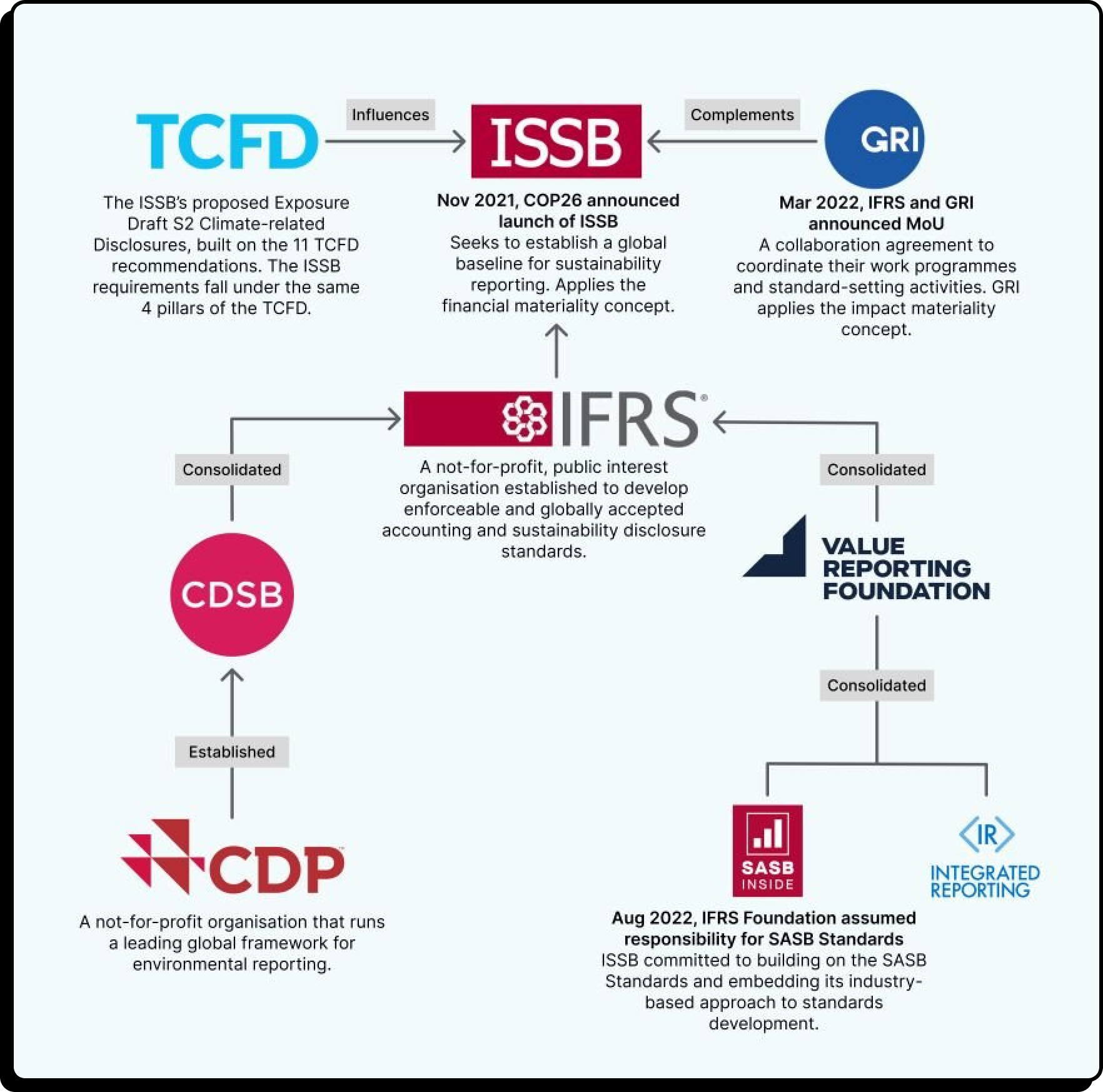
To carry out its mission, the ISSB has built upon work already conducted by various organizations and investor groups, including:
- the Task Force on Climate-related Financial Disclosures (TCFD), a body of the Financial Stability Board
- the Global Reporting Initiative (GRI)
- SASB (Sustainability Accounting Standards Board) standards for industry-specific requirements
- CDSB (Climate Disclosure Standards Board)
- VRF (Value Reporting Foundation)
These last three organizations have since been integrated into the IFRS Foundation as part of the establishment of the ISSB.
ISSB Standards
In June 2023, the ISSB unveiled two sets of standards, IFRS S1 and IFRS S2, which came into effect in January 2024.
New standards are currently under development and are expected to expand the ISSB's scope to include additional ESG indicators.
IFRS S1 - General Requirements for Disclosure of Sustainability-related Financial Information
This IFRS defines the methodology a company must follow to identify and disclose information regarding sustainability-related risks and opportunities affecting its business.
This involves conducting a financial materiality assessment to estimate the impact that sustainability will have on the company's cash flows, access to new financing, or cost of capital over the short, medium, and long term.
Under this IFRS, the company must specify:
- The governance mechanisms, controls, and procedures implemented to monitor, manage, and oversee sustainability-related risks and opportunities
- The strategy adopted to manage these risks and opportunities
- The methodology applied to identify, assess, prioritize, and monitor these risks and opportunities
- The indicators and targets it has defined or is legally required to meet, and its performance to date in achieving these objectives
IFRS S2 - Climate-related Disclosures
Following the same model as IFRS S1, this standard focuses on topics directly related to climate change.
In the same vein, the company must provide an analysis of the potential impact of climate change on its cash flows, access to new financing, or cost of capital over the short, medium, and long term.
This analysis must take into account climate-related risks and opportunities, including both the physical risks to which the company is exposed and the transition risks associated with adapting its operations to the consequences of climate change.
As with IFRS S1, it must specify details regarding:
- Its governance mechanisms
- The strategy adopted to manage climate-related risks and opportunities
- The processes for managing these risks and opportunities
- The chosen indicators and targets, as well as its progress in these areas
Under this IFRS, it must carry out an assessment of its greenhouse gas emissions across Scopes 1, 2, and 3 of its activities, ideally following the method defined by the GHG Protocol. Finally, it must specify its GHG emission reduction targets, the timeline for achieving these objectives, and whether these are absolute or intensity-based targets.
It must also indicate:
- whether the company executive's compensation is linked in any way to the company's climate policy
- whether an internal carbon price has been implemented within the organization, including its amount and how it is applied in the decision-making process
- if it uses or plans to integrate a carbon offsetting mechanism into its strategy, the type of carbon credit involved, and the process for third-party validation of the emission program
SASB industry standards
Building on the work previously conducted by the Sustainability Accounting Standards Board (SASB), the ISSB has integrated industry-specific standards. These standards currently cover 77 business sectors where sustainability-related financial issues are considered significant.
The sectors involved are divided into the following categories:
- Consumer Goods (7 industries)
- Extractives and Minerals Processing (8 industries)
- Financials (7 industries)
- Food and Beverage (8 industries)
- Health Care (6 industries)
- Infrastructure (8 industries)
- Renewable Resources and Alternative Energy (6 industries)
- Resource Transformation (5 industries)
- Services (7 industries)
- Technology and Communications (6 industries)
- Transportation (9 industries)
These standards are designed to meet the needs of investors for both cross-sector and sector-specific information, depending on their level of exposure to sustainability issues. They therefore complement the analyses conducted under IFRS-S.
What is the impact of the ISSB?
While the ISSB primarily targets investors, these international standards have a much broader impact, affecting both companies and their stakeholders.
For investors and financial markets
By striving to develop consistent global standards for sustainability reporting, the ISSB facilitates the comparability and transparency of information disclosed to financial markets.
The related effects are therefore:
- better decision-making by investors
- improved allocation of capital toward sustainable companies or those leading efforts to combat climate change
- the development of new sustainable financial products intended to fund these same companies
For companies
While adopting ISSB standards may involve implementation costs for companies, this approach will prove beneficial in the long run.
The ISSB encourages the integration of environmental, social, and governance (ESG) considerations into business decisions. By integrating sustainability into their governance, these companies will be more resilient to the consequences of climate change and will have the tools to implement an efficient ESG strategy.
By providing clear and reliable information on sustainability performance, the ISSB enables companies to strengthen the trust of investors, consumers, and other stakeholders.
Finally, it is an effective way to stand out in the market against competitors who are less inclined to disclose information on ESG criteria.
For society
ISSB standards contribute directly to the transition toward a more sustainable economy by encouraging companies to take concrete action and investors to fund economic players committed to this process.
They also foster a greater awareness of the environmental and social challenges facing society as a whole.
ISSB and CSRD: differences and commonalities
Despite some divergences, the standards supported by the IFRS on one hand and EFRAG on the other share a common goal and therefore tend to converge in both substance and form. Their main difference concerns the materiality analysis.
Financial materiality vs. double materiality
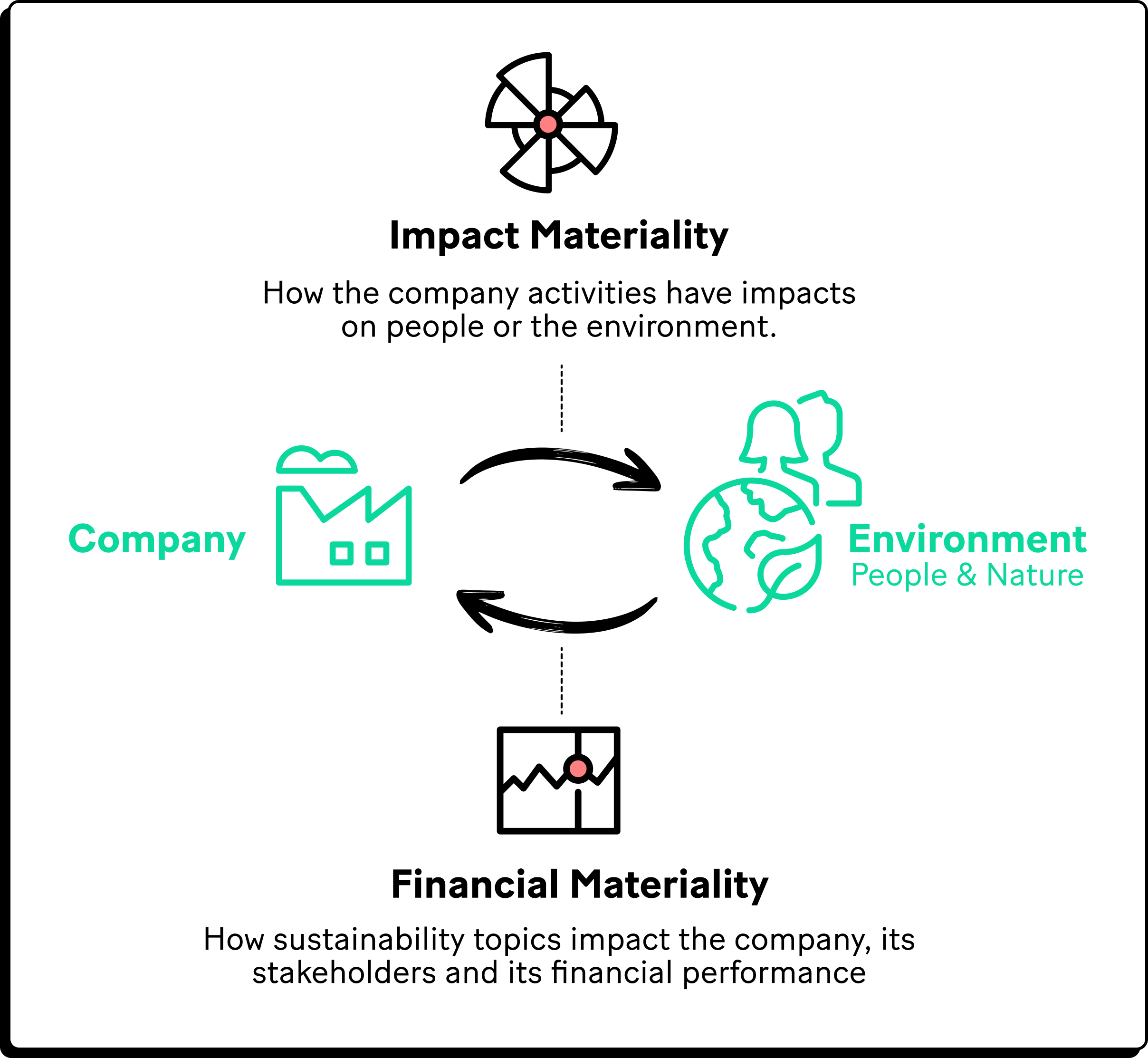
While both frameworks have integrated a materiality analysis as a prerequisite for information disclosure, the ISSB has chosen to focus solely on financial materiality, or single materiality. This involves estimating the impact that climate change will have on a company's operations, with a focus on the resulting financial consequences in terms of risks and opportunities. This approach is frequently criticized, as it implies that economic actors are only capable of acting through the lens of potential financial constraints or opportunities.
In the CSRD, EFRAG has chosen to require companies to conduct a double materialityanalysis. This means incorporating the concept of financial materiality while adding impact materiality. Companies must therefore not only estimate the financial consequences of climate change on their operations but also assess the impact their activities or transition to a sustainable model will have on various ESG indicators. This includes the environment in the broadest sense (greenhouse gas emissions, pollution, biodiversity, water resources, etc.) as well as social and societal dimensions (impact on suppliers, local communities, etc.).
What is the interoperability between ESRS and IFRS-S?
While the definition of "materiality" differs from one reporting standard to another, the CSRD and the ISSB share many points of convergence.
To reduce the risk of double-reporting that some companies might face, EFRAG and the ISSB have worked together to ensure a high degree of interoperability between their two sets of standards.
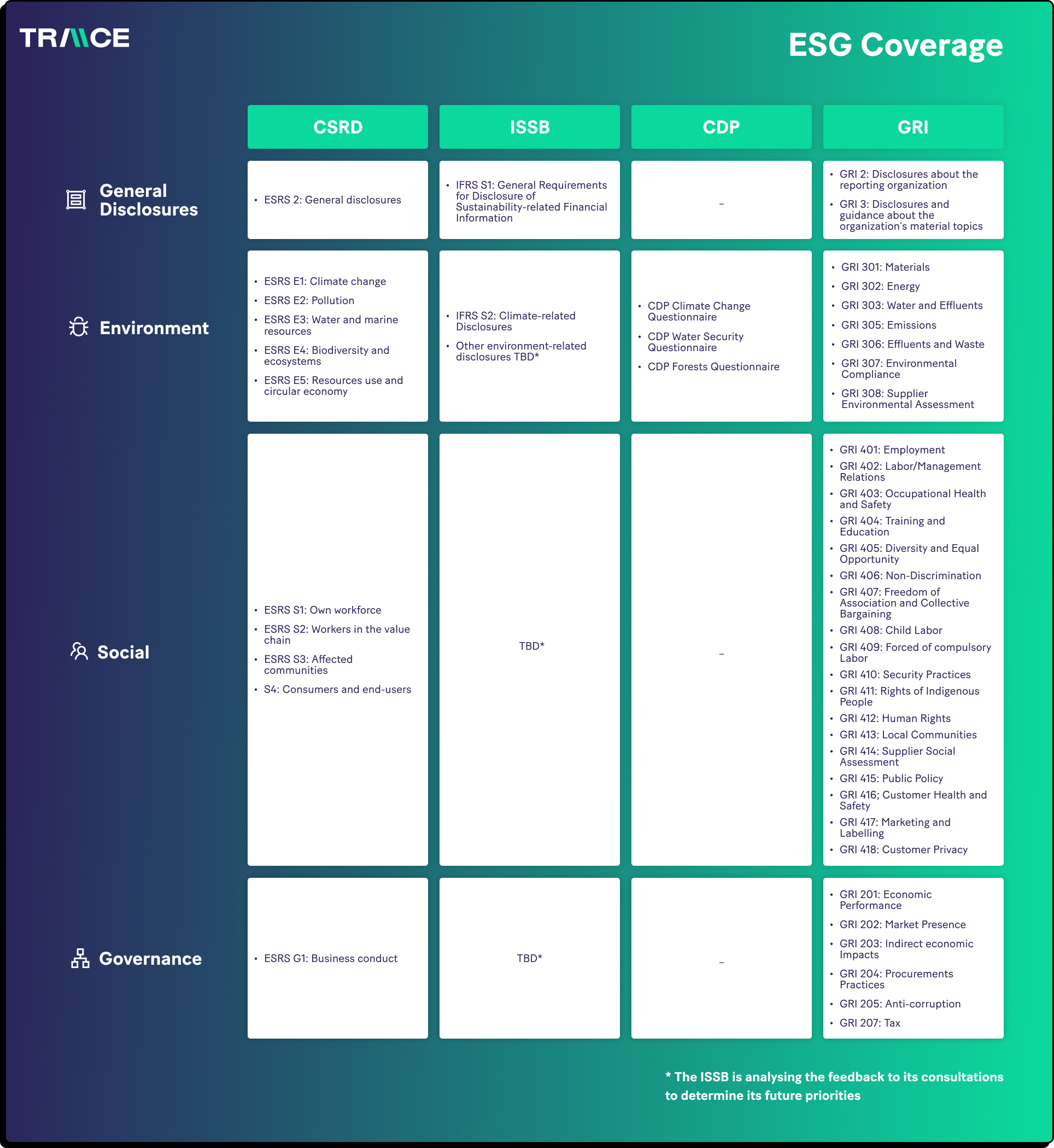
The IFRS-S1 standard shares many commonalities with ESRS 1 and ESRS 2, which correspond to the general criteria of the CSRD.
Regarding IFRS-S2, it should be compared withESRS E1 , which is dedicated to climate change. Most of the data points required under the ISSB are therefore included in CSRD reports.
However, ESRS E1 remains more comprehensive than its ISSB counterpart to date, particularly regarding actions taken to combat global warming, as well as issues related to energy consumption and the energy mix.
Furthermore, unlike IFRS-S2, ESRS E1 does not take into account the carbon credits as a way to achieve greenhouse gas emission reduction targets.
To provide clarity, EFRAG has published a mapping table between the two sustainability reporting standards to identify their points of convergence.
Global adoption of ISSB standards
As the IFRS-S standards were published recently, their rollout is still underway in many countries.
However, these sustainability standards have already been adopted by numerous countries, including the United Kingdom, Brazil, Costa Rica, Sri Lanka, Nigeria, and Turkey.
Other countries are currently conducting consultations with a view to adopting them, such as Canada, Japan, and Singapore.
Conclusion
The ISSB has quickly established itself as a major player in the regulation of sustainability reporting. By aiming to harmonize corporate sustainability disclosure standards worldwide, it will enable companies to demonstrate transparency and take concrete climate action. These standards have the potential to transform financial markets and the global economy.
Currently focused on climate indicators, the IFRS Foundation has indicated that it is working on new standards which, like the CSRD, could apply to other ESG indicators.
It is now up to companies and investors to prepare for the adoption of these standards, which will likely become the benchmark for sustainability reporting in many countries just as the CSRD is within the European Union.
Sources:
- “Double materiality loses the communication battle to Emmanuel Faber’s ISSB”, Anne-Catherine Husson-Traore, Novethic, 07/03/2023
- “IFRS S1 General Requirements for Disclosure of Sustainability-related Financial Information”, IFRS Foundation, June 2023
- “IFRS S2 Climate-related Disclosures”, June 2023
- “ISSB publishes IFRS S1 “General Requirements for Disclosure of Sustainability-related Financial Information””, IAS Plus (Deloitte), 06/26/2023
- “ISSB publishes IFRS S2 “Climate-related Disclosures””, IAS Plus (Deloitte), 06/26/2023
- “The International Sustainability Standards Board (ISSB)”, Julien Catanese Aubier, Compta Online, 06/18/2023
- “SASB: your pathway to ISSB”, SASB Standards
- “CSRD vs. ISSB: the financial-only lens is a mirage”, Fabrice Bonnifet (C3D), L’opinion, 11/06/2023
- “IFRS, ISSB, SASB, VRF: Friends and Family…”, Les Ateliers du Futur, 12/30/2022
- “Emmanuel Faber, Chair of the ISSB”, Séverine Leboucher, L’Actuariel, 07/21/2022