
.svg)




.webp)


Any company that has reflected on its environmental impact has already looked into the carbon credit mechanism.
In the spotlight for several years now, the carbon market has been repeatedly tarnished by scandals, both on the demand side (accusations of greenwashing, incentives to pollute more) and the supply side (unviable projects, weak certification criteria). The positive impact of certain carbon credits, despite being certified, has even been called into question. This is particularly the case for Verra REDD+ carbon credits.
Yet, carbon credits remain one of the pillars of Net Zero, aiming to achieve carbon neutrality on a global scale and supported by recognized organizations such as the SBTi and the Net Zero Initiative. It is therefore difficult today to navigate through all this information.
How do carbon credits actually work? Are they still a viable tool in a decarbonization strategy? Can they be used exclusively?
What is a carbon credit?
A carbon credit is a digital certificate attesting that a company or project developer has reduced or sequestered the equivalent of one tonne of CO2. It is issued by certifying bodies that follow a methodology generally taking into account 5 criteria, which were reaffirmed by France in its Climate and Resilience Law from 2021:
- additionality: the guarantee that emission reductions or offsetting projects are "additional" to what would have occurred under future circumstances, meaning they are complementary to the "baseline scenario" (e.g., preserving a forest that would have been cleared without the implementation of the conservation project)
- measurability: the quantity of CO2 avoided or sequestered must be measurable using a strict methodology
- verifiability: the ability to verify and quantify each year the actual avoidance or sequestration of the tons of CO2 sold as carbon credits. This verification must be carried out by an independent third party.
- permanence: GHG emissions must be sequestered, reduced, or avoided permanently or for a duration long enough to effectively offset the carbon generated upstream
- uniqueness: the guarantee that a certified carbon credit is unique to prevent double counting of credits for the same project.
Voluntary carbon offsetting allows companies, alongside the carbon quota market established by the Kyoto Protocol, toinvest in carbon sequestration projects and thereby reduce, at least on paper, the carbon footprint associated with their operations.
However, the operation of these credits has been subject to abuse, and their reliability is now being called into question.
A controversial practice
More and more companies are offering "carbon neutral" products or services. To understand how they reach this conclusion, it is important to look at the various levers companies have at their disposal to achieve their stated carbon neutrality goals. They can:
- avoid carbon emissions, by modifying all or part of their business or production methods
- reduce their carbon emissions across certain scopes
- offset their emissions by investing in projects that sequester CO2

While efforts are being made across each of these levers, it is inevitably the compensation lever that is currently the most successful, with a real explosion in the number of forest preservation or tree planting projects, particularly in developing countries.
A study by the Columbia Center on Sustainable Development states that 66% of the world's most polluting companies rely primarily on carbon credits to meet their carbon targets.
The solution may indeed seem simple. A company unable to reduce its gas emissions at a given moment has the option to offset them by purchasing carbon credits from companies investing in carbon storage projects. Carbon emissions therefore remain, in theory, in balance.
But is this viable in the long term? Is it not ultimately a stopgap measure that hinders investment in structural changes to their production methods or business models?
Questions regarding project viability
Over the past two years, several research institutes and media outlets have examined projects implemented by companies selling carbon credits as well as the third-party organizations responsible for certifying these credits.
The research conducted has raised several issues that could call into question the viability of these projects and their actual impact on carbon sequestration.
Minimal audits and oversight
The proliferation and scale of these projects make it difficult to effectively monitor their progress over the long term. For instance, journalists from the program Cash Investigation noted that in the context of a forest preservation and planting project in Peru, out of 3,810 plots, only 0.23% were inspected by certification bodies during their last audit.
To date, there are insufficient resources to ensure that projects have been properly implemented and remain viable over time.The criteria for verifiability and permanence are therefore undermined.
Overestimation of risks
If we look at the additionality criterion, it has been noted that some project developers tend to overestimate the risks facing their project sites.
As mentioned, preserving an existing forest can generate carbon credits. However, it must be proven that the forest is genuinely threatened by human activity, natural risks, and so on.
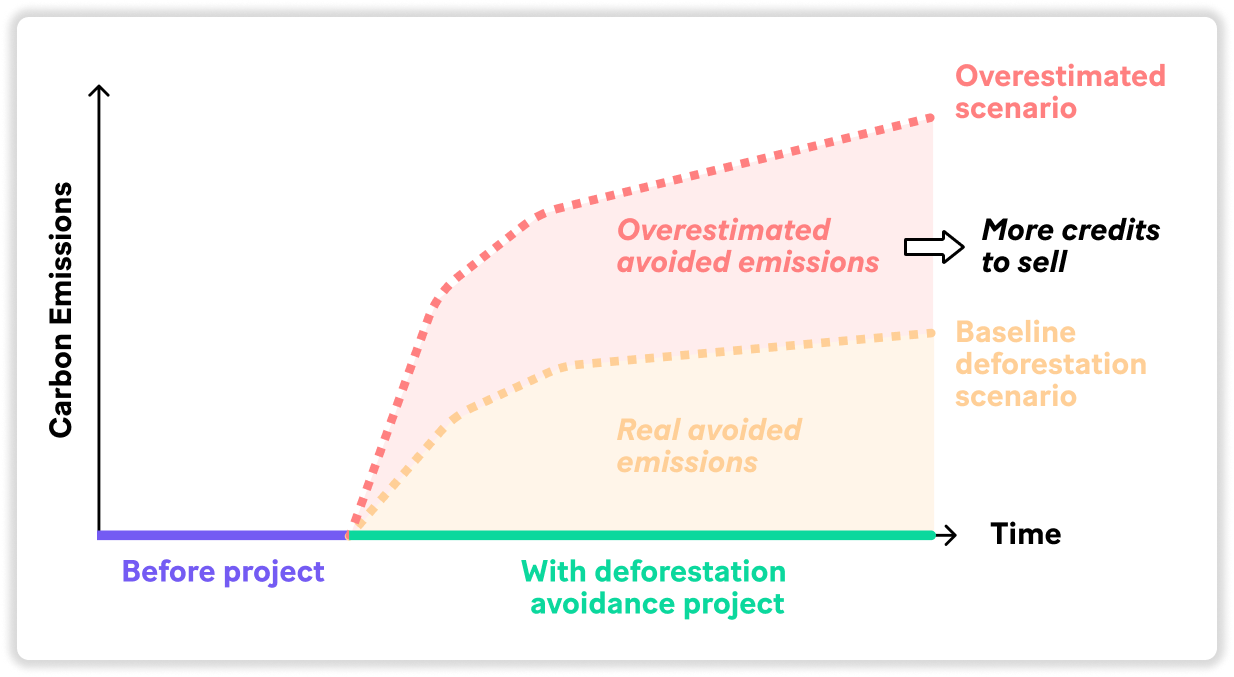
The media outlet Follow the Money for example, confirms that studies conducted prior to the launch of the Kariba project in Zimbabwe tended to overestimate the risks to forested plots, thereby allowing for the generation of more carbon credits.
Similarly, a study on wind farm projects in India showed that 52% of projects certified to issue carbon credits would have been built regardless, with or without the contribution of project developers. In this context, can carbon credits truly be considered legitimate?
Suspected conflicts of interest
Finally, third-party certification bodies are paid based on the number of carbon credits they certify, which raises questions regarding their evaluation criteria and objectivity in the certification process.
A measurement tool turned slogan
The race for carbon credits is primarily driven by the need for companies to meet the expectations of their various stakeholders (customers, investors, employees, etc.), who are increasingly concerned about corporate social responsibility. Companies often seek a solution that allows them to demonstrate their environmental commitment at a lower cost and with less risk.
Purchasing carbon credits allows companies to promote their supposed carbon neutrality. However, this relies primarily on buying credits to offset the greenhouse gas emissions generated by their operations, without those operations having been fundamentally changed or planned to be.
This strategy is harmful. It makes companies dependent on carbon credits, the cost of which is skyrocketing on the carbon market due to surging demand and rising government emission reduction targets. It also exposes companies to stricter legislation and accusations of greenwashing. For instance, since January 1, 2023, a decree in France has prohibited companies from claiming to be "carbon neutral" without being able to justify it according to strict criteria. Relying heavily on the purchase of carbon credits no longer allows them to tout the carbon neutrality of their business.
A mixed impact
Ultimately, the real impact of large-scale carbon sequestration projects is now being called into question. Is this strategy sustainable? Are the criteria used to implement these projects and the methodologies for certifying carbon credits sufficient?
A lack of space
Planting trees and preserving forests undoubtedly contribute to a virtuous cycle, or at the very least, a stated commitment to addressing climate issues. Nevertheless, our economic model has changed little since these issues were first recognized, and consequently, carbon emissions continue to rise year after year.
If companies truly wish to meet their targets, they will quickly face a bottleneck: the availability of land.
Bloomberg reported on January 15, 2021, that there were "only" 500 million hectares left at that time for planting new forests dedicated to carbon capture. Furthermore, these areas are in direct competition with agricultural operations and urban expansion.
Unless we find new, increasingly innovative ways to sequester carbon, a strategy focused on reducing CO2 emissions seems the most sensible approach in the long term.
Sociodemographic consequences
The majority of projects today are carried out in developing countries. Led by project developers or directly by companies, they sometimes have harmful consequences for ecosystems and local populations. Monocultures and land grabbing are issues that have been raised repeatedly.
Some researchers and NGOs are therefore advocating for the inclusion of additional criteria for the issuance of carbon credits. A study conducted by the Ministry of Energy Transition suggests considering additional criteria:
- respect for human rights
- environmental, social, and economic co-benefits
Time for an assessment
Since the Kyoto Protocol and the introduction of carbon credits, it is clear that the program has so far been a failure. Global carbon emissions are neither decreasing nor stagnating; on the contrary, they are rising.
Carbon credits are an ambitious project, yet they suffer from a lack of oversight. Some point to a legislative framework that is still too lenient or certification criteria that are too flexible.
For others, the carbon credit market allows large companies to absolve themselves of their environmental impact by simply offsetting their greenhouse gas emissions through credit purchases, without changing their business models or concerning themselves with the concrete impact of their carbon offset actions.
Finally, the proliferation of marketing campaigns claiming carbon neutrality for certain products and services plays on consumer psychology and distorts consumption patterns.
Rethinking Carbon Credits
At Traace, we believe in the value of carbon credits. They can once again become an effective and virtuous model for supporting companies in their ecological transition and in transforming their production methods.
However, to achieve this, they must be viewed as a tool to support your carbon reduction strategy, not as a quick fix.
A complementary solution
Carbon credits should not be seen as a mere accounting tool for companies to meet their carbon or neutrality targets. As we noted at the beginning of this article, companies have various levers at their disposal to improve their carbon footprint.
These levers should be applied across all of the company's scopes to the best of its ability, prioritizing the elimination of emissions first, followed by reduction in areas where elimination is not feasible in the short or medium term.
Carbon offsetting through certification or the purchase of carbon credits should only be used for what are known as "residual emissions"—those that can neither be eliminated nor reduced.
Furthermore, it is a tool that should be considered temporary. For an emissions reduction strategy to be effective, it must be measurable and objective across the company's Scope 1, 2, and 3 emissions. This means that once an assessment of existing emissions has been completed, reduction targets for the carbon footprint across each scope must be set for a specific period.
As this plan progresses, carbon offsetting will represent an increasingly smaller portion of the company's neutrality or carbon reduction strategy. Only under these conditions can a viable long-term strategy be implemented. It secures the company against changes in the carbon market, but more importantly, it drives structural changes in the company's production methods, its relationships with suppliers and service providers, and the way its products or services are consumed.
A new approach to Net Zero
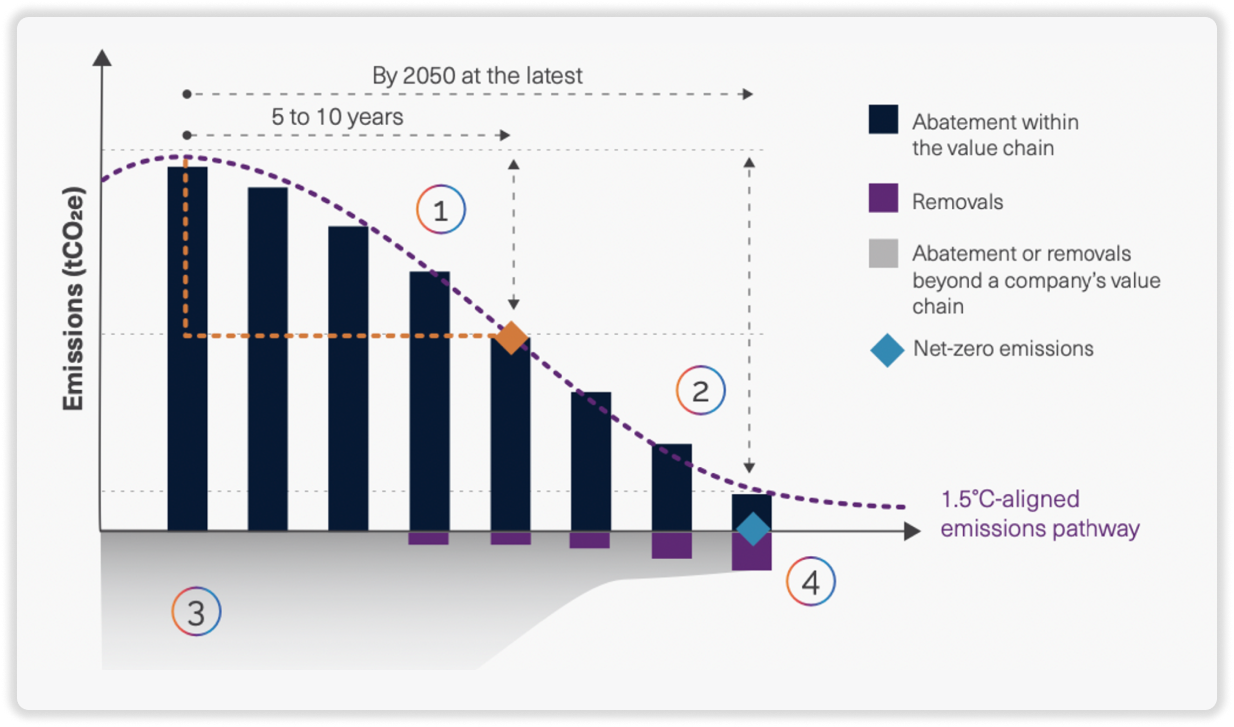
The Net-Zero Standard launched in 2021 by the SBTi aligns with this approach and aims to provide companies with a scientific methodology to concretely reduce GHG emissions.
This methodology operates on two timeframes: short-term goals over 5 to 10 years and long-term goals consistent with scenarios to limit global warming to 1.5°C, in line with the targets set by the 2015 Paris Agreement.
The method involves setting ambitious goals for 5 to 10-year periods that align with long-term objectives. These are reassessed at the end of each period so that, in the event of failure, they can be brought back in line with the long-term targets. By following this method, companies and institutions commit to effectively reducing their GHG emissions based on concrete data and a scientific approach. Residual emissions, which cannot be reduced or avoided to reach this goal, will be the only ones eligible for carbon offsetting projects.
This is also the project led in France by the Net Zero Initiative, launched by Carbone 4, supported by ADEME, and of which Traace is a signatory, aiming to achieve global carbon neutrality by 2050.
These two initiatives therefore provide two key elements:
- Carbon neutrality is a global concept on a planetary scale. Talking about carbon neutrality at the company level is meaningless.
- Priority must be given to emission reduction projects, with carbon offsetting only considered for residual emissions.
Carbon contribution instead of offsetting
At Traace, we encourage companies to stop using the term carbon offsetting and replace it with carbon contribution.
While it may seem like a simple semantic change, it is of great importance. It is no longer about implementing strategies to boast about a reduced or neutral carbon footprint on paper, but rather about moving beyond accounting logic to ensure that actions yield concrete results.
Carbon contribution moves away from the idea of emissions as a zero-sum game. Emissions cannot simply be offset. Carbon contribution requires that emission reduction be considered on a global scale, rather than just at the company level.
Therefore, a company's strategy must actively contribute to the reduction of global greenhouse gas emissions. We believe that only a collective effort will allow us to reach these goals.
It may be less of a marketing hook on paper. In any case, carbon neutrality is currently nothing more than a pipe dream. However, this collective contribution will enable concrete investments, structural changes, and a long-term reduction in carbon emissions worldwide.
Sources:
- “No more greenwashing: the European Union to regulate the use of the term carbon neutrality”, Novethic, 05/24/2023
- “Showcase project by the world’s biggest carbon trader actually resulted in more carbon emissions”, Follow The Money, 01/27/2023
- “Superprofits: multinationals dress in green”, Cash Investigation (France 2), 01/26/2023
- “Carbon markets”, Ministry of Ecological Transition and Territorial Cohesion - Ministry for Energy Transition, 02/10/2023
- “Revealed: more than 90% of rainforest carbon offsets by biggest certifier are worthless, analysis shows”, The Guardian, 01/18/2023
- “Greenwashing: misuse of the ‘carbon neutrality’ label now punishable by law”, Mathilde Golla, Les Echos Entrepreneurs, 01/04/2023
- “Carbon offsets”, John Oliver, Last Week Tonight (HBO), 08/22/2022
- Carbon quotas and carbon credits: what’s the difference?, Carbon Loop, 08/03/2022
- Climate: how the EU carbon market works in 8 questions, Clément Perruche, Les Echos, 06/09/2022
- Carbon Contribution, Aimery Cayol, Terra Terre, 05/20/2022
- Comparative study of existing offsetting standards, I-Care and Ministry for the Energy Transition, 03/22/2022
- Climate and Resilience Law: ecology in our daily lives, Ministry for the Ecological Transition and Territorial Cohesion - Ministry for the Energy Transition, 01/20/2021
- “Too Many Companies Are Banking on Carbon Capture to Reach Net Zero”, Kate Mackenzie, Bloomberg, 01/15/2021
- Voluntary carbon offsetting: 5 best practice rules recommended by ADEME, ADEME, 11/05/2019
- Stop saying "offsetting": From offsetting to contribution, César Dugast, Carbone 4, 07/04/2019
- “Forest tenure, governance & carbon rights”, UN REDD Programme, 07/04/2018
- Net Zero Initiative