
.svg)






Why is the #carbonneutrality hashtag gaining traction?
The number of companies aiming for a carbon-neutral trajectory has doubled in less than a year, highlighting the significance of climate change issues for businesses and investors! But behind these declarations, some of which may be tinged with greenwashing, what does carbon neutrality really mean ?
The goal of carbon neutrality was popularized during the Paris Agreement in 2015, which advocated for "achieving a global peak in greenhouse gas emissions as soon as possible." This is to be achieved through "a balance between anthropogenic emissions by sources and anthropogenic removals by sinks of greenhouse gases in the second half of the century." (Thanks for sticking with it!)
Simply put, carbon neutrality is an equilibrium between greenhouse gas emissions of human origin and their removal from the atmosphere. This concept is fundamental because achieving carbon neutrality by 2050 at the latest is the only probable scenario for limiting global warming to +1.5°C due to the direct correlation between global warming and greenhouse gas emissions (+1.5°C compared to pre-industrial levels (1850-1900 period), which serves as a reference. According to all authoritative scientists, particularly the IPCC).

This is even more crucial because the impacts of global warming on natural and human systems are already visible: heatwaves and related fires, heavy rains and drought threatening ecosystems, etc.
In the meantime, every delay makes achieving this global goal more difficult because carbon emissions accumulate. There is therefore an urgent need to act quickly and decisively. Acting quickly and decisively means first and foremost reducing our carbon emissions: -45% vs 2010 by 2030.
Can businesses "achieve carbon neutrality"?
By definition carbon neutrality can therefore only be measured globally hence the importance of working TOGETHER on common scenarios, with everyone acting at their own level (States, Businesses, Citizens) to achieve these reduction targets, in absolute terms or in intensity (e.g., tons of CO2 per product sold). The overall goal is to ensure that the sum of all these efforts allows us to stay below 1.5°C of global warming. This is the purpose of the SBTi.
(Science Based Target Initiative) and its SBT +1.5°C with sectoral pathways (Sectoral Decarbonization Approach).
These targets are sectoral because this reduction in carbon emissions can only be approached through a "value chain" : a product's carbon footprint being the sum of all emissions generated to manufacture, transport, sell, use, and then destroy it (or, in the best-case scenario, repurpose it in a circular system).
That's why a true corporate carbon footprint includes upstream and downstream emissions. Hence the need to work TOGETHER with its suppliers and customers to achieve its reduction targets
At an organizational level, it's preferable to speak of "contribution to global carbon neutrality" rather than carbon neutrality.
So, how exactly can companies "contribute to carbon neutrality"?
Theoretically, two paths are possible:
1) Reduce emissions from the company's operations
2) Offset emissions through avoided or negative emissions (i.e., by funding carbon capture projects)
At Tennaxia, we focus on reducing carbon emissions – the most certain solution – but we also encourage funding solutions that increase carbon sinks, while highlighting the importance of monitoring them.
1. Reduce emissions from your operations
This is the only truly effective lever for sustainably reducing emissions. It involves measuring your carbon footprint and then reducing your main sources of emissions (for example, replacing fuel oil energy with renewable energy, rethinking procurement – origin, type of materials, food, etc. – or reducing business travel).
This lever must be the fundamental pillar of any carbon neutrality strategy, as it is the only approach that simultaneously allows you to:
a. Limit the accumulation of GHG in the atmosphere
b. Align with the objectives of the Paris Agreement
c. Build a business resilient to climate risks and contribute to a future Carbon Neutral economy
2. Occasionally offset induced emissions through avoided & negative emissions
There are many solutions to combat global warming. In parallel with a reduction strategy, it is possible occasionally to offset induced emissions through so-called "negative" or "avoided" emissions.
2. a. Avoided Emissions
Increasing avoided emissions involves marketing low-carbon products and/or services to replace products (with the same use) that generate more GHGs. Thus, by capturing market share, these low-carbon products help avoid CO2 emissions from more emissive competing solutions (for example, electric motor vehicles vs. internal combustion engines in France).
2. b. Negative Emissions
Negative emissions correspond to the financing of solutions that increase carbon sinks. These solutions, some of which have been the subject of numerous R&D programs for about twenty years, are still uncertain. Their widespread adoption is hindered by numerous constraints:
- High cost relative to the tons of CO2 stored: 100 to 150 euros per ton of CO2 avoided
- The risk of gas leakage due to the presence of faults
- The health risk of acidification of the environments where the gas is injected and contamination of nearby water tables
ADEME estimates that the potential of this solution is limited and that it should only be considered as a "last step in a decarbonization strategy."
3. Adopt a "climate positive" strategy
Ultimately, we therefore recommend adopting a "climate positive" strategy, which is divided into two phases:
i. Define an ambitious carbon neutrality pathway in line with international commitments
ii. In parallel, financially contribute to the development of carbon sinks or CO2 capture/sequestration technologies to offset emissions that could not be reduced. This will minimize its environmental impact during its transition to neutrality.
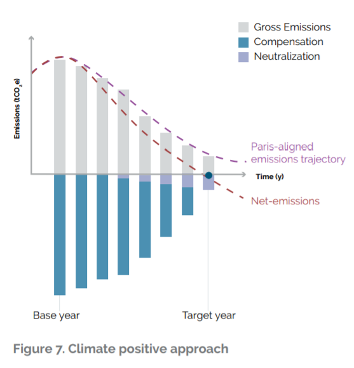
To build this climate strategy and contribute to global carbon neutrality, we therefore recommend:
1. Measure and track emissions
2. Set a carbon pathway and ambitious targets
3. Dynamically manage objectives over time to converge towards neutrality
And of course, Tennaxia can help you with that!
Our "Reduce" module supports you in defining and implementing your decarbonization plans. It allows you to manage your carbon pathway and identify the most relevant action levers for your business directly from our carbon footprint platform.