
.svg)





Global warming is rarely synonymous with good news. The rise in climate-related disasters is a glaring example of this.
So, when good news does arrive, it’s important to share it.
Traace’s primary mission is to empower companies to reduce their emissions and take concrete climate action. With this in mind, we’ve compiled a list of some of the most promising innovative solutions that researchers and entrepreneurs around the world are working on, grounded in scientific knowledge, to try and solve the greatest challenge of our century.
Of course, this doesn't change the fact that the #1 priority remains implementing a carbon trajectory that will allow us to drastically reduce our emissions. But seeing this multitude of climate-focused technological projects multiplying across all sectors of activity is encouraging.
In any case, you’ll see that human beings certainly don't lack creativity!
Climeworks: Filtering the air to capture CO2

Among the technologies receiving the most research effort is the technique known as "CCS," or "Carbon Capture and Storage."
As the name suggests, it involves extracting carbon present in the air. This technology can be applied to various use cases:
- For example, it can be implemented in a coal-fired power plant, where the CO2 generated by combustion is captured before it is released. This is referred to as "post-combustion" CCS.
- You can also "filter" ambient air to recover CO2. This is known as "direct air capture" technology. This is what the Swiss company Climeworks does.
Climeworks has developed a technology (usable both outdoors and in factories) capable of sucking up CO2 by blowing ambient air onto a "filter" and then heating it. The captured CO2 can then be sold to "fertilize" greenhouse plants, produce biofuels, or even carbonate beverages.
Carbfix: Turning CO2 into stone
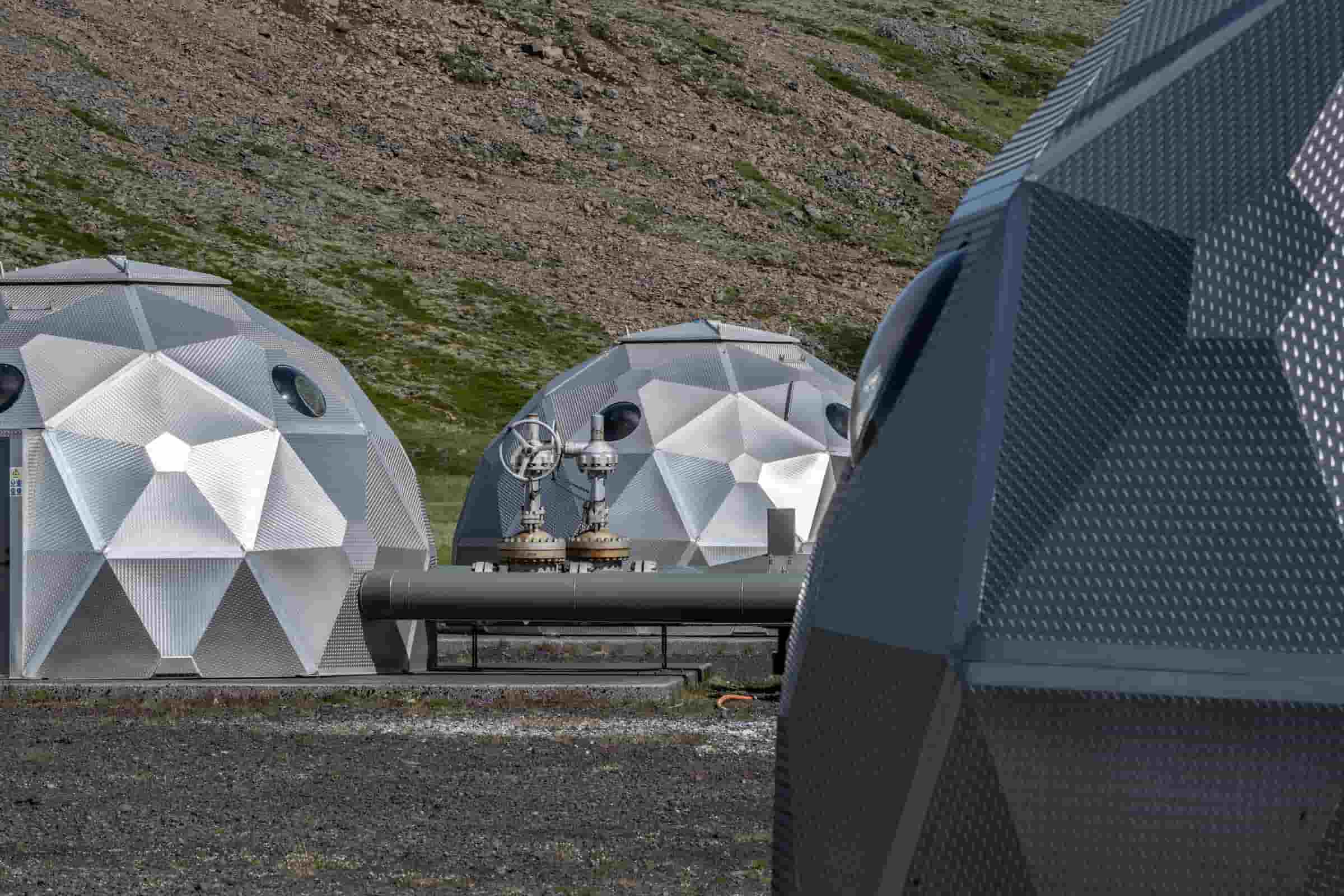
Launched by a team of Icelandic scientists in 2007, Carbfix involves sequestering CO2 by reacting it with basaltic rocks.
Initially developed to reduce GHG (greenhouse gas) emissions from the Hellisheidi power plant in Iceland, the project has since gained international renown as a true breakthrough technology for carbon sequestration. Icelandic, French, and American scientists are now working together on this new technology, which is heavily subsidized by the European Union.
How does it work?
The technology involves capturing carbon dioxide from the Hengill volcano, where the power plant is located.
Pipelines transport the CO2, reduced to a vapor state, to the iconic dome-shaped buildings. It is inside these domes that the carbon dioxide is dissolved in large quantities of water.
The result is a mixture of water and carbon dioxide, which is then injected into the deep basaltic rock. Once mixed with water, the carbon dioxide enters the highly porous structure of the basalt. Finally, through a chemical reaction, the CO2 solidifies into white crystals.
The main drawback to deploying this technology is the process's high water demand. Consequently, the Carbfix team is now working on a water recycling process that could allow the technology to be deployed in countries with more limited water resources than Iceland.
Mootral: Dietary supplements... for cows

With all the talk about carbon dioxide, it is easy to forget that a second gas is heavily involved in climate change: methane. Reducing its emissions is a major challenge for climate action.
Despite its relatively short lifespan in the atmosphere (10 years), methane has a significant impact because its global warming "potential" is 28 times higher than that of CO2. Today, it is primarily emitted by agriculture and waste.
And it is precisely to reduce these methane emissions that Mootral, a Swiss company, has developed a dietary supplement for ruminants.
A product that can effectively reduce a cow's emissions by up to 30% and paves the way for sustainable agribusiness.
Mootral was named one of the 12 most impactful "Climate" startups and has raised nearly €8 million to deploy its solution.
CarbonCure: The company injecting CO2 into concrete

CarbonCure is a company that captures carbon dioxide emissions to create an eco-friendly strengthening agent for concrete.
The process involves injecting liquefied CO2 into a concrete mix, where it reacts with calcium ions and water to produce limestone.
Even better: the strengthening agent increases the concrete's lifespan, which helps offset the additional costs of carbon injection. A first step toward a sustainable construction industry.
Good news for them: they just won the Carbon XPrize Competition, taking home a nice $20M prize to invest in their company...
Note: You might notice their website headline is quite similar to Mootral's... Who copied whom? We may never know.
GHGSat: The satellite monitoring methane emissions

For this final innovation, we return to the topic of methane, but with a perspective that is less down-to-earth than Mootral.
GHGSat is a Quebec-based company that develops satellites capable of detecting methane emissions. Their technology is used by industrial players (Oil & Gas, Waste Management, etc.) to understand and measure the methane emissions linked to their operations.
They are also developing an aircraft sensor capable of detecting methane emissions with one-meter precision!
BONUS: 5 solutions you can apply at home to fight global warming
While the vast majority of GHG emissions are caused by corporate activity, every action counts in the face of the climate emergency, and certain individual efforts can have a significant impact. Here are five concrete solutions and actions to fight global warming that you can implement today to reduce your carbon footprint while inspiring those around you.
Use more renewable energy
Adopting renewable energy at home is more accessible than ever. Installing solar panels or switching to a green energy provider helps reduce reliance on fossil fuels. Even if you cannot produce your own electricity, many providers offer 100% certified renewable plans. A simple administrative step can turn your energy consumption into a lever for the climate.
Start energy-efficient renovations on your home
Reducing energy loss in your home is a sustainable and cost-effective move. Proper thermal insulation, replacing windows, or installing more efficient heating systems, such as a heat pump, can significantly lower your bills and emissions by turning your home into a low-consumption dwelling. Many financial incentives are available for these projects, making the transition more affordable. Every degree gained without overconsumption is a victory for the planet.
Making your mobility more sustainable
In our daily lives, travel accounts for a significant portion of our carbon footprint, and these emissions have been rising sharply for several years. Adopt less polluting modes of transport: prioritize cycling, walking, or public transit for short trips. If you must drive, consider an electric or hybrid vehicle. Finally, reduce air travel, which has a high carbon impact, and opt for the train—a much more environmentally friendly alternative.
Recycle, reuse, and reduce
The circular economy starts at home. Sort your waste to maximize recycling and limit single-use products by choosing sustainable alternatives (reusable water bottles, bags, etc.). Also, get into the habit of repairing before throwing away: torn clothing or faulty electronic devices can often be saved. Reducing your consumption by buying less, but better, is both an ecological and an economic approach.
Switching to a more plant-based diet
Intensive livestock farming and meat production are major sources of greenhouse gas emissions. Reducing your meat consumption, especially beef and lamb, is a powerful climate action. Introduce more vegetarian meals into your week and explore protein-rich alternatives like legumes, tofu, or nuts. In addition to being beneficial for the planet, this diet is better for your health.
That's it! And if you'd like to discover another promising carbon innovation, feel free to browse our site 🙂 Tennaxia offers a solution that allows companies to accurately measure their GHG emissions, identify the best decarbonization levers, implement a solid carbon trajectory, and estimate the associated costs and benefits. A concrete solution for addressing the climate crisis.
What about you? Do you have any innovations in mind that deserve to be shared? Feel free to let us know at contact@tennaxia.com.