
.svg)




.webp)
.webp)


What is GRI (Global Reporting Initiative)?
The History of the Global Reporting Initiative
GRI, or Global Reporting Initiative, is an international organization established in 1997 at the initiative of CERES (Coalition for Environmentally Responsible Economies) and the Tellus Institute, in close collaboration with UNEP, the United Nations Environment Programme.
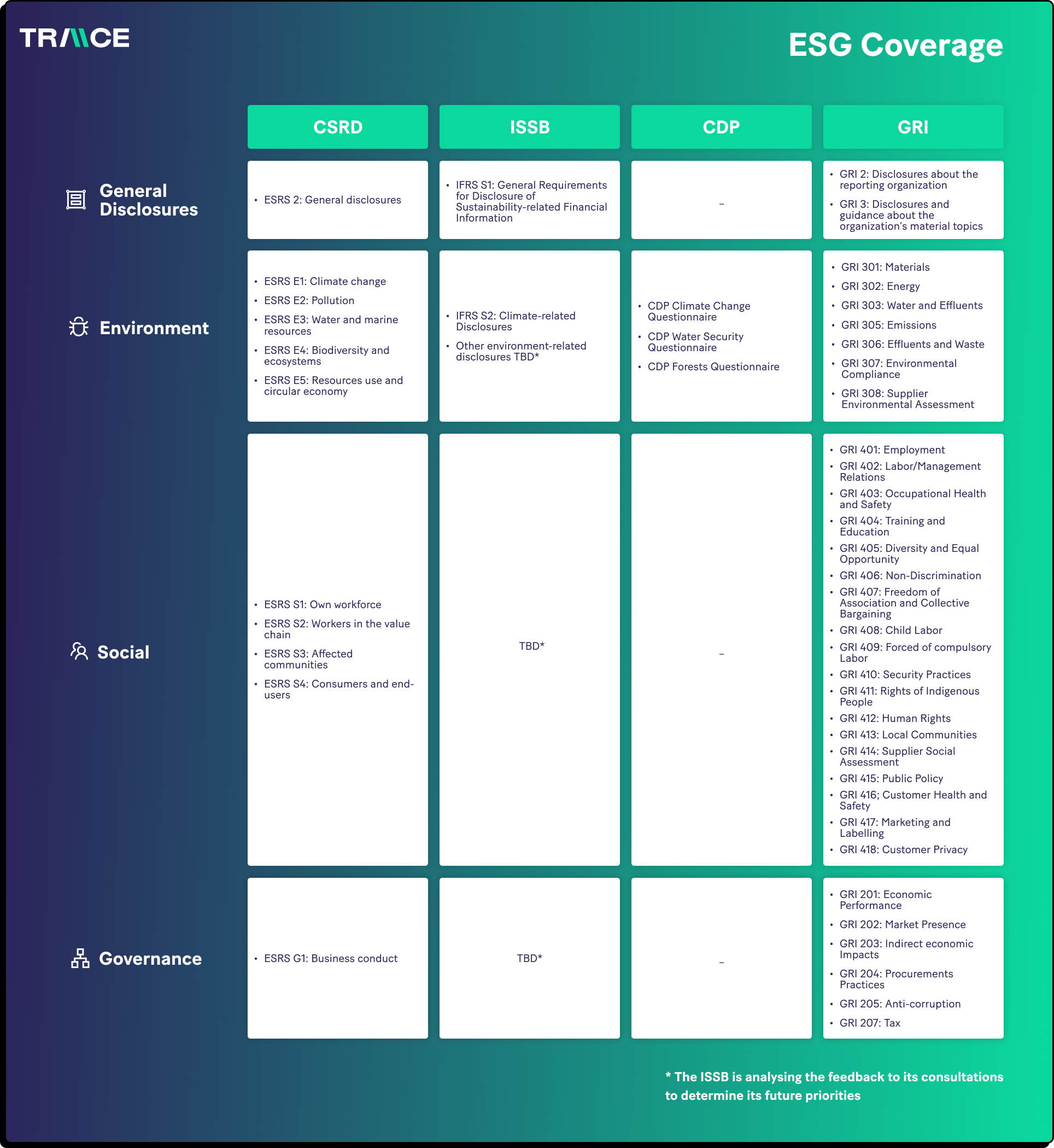
It was the first major global initiative aimed at creating standards for corporate CSR disclosure, which was later followed by the CDP, the European Union with the CSRD or more recently the IFRS S with theISSB which address the specific needs of certain stakeholders.
This framework is currently used by over 10,000 organizations across 100 countries and remains the most widely used non-financial reporting standard globally.
What is GRI's objective?
Like other major non-financial reporting standards, this internationally recognized organization aims to set the framework for corporate CSR reporting standards to facilitate report production and enable better readability and comparability of these reports.
To this end, it developed a list of guidelines and then standards aimed at assisting companies with their ESG reporting. The guidelines it has provided since 2000 became disclosure standards in 2016. They are regularly updated and are based on the United Nations Sustainable Development Goals (SDGs).
The primary aim of the Global Reporting Initiative is to enhance the transparency of organizations regarding environmental, social, and governance matters. Its particularly broad scope makes it one of the most comprehensive standards currently available internationally.
How do GRI Standards work?
GRI reporting is a voluntary procedure that does not require an audit to validate the methodology used and the data disclosed, although such an audit is recommended and is key to having results certified by the Global Reporting Initiative.
The GRI's non-financial reporting standard consists of 3 main sets of standards.
- Universal Standards
- Topic Standards
- Sector Standards

Universal Standards
As their name suggests, Universal Standards apply to all companies that have decided to undertake GRI reporting.
They consist of 3 documents:
- GRI 1: Requirements and Principles for using the GRI Standards
- GRI 2: Information Elements concerning the reporting organization
- GRI 3: Information Elements and Guidance on the organization's relevant topics
The first two provide context to understand the challenges related to reporting, as well as a guide to formalizing its implementation.
The third enables organizations to subsequently identify the impact topics they will need to report on under the topic standards. To do this, they must conduct a materiality analysis.
On this subject, like the CSRD and unlike the ISSB, GRI advocates for double materiality. That is, to identify the topics it will need to report on, the organization must analyze both the impact the subject has on its activities AND the impact its activities have on that subject.
Sector Standards
Sector Standards are specific to certain sectors identified by GRI as requiring particular analysis due to their unique characteristics or the major ESG challenges they face.
GRI has identified 40 priority sectors which will be subject to sector-specific standards. To date, standards have been published for four of them:
- GRI 11: Oil and Gas
- GRI 12: Coal
- GRI 13: Agriculture, Aquaculture and Fishing
- GRI 14: Mining
Two other sets of sector-specific standards are currently being developed and are expected to be published soon:
- Financial Services
- Textiles and Apparel
The Topic-specific Standards
Following the materiality analysis conducted under GRI 3, organizations must define which impact topics concern them and on which they must report within the GRI framework.
The topic-specific standards fall within this framework. They detail the normative framework for each reporting topic.
They are grouped into several categories
- biodiversity (GRI 101)
- economic standards (GRI 201 to 207)
- environmental standards (GRI 301 to 308)
- social standards (GRI 401 to 418)
GHG emissions are integrated into the GRI 305 topic-specific standard and include emissions generated by scopes 1, 2, and 3 in accordance with the definition provided in ISO 14064.
The diversity of these topic-specific standards makes GRI the non-financial reporting standard the most comprehensive to date and the only one, along with CSRD, to address topics beyond the environmental scope.
How are GRI reports structured?
The GRI Reporting Principles
The methodology developed by the Global Reporting Initiative is based on a list of principles considered essential to ensure the transparency and credibility of organizations' non-financial reports. Adherence to these principles establishes the report's legitimacy for stakeholders and facilitates its consultation and understanding.
According to GRI, they “guide the organization to ensure the quality and proper presentation of reported information. High-quality information enables information users to make informed assessments and decisions regarding the organization's impacts and its contribution to sustainable development.”
There are 8 such principles.
- Accuracy
The information provided must be accurate and detailed.
- Balance
Information must be disclosed impartially, without omitting the organization's negative impacts.
- Clarity
Information must be accessible and understandable to all stakeholders.
- Comparability
Information must be presented in such a way that it is comparable over time and comparable to that provided by other organizations.
- Completeness
The information provided must be sufficiently complete to allow for a thorough analysis of the organization's impact during the reporting period.
- Sustainability Context
The organization must frame its reporting within the broadest possible context, considering the potential impact of its activities on the various GRI indicators.
- Timeliness
Information must be disclosed according to a precise schedule, allowing stakeholders to review it before making decisions.
- Verifiability
Information must be recorded and sufficiently complete to allow for quality verification and analysis by third-party organizations.
What is the GRI reporting process?
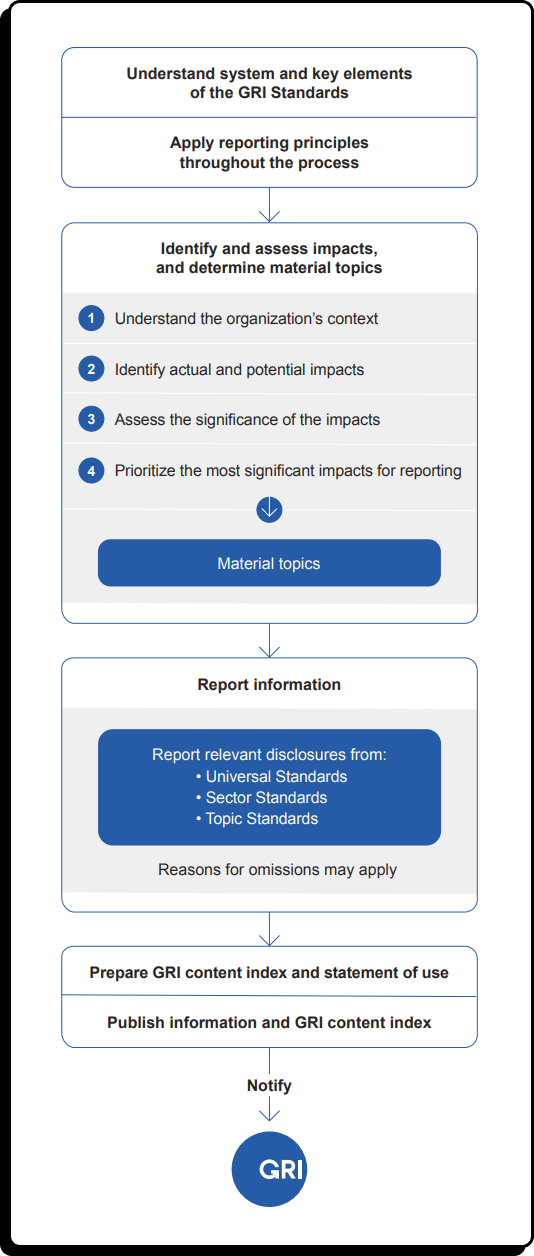
The GRI reporting process comprises 9 key steps that organizations must diligently follow. These steps help to better understand the disclosure framework and identify the most significant impacts for the company.
If these 9 requirements are not met, the organization cannot claim to have prepared its report in accordance with GRI Standards.
- Apply the reporting principles
The company must commit to adhering to the principles set out in GRI 1 throughout the reporting process.
- Communicate general information (GRI 2)
The company must provide the general information required under GRI 2, including details about the organization, the entities covered by the sustainability report, as well as reporting periods and frequencies.
- Identify material topics
The organization must determine its material topics and whether it is directly affected by any of the GRI Sector Standards.
- Communicate on these material topics in GRI3
The organization must detail in GRI3 the process by which it determined its material topics, list them, and indicate how it plans to address them.
- Provide the information requested in the topic-specific standards for each of these material topics
The company must complete the various topic-specific standards by submitting the requested data and state the reasons why it is unable to complete certain data points.
- Provide reasons for omitting requirements and information that the company could not follow or provide
For each data point it was unable to complete, the company must indicate the reason for this omission from 4 categories: not applicable, legal prohibitions, confidentiality constraints, or unavailable or incomplete information.
- Publish a GRI content index
The company must provide an index for its sustainability report to facilitate its reading and understanding by stakeholders.
- Submit a Statement of Use
The company must publish a statement confirming that it has completed and published its sustainability report in accordance with the GRI Standards.
- Notify GRI
The final step is to inform GRI of the use of its sustainability standards and submit the Statement of Use to them.
By following this process, organizations will be able to confirm their report complies with the standards established by GRI.
This process is summarized in the diagram below:
Why use GRI Standards in your sustainability reporting?
The benefits of GRI Standards and Guidelines
GRI Standards enjoy widespread international recognition and are, consequently, used by numerous organizations worldwide. In this regard, they offer several advantages for organizations that have decided to adopt them.
Increased transparency and accountability: Publishing a GRI report demonstrates an organization's commitment to transparency and accountability regarding its environmental, social, and governance impacts. This commitment strengthens stakeholder trust, including customers, investors, and also the company's employees.
Improved ESG performance: The process of drafting a GRI report encourages organizations to evaluate their performance on ESG indicators. This can lead to the identification of areas for improvement and the implementation of corrective measures, ultimately strengthening their resilience to the impacts of climate change and their competitiveness.
International comparison: GRI standards provide a common reporting framework for communicating ESG information, allowing organizations to compare themselves with their international peers and even build a competitive advantage in this area, at a time when companies' ESG performance is closely scrutinized by consumers and investors.
Harmonization with regulatory requirements: GRI standards are increasingly aligned with regulatory requirements for ESG reporting. The process is particularly advanced with the ESRS of the CSRD and the IFRS of the ISSB. This can facilitate organizations' compliance with new regulations and help them avoid the risk of having to produce double reports based on the requirements they are subject to.
Limitations of GRI standards
Despite its many advantages, GRI reporting also has certain limitations.
Voluntary nature: Adherence to GRI standards remains a voluntary process, meaning there is no legal obligation to do so. This can limit the widespread adoption of the standards and encourage organizations to prefer new non-financial reporting standards required by certain countries or blocs, such as the CSRD in the EU or the ISSB.
Costs and resources: The GRI report is particularly comprehensive given the wide variety of topics it covers. Drafting a GRI report can therefore be costly and time-consuming. This need for significant resources can be an obstacle for small organizations.
Complexity: The GRI framework is relatively complex and can be difficult for organizations without sustainability expertise to understand and implement. Once again, this will require the support of additional resources, internal or external, leading to induced costs.
Lack of independent verification: While auditing GRI reports is recommended by the Global Reporting Initiative, there is no independent verification requirement, unlike, for example, with the CSRD. The reliability of the information communicated can therefore be questioned by some stakeholders who will prefer audited reports.
What interoperability with reporting standards?
The emergence of new reporting standards across the world, particularly mandatory standards in certain countries, has prompted GRI to strengthen the interoperability of its standards with these.
While GRI and CDP have long worked on the interoperability of their two standards in shared areas, alignment with ISSB's IFRS is currently underway.
Regarding the CSRD, GRI has stated that a company reporting in accordance with ESRS is deemed to have done so under GRI. This prevents a European company from double reporting in a country where GRI has been made mandatory. A preliminary mapping indicating the correspondences between the data points of each framework has already been published.

Conclusion
In conclusion, the Global Reporting Initiative (GRI) has established itself as an essential framework for non-financial reporting worldwide. GRI standards offer a robust framework for communicating ESG information and can help organizations improve their sustainability performance.
GRI remains a valuable tool for companies seeking to demonstrate their commitment to sustainable development and meet stakeholder expectations. Its use helps strengthen the credibility of ESG reports and promote more sustainable practices globally.
The recent emergence of new mandatory reporting formats in some countries could potentially compete with it, but the strong interoperability of GRI standards with these formats allows it to maintain its appeal.
Sources:
- “Global Reporting Initiative (GRI): Application of Standards in Business”, Big Média (BPI France), 14/05/2024
- “GRI-ESRS Interoperability Index”, Global Reporting Initiative, 30/11/2023
- “Interoperability between ESRS and GRI Standards - EFRAG-GRI JOINT STATEMENT OF INTEROPERABILITY”, EFRAG, 23/08/2023
- “Global Reporting Initiative (GRI): Definition, Indicators, Guidelines”, Youmatter, 31/10/2016
- “GRI standards by language”, Global Reporting Initiative
- “Linking GRI reporting to other requirements”, Global Reporting Initiative
- “GRI – Global Reporting Initiative”, IAS Plus (Deloitte)