
.svg)





.webp)


🔎 Key takeaways
The CDP, or Carbon Disclosure Project, is an international organization well-known to carbon and CSR professionals. It is a benchmark for climate change action and corporate environmental performance reporting.
Operating on a system similar to a rating agency, it evaluates thousands of companies, cities, and regions based on their level of transparency regarding environmental data and their commitment to reducing their carbon footprint and, more broadly, their impact on the climate, water resources, and deforestation.
It also supports all these organizations in their ecological transition by providing the tools to implement a sustainable and effective development strategy.
What is the Carbon Disclosure Project (CDP)?
The CDP, formerly known as the Carbon Disclosure Project, is a non-profit organization founded in the UK in 2000 that shares the same philosophy as the GRI. To date, it holds the world's largest database of corporate and municipal environmental reporting, whereas the GRI focuses on states and international organizations.
It has an official presence or partners in over 50 countries worldwide. For its European operations, its headquarters are in Berlin, but it also has offices in London, Brussels, and Stockholm.
The CDP enables companies and institutions to publicly disclose information about their environmental performance. More than 18,700 companies worldwide, including 5,800 in Europe, currently report through the CDP on their environmental impacts and their involvement in climate change, water security, and forest preservation.
This is also the case for more than 1,100 cities, states, and regions, including 150 in Europe.
The CDP conducts its reporting through questionnaires completed annually by participating companies, cities, regions, and states. These non-financial reports have evolved over time and currently cover three major areas of expertise: climate, water resources, and forests.
- 2003: the CDP begins its operations by collecting data on corporate GHG emissions
- 2010: CDP expanded its scope of analysis by adding information related to water resource management. It also supplemented its GHG survey with the addition of an "Oil and Gas" module.
- 2013: CDP continued to broaden the topics covered by its surveys by adding a new analysis regarding the impact of companies on deforestation.
- 2016: CDP modified its scoring system by relying on the “Level of Engagement Score” instead of the “Climate Performance band” and the “Climate Disclosure Score”.
A data collection campaign is launched every year through the distribution of questionnaires. It serves to populate the CDP database. This database is primarily used by two types of organizations:
- Investors: CDP enables financial market participants to obtain information on companies and their level of engagement with environmental issues. To date, CDP has been requested by 746 financial institutions managing an asset portfolio estimated at over $136 billion.
- Purchasers: Companies use the CDP reporting database to learn about their suppliers. Today, more than 280 purchasers, representing a combined purchasing power of $6.4 billion, have requested that their suppliers complete CDP reporting.
CDP's Areas of Focus
As mentioned previously, CDP reports currently focus on three main themes: climate change, water resources, and deforestation.
Climate change
Based on historical analysis conducted by CDP, corporate climate impact is examined from various angles, the most significant being the greenhouse gas emissions generated by companies.
The questionnaire sent to companies, the most comprehensive of the three, addresses issues of corporate governance, methodologies for accounting for greenhouse gas emissions, the types and quantities of energy consumed in their operations, and actions taken to reduce their carbon footprint.
Sectors identified as the highest emitters must also respond to additional sector-specific questions.
Water resources
Faced with a water crisis that is accelerating year after year due to our consumption patterns and the direct effects of climate change, CDP decided in 2010 to integrate a survey on these topics into its annual reports.
It highlights that only 1.2% of the water on the planet is usable by humans and that, according to the United Nations, water supply is at risk of falling by 40% by 2030.
CDP’s mission is therefore not only to focus on the most water-intensive business sectors but also to propose alternatives and support them in changing their production methods.
Deforestation
The survey on corporate impact on forests was launched by CDP in 2013. Recognizing the crucial role of forest ecosystems in the natural balance (carbon emission regulation, biodiversity, water supply), CDP decided to analyze the impact of companies on forests and their dependence on these ecosystems.
Today, the primary cause of deforestation is agriculture, through the conversion of forest land into farmland. It is therefore logical that CDP first focused its attention on these sectors, looking at a few key agricultural products that are the main drivers of deforestation.
They have since expanded this analysis to all ecosystems and will soon publish reports on the impact of companies on these ecosystems and their initiatives aimed at restoring them or, at the very least, reducing this impact.
What is the CDP questionnaire?
Each year, CDP provides new questionnaires that companies can complete online. Once completed, these questionnaires are evaluated by partners trained by the Carbon Disclosure Project.
Companies are not required to answer all three questionnaires. They may respond to one or another depending on their business sector or the requests of their investors or clients.
As part of the climate change questionnaire, CDP has implemented a classification system, the CDP-ACS, which categorizes companies according to their business sector and assigns them the sector-specific questionnaires best suited to their profile. The goal of this sector-based approach is to identify the primary activities of each organization to better understand the risks and opportunities they face and what their environmental impact may be.
The CDP-ACS is a three-level classification system focusing on the business sector, then the activity group, and finally the specific activity. For a company to be subject to a specific sector questionnaire, the relevant activity must account for at least 20% of its revenue.
The generic climate change questionnaire consists of 15 modules:
- Governance
- Risks and opportunities
- Business strategy
- Objectives and performance
- Collection methodology
- Carbon data
- Energy
- Supplementary data
- Verification
- Carbon pricing
- Commitments
- Biodiversity
Companies will then be evaluated based on the responses provided in these questionnaires. Sector-specific questionnaires are primarily used to account for the nuances inherent to certain industries during this assessment.
Reports may then be released publicly or remain confidential and be shared with stakeholders upon explicit request.
CDP score: the different performance levels
At the end of their assessment, companies receive a score from A to D, which evaluates their environmental performance as well as their level of commitment to a strategy for reducing their environmental impact.
A final grade, F, is assigned to organizations that have not provided sufficient environmental information (in terms of quantity or data quality) to establish a performance score.
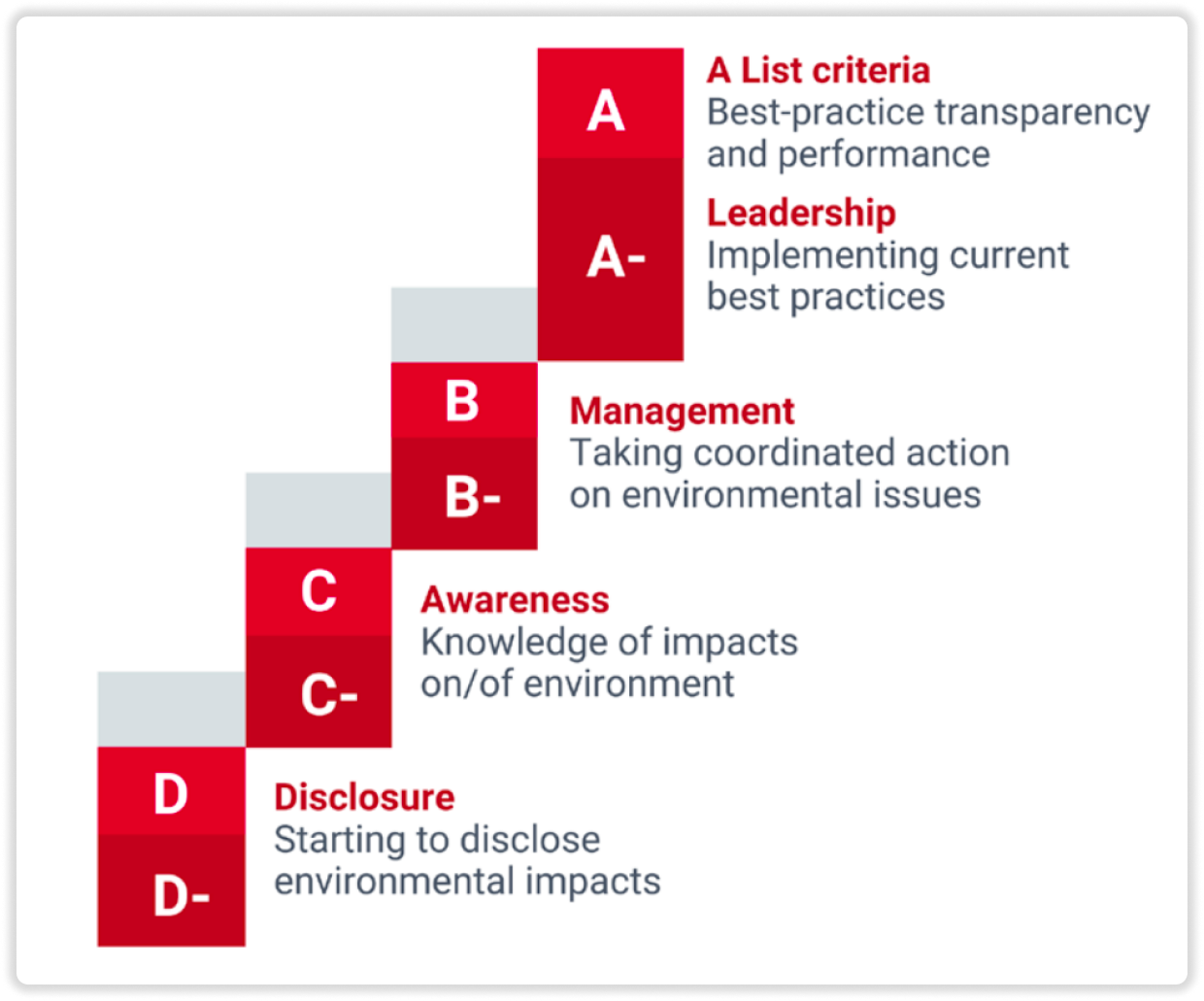
A - Leadership: Organizations demonstrate transparency in reporting their information regarding climate change, deforestation, and/or water management. They have already demonstrated best practices and have implemented a strategy to reduce their environmental impact with clear, science-based targets (SBTi) and a corresponding action plan across all their operations and value chains.
B - Management: Organizations have acknowledged the environmental impact of their activities and have implemented initial strategies and/or initiatives to reduce it. However, they lack clear or sufficiently ambitious objectives to be considered leaders.
C - Knowledge: Organizations are aware of the impact of their activities on climate change, deforestation, and/or water resources, but have not yet integrated this into their corporate strategy.
D - Disclosure: Organizations demonstrate transparency by disclosing their activity data and environmental impact, but have not taken any concrete measures or initiated any steps beyond responding to the CDP questionnaire.
For a company to be rated at the A level, it must reach at least this level in one of the three questionnaires. In 2022, more than 330 companies, including 147 European ones, received an A rating from the CDP, out of a total of more than 15,000 respondents. The high proportion of European companies in these results also rewards the European Union's efforts in environmental policy.
Why is the CDP essential for companies?
The CDP is an organization renowned for its rigor, and its expertise is now recognized internationally. Its score influences many stakeholders, and reaching the highest level is the "holy grail" for companies that submit to its annual questionnaires. A high score is synonymous with winning more contracts with clients and building better relationships with potential investors.
1. To anticipate regulatory constraints
Responding to CDP surveys allows companies to comply with the new green regulations emerging around the world. It also enables companies to anticipate the tightening of these regulations by better preparing their reporting, as well as by taking structural action on their business models and production methods to sustainably reduce their environmental impact while rethinking their relationships with the various stakeholders in their value chain.
For example, it is difficult today not to see a link between the new European regulation CSRD and how CDP surveys work. There will inevitably be synergies in environmental data collection processes and the actions to be implemented, as CDP scoring and CSRD reporting share common goals, such as the financial appeal of environmentally virtuous companies and the requirement for transparency.
2. To strengthen financial appeal
One of the main objectives companies aim for when responding to CDP surveys is to increase their financial appeal. More and more investors are scrutinizing companies' CDP scores before finalizing their investment strategies. It has even become a must-have for many of them.
CDP has also provided investors with a tool, Climetrics, which allows them to identify funds that best support companies virtuous in terms of information transparency and environmental impact.
Climetrics assigns a rating from 1 to 5 to investment funds based on their environmental performance. The tool evaluates thousands of companies according to their impact and then assigns ratings to funds based on the weighted average of their holdings.
Much like the European Green Deal, which aims to redirect investments toward companies actively contributing to the 2050 net-zero goal via the SFDR and the green taxonomy, CDP provides financial players with the information they need to make informed decisions as part of their investment strategy. Companies wishing to benefit from these investments therefore have every interest in being transparent and taking action to reduce their CO2 emissions and environmental impact.
3. To improve brand image
A final, and by no means least, advantage is the improvement of a company's brand image. Corporate transparency and consideration for CSR-related topics, particularly climate, are increasingly scrutinized by a company's various stakeholders : clients, consumers, buyers, investors, and more.
It is also an opportunity for the company to highlight the efforts it is making to manage and reduce its environmental impact.
Finally, beyond the CDP scores requested directly by stakeholders, it is also an opportunity for the company to attract new clients and investors by communicating its commitments.
How can you improve your CDP score?
Many companies begin their CDP survey with apprehension, fearing the possibility of receiving a low score and the negative consequences it could have on their business. Others simply prefer to opt out when they have the choice.
The first thing you need to tell yourself is thatwith the tightening of environmental regulations, it is highly likely that this is an exercise you will have to undertake sooner or later, whether through the CDP or another framework like the CSRD.
Furthermore, participating in CDP surveys will, in any case, highlight your transparency—a quality highly valued by investors. It is also an opportunity to benefit from CDP’s guidance and support as you embark on a genuine ecological transition policy.
Finally, remember that your CDP score also depends on the transparency of your approach. Providing complete, high-quality data will have an immediate impact on your score. Certain methods will help you simplify the questionnaire process and improve your CDP score.
1. Carbon footprint
The climate change questionnaire is the most comprehensive and complex of the three generic CDP questionnaires.
By conducting a carbon footprint assessment, you will already have the key data needed to answer many of the environmental questions in this Carbon Disclosure Project questionnaire. The more complete your carbon footprint—covering scopes 1, 2, and 3—and the higher its quality, by prioritizing physical data over monetary estimates, the more you will improve your CDP score. While GHG emission quantities are taken into account, the company's methodology and commitment are also important criteria.
2. Follow an SBTi approach
Conducting a corporate carbon footprint assessment is a first step. The next stage is to set targets for reducing your greenhouse gas emissions and to establish an action plan with a clearly defined timeline.
CDP is a partner of the Science Based Targets initiative (SBTi), which aims to implement corporate decarbonization plans that are scientifically sound and aligned with the goals set by the Paris Agreement. This is a recognized and highly valued method that allows a company to demonstrate its commitment to substantially reducing global GHG emissions.
3. Effectively manage your data collection
Data collection is a complex task. The data required to complete CDP questionnaires can be difficult to access depending on your structure, sector, and organization; it is scattered throughout your value chain and exists in a wide variety of formats with highly variable levels of quality.
Collection is therefore a task that requires the involvement of all stakeholders in your company and should be managed by a dedicated person who will centralize information and track your action plan. This is usually the role of a CSR manager.
Relying on a dedicated tool is often the best solution. It will allow you to simplify collection from various stakeholders, process the data, and implement an impact reduction plan while accounting for the many variables involved.
To assist you in this task, CDP provides a list of solutions it has accredited to support you in your ecological transition.
What is a CDP-accredited solution?
CDP has identified and accredited a list of solution and service providers capable of supporting companies participating in their surveys with their ecological transition plans, such as calculating their carbon footprint or implementing emission reduction actions.
The goal is to enable these companies to benefit from the best support to conduct a high-quality analysis of their environmental impact and to initiate actions that will substantially reduce that impact.
To be included on this list of providers, various criteria are taken into account, including specific security requirements. The provider must also collect 6 client testimonials, including at least 3 from large companies and 3 from companies that already respond to CDP questionnaires annually.
These companies must then provide the CDP with information regarding the type of service provided, its quality, its value for money, its ROI, and finally, its level of recommendation.
The carbon footprint platform from Tennaxia is part of the list of CDP-accredited providers in 6 categories:
- Greenhouse Gas Emissions Inventory
- Data Collection & Software Services
- Environmental Target Setting
- Scenario Analysis
- Scope 3 Services
- Sustainability communication
Conclusion
Participating in CDP surveys is certainly time-consuming, but it offers numerous benefits. The growing interest in CDP scores among investors and buyers means you will likely have to participate sooner or later as you grow. It is therefore better to prepare and anticipate this process rather than responding under pressure.
European companies have an advantage in this race. Regulations implemented under the European Green Deal, particularly the CSRD, already require thousands of companies to conduct a carbon footprint assessment and analyze the environmental impact of their operations. They already possess most of the data needed to complete CDP questionnaires and are currently in a favorable position to implement an ecological transition strategy.
Sources:
- “CDP Scoring Introduction 2023”, CDP, 03/16/2023
- “CDP: Revealing environmental risks to reduce them”, Orygeen
- “CDP”, Novethic
- “CDP’s Activity Classification System (CDP-ACS)”, CDP
- “The A list 2022”, CDP