
.svg)






Climate strategy is no longer an isolated concept within companies, managed by a team with no decision-making power. It has become a major priority. A priority in the face of pressure from stakeholders. A priority in the face of regulatory pressure. A priority due to the risks that global warming poses to business operations.
There is no point in burying our heads in the sand. Every company will, at some point, need to embark on defining and deploying a climate strategy.
It is now up to them to decide whether they want to be reactive to their transition or proactive. To treat it as a constraint or as a strength.
Most economic players are well aware of the urgency and have already implemented a climate strategy. Yet the goals they set, however laudable, are rarely met.
It is not that companies lack ambition. Goals are often set based on criteria established by third-party organizations or international agreements. However, these strategies suffer from several shortcomings. This may be a mismatch between the set objectives and the company's business priorities. It can also be a problem of resource allocation, which may be insufficient or poorly optimized.
For a climate strategy to be actionable, it can and must address business challenges. It must be built and managed in such a way that it allows the company to make it one of the pillars of its current and future development.
Why develop a corporate climate strategy?
Transitioning your development model is expensive.
That is indeed often the case. Nevertheless, in a rapidly changing world, it is inevitable. But a climate strategy should not be viewed as a cost. It is, first and foremost, an investment.
An investment that brings concrete benefits to the company and will allow it to consolidate its model and endure over time. By making it more resilient to climate change. By identifying new business opportunities. By building a genuine competitive advantage.
Improved access to financing
Financial market participants are increasingly taking companies' environmental policies into account in their investment strategies. This phenomenon is amplified by numerous standards and regulations aimed at increasing corporate transparency regarding financial and non-financial reporting, as well as the transparency of fund manager portfolios.
Within the European Union, this is the case with the SFDR and the green taxonomy. Both regulations aim to better allocate financial resources by redirecting them toward companies and activities with a positive environmental impact. These regulations are key components of the European Green Deal and are intended to help finance the European Union's transition by 2050.
Regarding international standards, the score established by the CDP is one of the elements regularly requested and scrutinized by international investors. It assesses a company's level of environmental commitment in the broadest sense and the credibility of its climate strategy.
TheISSB , a series of international non-financial reporting standards, was specifically created to meet investor needs for transparency regarding corporate environmental policies. It is now considered a benchmark for non-financial reporting in many countries around the world.
The goal is not only to support ambitious companies that have made strong commitments and are following through on them, but also to estimate their ability to adapt to global warming and their resilience to the economic changes this will entail.
New business opportunities
Investors are not the only ones taking corporate climate strategy into account.
Public and private tenders are increasingly incorporating selection criteria related to companies' climate commitments. These criteria take various forms, from simply conducting a GHG emissions assessment to making a concrete commitment to reducing one's carbon footprint. Others, such as the SNCF, implement a price per ton of emitted carbon that is added to the final commercial proposal, thereby transforming this non-financial data into financial data.
Among the CSR criteria regularly requested in tenders today, we find:
- commitments made by the brand ( SBTitrajectory, CDPscore, etc.)
- climate impact (carbon footprint covering scopes 1 to 3 at a minimum)
- capacity to adapt to climate change and the action plan
- the resources allocated to the action plan (human and financial)
- governance: integrating CSR issues into the governance process and steering the action plan
Committing to a climate strategy allows you to anticipate these demands, create new business opportunities, and even gain a genuine competitive advantage.
Factoring environmental criteria into contract awards is a trend that will only grow over time. Companies, particularly large corporations, are subject to increasingly strict climate reporting regulations, starting with the CSRD within the European Union. At the same time, they will need to reduce their impact by following clear objectives and a precise timeline. However, according to the CDP, on average, 75% of a company's emissions come from its Scope 3. To reduce them, they will therefore need to increase pressure on their suppliers and service providers. The goal is to create a snowball effect that will push all economic players to take climate action by leading their own corporate transformation plans.
A model adapted to market changes
According to a study conducted by Ipsos for the European Commission, in 2022, 56% of consumers in the European Union take environmental factors into account when purchasing products or services. In fact, 20% consider these types of criteria for all of their purchases.
Some sectors are more affected than others by these new requirements, starting with the automotive industry, known for being one of the largest emitters of greenhouse gases.
Growing awareness of climate issues is accompanied by new consumer demands and structural behavioral shifts in consumption habits. Increasingly, companies are becoming targets of lobbying or boycott campaigns related to the climate impact of their activities, across all sectors (agrifood, textiles, transport, tourism, etc.).
Added to this are new national and European regulations that limit the ability of companies to engage in greenwashing.
To meet these requirements and address the climate challenge, companies must often innovate and fundamentally rethink their production and distribution models. This is an opportunity to make a transition that will only benefit them by allowing them to build a new competitive advantage and adapt to a new economic environment. Finding solutions that allow them to meet their customers' needs is the best way to ensure their long-term viability.
How do you develop a climate strategy?
Implementing a corporate climate action plan requires following key steps to structure your strategy and set achievable goals, ideally based on scientific foundations as proposed by the SBTi method.
Measure your carbon footprint
The first phase obviously consists of assessing your current carbon footprint. This primarily involves collecting data across your entire value chain, known as scopes 1, 2, and 3. An emission factor will be applied to each piece of collected data to estimate the amount of greenhouse gases emitted for each data point and convert them into carbon equivalents. An uncertainty factor will also help estimate the reliability level of the measurement.
This exercise requires a rigorous approach because it can quickly become complex, especially the first time. Data often numbers in the thousands and is spread across all your production sites, departments, and stakeholders (suppliers, service providers, etc.).
Using an Excel file quickly reaches its limits, especially when implementing a climate strategy aimed at comparing data year over year and reducing it. It is therefore highly recommended to rely on tools that facilitate both data collection and processing.
Develop an action plan to reduce your carbon footprint
Once your GHG emissions have been measured, you need to analyze this data to identify your main sources of emissions and those where you have the most room for maneuver in order to determine your primary areas of action.
This initial analysis will allow you to set goals, a timeline, and a budget. Some actions can have quick effects with simple solutions, while others require efforts over several years. It is therefore essential to establish a schedule and identify the people responsible for the operational implementation of your climate plan across your various GHG emission sources.
As mentioned above, for many companies, the vast majority of their emissions come from their scope 3, i.e., their upstream and downstream value chain. Reducing your GHG footprint will therefore, in this case, require discussions with your suppliers and service providers to find ways to reduce the carbon impact of their activities. This can, of course, involve changing providers.
Track the results of your actions and adjust your climate strategy
The final step of your corporate climate strategy is, of course, to track the results of your actions and adjust your plan as it progresses.
In an ideal world, your emissions would follow your action plan perfectly. In reality, a company's activity is inevitably subject to a large number of internal and external factors that will necessarily impact your carbon footprint and require continuous adjustments. This could involve the acquisition of a new entity, changes in the raw materials market, or cost fluctuations that will impact your investment plans.
A dashboard system will simplify the task by allowing you to track your action plan granularly over several years and adjust your actions to help achieve the set goals, both in terms of operations and the Capex and Opex required to carry out your roadmap.
Can a climate strategy be profitable?
Implementing an action plan to reduce your environmental impact inevitably requires investment. The primary fear for executives is therefore not being able to make these investments profitable. Climate-related actions are thus perceived solely as a cost to the company.
This is one of the reasons why CSR can no longer evolve in isolation within companies, and why these topics are increasingly being handled in collaboration with—or even directly by—finance departments.
A well-executed climate plan can prove to be quite profitable. Indirectly, by opening up new market opportunities for the company, and directly, by enabling resource optimization or the modernization of production tools.
Another indicator to consider is the cost of inaction. Similarly, remaining in a wait-and-see mode can directly or indirectly harm a company's performance.
Finally, trade-offs must be made based on available resources. While sobriety measures are usually the least expensive and easiest to implement, they generally have the smallest impact on a company's GHG emissions. Conversely, actions requiring more significant investment are those that will have the greatest impact on carbon emission levels.
It is therefore necessary to implement financial management for your decarbonization plan. Currently, according to the CDP, only 3% of companies are able to provide credible information regarding the financial planning of their low-carbon transition.
Yet, a clear financial vision of a transition plan has many advantages. It allows you to:
- establish a carbon trajectory with clear objectives and a timeline
- more easily convince company leadership of the necessity of the actions to be taken and integrate climate-related topics into corporate governance
- better anticipate and allocate the financial resources required to implement the climate plan, thereby moving to action much more quickly
- identify the most effective levers by balancing costs against results in terms of GHG emission reductions and potential financial gains
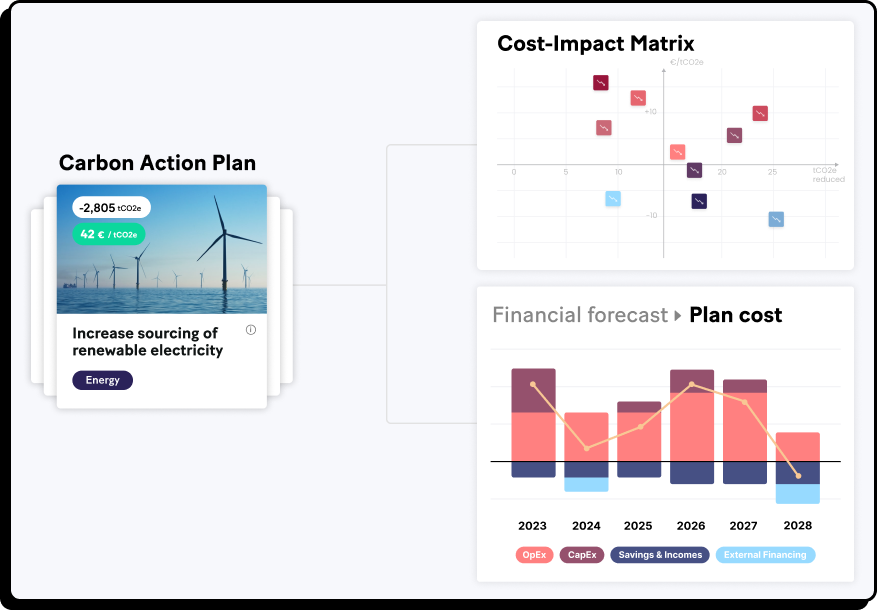
The financial module integrated into our carbon management platform allows you to model the financial impact of decarbonization actions, establish clear trajectories, and obtain a precise estimate of the investments required for implementation.
Conclusion
Implementing a climate strategy should be viewed as an opportunity for companies. In fact, it is often an essential process for ensuring the long-term viability of their business. It enables the pursuit of objectives that meet international standards, serving as a benchmark for many economic players.
The key is to reconcile financial and carbon data. To achieve this, the first step is to align your climate strategy with your business strategy. Rigorous carbon accounting combined with financial analysis allows you to identify and implement high-impact decarbonization actions.
Companies built to last have realized that business strategy and climate strategy must be given equal priority.