
.svg)




_Main%20Image.png)


🔎 Key takeaways
- The VS standard replaces the VSME and becomes the official European framework for voluntary reporting for companies not subject to the CSRD.
- It is based on two modules, a core base of 11 indicators and a comprehensive module of 9 additional indicators.
- The VS adopts the core principles of double materiality without requiring a formal analysis, and covers key environmental, social, and governance issues.
- The “value chain cap” limits to 23 data points what a large client can request from a company with 1,000 employees or fewer starting in 2027
The VS standard offers micro-enterprises, small businesses, SMEs, and mid-caps a simplified framework to structure their sustainability reporting and meet stakeholder expectations. Discover what this streamlined version of the CSRD contains, what has changed compared to the VSME, and how to use it to prepare and publish your sustainability report.
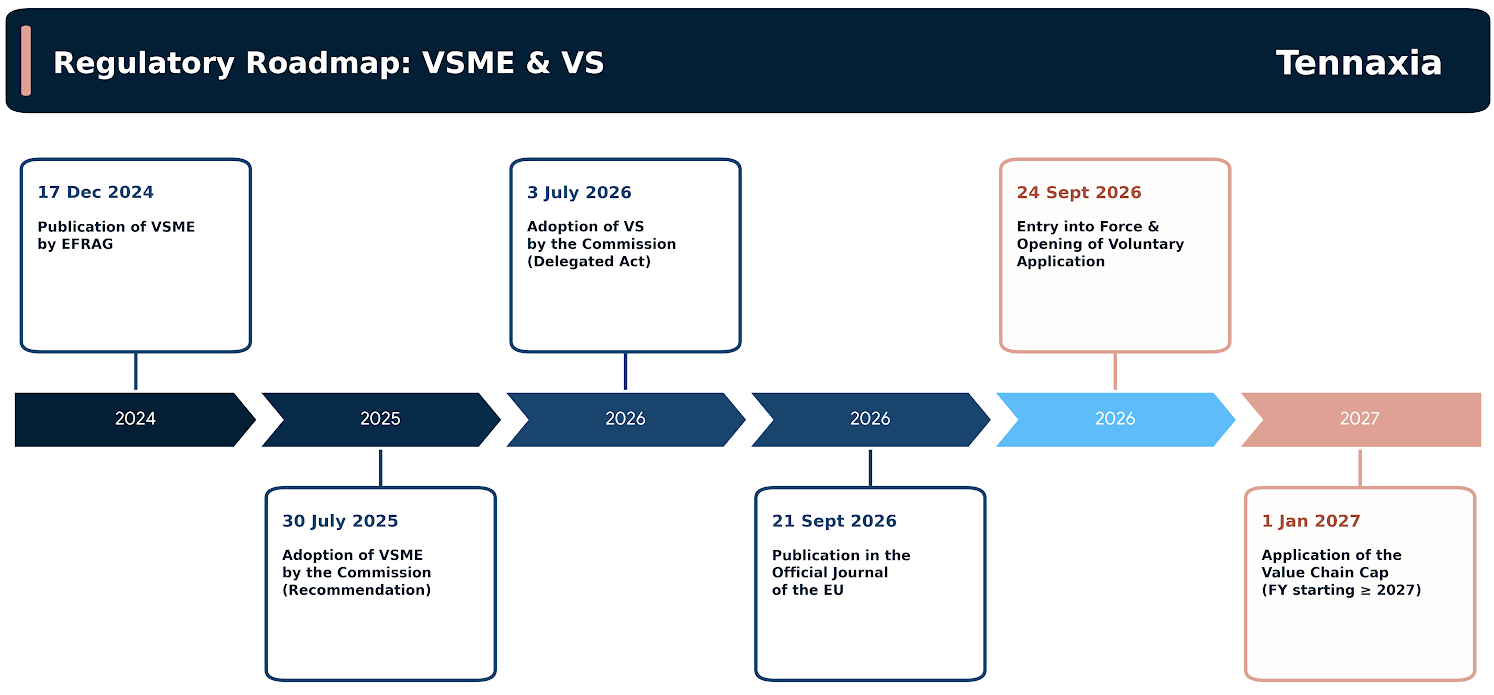
On July 3, 2026, the European Commission adopted the VS standard (Voluntary Standard), a sustainability reporting framework for companies not subject to the CSRD. Published in the Official Journal of the European Union on September 21, 2026 and entered into force on September 24, 2026, it succeeds the VSME and changes its legal nature: whereas the VSME was merely a recommendation, the VS is a delegated act.
This change in status is not just cosmetic. The VS becomes the official framework for the value chain cap, the ceiling that limits what a large company subject to the CSRD can demand from companies in its value chain. In other words: it is a standard that is voluntary to adopt, but which produces legally enforceable effects as soon as a principal requests information from its suppliers.
What is the VS standard (formerly VSME)?
The European Commission tasked EFRAG with developing a voluntary sustainability reporting standard for micro-enterprises, small businesses, and SMEs.
This standard, the VSME (Voluntary Sustainability reporting standard for SMEs), was published by EFRAG on December 17, 2024, and subsequently adopted by the European Commission on July 30, 2025, in the form of a recommendation.
The Omnibus I package then requested that the Commission transform this voluntary standard into a delegated act. This was achieved with Delegated Regulation (EU) 2026/1560 of July 3, 2026, which establishes the "voluntary sustainability reporting standards for companies protected by the value chain cap." The VSME, in its recommendation version, therefore gives way to the VS.
A standard aligned with the European Green Deal and the CSRD
While the VS standard is aimed at companies not subject to the CSRD, it is part of a comprehensive European sustainability reporting standardization project. Two texts were published in the Official Journal on the same day, September 21, 2026:
EFRAG has published a set of standards:
- the ESRS revised: Delegated Regulation (EU) 2026/1563, which simplifies and replaces the 2023 set of standards applicable to companies subject to the CSRD
- the VS standard: Delegated Regulation (EU) 2026/1560, intended for companies that remain outside the scope of the CSRD.
The VS was developed to be consistent with the ESRS: it covers the same sustainability issues, but with requirements proportionate to the capabilities and characteristics of the targeted companies, including micro-enterprises. The text explicitly states that it imposes no legal reporting obligation, unlike the ESRS.
What is the purpose of the VS standard?
The main objective of the VS is to help companies outside the scope of the CSRD align with the sustainability expectations of their business partners by providing them with a more accessible, proportionate framework tailored to their size and resources.
The text assigns it four purposes:
- to meet the data needs of companies subject to mandatory reporting that request sustainability information from their value chain;
- meet the needs of banks and investors, and thereby facilitate access to financing;
- improve the management of sustainability issues faced by these companies (pollution, occupational health and safety) to support their growth and strengthen their resilience in the short, medium, and long term;
- contribute to a more sustainable and inclusive economy.
Which companies are affected by the VSME?
This is one of the major changes compared to the VSME. The criterion is no longer the SME classification, but a single headcount threshold : the VS is aimed at companies that, at their balance sheet closing date, have not exceeded an average of 1,000 employees during the previous financial year.
In practical terms, this opens up the standard well beyond micro-enterprises and SMEs: mid-sized companies and a significant portion of large unlisted companies fall within its scope. Since the text came into force, any company not subject to CSRD reporting obligations can apply the VS.
The standard also provides for a second threshold, this one internal: a certain number of indicators, which are essential for other companies, become voluntary for companies with 10 employees or fewer. The text marks them in brackets.
What impact has the European Omnibus had on the VS?
The package Omnibus I has profoundly transformed the landscape of non-financial reporting in Europe. It has adjusted the provisions of the CSRD, the CSDDD and the Green Taxonomy by taking into account the economic realities of European companies.
The scope of the CSRD is now refocused on companies with more than 1,000 employees and a net turnover of over 450 million euros, which excludes the vast majority of companies initially subject to the reporting obligation.
However, these companies remain subject to requests from their stakeholders—investors, banks, and major clients—who wish to continue receiving ESG information. This is where the VS takes on its full meaning: it provides a structured and harmonized framework for meeting these expectations without imposing an excessive administrative burden.
By expanding the scope of the standard to companies with up to 1,000 employees, the Omnibus makes it a de facto market standard, particularly for mid-sized companies and businesses working with large groups subject to the CSRD. While not mandatory, it will nonetheless be in the interest of these companies, given their size and specific challenges, to supplement this regulatory baseline with sector-specific and/or strategic indicators when available.
The value chain cap : what a client can ask of you
This is the structural innovation of the VS, and the reason why it was transformed into a delegated act.
The principle
The value chain cap is a reporting cap. It prevents a company subject to mandatory reporting from requiring information from a company in its value chain that has 1,000 employees or fewer on average during the previous financial yearthat goes beyond what is provided for in the VS.
The goal is to avoid a trickle-down effect: without this cap, CSRD and CSDDD requirements would automatically be passed down, contract after contract, to companies that have neither the resources nor the obligation to comply with them.
This cap applies to financial years beginning on or after January 1, 2027.
The precise list of enforceable information
Annex II of the delegated regulation does not refer to the standard as a whole: it lists 23 data points, and only these, that a principal contractor may request. The list distinguishes between two regimes based on the size of the company being solicited.
Two useful pieces of information from this table:
- 15 of the 23 points fall under the basic module, and 8 under the full module. A company that has completed both modules has, in effect, already provided everything that can be requested of it.
- No environmental indicators are enforceable against a company with 10 employees or fewer. No energy, no GHG, no water, no waste.
The core principles of the VS standard
The VS standard establishes a clear framework for preparing sustainability reports. It is based on principles that aim to both ensure the quality of disclosed information and reduce the administrative burden on the companies concerned.
Information quality
While the VS does not require a double materiality assessment, it retains its core principles. Companies must disclose how they have had, or are likely to have, positive or negative impacts on the environment and people in the short, medium, and long term. They must also specify how environmental and social issues affect or are likely to affect their financial position, performance, and cash flows.
As with the CSRD, the information provided must be relevant, faithful, comparable, understandable, and verifiable. Depending on their activities, companies can, and should, include additional indicators or analyses that reflect sector-specific issues. This particularly concerns Scope 3 GHG emissions, which are not required to be reported under the VS, but which the standard notes may be appropriate for companies in the industrial, food, real estate construction, and packaging sectors.
Comparability of information
Starting from the second year of reporting, companies must provide comparative information for the previous financial year, except for indicators reported for the first time.
"If applicable" principle
Some indicators only apply to specific situations. A company is only required to report them if the described circumstances are applicable to its business. When a company does not provide this type of information, it is assumed by default that it is not applicable to its context.
Subsidiary integration
If the company is the parent company of a group, it is recommended that it prepares its report on a consolidated basis, by incorporating information from its subsidiaries. In this case, the subsidiaries are exempt from reporting.
Reporting frequency and accessibility
If the report is prepared to meet the needs of large companies or banks requiring an annual update, it must be produced annually. When the company produces financial statements, the sustainability report must cover a period consistent with them. If certain data has not changed from one year to the next, the company may simply state this and refer to the previous report.
The standard also provides for coordination with EMAS : a company publishing an environmental statement under Regulation (EC) No 1221/2009 may present EMAS and VS information in a single report, with common elements presented only once.
The primary function of this report is to inform current or potential business partners. The company may choose to make it public by including it in a separate section of its management report, if it publishes one, or as a standalone document.
Incorporation by reference
To avoid duplicating information, the company may refer, within its sustainability report, to information published in other documents accessible at the same time and from the same set of documents.
Protection of sensitive information
The company may omit four categories of information:
- in exceptional cases, information whose disclosure would seriously harm its commercial position;
- information relating to intellectual capital, intellectual property, know-how, technological information, or innovation results, classified as trade secrets ;
- information classified ;
- information that must be protected under other Union or national laws, or to preserve the privacy or safety of a natural person or the security of a legal entity.
Two cumulative conditions govern this option: the company declares, for each omitted data point, that it has made use of this exemption (under point b of indicator B1), and it re-evaluates at each closing date whether the omission remains justified.
Consistency with financial statements
When a company publishes financial statements, the information in its sustainability report must be consistent with them for the same period, and presented in a way that facilitates understanding of the links between the two, for example through appropriate cross-references.
A two-tier structure: basic standard and full standard
The VS standard consists of two modules: a basic module (Basic Module) and a full module (Comprehensive Module).
Modularity remains one of the standard's guiding principles. Companies have two options when preparing their sustainability report and must explicitly state which one they have chosen:
- OPTION A : basic module only;
- OPTION B : basic module and comprehensive module.
A module must be followed in its entirety, with the sole exception of the "if applicable" principle. And applying the basic module is a prerequisite for applying the comprehensive module.
The VSME standard basic module
The basic module is the target approach for micro-enterprises and serves as the minimum foundation for all others.
It consists of 11 indicators structured around the ESG pillars: environment, social, and business conduct.
Companies completing only this module but wishing to provide additional information may select specific data from the comprehensive module to enhance their report.
General information
B1 - Preparation basis
The company must specify:
- the chosen option (base module only, or base module and full module), accompanied by an explicit declaration of compliance with the standard;
- the information omitted for the protection of sensitive information, where applicable;
- whether the report is prepared on an individual or consolidated basis;
- in the case of a consolidated report, the list of covered subsidiaries, with their registered office;
- a foundation of general information: legal form, NACE code(s), total assets, turnover, number of employees (in headcount or full-time equivalent), country of main activity and location of significant assets, and geolocation of sites owned, leased, or managed.
The company must also briefly describe the sustainability certifications or labels it has obtained, specifying, where applicable, the issuing body, the date, and the score obtained.
🔍 Note: EFRAG guidance specifies that geolocation must be provided site by site, as spatial points for point-based units or as polygons for extended sites (farms, mines, facilities), with a precision of five decimal places.
B2 - Future practices, policies, and initiatives for the transition to a more sustainable economy
If the company has implemented practices, policies, or future initiatives for its transition to a more sustainable economy, it must indicate this and specify whether it has:
- practices : for example, efforts to reduce water and electricity consumption, reduce GHG emissions, prevent pollution, improve product safety, working conditions, or equal treatment, or partnerships related to sustainability projects;
- policies on sustainability issues, specifying whether they are public and whether there are separate environmental, social, or governance policies;
- future initiatives or forward-looking plans currently being deployed;
- targets to monitor the implementation of these policies.
Appendix B of the standard provides a list of sustainability issues that can be covered. The EFRAG guidance suggests structuring the response in a grid crossing ten issues (climate change, pollution, water, biodiversity, circular economy, own workforce, workers in the value chain, affected communities, consumers and end-users, business conduct) with three questions: existence, public accessibility, and existence of targets.
Environmental data
B3 - Energy and greenhouse gas emissions
[Voluntary for companies with 10 employees or fewer]
The company must indicate its total energy consumption in MWh. If the necessary information is available, it should provide a breakdown by electricity (as billed) and fuels, as well as by renewable and non-renewable energy.
It must also report its estimated absolute gross GHG emissions for the period, in tonnes of CO2 equivalent, based on the GHG Protocol:
- the Scope 1 emissions (sources owned or controlled);
- the Scope 2 emissions using the location-based approach (generation of purchased energy: electricity, heat, steam, cooling).
🔍 Note: EFRAG guidance explicitly allows the use ofEN ISO 14064-1 as a substitute for the GHG Protocol if this standard is better suited to the company's needs.
B4 - Air, water and soil pollution
The company must report emissions of pollutants into air, water, and soil resulting from its own operations, provided it is required to report them to the competent authorities under Union or national law, or if it reports them voluntarily as part of an environmental management system.
If this information is already public, the company may refer to the document where it appears, for example by providing a link.
🔍 Note: this primarily targets operators of installations covered by the IED directive, representing approximately 75,000 installations in the Union. A point highlighted by the guidance: the European register collects data at the installation level, whereas the ESRS requires a consolidated total at the company level.
B5 - Biodiversity
If the company has sites or locations in or near a biodiversity-sensitive area, it must disclose them, along with the name of the area concerned.
🔍 Note: the term "near" covers any site that overlaps, even partially, with or is adjacent to a sensitive area. A site that is neither adjacent nor overlapping may also be considered "near" if it falls within the area's zone of influence.
B6 - Water
[Voluntary for companies with 10 or fewer employees]
The company must report its total water withdrawal, meaning the volume of water brought within its organizational boundaries.
If it operates production processes that are highly water-intensive—such as drying, energy production, manufacturing, or agricultural irrigation—it must also publish its water consumption, calculated as the difference between withdrawal and discharge. These companies must also separately report the volume of water consumed at sites located in water-stressed areas.
🔍 Note: for a company that only draws water from the public network and discharges into the sewer system, consumption is near zero and may be omitted from the report. To identify water-stressed areas, the guidance refers in particular to the WRI Aqueduct atlas and the WEI+ indicator from the European Environment Agency, using a reference threshold of 40%.
B7 - Resource use, circular economy, and waste management
[Voluntary for companies with 10 employees or fewer]
The company must specify whether it applies circular economy principles and, if so, how.
Regarding waste, it must indicate:
- total weight of waste generated, with a breakdown between hazardous and non-hazardous waste;
- the proportion of waste diverted to recycling or preparation for reuse ;
- if it operates in a sector involving significant material flows—manufacturing, construction, packaging— the annual mass flow of relevant materials.
🔍 Note: the guidance specifies that diversion is measured based on waste sorted and sent to recycling or reuse operators, rather than the quantities actually recycled at the end of the process.
Social indicators
B8 - Personnel - General characteristics
The company reports its number of employees, in headcount or full-time equivalent, broken down by three categories:
- the type of contract (temporary or permanent);
- the gender ;
- the country of employment, if the company operates in more than one country.
Change from the VSME: the employee turnover rate is no longer in the basic module. It has been moved to the full module, under C5, and the 50-employee threshold that previously applied has been removed.
B9 - Personnel - Health and safety
The company shall disclose, for its employees:
- the number and rate of recordable work-related accidents ;
- subject to legal restrictions, the total number of deaths resulting from recordable work-related accidents and occupational illnesses.
B10 - Personnel - Remuneration, collective bargaining and training
The company must specify:
- whether its employees receive remuneration equal to or higher than the applicable minimum wage in the country concerned, whether established by law or collective agreement;
- the percentage pay gap between female and male employees, if the company is already required to report it under Union law or national regulations;
- the proportion of employees covered by a collective bargaining agreement ;
- the average annual number of training hours per employee.
Change compared to the VSME: the pay gap is no longer conditional on a 150-employee threshold, but on the existence of a pre-existing reporting obligation. And the number of training hours is no longer broken down by gender.
Governance data
B11 - Convictions and fines for corruption and bribery
In the event of convictions and fines during the period, the company must indicate the number of convictions and the total amount of fines incurred for violations of anti-corruption laws.
🔍 Note: the guidance significantly narrows the scope. The convictions referred to are finalcriminal rulings. The fines must be mandatory, paid to the public treasury and recorded in the financial statements for the fiscal year, excluding negotiated transactions and non-disbursed provisions.
The full VS standard module
Companies wishing to complete this module must first complete the basic module.
This module is intended for companies that need to provide non-financial information to their stakeholders. It was designed to meet the requirements of banks, investors, and major clients, and reflects their own regulatory obligations as well as the information they need to assess a company's sustainability risk profile as a potential supplier or borrower.
The standard also provides, in its Appendix C, a correspondence table with the SFDR, EBA Pillar 3, and the Benchmarks Regulation, intended for financial market participants who use this information.
The full module consists of 9 indicators, also structured into three main parts: Environmental, Social, and Governance.
General information
C1 - Strategy: Business model and sustainability initiatives
[Voluntary for companies with 10 employees or fewer]
The company discloses the key elements of its business model and strategy:
- a description of the significant groups of products and/or services offered;
- a description of the significant markets in which it operates (B2B, wholesale, retail, countries);
- a description of its main business relationships (key suppliers, customers, distribution channels);
- if the strategy includes key elements related to sustainability issues, a brief description of these elements.
🔍 Note: EFRAG guidance specifies that the description of business relationships must include the estimated number of suppliers, as well as their sectors and countries.
C2 - Description of practices, policies, and future initiatives for the transition to a more sustainable economy
The company must briefly describe the practices, policies, or initiatives that it reported in B2, as well as the resulting actions. If the practice, policy, or initiative covers suppliers or customers, it must be mentioned. It also describes the targets identified in B2 to monitor the implementation of its policies.
It may, on a voluntary basis, indicate the highest hierarchical level (person or body) responsible for the implementation of these practices, policies, and initiatives.
Environmental data
Considerations regarding Scope 3 emissions (in addition to B3)
The standard does not create a numbered indicator for Scope 3, but it does dedicate a section to it. Depending on the type of activity, quantifying Scope 3 may be appropriate for reporting on the climate impacts of the value chain. Companies in the industrial, agri-food, real estate construction, and packaging sectors are explicitly cited as likely to have significant Scope 3 categories.
If the company chooses to publish this metric, it refers to the 15 categories of the GHG Protocol and selects the significant categories based on its own assessment. When publishing its Scope 3, it presents it along with the information from B3.
C3 - GHG reduction targets and climate transition
[Voluntary for companies with 10 employees or fewer]
If the company has established GHG emissions reduction targets, it publishes them in absolute values for Scopes 1 and 2—and for significant Scope 3 categories if it has set such targets. It specifies:
- thetarget year and the target value;
- thebase year and the base value;
- the units used;
- the share of Scopes 1, 2 and, where applicable, 3 covered by the target;
- the list of key actions taken to achieve it.
A company operating in a high climate impact sector and that has adopted a transition plan for climate change mitigation may provide information about it, explaining how it contributes to emission reductions. If it does not have one, it must indicate whether and, if so, when it intends to adopt one.
Note: the guidance reiterates that carbon removals and avoided emissions must not be included in the company's gross emissions, as these elements fall under separate project accounting.
C4 - Climate risks
[Voluntary for companies with 10 employees or fewer]
This is the indicator that most closely resembles the CSRD double materiality analysis, even though it is significantly simplified.
If the company has identified climate-related hazards and transition events that pose risks to its business, it must:
- briefly describe them ;
- explain how it has assessed the exposure and sensitivity of its assets, activities, and value chain to these hazards and events;
- specify the time horizons for the identified hazards and events;
- state whether it has taken adaptation measures to address climate change.
The company may also publish the potential negative impacts of climate risks on its financial performance or operations in the short, medium, or long term, indicating whether it assesses them as high, medium, or low.
Social indicators
C5 - Other general staff characteristics
[Voluntary for companies with 10 or fewer employees for the first point]
The company must publish its employee turnover rate over the period.
It may also optionally publish:
- the gender ratio at the management level ;
- the number of independent contractors without employees working exclusively for the company, and of temporary workers provided by employment agencies.
Change compared to the VSME: the 50-employee threshold has been removed. The turnover rate is now a requirement of the full module for all companies with more than 10 employees, and the gender ratio at the management level has become an optional disclosure.
C6 - Additional personnel information — Human rights policies and processes
The company must answer the following questions:
- does it have a code of conduct or human rights policy for its staff? [Voluntary for companies with 10 employees or fewer]
- if so, does this policy cover child labor, forced labor, human trafficking, discrimination, accident prevention, or other issues to be specified?
- does it have a grievance mechanism for its staff? [Voluntary for companies with 10 employees or fewer]
C7 - Serious negative human rights incidents
The company must indicate whether it has recorded any confirmed incidents among its staff related to child labor, forced labor, human trafficking, discrimination, or other issues to be specified. If so, it may describe the measures taken to address them.
It must also indicate whether it is aware of anyconfirmed incidents involving workers in its value chain, affected communities, consumers, or end-users identified during the period, and provide details if applicable.
Note: the guidance strictly limits the definition of a "confirmed" incident. It only covers incidents supported by objective, factual, and verifiable information and that have been formally established by a court, the OECD, or an administrative authority. Ongoing proceedings are excluded from the scope.
Governance data
C8 - Revenue from certain activities
If the company is active in one or more of the following sectors, it must report the revenue derived from them:
- the prohibited weapons industry (anti-personnel mines, cluster munitions, chemical or biological weapons);
- the cultivation and production of tobacco ;
- the fossil fuel sector (coal, oil, gas), with a breakdown of revenue by source;
- the chemical production, i.e., activities falling under division 20.2 of Annex I to Regulation (EC) No 1893/2006.
Change from the VSME: the requirement to disclose the exclusion of EU Paris-aligned benchmarks is no longer included in the standard. Furthermore, "chemical production" is limited, within the meaning of division 20.2, to pesticides and other agrochemical products.
C9 - Diversity ratio in the governance body
If the undertaking has a governance body, it must disclose the gender diversity ratio for that body, calculated in accordance with the SFDR as the ratio of female members to male members.
What changes between the VSME and the VS: the summary
This last point deserves attention: the practical implementation guidance is no longer in the regulatory text. EFRAG now publishes it separately on its Knowledge Hub, with an explicitly non-bindingstatus; it "neither extends nor amends" the provisions of the delegated regulation. In practice, it remains essential: it provides the calculation formulas, reporting templates, emission factor databases, and operational definitions that the text alone does not provide.
Why do companies have every interest in adopting the VS standard?
Although its adoption remains voluntary, the VS standard represents a strategic opportunity for European companies not subject to the CSRD.
Protecting yourself from excessive value chain requests
This is the new argument, and likely the most decisive one. For financial years beginning on or after January 1, 2027, a company with 1,000 or fewer employees can invoke the value chain cap against a principal that requests information beyond the 23 data points listed in Annex II. Mastering the standard means knowing exactly where the limits of what can be asked of you lie.
Anticipating market expectations
Investors, banks, and large corporations are increasingly demanding transparency regarding ESG criteria. Adopting the VS allows you to structure your non-financial reporting and meet the expectations of your business partners in a format they recognize.
Facilitating access to financing
Financial institutions are gradually integrating ESG criteria into their credit and investment decisions. Appendix C of the standard explicitly establishes the correspondence between VS indicators and the requirements of the SFDR, EBA Pillar 3, and the Benchmarks Regulation. A company that follows the VS therefore directly produces the data that its financiers are themselves required to report.
Preparing for potential future obligations
Even though the VS is currently voluntary, regulations are evolving rapidly. Familiarizing yourself with these standards now allows companies to get a head start and avoid a sudden, difficult transition if these standards become mandatory in the future.
Optimizing risk management and improving resilience
Non-financial reporting is more than just an administrative burden. It allows you to identify vulnerabilities, anticipate climate, social, and governance risks, and adopt more robust strategies.
Gaining a commercial edge
A clear and structured commitment to sustainable development is a competitive advantage. It strengthens brand image, attracts new talent, and helps you stand out to clients or during tender processes.
Conclusion
The VS standard is part of a framework designed to simplify and harmonize sustainability reporting for companies that fall outside the scope of the CSRD. Its transition to a delegated act, and especially the implementation of the value chain cap for financial years beginning on or after January 1, 2027, make it much more than an optional reference: it is now the common language sustainability information exchanges between major contractors and the value chain.
Adopting the VS standard today means anticipating market expectations, securing exchanges with partners, and positioning yourself as a player committed to the sustainable transition.
Sources:
- "VS (formerly VSME): understanding the voluntary standard for SMEs", CSR Portal (French government), 07/30/2026
- "Commission Delegated Regulation (EU) 2026/1560 of 3 July 2026 supplementing Directive 2013/34/EU of the European Parliament and of the Council by establishing sustainability reporting standards for voluntary use by undertakings protected by the value chain cap", European Commission, 07/03/2026
- “Voluntary reporting standard for SMEs (VSME)”, EFRAG page
- “EFRAG Voluntary Sustainability Reporting Standard for non-listed SMEs (VSME)”, EFRAG, 12/17/2024
- “Commission Delegated Regulation (EU) 2020/1818 of 17 July 2020 supplementing Regulation (EU) 2016/1011 of the European Parliament and of the Council as regards minimum standards for EU Climate Transition Benchmarks and EU Paris-aligned Benchmarks”, European Commission, 07/17/2020