
.svg)






Non-financial reporting has become a major focus for many companies, driven largely by the CSRD. Teams responsible for compiling and publishing these reports often describe the process as time-consuming, claiming it comes at the expense of developing concrete environmental initiatives.
However, these reports do not necessarily have to be viewed as a burden. When managed properly, they can become the foundation for an effective climate strategy and generate numerous benefits for businesses.
Non-financial reporting: a thorn in the side of businesses?
The apparent complexity of the CSRD has sparked resistance from many economic stakeholders. And indeed, this new reporting model, which applies to over 50,000 companies operating within the European Union, can be quite daunting at first glance.
As a reminder, the CSRD involves:
- 12 sets of reporting standards, the well-known ESRS
- over 1,100 data points
- justified uncertainty calculations for every data point provided
- the publication of a comprehensive climate action plan
- the requirement to provide objectives, trajectories, and financing plans for the actions undertaken
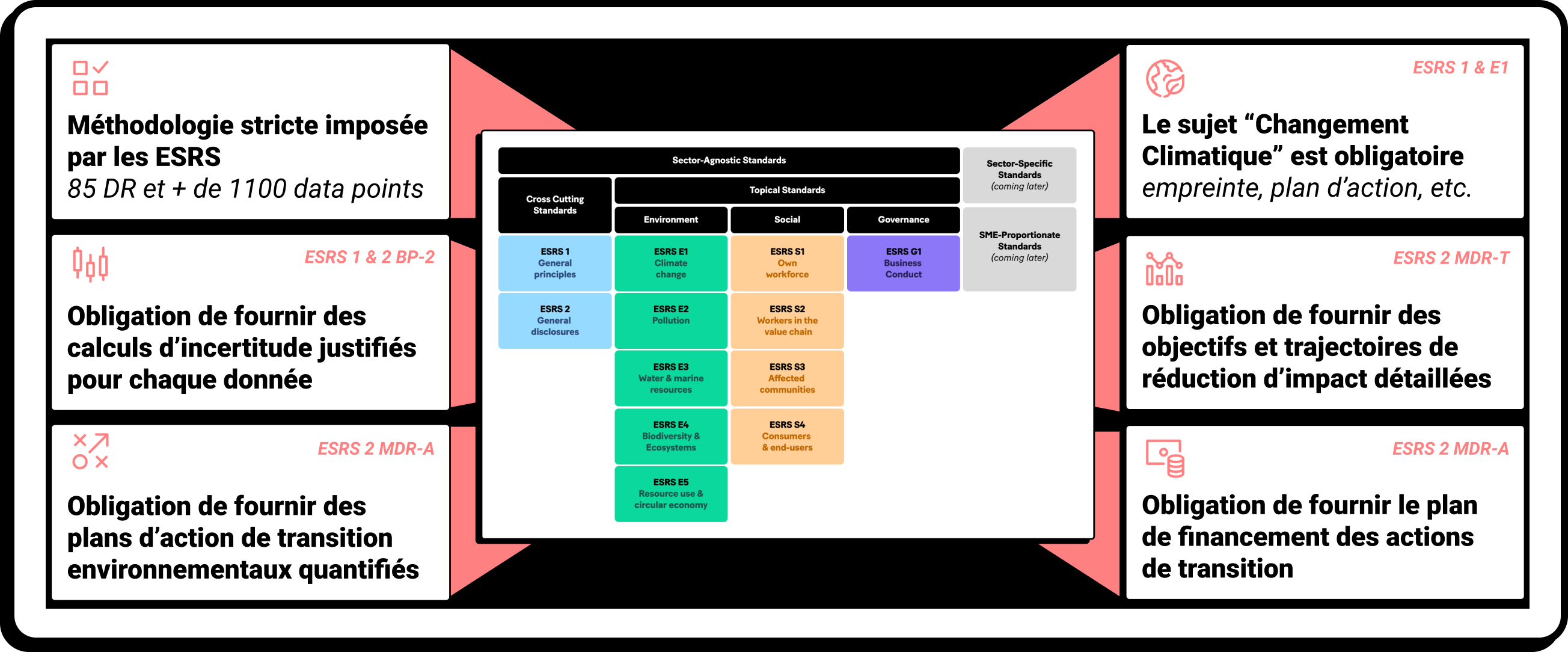
It covers topics as varied as carbon footprint, biodiversity, pollution, water resources, corporate governance policy, workforce, and the impact of your activities on your value chain.
And the exercise must be repeated every year. It is no surprise, then, that many CSR and finance departments see it as a modern-day version of the myth of Sisyphus.
So, how can you tackle this subject without over-burdening your teams or turning your ESG reporting into a bureaucratic nightmare?
CSRD: A framework designed to drive concrete action
What tends to worry CSR departments is not so much the number of boxes to tick in this annual reporting framework, but rather the lack of data, or the absence of high-quality data.
Many companies have already implemented processes to measure their carbon footprint across scopes 1, 2, and 3, which is the most significant component of the CSRD. However, uncertainty calculations, the presentation of transition plans, their financial modeling, or the measurement of expected impact are questions that very few of them are currently able to answer.
And that is perfectly normal.
The first year of reporting will inevitably be a test year requiring structure and iteration.
The very principle of this sustainability report—and perhaps this is where communication has fallen short—is to shift the mindset of companies. It is precisely about moving away from simple ESG reporting to an ESG data management system.
This management is organized into several stages:
- Identify data sources
- Collect data
- Process and transform this data
- Organize it at the most granular level possible
- Analyze it
- Report it
- Leverage it

The CSRD thus provides companies with the model to gain a comprehensive view of their ESG data, manage it, and structure tangible action plans.
Ultimately, this structure should enable the implementation of concrete action plans and, above all, it pushes companies to make the effort: the effort to have a long-term vision, the effort to set concrete and measurable goals, and finally, the effort to finance these actions.
Equipping yourself for the reporting transition
The nomenclature introduced by various non-financial reporting standards has rendered the "simple" Excel spreadsheet—which for years served as the go-to tool for measuring carbon footprints—obsolete. It limits analytical capabilities and, more importantly, is not the best-suited solution for bridging the gap between data collection and implementing an impact reduction trajectory.
The first essential step before embarking on publishing a non-financial report and, by extension, an action plan, is to equip yourself with the right tool. This is the prerequisite for taking ownership of the collected data and using it efficiently.
This tool must be able to help you:
1 - Collect all types of ESG data
You need a flexible collection system, capable of retrieving data in various formats and from diverse sources (APIs, Excel files, questionnaires, etc.), given the varied origins of this information.
2 - Process the data
The solution must be able to process raw input data to integrate it into your ESG database. This process is unique and complex in the context of CSR because the data often requires calculation assumptions, extrapolations, and more.
Added to this complexity is the imperative of traceability for these assumptions; necessary for the teams handling this data and its evolution year after year, and necessary for the auditors who will review your non-financial reports (which is mandatory under the CSRD).
3 - Analyze the data
Once the data is processed, the tool must allow you to organize and analyze it as granularly as possible. For CO2, this means different emission sources must be reportable by country of origin, specific site, product designed, and so on.
The finer this granularity, the more relevant your analysis will be, and the better you will be able to develop action plans that allow for concrete improvements across various ESG indicators.
4 - Model action plans
The ideal solution should allow you to reuse this data to model your various action plans. It enables you to set goals, establish a timeline, and measure the impact that specific changes will have on your greenhouse gas emissions, as well as what they represent in terms of CAPEX and OPEX.
Once all this information is centralized in the tool, you can simply export it in a format compatible with the standards set for your non-financial reporting. All that remains is to complete the qualitative questions.
CSRD and other standards are therefore merely additional features within an ESG data management system.
Moving from reporting to concrete action - putting operational teams in the driver's seat
The framework imposed by the CSRD has an underlying objective: to get you ready to implement an ESG strategy.
You have:
- a collection structure
- quality data
- fixed-horizon goals
- an estimate of expected impacts
- financial projections
All that remains is to organize this information to identify the most "profitable" levers for action. What efforts are required (structural, human, financial, etc.) for what expected result? Your plan will depend on the trade-offs you make based on this analysis.
In terms of organization, these actions are not managed by CSR departments. It is the operational teams who are truly in the driver's seat. Here, too, a change in mindset is necessary. Everyone must be involved for implementation to be effective. The CSR department defines and communicates the company's broad environmental transition guidelines.
It collects data from all levels of the company, consolidates it to provide a global view of the group, defines objectives, and supports operational staff in implementing the actions needed to achieve them.
Once these actions are implemented, the updated data flows back to the CSR department, allowing it, year after year, to enrich its CSRD reporting and adjust actions based on the goals to be achieved.
The CSRD allows you to create a virtuous cycle built on a robust ESG data management system. Long viewed as a constraint, this approach is ultimately more than just a short-term necessary evil; it is a true springboard that enables the development of concrete actions and the achievement of your medium- and long-term goals.