
.svg)







With few exceptions, there is now a consensus in both economic and political circles that decarbonizing the economy is a priority. That is excellent news!
It is time for companies to commit to decarbonization!
And the first step in reducing your emissions is, of course, measuring your carbon impact 📏
But you need to measure it correctly.
Before we discuss the Bilan Carbone® method, a few reminders
Distinguishing a "carbon footprint" from the "Bilan Carbone® method"
While the term "carbon footprint" has become common parlance for any process of measuring an organization's emissions, the "Bilan Carbone® method" is a registered trademark that applies specifically to the approach developed by ADEME and now managed by the Association pour la transition Bas Carbone. This method goes beyond simply measuring an organization's footprint; it is not just a snapshot of GHG emissions, but also involves implementing a transition plan.
It is therefore essential to distinguish a simple "carbon footprint" from the "Bilan Carbone® method".
To make this article easier to read, we will use the ® symbol for anything relating to the specific method, and omit it when referring to a carbon footprint in the generic sense.
The carbon footprint, the key first step in decarbonization 🍃
Before building a decarbonization trajectory, you must complete an essential step: a comprehensive assessment of your carbon footprint. This allows you to take stock of your greenhouse gas emissions, identify the primary sources of those emissions, and measure the effectiveness of the actions you take as part of your climate plan.
Several methods exist for this. Most are highly standardized and recognized by major international bodies and the non-financial reporting standards that companies must follow, whether due to regulatory requirements or stakeholder demands. These include:
- the ISO 14064 standard
- the GHG Protocol
- the French regulatory GHG assessment (BEGES)
- the Bilan Carbone® method
We will focus on the latter later in this article. Developed by ADEME, it is now considered a benchmark in carbon accounting and has been widely adopted by European companies.
What are greenhouse gases?
Greenhouse gases (GHGs) occur naturally. By trapping the sun's rays, they maintain the temperature necessary for life and contribute to our planet's climate balance.
Unfortunately, human activity is excessively increasing the concentration of some of these gases. This overproduction of GHGs is the primary cause of global warming.
There are many greenhouse gases. Most GHG emissions measurement standards are based on those covered by the Kyoto Protocol, namely:
- carbon dioxide (CO2)
- methane (CH4)
- nitrous oxide (N2O)
- hydrofluorocarbons (HFCs)
- perfluorocarbons (PFCs)
- sulphur hexafluoride (SF6)
- nitrogen trifluoride (NF3)
The Bilan Carbone® method also takes into account chlorofluorocarbons (CFCs) as well as water vapour contrails from aircraft engines.
The carbon footprint: definition 📖
A carbon footprint is an awareness-raising and diagnostic tool that allows companies to collect, analyse, and account for their GHG emissions. This tool allows organisations to carry out their greenhouse gas assessment.
This makes it possible to prioritise emission sources in order to guide companies in their climate-energy transition efforts.
Who is a carbon footprint assessment for? Is it mandatory?
Any organisation (company, association, local authority, etc.) wanting to measure its environmental impact can carry out a carbon footprint assessment. The various existing methodologies are not mandatory in themselves, but they help meet certain regulatory obligations.
In France, the Grenelle 2 law requires all organizations with more than 500 employees (250 in overseas territories), local authorities with more than 50,000 inhabitants, and public-sector bodies with more than 250 employees to conduct a greenhouse gas emissions assessment (BEGES) every three years.
The European CSRD directive, meanwhile, requires an annual carbon footprint measurement for European companies that meet at least two of the following three criteria:
- Employ 250 or more employees.
- Generate €50 million or more in turnover.
- Have a balance sheet total of €25 million or more.
Also covered are SMEs listed on European markets that meet at least two of the following three criteria:
- Employ 10 or more employees,
- Generate €900,000 or more in turnover.
- Have a balance sheet total of €450,000 or more.
This will be phased in between 2025 and 2029 depending on the size and turnover of the companies concerned.
Who can carry out a carbon footprint assessment?
Any company, and more broadly any organization, can carry out a carbon footprint assessment. Some calculators even allow individuals to carry one out.
It can be carried out for regulatory reasons, as mentioned above, but can also be carried out voluntarily by any organization wanting to measure the impact of its activity on the climate and take action on it.
Note that carrying out a carbon footprint assessment is also regularly required by certain stakeholders, first and foremost investors. Beyond the regulatory framework, measuring your carbon footprint can therefore quickly become a prerequisite for companies looking to grow their business.
How do you calculate a carbon footprint?
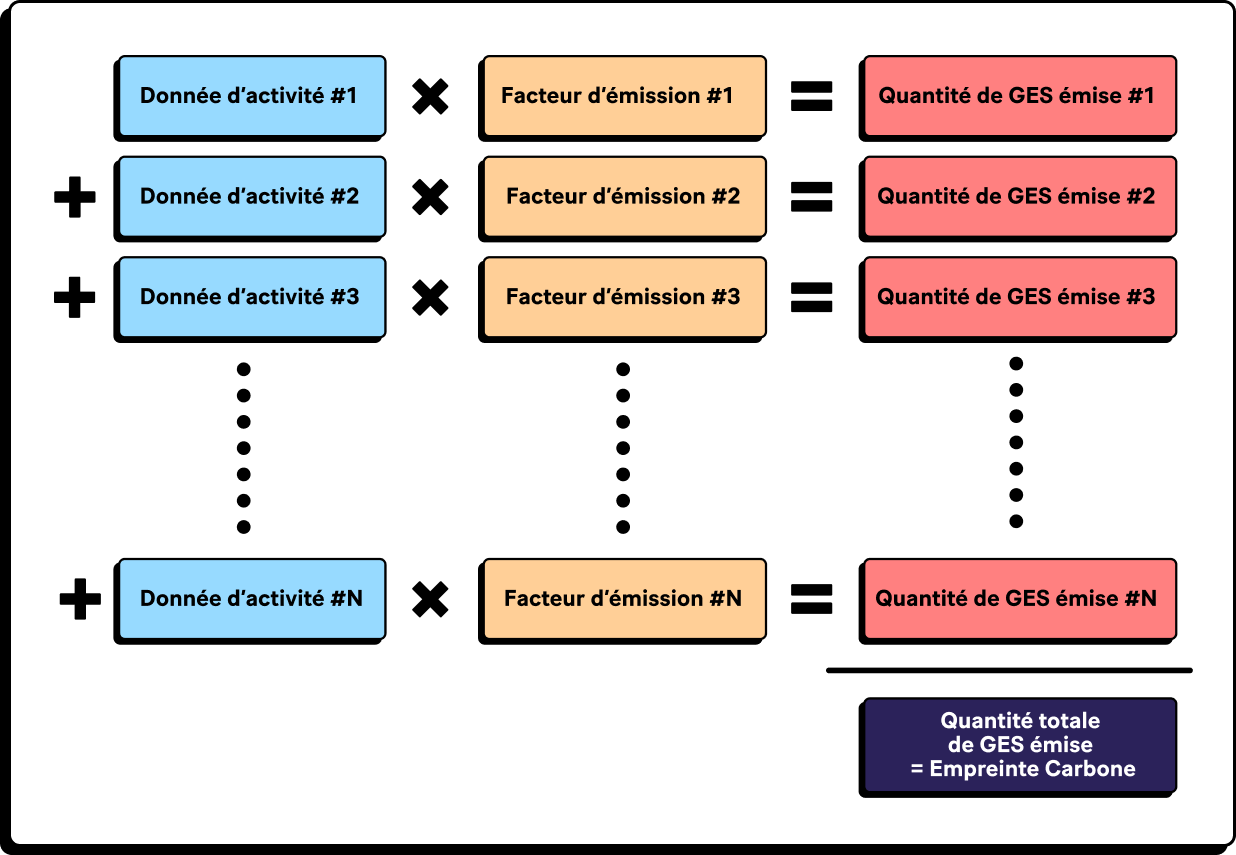
Every purchase, unit of electricity consumed, journey taken, and so on, translates into a quantity of GHG emissions. To carry out a carbon footprint assessment, you need to collect the company's activity data. This data is then combined with a corresponding emission factor, which allows you to calculate its carbon equivalent.
Lists of emission factors are made available to companies by ADEME and other sector bodies so they can measure their GHG emissions as precisely as possible.
There are 2 main types of emission factors: physical factors and monetary factors.
Physical emission factors measure emissions based on a physical unit of activity (e.g., kg CO₂e per litre of fuel consumed, tonne of product, or kWh of electricity). These are used when activity data is expressed in physical units.
Monetary emission factors measure emissions per monetary unit spent (e.g., kg CO₂e per euro spent). These are used when only financial data (spending) is available, for example, to estimate the emissions of a supply chain without detailed data.
- The first solution—the preferred one—is therefore based on the unit of the product (kg, litre, m²).
It specifies the quantity of CO2 per unit of product.
GHG quantity = Quantity consumed x Physical emission factor
E.g.: 2 kg of beef (quantity consumed) x 38 kg CO2 (specific emission factor) = 76 kg CO2
- The second calculation method takes into account the monetary factor.
GHG quantity = Price x Monetary emission factor
E.g.: €35 (price of 2kg of beef) x 21.78 (monetary emission factor) = 43.5 kg CO2
Note that ADEME and the Association pour la transition Bas Carbone now advise against using monetary factors, since these are influenced by price variations and do not always directly reflect associated emissions. Nor do they help identify emission-reduction levers (other than buying more cheaply, which can sometimes even lead to higher emissions).
What is the Bilan Carbone® method?
The creation of the Bilan Carbone® method and its developments
The Bilan Carbone® method was developed under the impetus of ADEME and initially led by Jean-Marc Jancovici. Officially launched in 2004, it is a standardised method for measuring companies' direct and indirect greenhouse gas emissions, thereby harmonising carbon accounting practices. It is a registered trademark.
In 2011, management of the method was transferred to the Association Bilan Carbone, now the Association for Low-Carbon Transition (ABC). Today, the Bilan Carbone is in its 9th version.
It grew in importance with Article 75 of the Grenelle II law, which made it mandatory for certain companies and local authorities to carry out a GHG assessment, the regulatory BEGES, which the Bilan Carbone® method can be used to meet.
The Bilan Carbone® method is also compatible with the requirements set out by the CSRD under ESRS E1.
The objectives of the Bilan Carbone® method
The Bilan Carbone® method has three main objectives:
- Mobilise internal and external stakeholders by raising their awareness, giving them ownership, and involving them all in the co-construction and monitoring of the changes linked to the transition plan.
- Account rigorously and comprehensively for all direct and indirect greenhouse gas (GHG) emissions, taking into account the organisation's scopes of responsibility and dependency.
- Develop an ambitious, operational transition plan to reduce GHG emissions and vulnerabilities, ensuring it is effectively managed and consistent with the emissions assessment.
The 7 main steps of the Bilan Carbone® method
The 9th version of the Bilan Carbone® method is structured around 7 main steps, which we detail below.
1. Scoping your Bilan Carbone® approach
First, the organisation must establish its level of maturity in carbon accounting and its transition journey. Is this its first time measuring its emissions? What resources is it mobilising? What are its expectations and objectives? The Bilan Carbone® method is divided into three main levels: Initial, Standard, and Advanced. These help define a level of rigour suited to the company.
The next step is to appoint a lead responsible for running the Bilan Carbone® project within the organisation. They will be at the heart of the process. Their role is that of a conductor. They are not meant to single-handedly carry out the process of measuring the company's carbon footprint and implementing the action plan. This is an effort that must be carried out collectively. The lead will need to raise awareness among and mobilise management and operational teams, define collection processes, centralise the data, and carry out the initial analyses together with operational teams in order to identify, with them, concrete ways to implement the company's climate action plan.
This first step is also when objectives are defined. These must be the subject of a formal, written commitment from the company's management. As a prerequisite for any Bilan Carbone®, these objectives will help better define the scope of study and the data collection and processing process that will be at the heart of the Bilan Carbone® approach.
2. Setting the boundaries of the approach
The second step of your corporate carbon footprint assessment requires setting the boundaries that will be taken into account when accounting for greenhouse gas emissions.
Defining emission boundaries requires first creating a flow map. As its name suggests, this is a map that lists the energy flows, raw materials, waste, and incoming and outgoing products within an organisation. This tool, both strategic and operational, helps identify the main sources of emissions, the interactions between activities, and opportunities to reduce the carbon footprint.
Based on this flow map, 3 emission boundaries can be distinguished within a company, which will be taken into account when accounting for GHG emissions.
- The organisational boundary covers all the sites and facilities of your organisation.
- The operational boundary accounts for direct and/or indirect emissions resulting from your company's activities, distinguished into three separate families, known as Scopes 1, 2 and 3
- The time boundary, over an observed period – generally 1 year – allows you to collect the GHG emissions data on which your carbon footprint assessment is based.
To make it easier to calculate GHG emissions (the operational boundary), these are divided into 3 scopes.
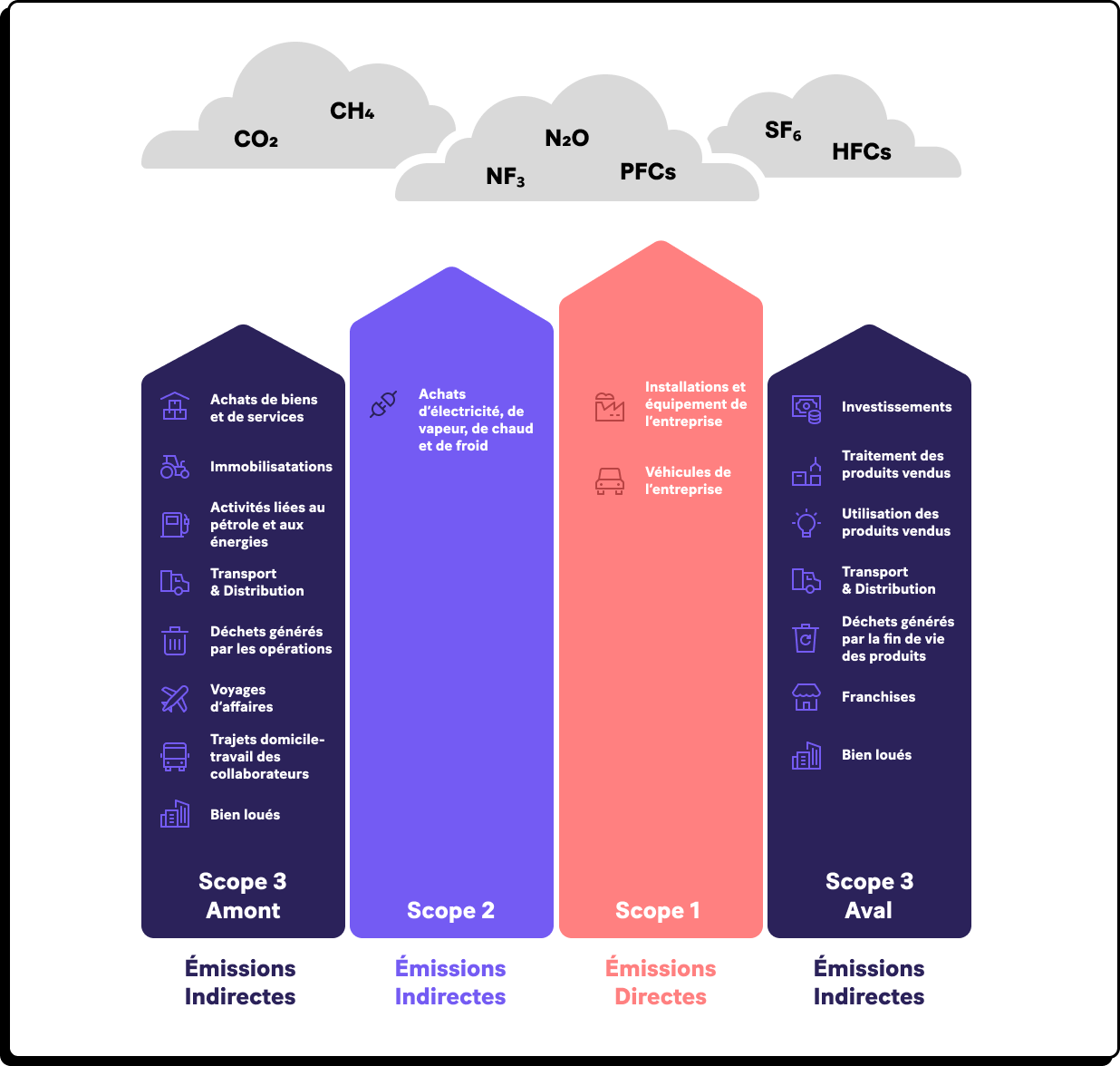
Direct emissions
- Scope 1 (the company's assets) comes from fixed and mobile sources.
It accounts for direct emissions linked to energy combustion: oil, gas, coal (examples: heating buildings, running vehicles, etc.)
E.g.: in the case of a logistics company, emissions from company-owned delivery vehicles.
Indirect emissions
- Scope 2 covers CO2 emissions linked to electrical energy, the intensity of which depends on the country's energy mix (building electricity, electric vehicles, etc.)
E.g.: in the case of a restaurant, refrigerant fluid in the fridges needed to store food.
- Scope 3 (the widest-ranging) covers all other emissions not associated with the direct manufacturing of your products or services. It is itself divided into two categories.
Upstream:
This corresponds to purchases of supplies and services: manufacturing, transport, packaging, etc. It accounts for the direct emissions of subcontractors and suppliers. It also includes business travel by air, rail and car, along with emissions from employees' home-to-work commutes.
Downstream:
This accounts for downstream transport of goods, as well as all emissions linked to waste and the life cycle of the products and services sold.
3. Planning the mobilisation steps
This step, recently added in the 9th version of the Bilan Carbone® method, aims to mobilise the various stakeholders who will be involved in measuring your GHG emissions, as well as in defining and rolling out your sustainable transition plan.
Mobilisation must take place across all the steps of your Bilan Carbone® approach and will involve all your internal and external stakeholders. Preparing this mobilisation is therefore essential to ensure the various phases of your Bilan Carbone run smoothly.
This mobilisation consists of the following elements:
- Awareness-raising and simplification: at the scoping and objective-setting stage (step 1), this should make it easier to understand the approach and why it's needed
- Ownership: this phase should make it easier to identify emission sources and the data that will need to be collected, while involving the stakeholders contributing to the exercise (steps 2 and 4)
- Co-construction: the aim is to give ownership to the various stakeholders around building a sustainable transition plan, to make its subsequent implementation easier (step 5).
Reporting and communication: this is about ensuring all relevant stakeholders can take ownership of the results and identify the key issues linked to the organisation's Bilan Carbone® approach (step 6)
4. Collecting and processing data
After these 2 preparatory steps, the third phase brings you to the heart of measuring your carbon footprint. This involves identifying and then collecting the data that will be used to calculate the greenhouse gas emissions generated by your organisation within the scope of analysis you defined in the second step of your Bilan Carbone.
This data, coming from your entire value chain, is both internal and external to your company. Collecting it therefore requires implementing a rigorous process.
- Take the time needed to identify all the data required to obtain a reliable measurement of your carbon footprint
- Appoint contacts at your main sites or emission sources who will be responsible for reporting information back to the lead and documenting it
- Make sure you have the time needed to collect, then process, and finally analyse this data, which can number in the thousands; given the scale of the task, it needs to be spread out over a sufficient period of time to collect quality data
The data collected will then be matched with physical or monetary emission factors, which convert this data into tonnes of CO2 equivalent. For each emission factor, the organisation must transparently state the degree of uncertainty associated with it.
Analysing this data will, after the first exercise, help identify the main emission sources. These are the ones that need to be addressed as a priority in order to reduce your carbon footprint. This analysis will also help you define how much leeway you have to act on the emission sources you have identified. Indeed, it is often more complex, for example, to act on emissions generated within your company's Scope 3, since these depend on stakeholders external to your organisation.
In subsequent exercises, the analysis phase must include a comparison with data from previous periods. Have emission levels been reduced? What actions led to this result? Could external factors or structural changes within my organisation have affected this result?
The exercise will be repeated over periods corresponding to the time boundary you defined in step 2.
5. Establishing a transition plan and defining monitoring indicators
Based on the data collected and the analysis carried out during the third step of the Bilan Carbone® method, the lead must build a transition plan.
This plan must include emission-reduction targets, a list of actions defined together with a technical committee responsible for implementing it, and a decarbonisation trajectory aligned with these targets and actions.
The short- and medium-term actions in this action plan will be classified into two categories:
- immediate actions: these are actions that can be activated quickly and easily, and which help mobilise teams to implement the action plan
- priority actions: these are short- or medium-term actions that will have a strong impact on reducing GHG emissions
Each action included in this transition plan must follow a precise protocol and have:
- one or more objectives
- result-tracking indicators
- one or more project leads
Finally, for each action, you will need to specify its exact rollout, the stakeholders involved in implementing it, the budget allocated, its planned timeline, and finally the potential obstacles and facilitating factors for carrying it out successfully.
As the various GHG assessments are carried out over time, the implementation of each action and its results will be reassessed against the targets set, in order to adjust some or all of the elements needed to achieve the final expected results.
6. Summarising and reporting on the Bilan Carbone® approach
The organisation must summarise its Bilan Carbone® approach in a document intended for management, complying with the principles of the Bilan Carbone®. This report, produced by the lead with input from internal stakeholders, can include the Bilan Carbone® logo if it follows the official recommendations of the Association pour la transition Bas Carbone. It must inform stakeholders and make it easier to verify the approach taken.
This report must include:
- A description of the organisation
- A presentation of the lead responsible for the Bilan Carbone® approach within the organisation
- The flow map
- The chosen time boundary
- A description of the chosen organisational boundary and, where necessary, a justification for that choice
- A description of the data collection process implemented
- The organisation's GHG profile, listing CO2 emissions
- The chosen reference exercise and its GHG profile
- Justification for any changes made to the reference exercise
- Documentation of the emission factors used
- The uncertainties associated with the GHG profile
- The quantified map of the organisation's energy and material flows
- The GHG-related risks and opportunities facing the organisation
- The lead's recommendations and the action plan initiated by the organisation
- The monitoring indicators defined to track this action plan
- An assessment of the action plans already launched
- The organisation's transition vision
- Indicators for monitoring the organisation's activity data
- A statement indicating whether the Bilan Carbone has been verified by a third party
An improvement report must also be drawn up. This document helps ensure the continuity and improvement of the carbon accounting process. It includes:
- An assessment of compliance with the principles of the Bilan Carbone® method.
- The objectives and the improvements needed to achieve them.
- Identifying errors or omissions in emissions accounting.
- Reviewing feedback on awareness-raising initiatives.
- Proposing improvements (e.g., automating data collection or incorporating specific emission factors).
- This report may be submitted for external verification to enhance its credibility.
Finally, the report's findings must be presented to the technical team and management, focusing on priority and immediate actions.
The organization can further strengthen its GHG strategy by leveraging best practices from other organizations or sector-specific guides, such as those provided by ADEME. These additional initiatives must be documented and justified.
7. Assessing the quality of the Bilan Carbone®
This final, optional step encourages organizations to have the quality of their Bilan Carbone® process assessed by independent evaluators. This process must follow a strict framework, which, upon completion of the audit, allows the Bilan Carbone® to be certified as compliant with the ABC methodology.
What are the benefits of conducting a carbon footprint assessment for a company?
Improving the company's carbon footprint
A carbon footprint assessment provides a company with visibility into its emissions.
Beyond providing a detailed look at your emitting activities, it allows you, through specific measures, to find concrete solutions to reduce your highest-impact activities.
E.g.: Reducing travel, decreasing or changing energy consumption, limiting waste, favoring short supply chains, replacing certain purchases with lower-emission alternatives, etc.
Engaging your employees and improving your employer brand
Involving employees and staff in a CSR strategy helps the company ensure that reduction actions are effectively implemented.
It is also worth noting that employees are generally sensitive to their company's commitment to climate issues and its approach to sustainable development.
Reducing costs and improving competitiveness
And yes, reducing your carbon footprint can also mean saving money!
The carbon footprint assessment highlights certain expenses and allows you to take action or invest to reduce them over the medium term.
How? For example, by reducing energy costs: switching to low-energy lighting or changing work habits (turning off computers and lights, etc.).
You can also gain a competitive edge, as a carbon footprint is becoming an increasingly important criterion for procurement departments. It is sometimes even a mandatory requirement for tenders.
Securing funding more easily
Implementing a carbon strategy attracts and reassures: it helps you demonstrate a sound business model when seeking funding from banks or investors.
Anticipating the sale or growth of your company: well-established carbon accounting fosters productive discussions and builds trust with potential buyers.
Communicating with your customers
A carbon footprint assessment shows your customers, employees, and investors that your company is committed to the environment.
In recent years, consumers have increasingly favored products and services with eco-responsible manufacturing processes. Communicating your commitments and CSR approach is an asset worth highlighting.
Don't hesitate to share it transparently with your customers, suppliers, and partners through your various communication channels.
Which software should you use for a Bilan Carbone®?
Depending on the size of your organization, assessing the greenhouse gases emitted by your company can quickly seem like a complex task.
Carbon footprint software, such as the one offered by Tennaxia, can significantly simplify the process. It allows you to map your organization and set up a data collection system involving all internal and external resources that contribute to measuring your carbon footprint.
The solution, backed by the expertise of our consultants, provides a precise measurement of your carbon footprint based on quality data, always prioritizing physical emission factors and complying with the Bilan Carbone® methodology. Our carbon footprint platform then automatically matches this data with emission factors and clearly visualizes your emission sources, and therefore your levers for action.
Finally, our Reduce module lets you build and precisely manage a multi-year carbon trajectory to achieve your environmental objectives with concrete implementation. A financial analysis of the action plan, built directly into the tool, also helps estimate the costs and benefits of your transition plan in terms of CapEx and OpEx.