
.svg)





.webp)


Since the 1990s and the growing awareness of the need to combat climate change, many economic players have implemented actions to limit their environmental impact. This commitment has steadily accelerated in the face of increasingly stringent demands from consumers, investors, and the legislation emerging worldwide to guide our society toward an ecological transition.
However, this trend also led to rampant greenwashing by companies that prioritized communication over action, resulting in growing consumer distrust. This greenwashing is now gradually being replaced by greenhushing, which is a desire on the part of companies to remain discreet about any climate-related actions they may have taken.
What is greenhushing?
Greenhushing: definition
Greenhushing is a new trend that has emerged in direct opposition to the concept of greenwashing. It characterizes companies that downplay their environmental efforts and results, as well as the actions they have taken to reduce their climate impact. First mentioned in 2008 in a study conducted by the consulting firm Treehugger, this practice is becoming increasingly widespread.
While often explained by a desire to remain low-profile in the face of perceived climate inaction or a fear of being singled out by activists or NGOs regarding their carbon footprint, the causes of greenhushing are actually much more complex, and its consequences are harmful.
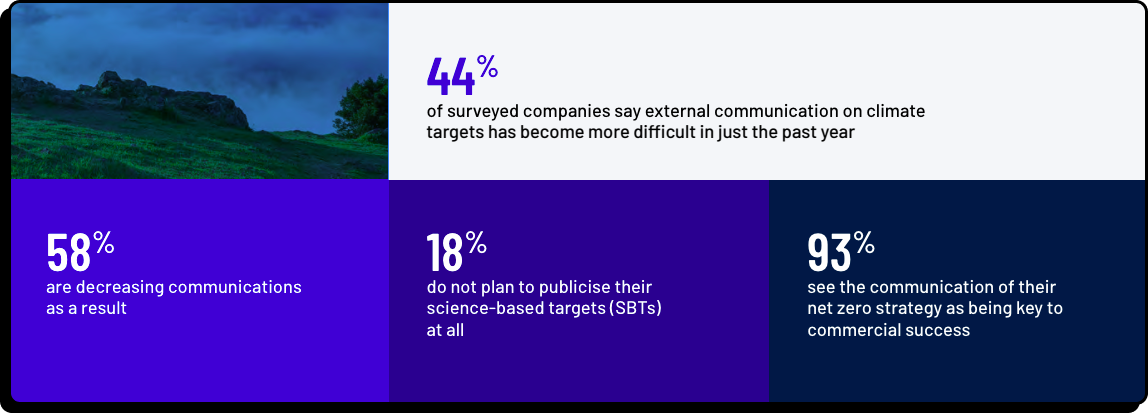
According to a study conducted by the consulting firm South Pole of 1,400 companies worldwide that have made climate commitments, 58% of them reduced their communication efforts regarding their climate goals and environmental initiatives in 2023, and 18% do not even plan to publish the SBTi targets they have set for themselves.
How it differs from greenwashing
Greenwashing Greenwashing, which saw its heyday in the 90s and 2000s, involved companies using extensive communication campaigns to tout the supposed ecological virtues of their products and services or the actions they had taken for the climate.
Claims like "environmentally friendly" or "biodegradable" have proliferated on packaging without concrete proof of environmental benefits or factual accuracy. An airline could blithely claim to be carbon neutral by investing in carbon credit programs on the other side of the world, while simultaneously casting aspersions on projects that were initially intended to be virtuous.
Conversely, greenhushing drives companies to remain silent about, or even hide, their climate goals, environmental efforts, or the ecological performance of their products.
Why are companies turning to greenhushing?
While we can identify reasons for this growing trend toward greenhushing, in the absence of concrete results, we can only speculate.
Increasingly demanding stakeholders
The fight against global warming involves all members of our society, and many have raised their expectations in recent years, especially in the face of the looming climate crisis.
A study conducted by Goodvest in 2023 pointed out that 75% of French people are skeptical of corporate environmental claims and 72% of them want these claims to be better regulated.
This consumer distrust is accompanied by rising demands from investors, who are increasingly scrutinizing corporate climate goals and relying solely on tangible data to conduct their analyses.
Better safe than sorry: companies prefer to lower their climate targets or keep them quiet rather than face the distrust of stakeholders essential to their business model.
Increasingly restrictive legislation
In response to erratic environmental communications that could mislead consumers, new laws have emerged around the world, drastically regulating these practices. These laws have often gone hand-in-hand with new regulations aimed at increasing corporate transparency regarding the disclosure of environmental data.
France has been a pioneer in this area with the Climate and Resilience Law of 2021, which regulates misleading commercial practices regarding environmental claims. Since January 1, 2023, it has been prohibited to label a product or service as "carbon neutral," "biodegradable," or "environmentally friendly" without tangible proof.
At the European level, a law was passed with similar terms in January 2024 by the European Commission, banning all unsubstantiated environmental claims and prohibiting the promotion of carbon neutrality based solely on greenhouse gas emission offsetting processes. EU member states now have two years to implement this into their national legislation.
In parallel, various laws from the European Green Deal have established standards for environmental data disclosure to ensure that every company is transparent and follows a common framework. Notable examples include the CSRD, the SFDR , and the CSDDD.
While necessary, this regulation has had the unintended side effect of pushing companies toward excessive caution, which in turn has contributed to greenhushing.
Risky communication
CSR communication remains a sensitive subject within organizations. Companies often lack clear data on the results of their actions and are therefore hesitant to communicate openly. They fear being exposed to harsh criticism and being confronted with their own contradictions. The risk of a PR backlash could outweigh the benefits of a communication campaign, ultimately damaging their brand image.
Evolving governance models
Governance models have also played a role in the shift from greenwashing to greenhushing. While CSR was once largely the domain of corporate communications departments, it now often has its own dedicated division due to its growing importance within organizations.
However, CSR professionals—particularly those focused on carbon issues—are not communications experts. Given the new regulations, these departments are mostly made up of engineers and data professionals whose primary goal is to analyze the current situation, set clear objectives, and implement concrete actions to reduce their company's environmental impact. Communication is by no means their priority, and it should only take place once all data has been validated. Furthermore, these departments often remain relatively isolated within organizations, even though this model has evolved in recent years to see CSR integrated into executive management.
What are the consequences of greenhushing?
Compared to greenwashing, greenhushing might seem like the lesser of two evils at first glance. However, some of the consequences of this practice are harmful to the company, its stakeholders, and society as a whole.
Greater corporate accountability
Is greenhushing a cause or a consequence of greater corporate accountability?
The problem is complex. Nevertheless, it has allowed many companies to better gauge their responsible communication campaigns and demonstrate greater transparency to their various stakeholders by prioritizing concrete, sourced, and high-quality information. The main benefit of greenhushing remains that it has put an end to greenwashing.
It therefore signals a better management of environmental data by companies and forces them to set achievable goals and implement concrete action plans, a prerequisite for eventually communicating about them, should they choose to do so.
But a risk of invisibilization and a reduction in ecological initiatives
However, staying silent about environmental efforts inevitably has damaging effects.
- Companies may be reluctant to commit to the environment.
By preventing themselves from communicating about their environmental actions, companies may find the cost-benefit analysis too skewed to truly commit to sustainable development. The fear of doing it wrong or not doing enough can ultimately lead to lowering environmental targets or even stopping all action. Yet, the fight against global warming requires committing to ambitious goals and creating a ripple effect internally, mobilizing the company's employees.
- A loss of trust and missed opportunities
A company that hides its sustainability efforts may arouse suspicion among its customers, investors, and other stakeholders. They may feel that the company is not sincere in its ecological commitment or that it is not doing enough. The first risk is therefore creating a Streisand effect: by concealing information, a company may, on the contrary, become a center of attention. The second risk is missing out on opportunities that would allow it to build a real competitive advantage, whether with its customers or potential investors.
- Reduced ripple effects for businesses
Communicating about sustainable initiatives generally creates a ripple effect that encourages competitors to adopt similar practices. This effect is a key driver of progress toward sustainability, as it helps spread best practices and encourages systemic change. Greenhushing breaks this ripple effect by depriving other companies of valuable sources of inspiration and information.
Businesses: how to avoid greenwashing without falling into the greenhushing trap?
Ultimately, greenhushing may be an easy way out for many companies. But its adverse effects can cast a negative shadow over your operations, fueling distrust and dissatisfaction among both internal and external stakeholders.
However, it is possible to communicate about your environmental actions without falling into the greenwashing trap.
Be confident in your carbon data
Communicating about your goals, actions, and progress in the fight against global warming first requires relying on concrete, reliable, and verifiable data. By establishing a process for collecting environmental data year after year, you will be able to demonstrate transparency by providing clear and objective information to your stakeholders.
This is also the primary objective of the CSRD. It provides a framework and a CSR reporting methodology that harmonizes non-financial reporting across the European Union, making it easier to process and compare. Tools like Tennaxia ESG also allow you to simplify the collection of environmental data and publish it in the formats required by the main global non-financial reporting standards.
Develop a real strategy
By leveraging the data collected, you will be able to implement a serious decarbonization and impact reduction strategy. This involves setting short-, medium-, and long-term goals, assessing their feasibility and cost, and finally, putting them into action. Establishing a climate trajectory based on concrete data allows you to communicate transparently with your stakeholders and build confidence in the seriousness of your carbon emission reduction targets. It is also a way to build a competitive advantage by meeting consumer expectations and securing funding for future developments by reassuring investors, who are increasingly eager for this type of information.
Communicate responsibly
The final step is to communicate transparently and, above all, objectively. Collecting data and establishing a carbon trajectory allows you to make a concrete commitment. There is no need to use superlatives or exaggerate the environmental performance of your products and services. Your responsible communication must be based on sourced, audited, and verifiable information. This is exactly what will make the difference between environmental communication and greenwashing, and between you and your competitors.
Conclusion
While greenwashing has not completely disappeared, its significant reduction, driven by scandals and legislation, has been largely beneficial. Nevertheless, the parallel—and ultimately quite logical—development of greenhushing also has its harmful effects. However, silence is not the best solution to poor communication.
Companies must relearn how to communicate about their environmental commitments. This is all the more important as pressure from stakeholders on this subject continues to grow. To this end, frameworks and methods exist that allow economic actors to communicate more effectively.
Their recent development may, however, suggest that greenhushing is only a transitional phase. Having often communicated recklessly for years, companies must now build ambitious climate strategies based on concrete data—but Rome wasn't built in a day. Let us hope that the implementation of these climate trajectories and the collection of initial results will encourage companies to communicate again and create the momentum needed to guide society toward global carbon neutrality.
Sources:
- “Is greenhushing a counterproductive trend?”, Enola Gambey, L’Assurance en Mouvement, 02/29/2024
- “After greenwashing, greenhushing?”, Mathis Navard, The Conversation, 02/11/2024
- “Stopping greenwashing: how the EU regulates green claims”, European Parliament, 01/15/2024
- “‘Greenhushing’: Why some companies quietly hide their climate pledges”, Maxine Joselow, The Washington Post, 07/13/2023
- Greenwashing: French people don't believe corporate promises, according to a Poll&Roll survey for Goodvest, Cdurable, 05/30/2023
- Advertising: the fight against greenwashing is underway, notre-environnement.gouv, 04/20/2023
- “Going green, then going dark – One in four companies are keeping quiet on science-based targets”, South Pole, 10/18/2022