
.svg)





.webp)


The ACT method, for Accelerate Climate Transition (formerly Assessing Low Carbon Transition), has become an international benchmark for supporting companies that want to launch a decarbonisation plan for their activities and contribute to global carbon neutrality.
Through ACT Step-by-Step and ACT Evaluation, its original purpose is to guide companies in implementing the most effective action plans to reduce their greenhouse gas emissions.
Its new methodologies, ACT Adaptation and ACT Biodiversity, now extend its area of expertise to climate topics more broadly, which also explains the recent change in the meaning of its acronym.
A closer look at an initiative that, thanks to its recognised educational approach, is winning over an increasing number of companies around the world
What is the ACT (Assessing low Carbon Transition®) initiative?
Created in 2015 on the initiative of ADEME, the Carbon Disclosure Project (CDP) and the World Benchmarking Alliance (WBA), the ACT initiative has helped support more than a thousand companies in their decarbonisation efforts. It is part of the Global Climate Action Agenda set up by the United Nations and is supported by the French government.
Particularly widely used in France, its country of origin, it is now expanding internationally, notably in Japan and Latin America.
Originally, the ACT programme aimed to establish a methodology for assessing companies' commitment to reducing their GHG emissions. Today, this programme has expanded to go beyond simple assessment.
The ACT initiative currently consists of 3 programmes:
- ACT Step-by-Step to support companies in building their decarbonisation plan
- ACT Evaluation to assess the results of a company's climate strategy and identify areas for improvement
- ACT Adaptation, the newest addition to the initiative, to support companies in adapting their activities to the consequences of climate change
ACT: a sector-based methodology
The ACT Initiative aims to be universal and is intended to support all private-sector players, whether large groups or small businesses, regardless of their location or industry.
To this end, it has developed specific methodologies for the sectors of activity considered a priority in implementing a decarbonisation trajectory:
- Automotive
- Electricity
- Retail
- Cement
- Transport
- Oil and gas
- Construction
- Real estate
- Property development
- Iron and steel
- Aluminium
- Pulp and paper
- Glass
- Chemicals
A generic method is designed to support other sectors, in particular mining, industry, services, water management and waste management.
Three sector-based methodologies are currently being tested:
- Agriculture and agri-food
- Banking
- Financial services
Everything you need to know about ACT Step-by-Step
ACT Step-by-Step is a methodology designed to support companies in structuring and implementing their decarbonisation strategy. Ultimately, it should help them best prepare for ACT Evaluation, but it does not guarantee a good rating, which depends solely on the efforts the company makes over time.
What are the objectives of ACT Step-by-Step?
ACT Step-by-Step meets two main objectives:
- Ensuring the company actively contributes to mitigating global warming by reducing its direct and indirect GHG emissions as much as possible across its entire value chain
- Supporting the company's transformation towards a transition to a low-carbon world. This involves identifying the factors that will affect its development as part of this transition, and helping it factor these elements into the development of its business strategy and its climate strategy.
How is ACT Step-by-Step organised?
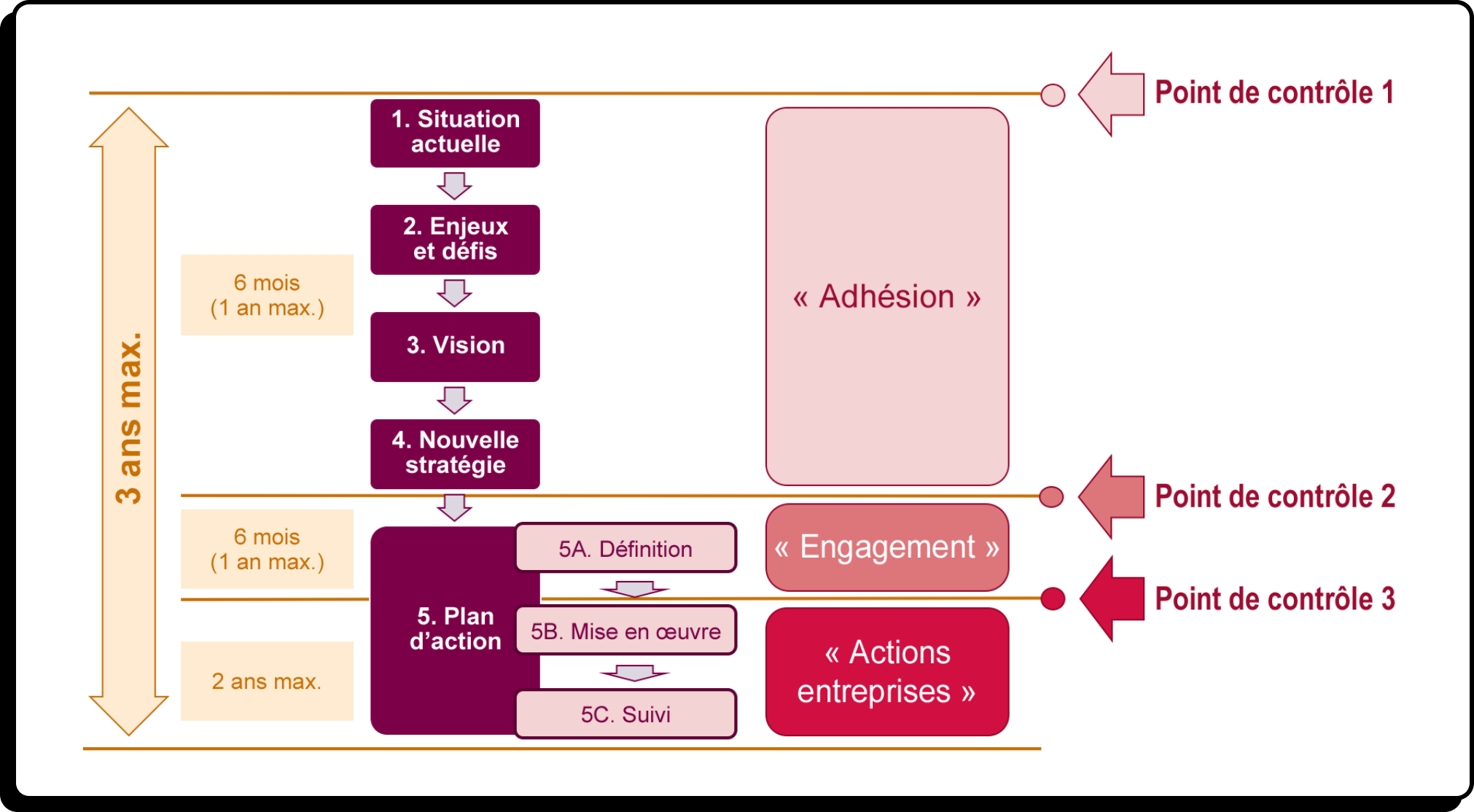
ACT Step-by-Step is a process comprising 4 strategic levels, 5 stages and 3 checkpoints, spread over 2 years. At each stage, the organisation can draw on specific decision-support tools to help formalise its analysis and reporting.

The five stages that make up the ACT Step-by-Step methodology should ultimately enable the company to begin its low-carbon transition. They are structured as follows:
- Current situation: this involves carrying out an initial diagnostic of the maturity of the organisation's decarbonisation strategy and of the actions already undertaken.
- Issues and challenges: using a SWOT matrix, the company must analyse its strengths and weaknesses as part of the transition to a low-carbon world, identify its performance indicators along with the reference trajectories it associates with them, and assess its current performance against the targets it has set. This stage also includes a training phase for board members on climate issues.
- Vision: this involves developing a vision of the company in a low-carbon world and establishing a roadmap to achieve it. This stage requires formal approval of this vision by the company's board of directors.
- New strategy: the company must set new targets and implement a strategic plan to achieve them. The board of directors must formally approve these targets and this strategic plan.
- Action plan: in this final stage, the company must identify and implement the concrete actions needed to implement its decarbonisation strategy, and monitor the results of this action plan.
The ACT Step-by-Step programme places these 5 stages within 4 strategic levels of the company:
- Governance: the company's governance processes regarding its carbon strategy.
- Strategy: measuring the actual and potential impacts of a low-carbon society on the company's activity, from both an operational and a financial standpoint.
- Managing the low-carbon transition: the processes the company has put in place to carry out its transition to a low-carbon world.
- Indicators and targets: the targets it has set for itself, and the relevant measurement tools used to assess its decarbonisation strategy
The table below helps visualise how these 4 strategic levels are organised across each stage of the ACT Step-by-Step methodology.

Throughout this process, various checkpoints validate the company's commitment and allow it to move on to the next stages. They are also a prerequisite for the ACT Initiative to authorise the company to publicly communicate on its progress within the ACT Step-by-Step programme.
Companies have a limited amount of time to validate each of these checkpoints.
- Commitment: this checkpoint is validated at the end of the first 4 stages of the ACT Step-by-Step methodology. It validates the commitment of the company and its management to the project.
- Engagement: this checkpoint takes place during stage 5. It must validate the company's and its management's concrete commitment to its decarbonisation strategy, as well as the definition of GHG emission reduction targets.
- Actions undertaken: also located in stage 5, this final checkpoint validates the implementation of the action plan the company has committed to.
Taking part in the ACT Step-by-Step programme requires at least one person within the company to have completed and validated ADEME's training programme dedicated to this methodology.
That said, it is also strongly recommended to have the approval of the company's board of directors, or even for the project lead to be a board member themselves, and for the company to have already carried out an initial Carbon Footprint assessment within the past two years.
The project team must include the project lead, a coordinator, and a team representing the company's main operational units. Depending on the size and specifics of the company, it may also call on specialised consultants trained in the ACT Step-by-Step methodology, as well as external stakeholders able to actively contribute to the smooth running of the programme.
Understanding ACT Evaluation
ACT Evaluation is the original programme of the ACT Initiative. As its name suggests, it is a process for assessing a company's decarbonisation strategy. It takes place over 5 months and is carried out by independent third parties to ensure the transparency of the process.
How does the assessment process work?
Companies are asked 5 main questions, which assess their level of commitment, their credibility in the fight against global warming, and how well their current strategy aligns with the targets they have set themselves. The answers to these questions must include both quantitative and qualitative elements.
They provide a comprehensive view of the company's track record on climate commitment, its current decarbonisation actions, and the targets it has set for the future.
The 5 questions asked as part of the ACT assessment are as follows:
- Targets: What are the company's targets?
- Transition plan: How does the company intend to achieve them?
- Present: What are the company's current actions?
- Legacy: What is the company's recent track record of action?
- Consistency: How consistent are these actions and targets overall?

A greenhouse gas emissions assessment for the company must have been carried out beforehand. For this exercise, the ACT Initiative relies on the methodologies developed by the GHG Protocol and standard ISO 14064.
How does the ACT Evaluation scoring system work?
ACT Evaluation scoring takes into account three scores, which ultimately determine the company's overall rating:
- The performance score, rated from 1 to 20
- The consistency score, rated from A to E
- The trend score, which is more specific. A “+” indicates an improvement, a “-” a decline, and an “=” a stable state.
The best possible rating would therefore be 20/A/+, and the worst 1/E/-.

The performance score is calculated based on an analysis carried out across 9 modules:
- Targets set
- Tangible investment
- Intangible investment
- Product performance
- Management
- Suppliers
- Clients
- Engagement policy
- Business model
The consistency score is also based on the answers given as part of this initial analysis. They allow the assessor to check the consistency of the actions taken by the organisation in light of its commitments and targets. To do this, it draws mainly on:
- The company's business model and strategy
- The consistency and credibility of the actions put in place
- The organisation's reputation
- The risks the company faces
Finally, the trend score is based on the same answers and aims to assess a potential change in the company's decarbonisation strategy and related results. It draws in particular on:
- The likely changes in GHG emissions
- The expected evolution of the business model and strategy
ACT Adaptation – a new methodology to support companies' resilience to climate change
The newest addition to the ACT Initiative, ACT Adaptation should make it possible to assess companies' ability to adapt to the consequences of climate change and to the transition to a low-carbon world.
This new methodology stems from the observation that even if we manage to limit global warming to 1.5°C by meeting the target set by the Paris Agreement, it has already had, and will continue to have, consequences for our environment and our ways of life. It is therefore important for companies to anticipate these changes as best they can.
This analysis is carried out across 3 main dimensions:
- the company's governance and strategy
- the climate and physical risks it faces
- its adaptation capacities and actions
18 indicators across 9 analysis modules are thus studied to measure the company's adaptive capacity.

Each indicator is assessed according to the company's maturity on the topic. The assessment levels are associated with a score:
- Basic (0)
- Standard (0.25)
- Advanced (0.5)
- Mastered practice (0.75)
- Best adaptation practice (1)
The final score is then broken down according to the 3 dimensions, and, via an arithmetic average, converted to a score out of 20.

At the end of the analysis, the assessor will provide the company with an overview of its current level of adaptation, along with a list of recommendations to help it improve its processes, and therefore its score.
How does the ACT method help structure your low-carbon strategy?
The ACT method offers a structured, methodological framework to help companies develop an ambitious, credible low-carbon strategy. It also makes it possible to track progress and communicate on the actions implemented.
It is both a way of showcasing companies that have implemented concrete actions to reduce their carbon footprint and set ambitious targets aligned with the Paris Agreement, and a way of supporting them in their ecological transition.
The Step-by-Step method thus allows companies to set clear, achievable targets, as well as identify the most relevant levers for achieving them, and thereby contribute to global carbon neutrality.
This methodological framework, backed by internationally recognised organisations, aims to be accessible to all economic players, while also adapting to sector-specific characteristics to better tailor action plans to each organisation's requirements.
Where non-financial reporting standards, such as CDP scoring, focus on disclosure and transparency of environmental information, the ACT method operates much further upstream by directly driving concrete action.
Sources:
- “Assessing low-Carbon Transition: Generic”, ACT Initiative, December 2023
- “With ACT Adaptation, ADEME helps companies adapt”, ADEME, 27/11/2023
- “ACT method: definition, method, benefits”, Selectra, 28/07/2023
- “ACT Adaptation methodology”, ACT Initiative, June 2022
- ACT Step-by-Step: Development project results, 02/10/2021
- “ACT Step-by-Step: methodology”, ACT Initiative, February 2021