
.svg)





.webp)


As part of the European Green Deal, the European Commission has announced plans to mobilize nearly €1 trillion by 2030 to support Europe's environmental transition policy. Its goal is to reduce European greenhouse gas emissions by 55% compared to 1990 levels and to achieve carbon neutrality by 2050.
This financing plan relies on both public and private funds. Of this €1 trillion, the EU intends to issue €250 billion in green bonds by 2026 through its NextGenerationEU program.
However, green bonds are neither new nor uniquely European. They have existed since the beginning of the 21st century. Although they were not yet called green bonds, the first ones are considered to have been issued in 2001 by the city of San Francisco to fund a solar power project.
How do they work? What is their role in financing the European and global environmental transition? How can you tell if a green bond is truly green?
What are green bonds?
First, let’s recap what a bond is.
It is a debt security issued by companies or governments and traded on financial markets. It allows these entities to borrow money from individual or professional investors to repay debts or invest in new projects.
Investors are compensated through interest payments until the invested capital is repaid. The level of risk (and return) is inversely proportional to the creditworthiness of the issuer and, therefore, its ability to repay the investor at the end of the contract term.
Green bonds operate on the same principle as traditional bonds but are intended to finance projects within the sustainable economy. They are now considered one of the primary vehicles for financing sustainable investments by companies and governments, and have seen a real boom since the 2015 Paris Agreement.
Who can issue green bonds?
Green bonds can be issued by a wide variety of entities: public or private companies, governments, local authorities, international institutions, and more.
The first bonds to bear the name "green bonds" were issued in 2007 by the European Investment Bank, followed in 2008 by the World Bank.
As for governments, France and Poland were pioneers in this area, issuing their first sovereign green bonds in 2017 to fund their transition to a low-carbon economy. Today, more than 62 countries around the world have issued sovereign green bonds, and this number continues to rise.
The distribution of issuances by issuer category varies significantly from year to year, although governments still lead the way. In 2022, the public sector accounted for 39% of issuances, financial institutions for 32%, and corporations for 29%.
A booming market
The issuance of green bonds is booming. Many stakeholders see it as an opportunity to finance a costly ecological transition, as well as a response to the increasingly stringent sustainability requirements of investors.
As of January 1, 2023, they have helped raise over $2.5 trillion worldwide and, despite a slight slowdown in 2022 caused by the crisis and inflation, the cumulative volume of funds raised is growing at a steady pace. Sustainable bonds (green bonds, social bonds, and sustainability-linked bonds) currently account for approximately 7% of the global bond market.
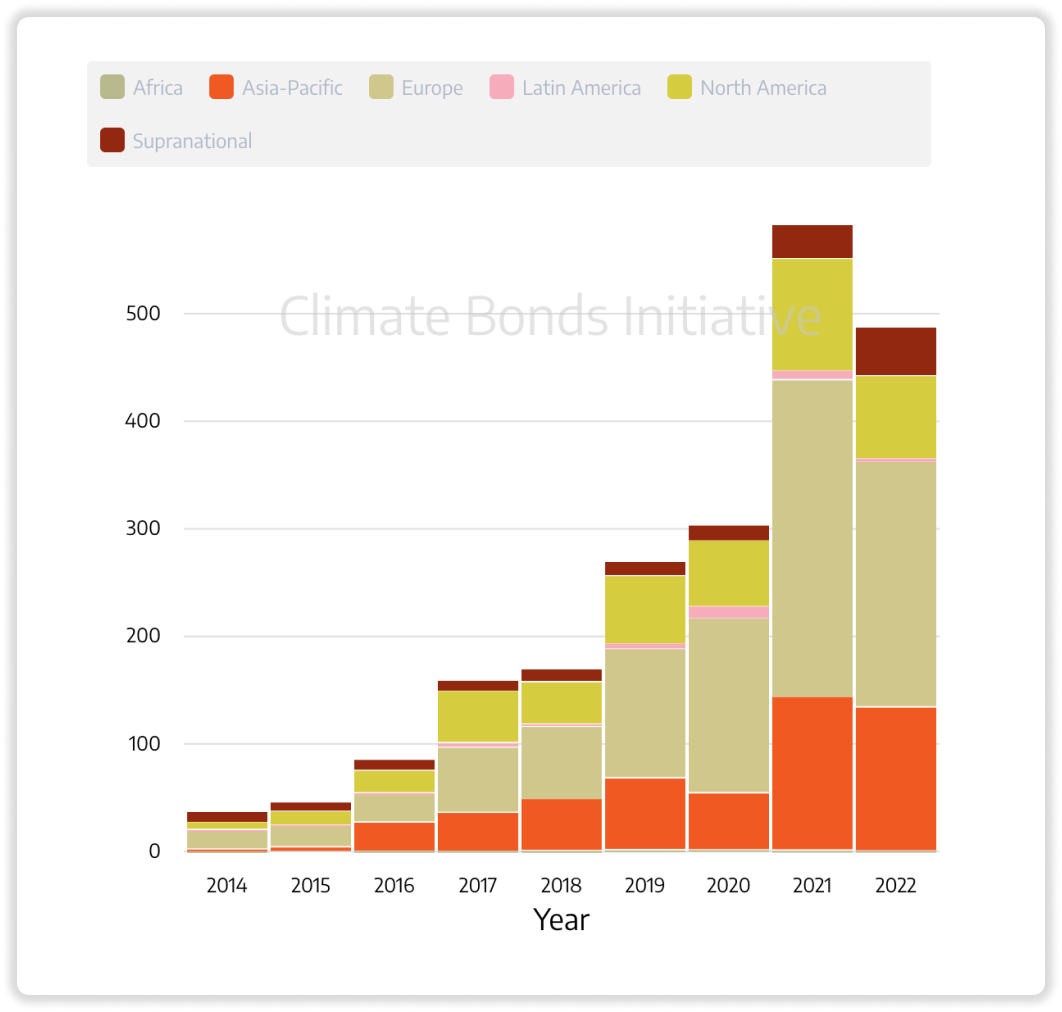
They are also a way for many countries to meet the sustainable development goals set out in the 2015 Paris Agreement. We are seeing more and more emerging countries issuing sovereign green bonds to finance their energy transition, including India, Fiji, Egypt, Thailand, and Mexico. The record is held by Chile, which has issued nearly $34 billion in sovereign green bonds.
France is not to be outdone. In 2022, it was the world's largest issuer of sovereign green bonds, having raised over €42 billion since the launch of its first green OAT (French Treasury bond) in 2017.
The European Union as a whole is the largest issuer of green bonds in the world, accounting for 43% of all green bonds issued to date. As proof of their success, in Europe, sustainable securities accounted for 25% of the volume of new euro-denominated issues in 2022.
Regulation still in progress
The rise of green bonds in recent years has led to various abuses in the use of these financial instruments. While their numbers have exploded, their reliability has also proven increasingly variable.
Some green bonds are green in name only. Until now, the definition of what constituted a green bond depended essentially on the issuer, who could therefore subjectively determine what a "green" project was. This is how some bonds were used to finance airport runways in Hong Kong.
Regarding sovereign bonds, the social and environmental responsibility of certain issuing countries, such as Saudi Arabia or Russia, also frequently raises questions.
The ability to monitor the use of funds and the actual sustainability of the projects financed remains limited, undermining the credibility of these green bonds.
Some states, particularly within the European Union, have begun to regulate the term "green bond," but without coordinating their efforts. Numerous legislations therefore coexist depending on the country, and in a fully globalized financial market, green bonds are traded without sharing the same definition, constraints, or obligations.
Several initiatives have therefore been put in place, ranging from the creation of institutions like the Climate Bonds Initiative and labels such as the SRI label, to common regulations like the one recently introduced by the European Union.
The Climate Bonds Initiative
The Climate Bonds Initiative is a non-governmental organization that aims to promote and support the development of green bonds worldwide. Its funders include foundations, public and private organizations, and the United Nations.
The Climate Bonds Initiative was the first organization to implement a certification system based on a taxonomy that identifies truly "green" bonds, thereby helping to combat greenwashing.
It works alongside states, financial players, and investors to develop a framework that encourages the issuance and promotion of green bonds.
.png)
According to the Climate Bonds Initiative, $5 trillion per year will need to be mobilized starting in 2025 to effectively combat climate change risks and meet the 1.5-degree warming limit set by the Paris Agreement—nearly 10 times the amount currently raised through green bond issuances each year.
Green bonds and the European taxonomy
Since the Paris Agreement, the European Union has implemented an active policy to develop sustainable finance as part of the European Green Deal.
The development of the green taxonomy and the implementation of the SFDR were the first milestones. The primary objective was to improve corporate transparency regarding their activities and the investment strategies of financial players.
The issue of green bonds has become increasingly prominent as they have grown across various EU countries, whether through the issuance of sovereign bonds or green bonds from private institutions or companies. Green bond issuances are also part of the European Green Deal's financing plan, notably through the NextGenerationEU program, which aims to reach an issuance volume of approximately 250 billion euros by 2026.
The value of such legislation lies in harmonizing existing regulations and providing investors with a common framework for evaluating green bonds. As the world's largest issuer of this type of debt security, the European Union needed to be able to regulate it in order to provide a clear definition of what is considered "green."
On October 5, 2023, members of the European Parliament adopted the first regulation proposal addressing green bonds. It must now be reviewed by the Council of the EU.
This regulation links the issuance of green bonds to the European taxonomy, which classifies activities based on their sustainability according to a list of strict criteria. It will thus allow investors to ensure that the bonds issued support projects considered green by the taxonomy.
The goal is therefore to create a favorable framework for the issuance of these bonds and to support their strong growth. This standard will remain optional for issuers but will allow for formal certification of the sustainability of the projects financed. It will also be open to issuers from non-EU countries wishing to benefit from the framework offered by this regulation.
To qualify for the EuGB (EU Green Bond) designation, a bond must meet several criteria:
- all funds must finance a project considered sustainable under the European taxonomy
- issuances will be audited by an external reviewer registered with ESMA (European Securities and Markets Authority)
- issuers will be subject to a list of disclosure requirements
Conclusion
Green bonds are an effective tool for the development of sustainable finance around the world. They can be an excellent way to mobilize new funds for the ecological transition of states and companies, as evidenced by their success in emerging economies.
The regulatory process currently underway within the European Union will help to better regulate this booming market and reassure investors about the sustainability of the projects financed through these debt securities.
Nevertheless, despite the growing success of green bonds since the Paris Agreement, their growth is still too slow to provide the funds necessary for this large-scale project. The volume of issuances would currently need to increase tenfold. The gradual establishment of an international market favorable to their development must now take into account the need to accelerate their issuance on a large scale.
Sources:
- “Sustainable finance: where do European green bonds stand?”, Actu-Juridique.fr, 10/10/2023
- “Word of the News - Green Bond”, Banque de France, March 2022
- “Green bonds”, WWF
- “High-flying greenwashing around a new green bond for Hong Kong Airport”, Reclaim Finance, 04/01/2023
- “Green bonds face new questions over authenticity”, Financial Time, 29/11/2021
- “Sustainable Debt Market - Summary H1 2023”, Climate Bonds Initiative, August 2023
- “$500bn Green Issuance 2021: social and sustainable acceleration: Annual green $1tn in sight: Market expansion forecasts for 2022 and 2025”, Climate Bonds Initiative, 31/01/2022
- “NextGenerationEU: European Commission successfully launches first green bond issuance to finance a sustainable recovery”, European Commission, 12/10/2021
- “‘Sustainable’ borrowing accounts for a quarter of bond issuance in Europe”, Les Echos, 21/11/2022
- “Green, Social, and Sustainability (GSS) Bonds - Market Update - January 2023”, World Bank, January 2023
- “From India to Indonesia, green bonds are helping countries shift toward sustainable development”, World Bank, 10/04/2023
- “European green bonds: Council adopts new regulation to promote sustainable finance”, European Council, 24/10/2023