
.svg)






What is a Data Platform ?
Data Platforms ,or data management platforms, emerged with the democratization of data usage and the exponential increase in data generated and processed by companies. Effective data utilization, in any field, has become a strategic advantage.
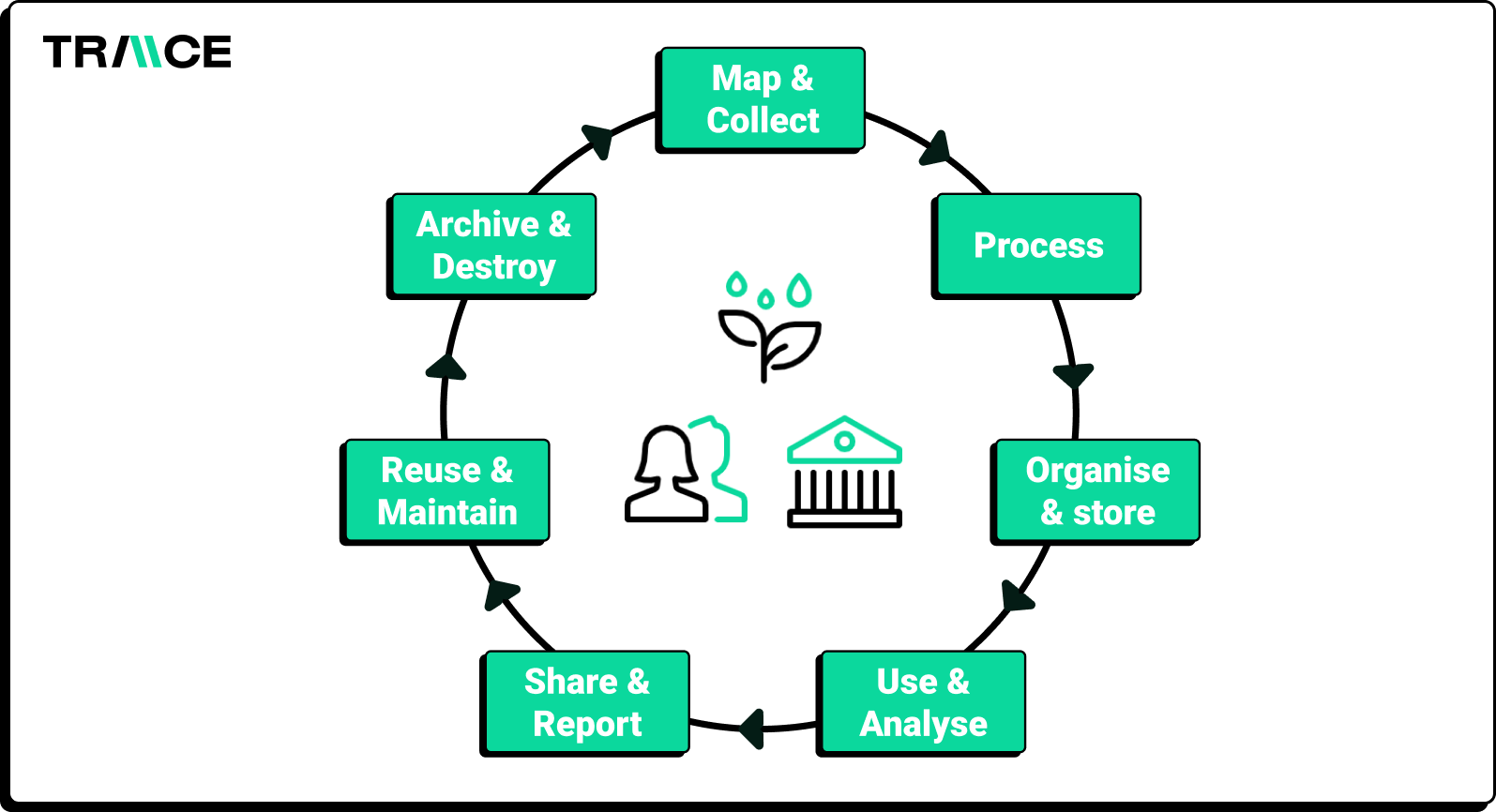
Data Platforms allow you to manage data throughout its entire lifecycle and address all the challenges raised by the sophisticated use of sensitive data in a competitive business environment:
- Where is the source data located?
- How can it be collected efficiently?
- Where should the collected data be centralized?
- What processing should be applied to obtain useful results or insights?
- How can the data be visualized for analysis?
- How can data reliability (completeness, accuracy, etc.) be ensured to make sound decisions or produce public reporting?
- How do you collaborate on a dataset?
- etc.
Why companies today need real Data Platforms for processing carbon and ESG data?
Many data platforms managing specific types of data have emerged to address data processing needs that companies previously handled by combining multi-tab Excel files with endless email chains to collect raw data and collaborate on these Excel files to manipulate and leverage that data.
As one of these needs becomes a strategic priority for the company (customer data management, inventory management, project management, etc.) the "Excel + email chains" duo reaches its limits and begins to hinder effective data utilization: Incomplete data, calculation errors, high costs for maintaining files and macros, difficulty tracking historical data, and impossible data security and analysis, etc.
This is exactly what is currently happening with the management of carbon emissions and ESG data. Most companies tackling this task have relied on Excel until now to calculate their carbon footprint or to aggregate and manage their ESG data, before eventually reformatting this data for publication in an annual report.
At Tennaxia, for example, we regularly integrate the carbon footprint measurements our new clients performed in previous years using Excel. When comparing these with the first measurement we conduct using our platform, we very often find significant calculation errors in the imported Excel files, requiring us to revisit the history of their carbon assessmentsⓇ to enable a usable analysis of carbon measurement trends. These errors are most often due to data entry mistakes or Excel file manipulation rather than errors in carbon accounting methodology.
This is why the market in which Tennaxia operates—SaaS platforms for carbon and ESG data management—was born. More and more companies are now looking for solutions that allow them to manage their impact data in an advanced way. A solution that must be user-friendly to enable collaboration across all company stakeholders, especially operational staff who are not climate experts.
A need for software tools reinforced by the entry into force of the CSRD
Beyond simple footprint measurement, mature companies have realized that modeling and managing decarbonization trajectories by entity and deploying transition action plans within their organization to stay on track is simply impossible without the right tool.
Today, the urgency for companies to truly reduce their operational carbon emissions on one hand, and the regulatory pressure to produce advanced non-financial reporting on the other—especially with the entry into force of the CSRD— makes relying solely on Excel and email-based team collaboration extremely risky for businesses.
Indeed, the CSRD is a matter of "ESG data" management, and the difficulty of the CSRD lies not so much in the number of boxes to check, but in the questions asked and the data required to answer them.
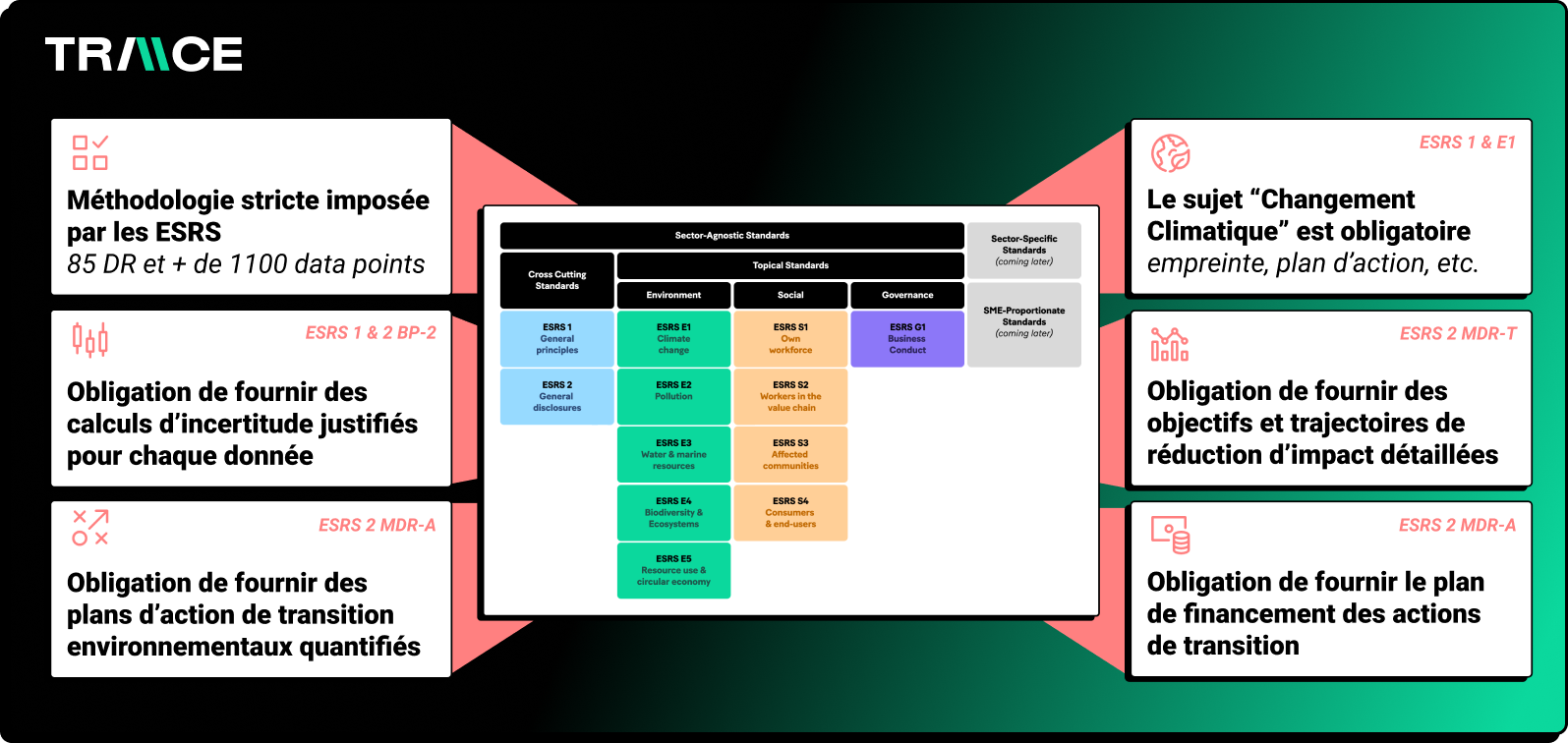
The CSRD requires organizations to achieve a level of transparency and control over their ESG data that has never been demanded before, particularly regarding the environmental aspect, with the mandatory requirement to provide:
- A complete and detailed carbon footprint measurement with a comparison to the base year and justification for any variations if the calculation scope has been modified. - ESRS 1 & ESRS E1
- Requirement to provide justified uncertainty calculations for each reported data point. - ESRS 1 & 2 BP-2
- Detailed impact reduction targets and trajectories. - ESRS 2 MDR-T
- A transition action plan with quantified impacts linked to maintaining trajectories and achieving targets. - ESRS 2 MDR-A
- A financing plan for transition actions (CapEx, OpEx, etc.). - ESRS 2 MDR-A
All these elements, combined with the need to generate future CSRD reporting files in XBRL format (digital taxonomy), make the use of ESG software almost essential.
Meeting CSRD requirements by relying solely on Excel or legacy ESG reporting tools would expose you to non-compliance, significant additional costs, and create a competitive disadvantage by incurring technical debt regarding the management of your transition plan:
- Partial and imprecise data collection
- Inability to report on impact reduction trajectories
- Inability to report on action and transition plans and their financing
- Significant expenditure on human resources, whether internal or external consulting.
- Failure to capitalize on Year 1 efforts for subsequent years.
- Team disengagement and burnout among reporting staff
- Inability to report on the progress of impact reduction efforts
The CSRD marks the end of traditional, partial, and à la carte non-financial reporting, and mandates the need for modern ESG management while reinforcing the requirement for a Data Platform tailored for Carbon and ESG.
How did Tennaxia design and build its Carbon and ESG Data Platform?
The Tennaxia ESG platform is designed as a true nerve center for all data used to analyze and steer climate and ESG strategies. Tennaxia’s goal is to make impact data actionable, enabling the construction and deployment of effective transition plans and facilitating concrete action for our clients.
The Tennaxia ESG platform serves as:
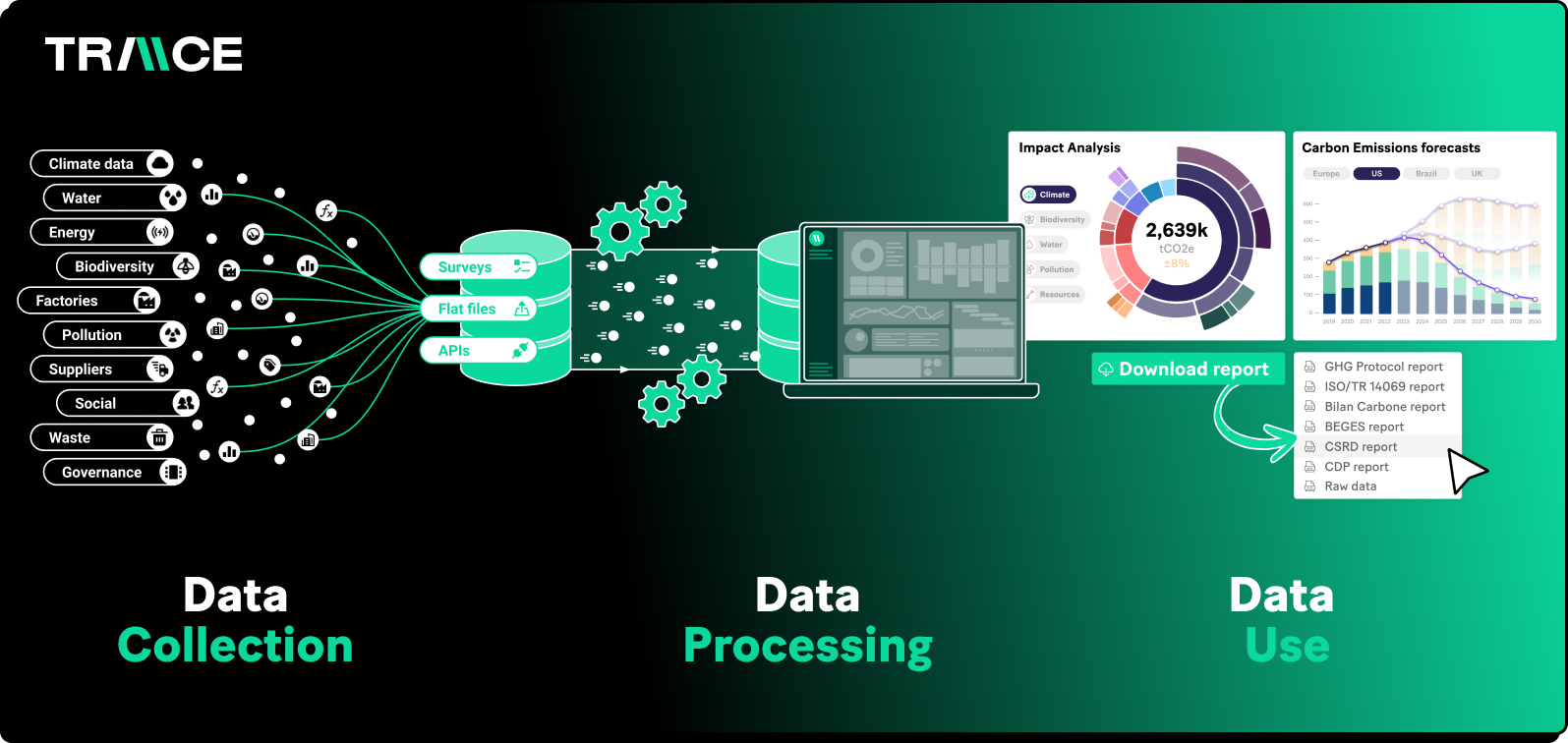
- a central repository for all ESG & Carbon data - Data Repository: data is reliable, comprehensive, accessible, exportable, auditable throughout its entire lifecycle, and, above all, secure.
- a data processing center - Processing Hub: raw data ingested into Tennaxia ESG can be manipulated, processed, converted, combined, and filtered using advanced methods to generate desired impact analyses or simulations, collaborate on datasets, and easily create custom reports at the required levels of granularity.
Key features of the Tennaxia Data Platform:
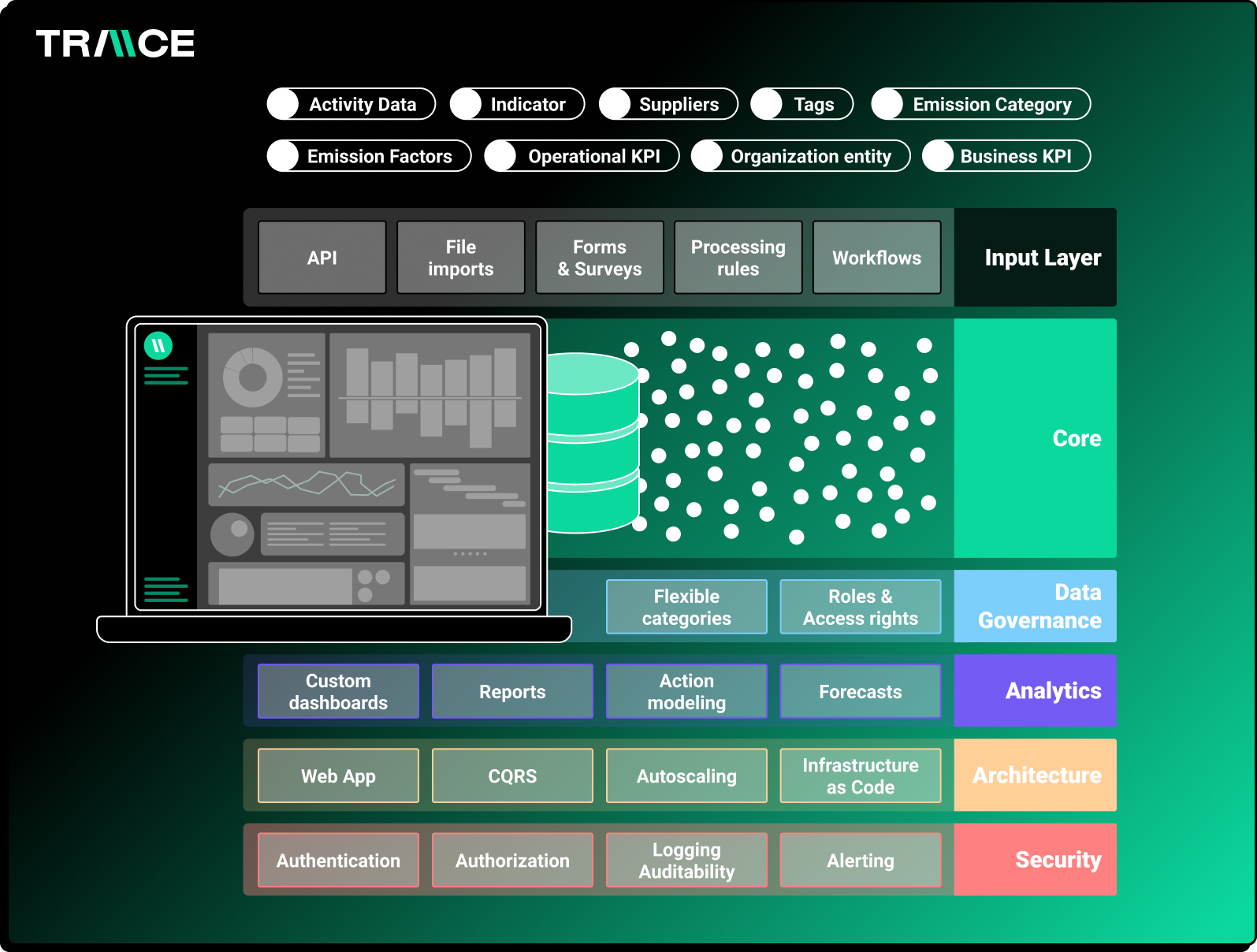
- Its flexibility
Since its inception, Tennaxia ESG has been built on a flexible Data Model. Our data model is specifically designed to make our platform adaptable, customizable, easy to integrate, and, most importantly, scalable. This foundation allows our technical team to maintain a high release cadence for new features, ensuring we can quickly respond to our clients' evolving needs.
- Its scalability
An effective Data Platform adapts to its users' data volume. Tennaxia ESG is highly scalable, currently collecting and processing millions of data points. - Its collaborative dimension
Data governance model: operational modeling + granular role management, enabling the implementation of true data governance to ensure quality and effective utilization. - Its security
Tennaxia is SOC 2 Type II and ISO 27001 certified, GDPR compliant, and hosts data exclusively in Europe. Our clients' data is strictly isolated within a single shared infrastructure. Furthermore, its robustness is regularly tested through penetration testing and Business Continuity Planning (BCP - Business Continuity Planning testing). - Its In/Out connectivity
The technical data ingestion layer of Tennaxia ESG is designed to ensure that raw activity and ESG data collection is comprehensive, reliable, collaborative, and as automated as possible.
Thanks to multi-format data ingestion on one hand (Interface entry, API, file uploads, specific questionnaires configured in the tool and sent to stakeholders, etc.) and via automated raw data processing on the other (collaborative workflows for source data quality validation, automated conversion and calculation rules, automatic data grouping by category and analysis grid, etc.)
Conviction - The limitations of a Data-First approach to ESG topics
When done seriously and in an actionable way, measuring a company's environmental footprint and ESG impact is based on sensitive operational and activity data : industrial processes, value and supply chains, internal organization, investments and procurement, etc.
Carbon and ESG data is now clearly a strategic priority for businesses, and in order to manage their impact and transition, it can be tempting to seek absolute exhaustiveness in data collection and management by trying to "API-ify" or "automate" everything.
Unless complex global value chains with multiple suppliers and customer outlets become fully connected in the near future, offering reliable and instantly available data, trying to "API-ify" everything for impact data collection is purely utopian and does not reflect the pragmatic reality of the transition organizations need to undergo.
At Tennaxia, we automate what can be automated and connect what can be connected, but we do not make false promises to our clients. Our approach is realistic and pragmatic, with a single goal: to enable our clients to take real action and accelerate the reduction of their negative impacts.
Decarbonization, and more broadly the transition to low-impact business models, are long-term processes. These processes require regular iterations (at least annually) on the collection, measurement, analysis, and simulation of ESG and carbon data. Data quality takes precedence over quantity, enriched by methodological expertise and a critical eye to enable, once again, informed and rapid decision-making to implement transitions on the ground.