









🔎 Key takeaways
- The draft ADR 2027 introduces new UN numbers, particularly for certain lithium metal and sodium-ion batteries installed in transport vehicles.
- New rules apply to articles and machinery containing dangerous goods, including an exemption for certain used equipment intended for repair, recycling, or disposal.
- Waste transport regulations have been relaxed in several areas, including certain uncleaned empty drums and IBCs, as well as the estimation of quantities in transport documents.
- Subject to final adoption, ADR 2027 will enter into force on January 1, 2027, with mandatory application starting July 1, 2027.
The draft amendments to Annexes A and B of the ADR focus in particular on:
New UN numbers and entries
New UN numbers are being added to Table A of the ADR:
Addition of packing group II entries for two existing UN numbers
Note : packing group III entries for these UN numbers already exist in ADR 2025
New UN numbers
Batteries installed in transport vehicles – Class 9
In accordance with special provision SP 389, these Class 9 UN numbers apply to batteries installed in cargo transport units (such as a container) and designed solely to provide power outside the cargo transport unit.
To account for developments in battery technology, UN numbers have been added and others modified in ADR 2027: sodium batteries, and the creation of separate UN numbers for lithium-ion and lithium-metalbatteries:
- Designation supplemented by the term "ION" for UN 3536 :
UN 3536 LITHIUM ION BATTERIES INSTALLED IN CARGO TRANSPORT UNITS
- Creation of the UN number for lithium " METAL" :
UN 3563 LITHIUM METAL BATTERIES INSTALLED IN CARGO TRANSPORT UNITS
- Creation of UN number 3564 for sodium-ion batteries :
UN 3564 SODIUM-ION BATTERIES INSTALLED IN CARGO TRANSPORT UNITS
Note that the batteries must be installed in accordance with the requirements of special provision SP 389:
"The batteries must be securely fastened to the interior structure of the cargo transport unit (e.g., on shelves or in cabinets) in such a way as to prevent any short-circuit, accidental operation, or significant movement when the cargo transport unit is subjected to shocks, handling, or vibrations inherent to transport"
The batteries are not individually subject to marking and labeling requirements.
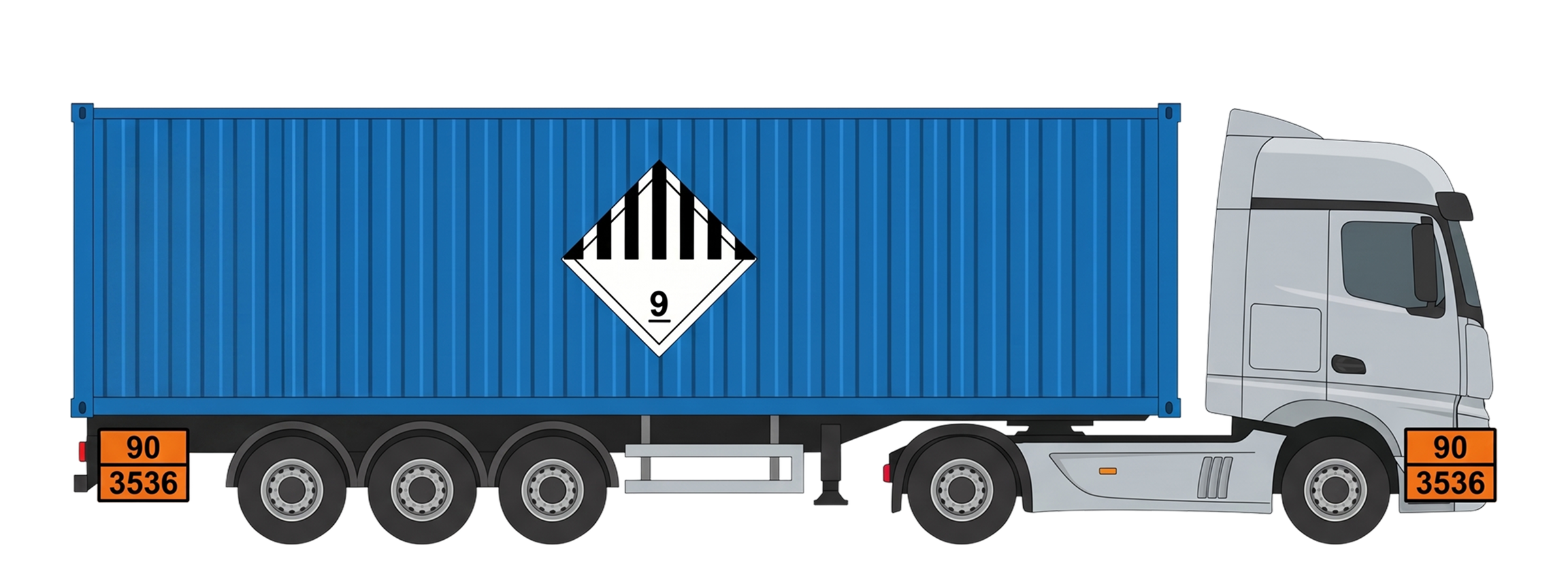
This type of vehicle must be marked (unless transported under the 1.1.3.6 exemption) as follows:
- Class 9 placards on both opposite sides
- Codified orange-colored plates on both opposite sides
- Blank orange-colored plates on the front and rear of the transport vehicle
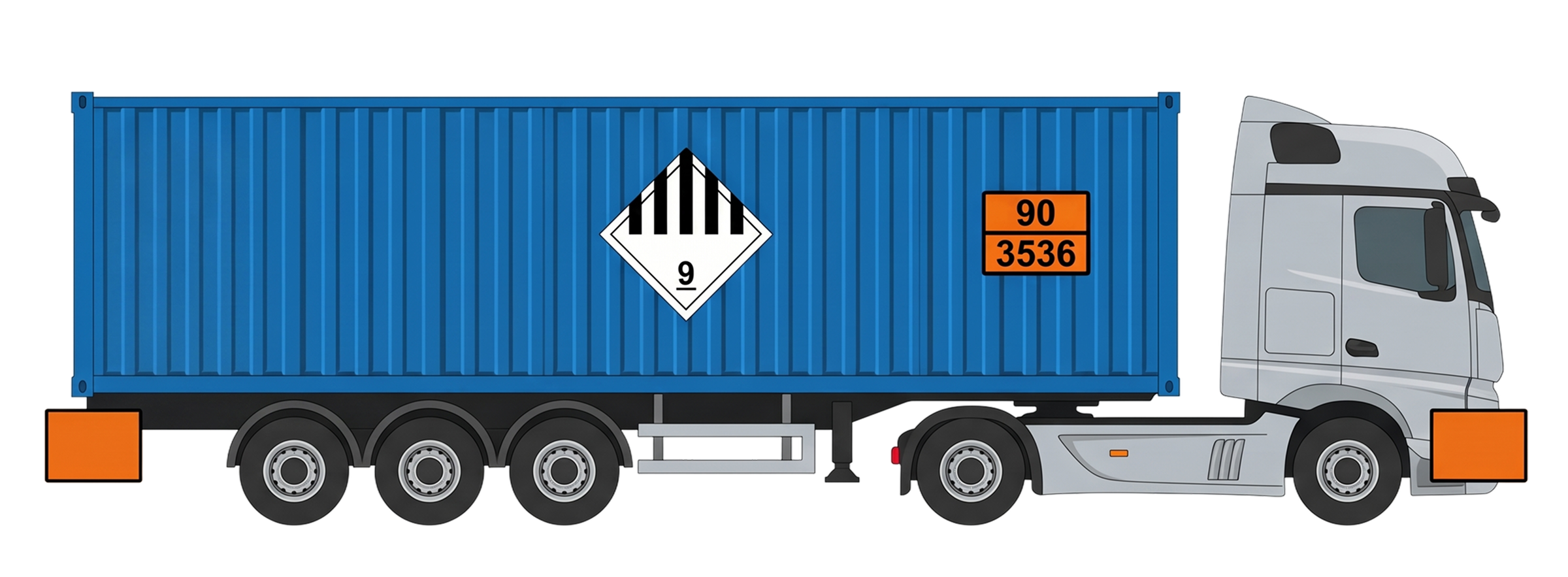
According to paragraph 5.3.2.1.6, transport units carrying only one single dangerous good and no non-dangerous goods, the following marking may be used:
Article containing dangerous goods
UN 3363 – Dangerous goods in articles, machines, or apparatus containing limited quantities of dangerous goods
An article, machine, or apparatus containing dangerous goods may be classified under UN No. 3363 under certain conditions defined in particular in the note to chapter 2.1.5 and special provision 301:
- The quantities of dangerous goods contained in the article must not exceed, for each substance, the limited quantity limits(see column 7a of Table A - LQ)
- Machines, apparatus, or devices containing dangerous goods as residues or as an integral element
- If the articles contain dangerous goods that may react dangerously with one another during transport, each dangerous good must be packed separately (see 4.1.1.6).
- Except for machinery or articles having a proper shipping name in the ADR (e.g., REFRIGERATING MACHINES UN 2857 or UN 3358, ARTICLES, PRESSURIZED, PNEUMATIC UN 3164, MERCURY CONTAINED IN MANUFACTURED ARTICLES UN 3506, etc.)
ADR 2027 introduces the phrase " other than cells or batteries" in this note to 2.1.5.
This means that these articles may contain cells or batteries, however, the specifications of these will be limited with the addition of the following statements in special provision 301:
"These articles may also contain lithium cells or batteries or sodium-ion cells or batteries, provided that the cells or batteries:
a) Provide the electrical energy necessary for the operation of the article; and
b) Meet the requirements of paragraphs a) to c), e) and f) of special provision 188. »
Summary of certain special provisions of SP188 (applicable in particular to lithium cells and batteries and equipment containing them)
- Technical specification limits :
- Protections when cells or batteries are installed in equipment :
- Protection against damage and short circuits
- Equipped with effective means to prevent accidental activation (unless intentionally active during transport (trackers, temperature monitoring devices, etc.))
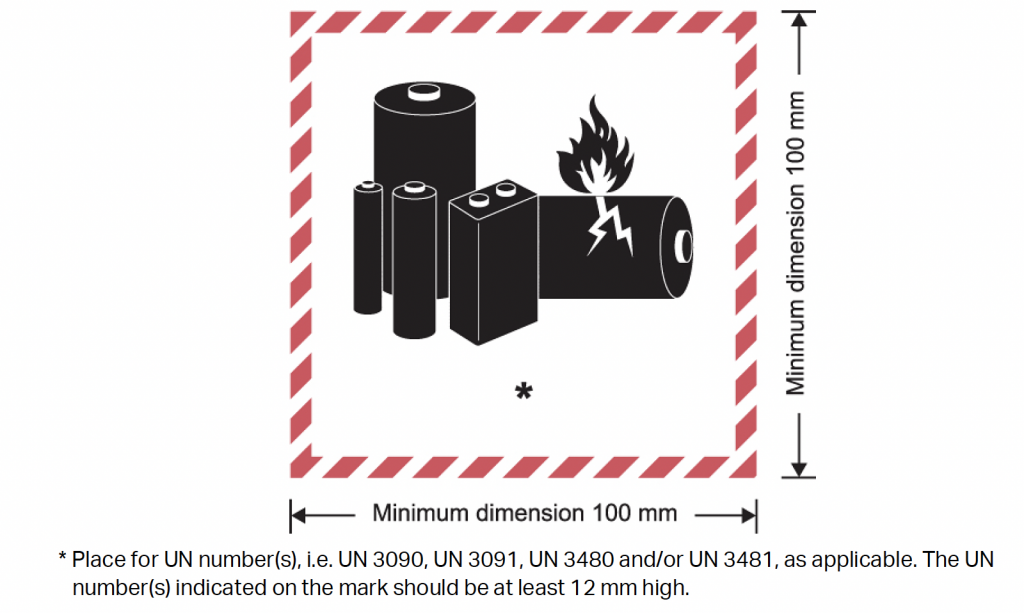
- Battery marking (5.2.1.9):
The transport of these objects, machines, or apparatus assigned to UN 3363 is not subject to other ADR provisions (ADR exemption according to SP 672) under certain packaging conditions:
Objects such as machines, apparatus, or devices transported under this entry and in accordance with special provision 301 are not subject to any other ADR provisions provided that they are either:
- Packed in a strong outer packagingconstructed of suitable material, with strength and design appropriate to the packaging capacity and intended use, and meeting the applicable requirements of 4.1.1.1
or
- Transported without outer packaging if the object is constructed and designed so that the receptacles containing the dangerous goods are adequately protected.
Other objects, machines, or apparatus containing dangerous goods that cannot be assigned to UN 3363
If an object cannot be assigned to UN 3363 (for example, because it contains a quantity of dangerous goods exceeding the limited quantity (LQ) thresholds), it must be assigned to the following UN numbers, depending on the hazard of the dangerous goods it contains (excluding Class 1 - Explosives, 6.2 - Infectious substances, and 7 - Radioactive material):
The term "object" refers to machines, apparatus or other devices containing one or more dangerous goods (or residues thereof) that are an integral part of the object and necessary for its operation and that cannot be removed for transport.
As with UN 3363, these objects may contain lithium batteries, but their characteristics are no longer limited to those specified in SP188.
ADR 2027 introduces a new paragraph exemption specific to the transport of these "used" objects :
Used objects, machines, and apparatus that may be internally contaminated with dangerous goods or contain residues are not subject to the other provisions of the ADR if the following conditions are met:
(a) The objects, machines, or apparatus are transported for repair, inspection, maintenance, disposal, or recycling ;
(b) The classification of the substances or mixtures contained is not possible without disproportionate cost or effort ;
(c) The objects, machines, or apparatus do not contain substances from the classes 1, 5.2, 6.2 or 7, or self-reactive substances of class 4.1 ;
(d) The dangerous goods contained are removed as far as possible, but it is not possible to remove them completely before transport ;
(e) No residue of dangerous goods adheres to the outside ;
(f) These articles, machines or equipment are:
- either packed in a strong outer packaging, made of suitable material, of adequate strength and design in relation to the packaging's capacity and its intended use, and meeting the applicable requirements of 4.1.1.1;
- either transported without outer packaging for articles that are manufactured and designed in such a way that the receptacles containing the dangerous goods are sufficiently protected;
(g) The packages are marked "ARTICLE CONTAINING DANGEROUS GOODS";
(h) When it is necessary to ensure that residues of dangerous goods liquid remain in a specific orientation, orientation arrows are affixed to at least two opposite vertical sides, with the arrows pointing in the correct direction in accordance with 5.2.1.10; and
(i) Transport documents must include the following statement: "Transport in accordance with 2.1.5.7 of the ADR".
NOTE: For medical devices or equipment, see also 2.2.62.1.5.9. »
Transport of empty, uncleaned drums and IBCs, new section 4.1.1.11.2
To promote the circular economy while ensuring transport safety, this new section allows for the transport of empty, uncleaned waste drums and IBCs for disposal, recycling, or material recovery (other than by classifying them under UN3509), even if:
- The expiration date of the last inspection (every five years) or the last periodic test (every two and a half years) has passed for any metal IBC, rigid plastic IBC, or composite IBC;
- The five-year service life from the date of manufacture has been exceeded for plastic packaging (drums, rigid plastic IBCs, and composite IBCs with plastic inner receptacles); or
- The packaging approval certificates and the instructions for use and closure provided by the manufacturers are unavailable.
Nevertheless, a number of requirements must be met, including:
- Drums and IBCs must have a capacity of more than 150 liters;
- Labeling and marking must correspond to the residues present in the drums and IBCs;
- Drums and IBCs must remain upright and be securely closed using the original closure devices or other locking mechanisms, so that they remain leakproof under normal transport conditions;
- Transport is strictly prohibited for the most hazardous residues. For example, dangerous goods of classes 1 (explosives), 2 (gases), 4.2 (substances liable to spontaneous combustion), 4.3 (substances which, in contact with water, emit flammable gases), 5.2 (organic peroxides), 6.2 (infectious substances), and 7 (radioactive material) are excluded, as are substances assigned to a packing group or for which "0" appears in the limited quantities column of Table A of the ADR.
Estimated quantity in the transport document for waste, amendment to section 5.4.1.1.3.2
This amendment aims to clarify and facilitate the rules for estimating the quantity of waste entered on the transport document when it is impossible to measure the exact quantity of waste transported at the loading site. ADR 2027 introduces the ability to estimate the quantity of waste for:
- For all tanks (and not just those operating under vacuum), provided that a device or procedure is used to ensure compliance with the tank filling degree,
- For waste aerosols (UN No. 1950) and gas cartridges (UN No. 2037);
- For waste transported in accordance with 4.1.1.5.3 (small laboratory waste or diffuse chemical waste packed in bulk). As a reminder, this article, created in ADR 2025, allows for the grouping of multiple small inner packagings containing different types of waste into a single large outer packaging (such as a 50H pallet box or a 1H2 or 1A2 drum), under certain strict conditions (compliance with the outer packaging type or the prohibition for class 1, 2, 6.2, or 7 waste, etc.). ADR 2027 thus corrects a loophole in ADR 2025 by explicitly authorizing limited quantities for this type of shipment; indeed, by creating article 5.4.1.1.3.3, which specifies that the mention "ESTIMATED QUANTITY IN ACCORDANCE WITH 5.4.1.1.3.2" does not need to appear on the transport document, the legislator's intention in 2025 was clearly to authorize estimation for 4.1.1.5.3.
Finally, logically, for UN No. 3291, CLINICAL WASTE, UNSPECIFIED, N.O.S. or (BIO)MEDICAL WASTE, N.O.S. or REGULATED MEDICAL WASTE, N.O.S., ADR 2027 clarifies that the estimated quantity is also possible when this waste is packed in accordance with packing instruction IBC620 or LP621; indeed, ADR 2025 only mentions packing instruction P621.
To justify the estimation, the other rules defined by ADR 2023 for the transport document remain the same. The document must also include:
- For packaging (drums, boxes, etc.), a list of the packaging specifying its type and nominal volume (e.g., estimate of 20 kg in a drum with a capacity of 100 l),
- For containers (skips), their nominal volume and other available information, for example, the type of waste, average density, and filling degree.
Estimation remains prohibited:
- When applying 1.1.3.6, as the exact quantity of waste must be known,
- For Class 4.3 waste (substances which, in contact with water, emit flammable gases), unless such waste is included in a shipment in accordance with 4.1.1.5.3,
- For waste containing the substances referred to in 2.1.3.5.3, namely substances of Classes 1, 2 (with the exception of UN Nos. 1950 and 2037), desensitized liquid explosive substances of Class 3, self-reactive substances and desensitized solid explosive substances of Class 4.1, pyrophoric substances of Class 4.2, substances of Class 5.2, substances of Class 6.1 that meet the criteria for inhalation toxicity of Packing Group I, and substances of Class 6.2 (with the exception of UN No. 3291). Naturally, if certain waste covered by one of these classes is shipped in accordance with 4.1.1.5.3, then the quantity shipped can be estimated.
Update to the instructions in writing template
As a reminder, instructions in writing must be kept readily available in the vehicle cab to assist in an emergency during transport. These instructions must be provided by the carrier to the vehicle crew before departure and must correspond to the template provided in 5.4.3.4 of the ADR in both form and content.
ADR 2027 aligns the terminology of the instructions in writing with other regulations, namely REACH and CLP. Thus, terms related to "risk" are replaced by "dangerous," and "Risk of burns" is replaced by "May cause burns," etc.
Furthermore, ADR 2027 adapts the instructions in writing for electric trucks. Instead of requiring the battery master switch to be operated, it now requires the device for de-energizing the electrical circuits to be operated.
Drivers may continue to present the old template (the one applicable until December 31, 2026) during roadside checks without being in violation until December 31, 2027.
Precautions regarding foodstuffs, other consumer goods, and animal feed
The ADR requires that precautions be taken (prohibition of loading in proximity, segregation, etc.) when loading foodstuffs, other consumer goods, and animal feed together with other dangerous goods. This applies to:
- All packages bearing 6.1 labels (toxic substances).
- All packages bearing 6.2 labels (infectious substances).
- Packages bearing 9 labels (miscellaneous substances) if they contain UN Nos. 2212, 2315, 2590, 3151, 3152, or 3245 (asbestos, PCBs, etc.). For this third category, ADR 2027 removes the list of UN numbers to indicate that these are dangerous goods assigned special provision CV28 in column 18 of Table A. In practice, this does not change the number of dangerous goods concerned, but it simplifies the work of the loader. This rewrite also makes the ADR more reliable. Previously, if the UN committee created a new UN number requiring segregation from food, it had to remember to update the list in article 7.5.4.
Applicability
The provisions presented here are part of the draft amendments to the ADR for its 2027 version. You can consult this draft dated February 2026, as well as an addendum and two corrigenda dated June and July 2026, by following this link: ADR 2025 - Agreement concerning the International Carriage of Dangerous Goods by Road | UNECE
In addition to the amendments commented on in this article, you will also notice developments for Chapter 6.8, notably ending the dual approval of a tank (as a portable tank under Chapter 6.7 and as a "tank-container" subject to Chapter 6.8). By modifying this chapter, ADR 2027 also allows for the extension of the interval between periodic inspections for battery-vehicle elements used for the transport of certain compressed gases, such as Helium (UN No. 1046) and Hydrogen (UN No. 1049), under certain conditions.
Note : Only the final version of the ADR 2027 is authentic; it is therefore advisable to wait for the publication of this version before finalizing these changes.
These amendments were officially notified to the ADR Contracting Parties on July 1, 2026. The ADR Contracting Parties have a period of three months, i.e., until October 1, 2026, to examine the proposed amendments and formulate objections if they wish. A final meeting of the WP.15 working group is scheduled for November 2026. In the absence of any objection formulated in accordance with the procedures provided for by the Agreement, the amendments will enter into force on January 1, 2027.
As a 6-month transitional period is established upon the publication of new versions of the regulation, the provisions of the ADR 2027 will therefore be definitively mandatory as of July 1st July 2027 (except for specific transitional provisions granting an additional implementation period as set out in Chapter 1.6).
Authors: Thomas Pallez and Monique Argaud, HSE consultants at Tennaxia
📝 Note
For objects that do not have an official transport designation and contain only dangerous goods in quantities, other than cells or batteries, not exceeding those specified in column (7a) of Table A in Chapter 3.2, UN No. 3363 and special provisions 301 and 672 of Chapter 3.3 may be applied.