
.svg)







The same question arises tirelessly whenever it comes to equipping yourself with a new tool to simplify your teams' daily work. Is it better to build it yourself or use an existing solution on the market?
The prospect of building the tool in-house by mobilizing your IT teams might seem attractive at first glance. Who hasn't dreamed of the perfect tool? One that checks every single box in your specifications.
But have you actually thought about filling in all those boxes? Is those specifications document still up to date now that you have the tool in hand? Who will be responsible for updating it? Do you have the necessary budget? Does the IT team have enough bandwidth? And the necessary business expertise?
This question is resurfacing as corporate carbon reporting becomes increasingly complex. Your CSR and finance teams are facing a drastic increase in the requirements of the various existing reporting standards, which are shifting away from simple data compilation toward the implementation of decarbonization strategies with fixed deadlines.
If you were previously able to rely on a "simple" Excel file to consolidate all your carbon data, that is now impossible. Data collection is becoming more complex due to its frequency, the volume of data, and the processing involved. This annual exercise is highly likely to resemble Sisyphus's boulder if you are not properly equipped to carry it out.
So, for this new carbon accounting tool, is it better to develop it or use a software provider?
Watch your timeline
The first question is one of timing. Are you ready to embark on a project to build carbon accounting software, taking into account the time it will take, as well as the time of the teams that will be mobilized for this project?
Building a tool from scratch first requires clearly expressing your needs, creating an exhaustive set of specifications, and balancing the requirements contained in that document with the time that IT teams will be able to allocate to this project.
While some simple tools can be created in a few weeks (we are talking about the famous Excel file), a more complete tool will inevitably require months of development, iterations, testing, and adjustments before it can be used effectively.
The fact is that carbon accounting is becoming more complex. New international standards and increasingly stringent regulations require ever more comprehensive data covering your entire value chain. Data quality, formats, and processing methods also vary greatly: physical vs. monetary data, quantitative vs. qualitative data, emission factor management, uncertainty rates, and more.
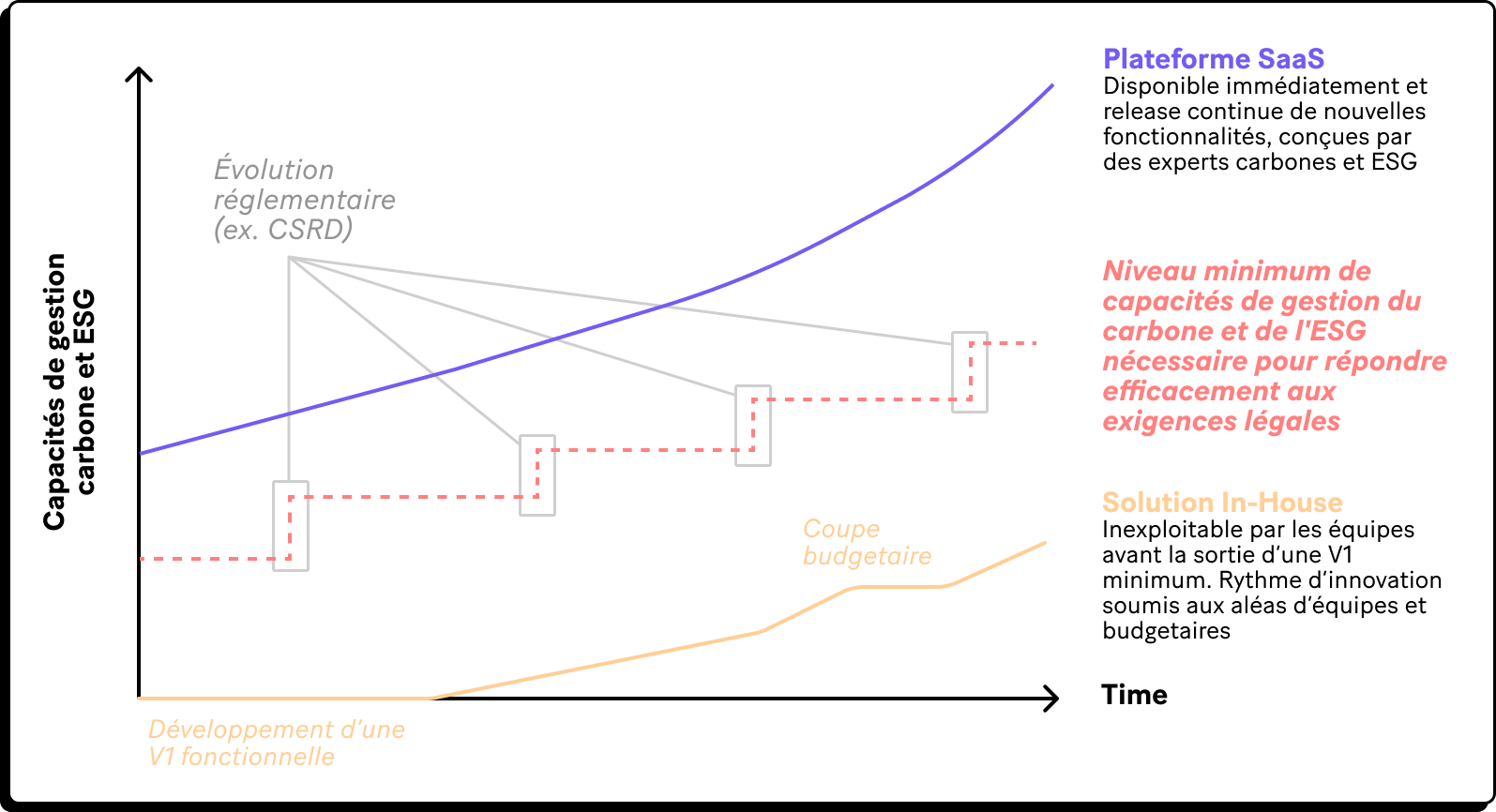
This trend effectively renders the use of Excel spreadsheets obsolete., no matter how polished it may be. You will therefore need to bet on a scalable tool with much more advanced features.
Assume from the start that its development will take many months and will progress only as your IT teams have availability, as your tool may not necessarily be their top priority.
Conversely, a SaaS tool is available turnkey.
Weigh the costs
The other key question is, of course, the cost.
Carbon accounting tools have variable costs. For software that processes physical data—necessary to meet major international standards and regulations—you should expect a minimum annual budget of €10k for a company with relatively simple operations and organization. For software that handles ESG indicators as a whole, which is essential for CSRD compliance, you should plan for an additional budget of the same magnitude. Depending on your budget, these costs may seem high and justify developing your own solution.
However, we are telling you nothing new by saying that developing an in-house tool also has a cost: the cost of the man-hours that you and the many stakeholders involved will spend on the tool, as well as hosting and maintenance costs.
Unlike a SaaS tool, where the cost is transparent and predictable, the cost of your own project is difficult to estimate and can quickly spiral out of control.
Your cost analysis must necessarily take into account the expected return on investment for your tool, whether it was purchased or developed in-house. However, the only way to calculate this is to be able to make an accurate estimate of its initial and future costs.
For example, our estimates for using Traace for carbon accounting show an average ROI ranging from 150% to 400% depending on the depth of the company's carbon footprint measurement, effectively making the investment in the tool profitable.
Evaluate the level of expertise required
The primary benefit you will gain from an in-house tool is that it can perfectly meet all your requirements, even the most specific or unusual ones.
Conversely, a SaaS tool is generally designed and built to meet the needs of the widest possible audience. Customization will be more limited, so it may not necessarily meet all of your requirements.
However, by opting out of a SaaS tool, you also miss out on two things:
- the expertise of those who built the tool in the field of carbon accounting
- the continuous improvements made thanks to feedback from the community using the tool
Your IT team, however talented they may be, is unlikely to have a clear and comprehensive view of the challenges involved in carbon accounting and the issues this exercise raises. Their added value lies in how they respond to your requests, which requires a very detailed set of specifications. However, these specifications will have been written at a specific point in time, and your expertise alone will not be enough to anticipate all the potential future evolutions of the tool, driven by the regulatory framework, the expansion of your carbon analyses, or the growth of your company.
The result can be a tool that lacks flexibility and is difficult to maintain in the long term. Added to this is the risk that the software may not comply with regulatory reporting requirements.
Conversely, a SaaS tool is supported by a team that is well-versed in the issues surrounding carbon accounting. They will be able to build the tool in a much more flexible and scalable way, anticipate regulatory changes, and help you scale up extremely quickly by leveraging the tool's pre-existing features.
Contributions from the solution's many users will not only allow for continuous improvement but also the development of new features you might not have thought of initially, which could prove to be very useful.
Finally, relying on a team of experts means that, beyond the software functionality, you benefit from support in the implementation, deployment, and management of your carbon strategy from teams with a global view of the market. Having faced numerous sector-specific challenges, they have developed expertise that will be useful when it comes to correctly analyzing your carbon footprint and identifying the most relevant levers to reduce your emissions.
It is this global vision and the responses provided to our users' needs that have allowed Traace to provide a full range of features that go far beyond a simple data collection tool. For example, you will find dashboards that simplify your analysis, tools for modeling your GHG emission reduction actions, financial projections, and even a module for assessing your supply chain.
Estimate the lifespan of your tool
When you decide to develop ESG software in-house, you must take into account the fact that, like any other software, it will require regular updates and maintenance.
These interventions have various motives, sometimes technical (security, obsolete technologies, etc.), sometimes operational (changing needs, evolving regulatory framework, etc.).
This criterion is all the more important given that the subject of carbon accounting is extremely fluid. The regulatory framework is evolving at breakneck speed, as are the associated international standards.
To accurately analyze and act on your carbon footprint, you will need to ensure, for example, that you have up-to-date emission factor databases.
To make your decision, you will need to analyze these operations in terms of the costs they represent and the bandwidth they require from both the CSR and IT teams.
By choosing turnkey software, you benefit from updates and maintenance operations that are an integral part of the software team's roadmap. Barring major changes, these operations are generally included in the base price of the tool and are carried out on an ongoing basis, without the need for specific requests.
You may be concerned about the security of the tool. It contains key data for your company, and it is perfectly normal to be concerned about how this data is handled and whether the software is secure enough to prevent any leaks. If you opt for a SaaS tool, you must look into their security and data management policy.
An alternative: "buy and make it"?
Build or buy—as is often the case, the best alternative may lie in the middle.
Developing in-house allows you to have a tool that exactly meets your needs, without compromise or unnecessary features. However, you must take into account the substantial costs generated, the availability of the teams involved, and the potential lack of flexibility of your tool.
Conversely, SaaS software allows you to benefit from clear pricing, an evolving product, and a development team that is an expert in the field of carbon accounting and better able to understand and formalize your needs. However, you will need to ensure that the carbon footprint platform is secure and capable of supporting your development.
An alternative solution is "buy and make it." A turnkey carbon accounting solution, developed by experts in the field BUT highly customizable. The software would allow you to build your data collection workflows, work collaboratively, customize your analyses and action levers, create your own dashboards, and more.
The software thus provides you with all the tools to carry out your missions while leaving you in control of implementing your carbon strategy. The “buy and make it” approach thus acts as a facilitator.
No need to call on your internal IT team; you will be able to apply the requirements of your specifications yourself in a simple and intuitive way within the tool.
It is based on this philosophy that we developed Traace. Our goal is to provide you with a modular tool, which will allow you not only to tailor your carbon accounting to your company's specific needs but also to scale the tool as your business grows and your carbon strategy evolves. Opportunities for co-development will allow you to take this process even further based on any additional needs you identify.