
.svg)




.webp)


When discussing carbon and global warming, we are often inclined to think of the essential role of forests in carbon sequestration and to consider ways to counter the threats facing these ecosystems. Yet, on a planet covered by 72% water, marine ecosystems—and coastal areas in particular—play a role that is at least equivalent to, if not more significant than, that of terrestrial ecosystems in sequestering carbon.
With this in mind, we will discuss the essential role of blue carbon here.
What is blue carbon?
The term "blue carbon" refers to the capacity of oceanic and coastal ecosystems, such as mangroves, seagrass meadows, and coastal wetlands, to store and sequester carbon from the atmosphere and the oceans. These ecosystems act as carbon sinks, thereby helping to mitigate the effects of climate change. They transform carbon dioxide into biomass through photosynthesis and sequester it in sediments. This carbon primarily originates from the decomposition of organic matter (plants, decaying animals, etc.).
Mangroves, for example, are coastal ecosystems composed of plants that live in intertidal zones. These wetlands act as carbon reservoirs, storing carbon dioxide (CO2) from the atmosphere and helping to prevent its accumulation, thus contributing to the reduction of the greenhouse effect.
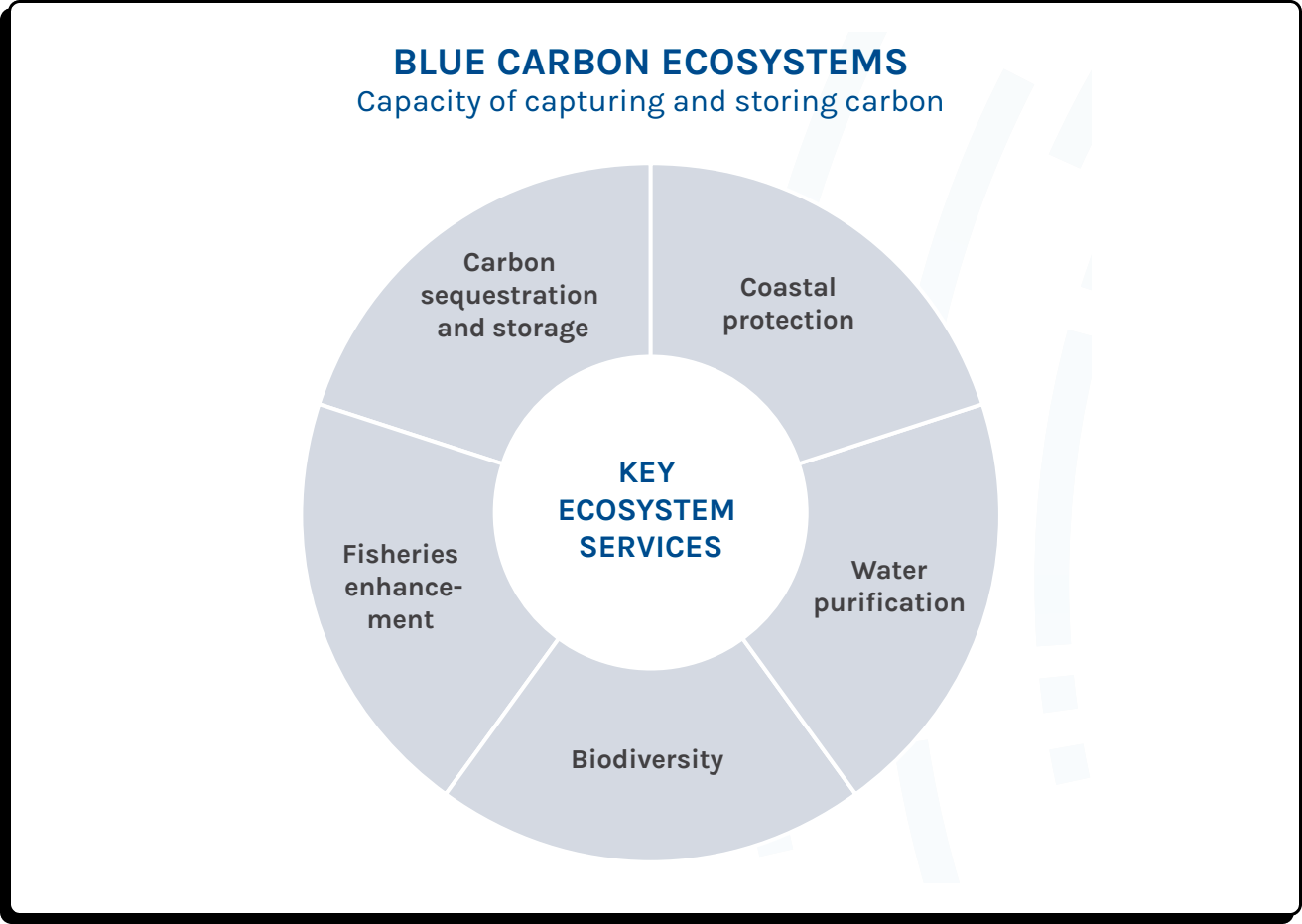
Blue carbon ecosystems also provide numerous ecosystem services related to biodiversity and coastal protection.
The use of the term "blue carbon" highlights the importance of conserving and restoring coastal ecosystems as part of climate change mitigation strategies.
The 3 types of blue carbon ecosystems
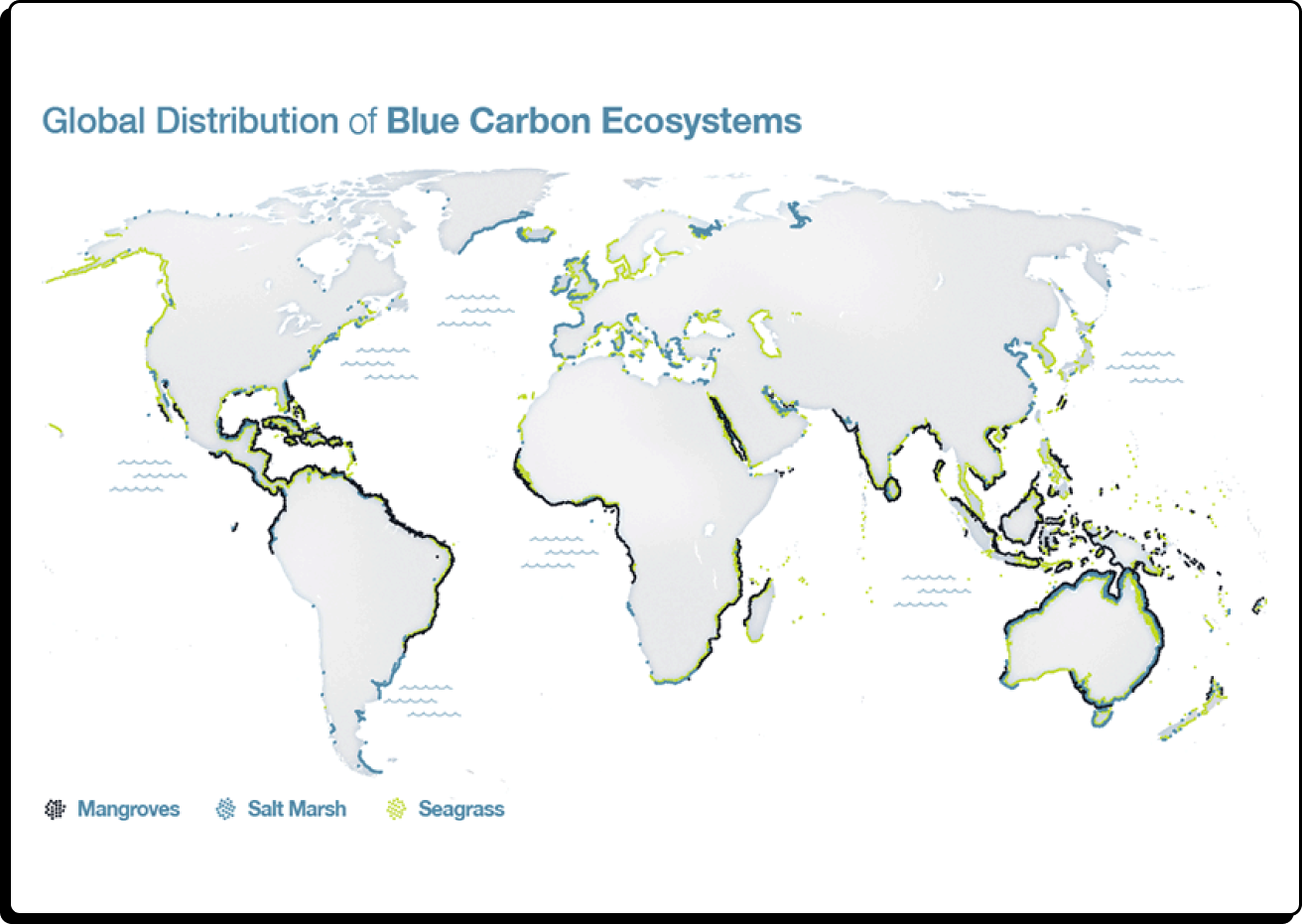
There are 3 main types of ecosystems that store blue carbon. They are distributed along coastlines across the globe, with the exception of Antarctica.
Seagrass meadows
Seagrass meadows are made up of marine algae and non-vascular marine plants. They are found in shallow coastal areas where sunlight can penetrate sufficiently to allow for photosynthesis.
Essential for the survival of many species, seagrasses serve as both a habitat and a food source for numerous marine animals. They also play an important role in stabilizing the seabed, oxygenating and purifying the water, and preventing coastal erosion by reducing the speed of ocean currents. Furthermore, they are capable of storing twice as much carbon as terrestrial forests.
Although they account for only 0.2% of the ocean's surface, it is estimated that seagrasses store more than 10% of oceanic carbonTheir surface area is shrinking by 1.5% per year, and to date, they have lost nearly 30% of their global coverage.
Mangroves
Found primarily in tropical and subtropical regions, these ecosystems are located in sheltered coastal areas and consist of plants and trees—most notably the mangrove tree—that are perfectly adapted to the brackish waters of intertidal zones.
They have a carbon storage capacity 4 to 5 times greater than that of a forest. One hectare of mangrove can store up to 3,754 tonnes of carbon (UNESCO). The majority of the carbon stored by mangroves is found in their soil (83%), with the remainder stored in the biomass of the trees that make up the mangrove. Beyond their utility for carbon sequestration, mangroves also serve as a habitat for numerous species and play a key role in water filtration and protecting coastlines from erosion and severe weather.
At the current rate, the area occupied by mangroves is shrinking by 2% each year. It is estimated that human activity has led to the destruction of 30% of their original surface area. Their CO2 absorption capacity is such thatit is estimated that the destruction of mangroves is responsible for 10% of CO2 emissions linked to deforestation even though they cover only 0.7% of the Earth's surface.
Salt marshes
Salt marshes are intertidal zones located along coastlines, found primarily in temperate regions of the globe. These wetlands are characterized by saltwater from the ocean or sea mixing with freshwater from streams, rivers, or lakes. They are often subject to tides, resulting in fluctuating water levels and salinity. They are composed of halophytic plants, which are adapted to high-salinity environments.
Just like mangroves, these coastal marshes are a tremendous carbon reservoir, both in their biomass and their soil and play an essential role in protecting coastlines, preserving biodiversity (particularly for migratory birds), and filtering water.
Salt marshes are disappearing at a rate of 1 to 2% per year. While they still cover 140 million hectares worldwide, they have already lost more than half of their historical surface area.
Why is blue carbon so important?
Blue carbon plays a vital role in the fight against global warming. Its capacity to store organic carbon is unmatched by any other ecosystem on the planet.
The vast majority of this carbon is found in sediments, up to 6 meters underground, and is therefore stored for the very long term. Furthermore, the rate of carbon burial in these sediments is up to 55 times faster than that of tropical rainforests.
It is currently estimated that blue carbon ecosystems cover 49 million hectares and store between 10,450 and 25,070 million tonnes of CO2 in the first meter of soil alone (Ramsar).
Preserving these wetlands is therefore necessary:
- to mitigate the effects of climate change linked to anthropogenic emissions
- to protect these immense carbon stocks sequestered within biomass and sediments
The destruction of blue carbon ecosystems has a devastating effect on the climate. It prevents the absorption of CO2 by these ecosystems and, worse still, can lead to the release of billions of tonnes of additional carbon into the atmosphere, effectively accelerating global warming.
Beyond their crucial role in carbon storage, these ecosystems are also essential to the environment due to their numerous ecosystem services:
- They contribute significantly to the protection of marine and terrestrial biodiversity by serving as shelters, nursery areas, and food reserves
- They help combat coastal erosion and protect shorelines against severe weather
- They filter water and therefore preserve its quality
Threatened ecosystems
Awareness of the importance of these ecosystems in the fight against global warming and the mitigation of its effects is relatively recent.
In the meantime, they have been and continue to be victims of human activity and the consequences of climate change, which increases their vulnerability.
Despite the launch of numerous conservation programs, the degradation of blue carbon ecosystems continues, and the area they cover keeps shrinking.
One of the primary causes of the degradation of these ecosystems is eutrophication resulting from human activities, particularly certain agricultural practices. The proliferation of algae in marine environments leads to the suffocation of blue carbon ecosystems.
These ecosystems are located in maritime areas where human activity is most concentrated and therefore has the greatest impact.
Water pollution and coastal development are also among the main sources of destruction for coastal blue carbon ecosystems.
Seagrass beds are also victims of trawling or the anchoring of fishing and pleasure boats.
Added to this are natural disasters, the frequency and intensity of which are amplified by global warming: droughts, storms, rising sea levels, and more.
According to the Blue Carbon Initiative, between 340,000 and 980,000 hectares of blue carbon ecosystems disappear every year. We have already lost at least 67% of mangroves, 35% of salt marshes, and 29% of seagrass beds. Yet, as we have mentioned, this degradation not only harms carbon storage capacity but also leads to net emissions of carbon and other greenhouse gases.
Growing interest in blue carbon
For a surprisingly long time, the ocean and its ecosystems remained outside of international climate agreements. It was COP26 and the Glasgow Climate Pact that finally recognized the importance of protecting the oceans in the fight against global warming and for environmental protection more generally. Since then, many countries have integrated the protection of the ocean and its ecosystems into their environmental policies and have implemented various carbon contribution projects to that end.
The growing awareness of the importance of blue carbon goes hand in hand with the implementation of conservation projects that generate dedicated carbon credits .
The ability of these ecosystems to store massive quantities of carbon over the very long term, coupled with their crucial role in preserving biodiversity, has led to clear interest in these projects, making it easier to finance their development.
France, within the framework of its low-carbon labelhas therefore integrated methods aimed at certifying and, consequently, funding projects for the protection and restoration of mangroves and seagrass meadows, which are particularly threatened in the Mediterranean basin.
The Blue Carbon Initiative, a coalition to protect blue carbon
Numerous international initiatives have emerged in recent years to raise awareness of the risks facing these ecosystems and to commit to concrete actions aimed at protecting them.
UNESCO, the IUCN (International Union for Conservation of Nature), and the NGO Conservation International founded the Blue Carbon Initiative. This coalition aims to:
- Develop and promote scientific knowledge on blue carbon
- Contribute to restoration and protection projects for blue carbon ecosystems around the world
- Support institutions in implementing policies for the protection and restoration of these ecosystems
UNESCO already includes at least 21% of the world's blue carbon ecosystem area within its marine World Heritage sites, thereby better protecting these areas that benefit from special status.

By bringing together diverse stakeholders (governments, NGOs, research institutes, etc.), this coalition aims to coordinate international efforts for blue carbon and promote the importance of this resource in mitigating climate change and protecting biodiversity, while involving various stakeholders, including local communities heavily impacted by the destruction of these ecosystems.
Among their main missions are the accounting, for each country, of sequestered carbon stocks and emissions generated by blue carbon ecosystems, the improvement of blue carbon ecosystem management in protected marine and coastal areas, and the development of carbon contribution projects.
Sources:
- “Mangroves: a blue carbon ecosystem to protect at all costs!”, Zoo Parc de Beauval, 07/26/2023
- “A global study reveals a widespread decline in salt marshes”, Les Echos, 02/21/2023
- “UN Ocean Conference: the promise of blue carbon”, Agence Française de Développement, 06/30/2022
- “The contribution of blue carbon ecosystems to climate change mitigation”, Ramsar, 10/14/2021
- “The ocean included in the Glasgow Climate Pact”, Prince Albert II of Monaco Foundation, 11/16/2021
- “UNESCO Marine World Heritage: custodians of the globe’s blue carbon assets”, UNESCO, 2021
- “About Blue Carbon”, The Blue Carbon Initiative
- “The Blue Carbon Handbook”, Ocean Panel
- “Why protecting & restoring blue carbon ecosystems matters”, UN Environment Programme
- “Seagrass meadows: underwater prairies with a significant ecological role”, French Office for Biodiversity