







🔎 Key takeaways
- Reducing emissions (mitigation) must now be accompanied by a robust strategy for adapting to physical risks (droughts, floods, etc.) that directly threaten production assets.
- Precise assessment of the vulnerability of sites and value chains has become an unavoidable requirement.
- The European CSRD directive is accelerating this shift by requiring companies to disclose the financial impact of these risks and their adaptation plans.
- Insurers (AXA) are warning about the cost of inaction: without an adaptation plan, certain areas and activities risk becoming uninsurable in the future.
- For banks (LCL), financing is directly contingent on resilience: a company that cannot be insured becomes, de facto, unfinanceable.
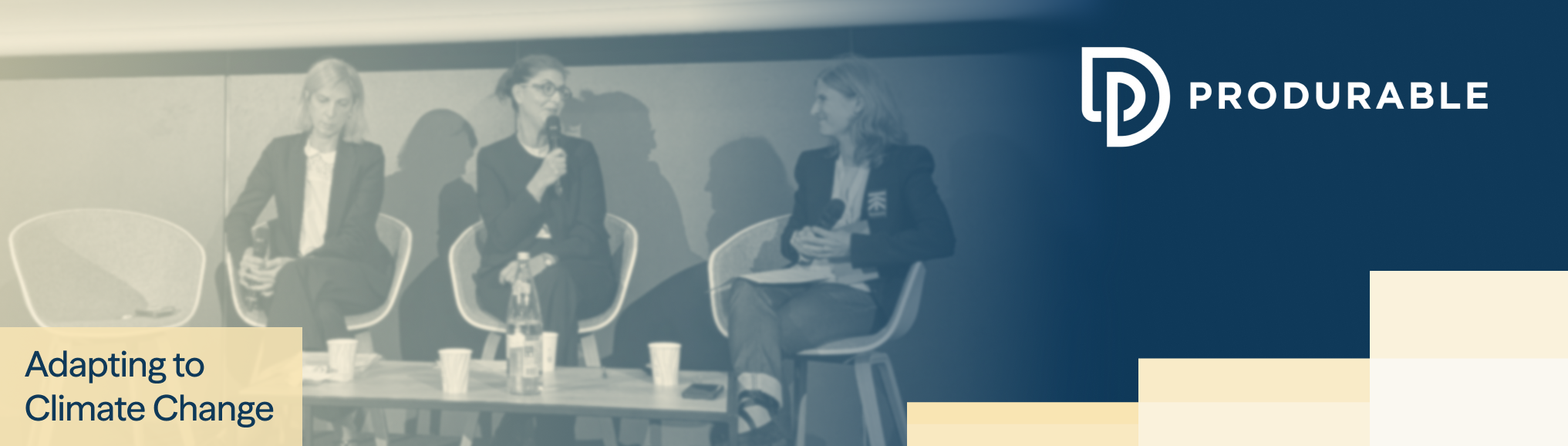
Sustainable transformation is no longer a peripheral regulatory option; it is becoming a central issue of economic performance and survival for organizations. At the Produrable trade show, Solène Garcin-Charcosset, Director of ESG and Carbon Consulting at Tennaxia, led a workshop dedicated to adapting to climate change alongside Catherine Chazal, Group Head of Environmental and Social Impact at AXA, and Gladys Leclerc, Head of Energy and Finance at LCL.
Between the urgency of acting in the face of materializing climate risks, the strict evolution of requirements from banks and insurers, and the need to concretely adapt business models on the ground, this session demonstrated that adaptation is now redefining the competitiveness and longevity of companies.
Why adaptation has become the new pillar of resilience
We are now living in a world where the consequences of climate change are no longer distant projections, but immediate operational realities. Water stress, heatwaves, flash floods: warning signs are mounting and directly impacting global infrastructure and supply chains. This was the starting point highlighted during the workshop: it is no longer enough to simply try to limit warming; we must now actively prepare to endure its impacts.
In this context, CSR now includes a component of pure and simple physical risk management. Long confined to reducing carbon footprints (mitigation), corporate climate strategy must now be balanced to become a protective shield.
Measuring to act: the tactical assessment of physical risks
Adaptation has reached a major operational milestone, moving beyond the theory of major international agreements to become anchored in the reality on the ground.
As Solène Garcin-Charcosset emphasized, this process requires a rigorous methodology above all else. It involves mapping the company's geographical footprint and its entire value chain in detail to identify specific vulnerabilities.
This tactical approach forces general and industrial management to ask themselves very concrete questions:
- Which of the company's critical sites are exposed to flood or drought risks by 2030 or 2050?
- How could these hazards paralyze the supply of strategic raw materials?
- What capacity-building and financial action plans (adaptation CAPEX, relocation, process modification) must be triggered today? Adaptation plans must be based on projected climate data to prioritize investments and protect business continuity in the long term.
CSRD: A regulatory catalyst for building resilience
To successfully carry out this assessment, companies are no longer starting from scratch. The CSRD now acts as a powerful accelerator for this awareness.
Through the ESRS E1 standard dedicated to climate, the European directive now requires full transparency regarding exposure to physical and transition risks. Companies must clearly state the financial impact of these climate risks on their operations and provide credible details of their adaptation plans.
Far from being a mere compliance exercise, the CSRD provides a robust methodological framework. It forces departments (CSR, finance, risk, operations) to break down silos to anticipate shocks. It is precisely the reliability of this standardized data that now makes it possible to reassure stakeholders and maintain the trust of financial players.
The insurability risk: AXA's warning on inaction
One of the most impactful messages from this workshop, delivered by Catherine Chazal for AXA, concerns the direct cost of the status quo and the fundamental role of insurance.
With temperatures in Europe projected to rise by around 4°C by 2100 under an intermediate emissions scenario (SSP2-4.5), the frequency and intensity of climate-related disasters are increasing. The major risk emerging today, well beyond compliance, is the insurability of assets.
Faced with the systemic increase in damages, the insurance sector is being forced to revise its exposure models. If a company cannot demonstrate that it has implemented a rigorous adaptation plan to secure its infrastructure (protective dikes, adapted cooling systems, roof reinforcement), it faces a sharp rise in deductibles and premiums, or even an outright refusal of coverage in the most exposed areas.
Climate inaction therefore translates into a lethal insurance risk for the company.
The key role of banks: LCL's requirements and support
This threat to insurability is closely linked to borrowing capacity. Gladys Leclerc strongly reiterated an equation that has become unavoidable in the financial sector: "no insurance, no financing."
The role of banks like LCL is evolving drastically to integrate this new reality. Financial institutions are now required by European regulators (such as the ECB) to assess the materiality of physical risk in their credit portfolios. LCL is positioning itself as an active partner in the transition by financing the material investments necessary for adaptation, but in return, it requires tangible proof of its clients' resilience efforts.
The closing message to executives is unequivocal: adaptation is not a cost center; it is a vital investment. Working transparently with financial and insurance partners, anticipating physical shocks, and transforming one's business model are now essential conditions for remaining on the economic map of tomorrow.