
.svg)



%20(1)%20(1).jpg)


🔎 Key takeaways
- Sustainability is becoming a direct driver of competitiveness and long-term viability, faced with climate, energy, and geopolitical crises that weaken business models.
- CSR is entering a more operational phase, focused on the concrete adaptation of sites, value chains, and on-the-ground decisions.
- The demands of banks and insurers are reinforcing this dynamic : without a credible adaptation plan, access to insurance and financing can deteriorate.
- Europe's lead in sustainable finance remains an asset, provided companies continue to structure their transition and resilience.
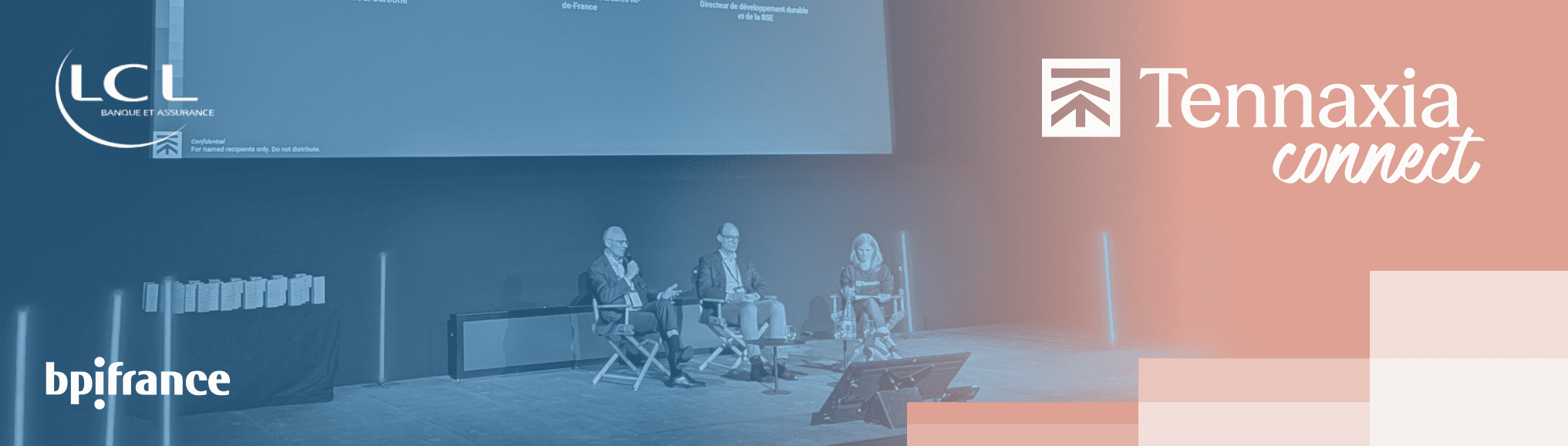
Sustainable transformation is no longer a peripheral regulatory option; it is becoming a central issue for economic performance and organizational survival. At the Tennaxia Connect event, Solène Garcin-Charcosset, Head of ESG/Carbon Consulting at Tennaxia, led a key round table alongside Philippe Kunter, Director of Sustainable Development and CSR at Bpifrance, and Julien Duquenne, Head of Sustainable Solutions Île-de-France at LCL. Amidst the urgency to act in the face of multiplying crises, evolving demands from banking regulators, and the need to adapt business models on the ground, this discussion demonstrated that sustainability is profoundly redefining corporate competitiveness, resilience, and strategic management.
Why sustainability is becoming a compass for performance
We are currently operating in a complex and paradoxical world, marked by a certain regulatory unraveling in Europe, even as systemic crises show no signs of slowing down. The 2022 energy price crisis, the Strait of Hormuz blockade, the acceleration of extreme weather events: warning signs are rapidly accumulating. This was the initial observation highlighted at the conference: the urgency to act is imperative for everyone and demands a growing need for resilience from businesses.
In this context, CSR is radically changing its nature. Long perceived through the lens of ethics, morality, or personal convictions sometimes championed in isolation by CSR directors, it is now becoming a true compass for performance and resilience. This shift is now largely materialized by the increasing involvement of financial players, who have placed sustainability at the heart of strategic discussions.
From Macro Strategy to On-the-Ground Tactics: The "Season 2" of CSR
Sustainability has reached a major operational milestone. Julien Duquenne summarized this transition by announcing the opening of a "Season 2" of CSR, decidedly tactical and rooted in on-the-ground realities. The first phase, very top-down and prescriptive, was primarily focused on compliance with major global macroeconomic scenarios, such as the 2015 Paris Agreement.
Today, the challenge shifts directly into the gears and engine of businesses. This tactical approach compels financial institutions and leaders to concretely analyze the impact of climate change at each site level:
- What does this mean for the value chain and the company's specific geographical footprint?
- How do these disruptions affect current economic metrics?
- How capable is the organization of planning for and anticipating these changes to its business model?
Transition plans can no longer be abstract concepts casually approved in a board meeting; they must be executed with great agility on the ground to preserve companies' competitiveness in the face of fierce national and international competition.
Action as an anxiety-reducer: Bpifrance's support strategy
For Philippe Kunter, facing an uncertain future and shocks that will inevitably intensify, action is the best antidote to anxiety. Bpifrance has acknowledged that these disruptions (whether climatic, health-related, or biodiversity-related) are not temporary side effects, but permanent structural realities that must be culturally integrated.
To prevent entrepreneurs from feeling isolated, the public bank is now implementing concrete support strategies for businesses ranging from startups to large corporations, including SMEs and mid-caps. This approach is based on three fundamental pillars:
- The Accelerators : Programs conducted in partnership with regions to help companies advance in terms of knowledge, business practices, and experience sharing.
- Strong Communities : Networks of committed entrepreneurs, symbolized by the Green Rooster for ecological and energy transition, or the White Rooster for health.
- Consulting and Diagnostics : Close support to formalize action plans (such as decarbonization plans), carried out hand-in-hand with leading expert partners like ADEME or OFB (French Office for Biodiversity).
Philippe Kunter emphasizes a golden rule: this support must be long-term. Nothing can be built on one-off actions. Resilience requires being a solid partner, consistently present alongside entrepreneurs.
The major risk of inaction: the insurability of business models
One of the most impactful messages from this round table concerns the direct cost of the status quo. A major risk is emerging today, overshadowing traditional financial concerns: corporate insurability. France has adopted an official trajectory for adaptation to climate warming which anticipates a scenario of +4°C by 2100. Faced with the assessment of these physical risks, some insurers are already beginning to withdraw from certain territories or refuse coverage.
"No insurance, no financing." — Julien Duquenne
This pragmatic reality redefines the role of banks. If a company fails to demonstrate that it has implemented a rigorous adaptation plan to secure its infrastructure or raw material supplies, it risks losing its insurance, which will automatically block its access to bank financing.
This dynamic is strongly accentuated by regulatory authorities. The European Central Bank (ECB) and the European Banking Authority (EBA) now require banking institutions to map and measure the ESG risks (physical risks and non-adaptation risks) of their portfolios, while demonstrating how they concretely support their clients' transition trajectory. Extra-financial risk has definitively become a major financial risk factor, which will dictate the future allocation of capital and resources.
Maintaining Europe's lead: an imperative for supply chains
When asked about France's and Europe's international standing, the speakers highlighted the robustness and maturity of the European extra-financial framework, despite contrasting global dynamics. Like China, the world's largest polluter but also the leader in the forced deployment of renewable energies, opposing forces are clashing.
Europe, for its part, is navigating an intermediate period, seeking to reconcile the firmness of the ambitions of the Green Deal and recent political desires for simplification. Nevertheless, thanks to the development of advanced financial tools (Green Bonds, Social Bonds, sustainability-linked loans), Europe and France maintain a clear structural advantage.
The closing message to leaders is unequivocal: don't give up. In an economic landscape where all supply chains are interconnected, small businesses work closely with major clients. Facilitating the technical adaptation of one's business model (such as the historical shift from gas to electricity, for example) and strengthening operational robustness are no longer imposed constraints, but indispensable conditions to remain relevant in tomorrow's economy.