
.svg)







🔎 Key takeaways
Please note: This article concerns French legislation. The requirements described may not apply in other countries.
I have combustion installations; how do the regulations for classified facilities apply? Combustion installations are common equipment in industry, but they are also found in other sectors such as the service industry (office buildings, retail, etc.) or logistics. All these establishments may therefore be subject to classification as an installation classified for environmental protection under heading no. 2910 or even no. 3110. Since there are many types of equipment covered by these headings and determining the power to be taken into account can be complex, this article aims to summarize the main elements to consider for determining this ICPE 2910 classification.
🔄 REGULATORY UPDATE: 2025 MILESTONE NOW IN FORCE
Please note: the emissions reduction timeline under the EU Medium Combustion Plants (MCP) Directive has entered its active phase.
- Tighter emission limit values (ELVs): Since 1 January 2025, existing installations with an output over 5 MW must comply with significantly lower air emission thresholds (dust, nitrogen oxides - NOx). The deadline remains 1 January 2030 for lower-output installations (between 1 and 5 MW).
- Harmonised power calculation: Following the decree of 21 July 2021, the rules for calculating total rated thermal input have been standardised across all regimes (Declaration, Registration, Authorisation) under heading 2910, now based exclusively on the criterion of technically connectable units.
Determining the ICPE 2910 or 3110 classification for combustion installations
To determine the classification applicable to a site, a three-step process must be followed:
1) Inventory of all combustion appliances, including those with a power output of less than 1 MW: this may include boilers, radiant heaters, unit heaters, furnaces, engines or turbines, generators, dryers, thermal motor pumps, flares, burners, etc.
2) Sum of the rated thermal input (**) of all appliances present on the site that can operate simultaneously:
- If this power exceeds 50 MW, the site is subject to authorization under heading 3110,
- If this power is less than 50 MW, the site is not classified under heading 3110; you must proceed to the next step to evaluate classification under heading 2910.
Note: double classification is not permitted. ICPE 2910 /3110
(**): Nominal thermal power of a combustion appliance: this corresponds to its net calorific value. It refers to the input power (as opposed to the useful power or electrical power). It is obtained in two ways:
Calorific power (kW) = fuel input rate (m3/h or tons/h) × LCV (kWh/m3 or kWh/tons) or,
Calorific power (kW) = Useful power (kW) / Efficiency.
3) Sum of the thermal power of appliances that can operate simultaneously and are technically connectable (***) including those with a power of less than 1 MW, with the exception of flares, radiant panels, thermal oxidizer burners, activities classified under other headings of the nomenclature where combustion is part of the melting, cooking, or treatment process, mixed with the combustion gases of the incoming materials (glass furnaces, chemical process furnaces, cement kilns, dryers, etc.) and activities covered by headings 2770, 2771, 2971, or 2931:
For each set of appliances (= installation), the ICPE 2910 classification is determined based on the heading table according to the fuel used. If the installation includes appliances consuming fuels that fall under different headings, the most restrictive heading for classification is applied,
Note: on a single site, there may be several installations classified under heading 2910-A and/or heading 2910-B.
(***): The following are not considered technically connectable:
- All combustion engine-driven pumps,
- Devices located more than 300 m apart or situated in buildings with different addresses,
- Devices that received authorization, registration, or declaration before July1st, 1987 and are not connected to a common chimney,
- Devices under 2 MW that were not subject to ICPE regulations before December 20, 2018, and are not connected to a common chimney.
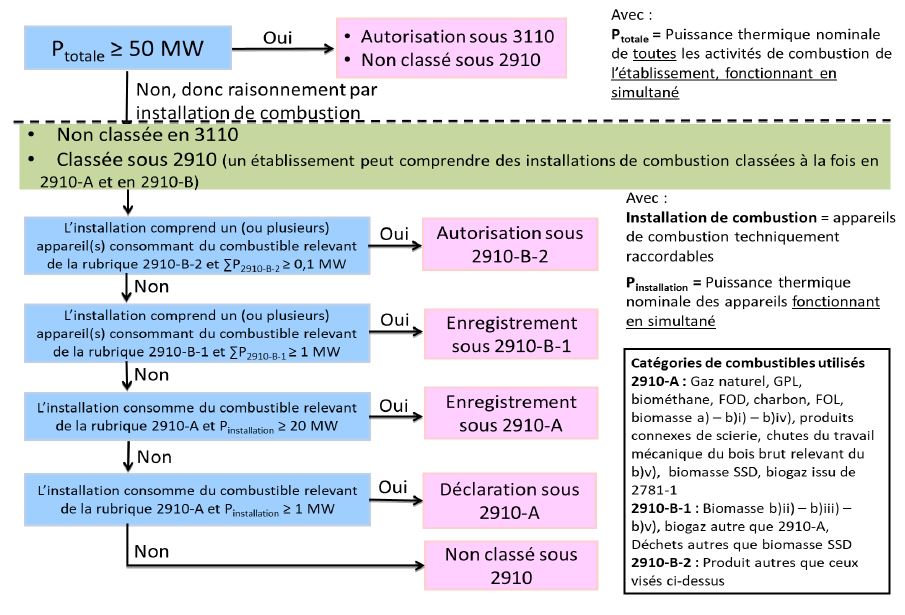
The diagram below summarizes this process:
Which general requirements order applies?
Several general requirements orders may apply to ICPE facilities under headings 2910 or 3110:
- "General Declaration Order": Order of August 3, 2018, regarding the general requirements applicable to installations classified for environmental protection subject to declaration under heading 2910 (NOR: TREP1726498A);
- "Biogas Declaration Order": Order of August 3, 2018, regarding the general requirements applicable to combustion appliances consuming biogas produced by anaerobic digestion facilities classified under heading no. 2781-1, included in a combustion installation classified for environmental protection subject to declaration under heading no. 2910 (NOR: TREP1726505A);
- "Registration Order": Order of August 3, 2018, regarding the general requirements applicable to installations subject to the registration regime under heading 2910 of the nomenclature of installations classified for environmental protection (NOR: TREP1726510A);
- "Authorization Order <50 MW": Order of August 3, 2018, regarding combustion installations with a total rated thermal input of less than 50 MW subject to authorization under headings 2910, 2931, or 3110 (NOR: TREP1726534A);
- "Authorization Order ≥ 50 MW": Order of August 3, 2018, regarding combustion installations with a total rated thermal input of 50 MW or more subject to authorization under heading 3110 (NOR: TREP1726535A).
To determine the ministerial order applicable to a combustion installation:
1) For ICPE heading 3110:
- If the sum of the nominal thermal capacities of the units making up the installation, after excluding units under 15 MW and those listed in point 3 of Article 3 of the "Authorization Order ≥ 50 MW", is 50 MW or more: the "Authorization Order ≥ 50 MW" applies.
- If the sum of the nominal thermal capacities of the units making up the installation, after excluding units under 15 MW and those listed in point 3 of Article 3 of the "Authorization Order ≥ 50 MW", is less than 50 MW: the "Authorization Order < 50 MW" applies.
2) For ICPE heading 2910:
- The general requirements order applies to each installation individually based on its classification.
- For an installation composed of units operating with different fuels that result in classifications under different sub-sections: The requirements order corresponding to the most stringent regulatory regime applies.
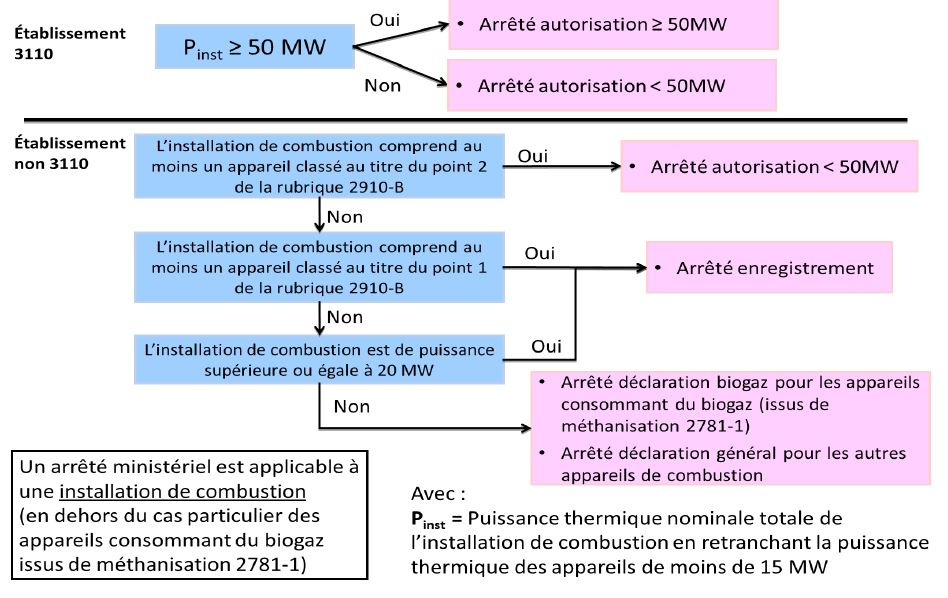
Regarding the applicability of the new ministerial orders, another diagram from the Ministry's Combustion Technical Sheets helps determine which order applies to the various installations present:
Content of applicable requirements
The general requirements orders mentioned above define the rules applicable to combustion installations. They can be categorized as follows:
| Categories of requirements | Details and points of attention |
|---|---|
| Construction requirements for premises housing combustion installations |
• Siting distance • Fire resistance of premises and smoke extraction • Pipework |
| Monitoring of air emissions, which vary depending on the type of combustion equipment (boilers, engines, turbines, etc.) and their annual operating time |
• Periodic or continuous monitoring plan POINT OF ATTENTION: Plan ahead for the modifications needed to your combustion installations in order to meet the emission limit values, which will be lowered by the set deadlines (2025 or 2030, depending on the case). |
| Monitoring of water discharges |
• Wastewater • Stormwater • Groundwater |
| Accident and pollution prevention |
• Containment of firefighting water and accidentally spilled liquids • Risk localisation • Gas detection, automatic fire suppression, etc. |
| Operational provisions |
• Monitoring of the installation • Works • Periodic inspections • Operating instructions |
In addition to these ICPE regulations, boilers are also subject to other obligations, in particular:
- Minimum efficiency standards, pollutant emission checks, and energy efficiency inspections (Environmental Code, Articles R.224-16 to R. 224-41-9);
- Reporting of information regarding medium combustion plants (Environmental Code, Articles R. 515-113 to R. 515-116: Medium combustion plants).
Photo credit: Ludomił Sawicki