
.svg)



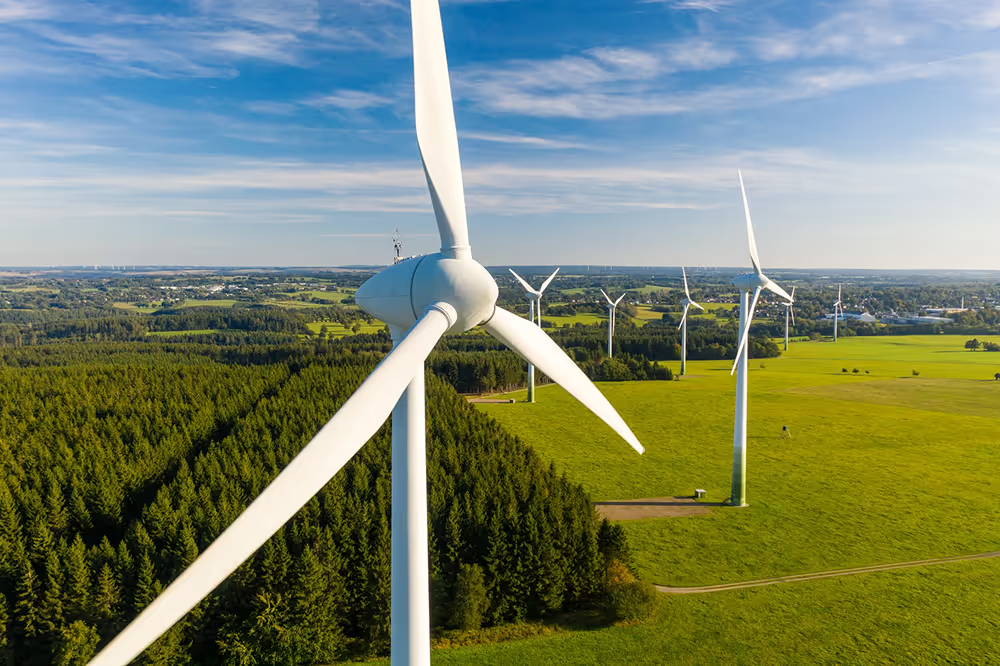


Carbon accounting is a term used to describe the assessment of an organization's greenhouse gas emissions. Emerging about fifteen years ago and popularized in France through the Bilan Carbone tool, this new discipline is currently undergoing profound changes.
Indeed, stricter regulations related to climate issues (Climate and Resilience Law), the integration of carbon criteria into procurement departments, and rising costs associated with carbon emissions (cross-border carbon taxes, surging prices for carbon credits and quotas) are raising the standards for carbon accounting.
In short, organizations must now prepare to measure their carbon emissions more accurately and more frequently than before.
This paradigm shift is leading to more complex carbon accounting rules. To address these new complexities, new technologies are emerging, including SaaS solutions. These solutions help overcome several carbon accounting challenges, 5 of which we have listed and detailed below:
1. A company's carbon footprint is measured over time
Heads up! If you are not familiar with what a carbon footprint assessment is, the rest of this article may seem quite complex. 🙂 If needed, here is a quick refresher in this article.
Conducting a carbon footprint assessment is a good start. Updating it every year is even better. Why? Because it allows you to visualize your progress in reducing emissions.
This advantage becomes increasingly significant over the years. Indeed, when a company commits in 2020 to a reduction target for 2040 or 2050, it implies that it will need to measure its emissions annually to verify that it is on the right track.
However, once a company has already completed 3 or 4 carbon assessments, many difficulties arise:
- You must maintain a consistent data structure over time to accurately measure progress, even as the company grows (through external growth, international development, etc.).
- You need to keep all data in one place, including notes on data processing (for example, if the person in charge of the carbon assessment is replaced).
- You must recalculate reduction targets for future years based on the results of previous years.
An CSR team surely has better things to do than manage all this manually :)
2. Emission factors change over time
In line with the first point, updating this carbon assessment presents a challenge that is often underestimated: Updating emission factors.
Here are 2 examples to illustrate the type of problem a company may encounter when updating emission factors.
1st example: I want to update my emission factors every year, particularly to take into account the progress made by my country in terms of the carbon impact of the energy mix.

2nd example: An essential emission factor in my assessment has been corrected. This correction leads to a sharp increase in my assessment! I must therefore recalculate my previous assessments with this new factor to visualize the "real" reduction.

In this second case, it means having to recalculate all previous carbon assessments with the new corrected emission factor. And if this factor is corrected again in 3 years, the correction will have to be applied to all carbon assessments once more.
You can see the problem if you keep all your carbon assessments in simple files.
3. The action plan must be manageable at every level of the company
To ensure a company reduces its emissions, an "action plan" is defined, which is a roadmap consisting of several internal projects aimed at reducing the company's emissions, if possible without impacting its operations.
These reduction projects can be extremely varied: they may involve people from all departments (procurement, CSR, production, etc.), vary in duration (some are one-off actions, while others span 5 years), and involve multiple company entities across different countries.
These various factors make tracking emission reduction projects complex, especially for multi-country projects involving multiple departments (anyone with some project management experience knows what we're talking about).
Carbon project tracking solutions must therefore be able to:
- create a collaborative and intuitive workspace, as it must involve a wide variety of users within the company
- manage the complexity associated with geographical differences (language, data formats, etc.)
- Collect operational data related to the project on a recurring basis (monthly or quarterly)
These features are necessary so that the Carbon Footprint goes beyond the scope of CSR and keeps all involved employees engaged.
4. The historical environmental data register must be easily accessible and auditable
If a client or shareholder asks you to provide your carbon footprint today, how do you do it?
If a client, shareholder, or regulator asks you to provide your emissions for the last 3 years, how do you do it? And what about for a specific subsidiary of your company?
While these specific cases may seem far removed from your current challenges, be aware that some companies have to answer these types of questions very regularly, particularly in the context of tenders.
Indeed, more and more procurement departments are taking this criterion into account, and it is even becoming a deciding factor in certain public tenders.
These new rules require companies to have easy access to structured and auditable data (for example, by attaching an electricity bill to the corresponding emission source). This is a challenge that a SaaS solution addresses perfectly.
5. It must be easy to exchange data between clients and suppliers
Here is the million-dollar question in carbon accounting: How to accurately determine emissions related to my supplier ?
Since Scope 3 of a carbon footprint is primarily linked to emissions from suppliers and subcontractors, it is essential to have a clear understanding of your partners' emissions to accurately measure those of your own organization.
Many companies are currently tackling this issue, driven in particular by large international groups that have made public climate commitments.
A brief diagram to explain the impact of these commitments across the entire value chain:

This paradigm creates new challenges:
- You must ensure the traceability of data provided by the various players in the value chain.
- You must implement a common system for data exchange.
Solutions are currently being developed, and we are already seeing some major accounts implementing systems like blockchain to fulfill this function.
In this context, the value of a carbon footprint platform that allows a company to easily request data directly from its suppliers becomes clear.
Conclusion
Carbon accounting is becoming increasingly complex, driven by stricter regulations, rising costs associated with emissions, and the integration of carbon criteria into procurement departments.
This rise in standards is driving the professionalization of the sector, with the emergence and development of firms specializing in carbon accounting and strategy, and the rise of SaaS solutions designed to make measuring and tracking these emissions easier for everyone.
In some complex cases, it may be relevant to consult a specialized advisory firm and back their findings with a carbon accounting platform. This involves conducting an analytical exercise at the start of the project to define a data collection framework and an action plan tailored to the company's business, then deploying the SaaS tool to track performance and support decision-making over the long term.
At Traace, we are convinced that all these approaches will help accelerate the transition of companies toward a sustainable model for the environment and society.
If you would like to learn more about our carbon accounting and tracking platform, please feel free to book a meeting with us for a demo of our tool. 🙂
If you have any questions or suggestions regarding this article, please feel free to email us at contact@tennaxia.com!