
.svg)



.jpeg)


Short on time? Here is a quick summary below. 😊
- A carbon footprint is a tool used to measure a company's greenhouse gas emissions over a one-year period.
- Carbon footprinting is becoming increasingly essential due to changing regulations.
- It is a tool based on 3 scopes of action : direct company emissions (e.g., fuel consumption), indirect emissions related to energy consumption (e.g., electricity), and other indirect emissions (purchases, waste, etc.).
- A carbon footprint assessment is tailored to your specific needs and should align with your CSR plan.
- A carbon footprint can be a competitive advantage. It is increasingly being requested as part of tender processes.
- A carbon footprint can help you save money.
- A carbon footprint is a first step toward respecting the planet.
Corporate Carbon Footprinting: A How-To Guide 📖
With global warming intensifying and new heat records being set almost every year, it is often said that it is essential for companies to reduce their CO2 emissions by adopting an appropriate CSR strategy. This generally involves a carbon assessment conducted by an external party that will propose an action plan and/or via a carbon footprint platform.
Want to know everything about Carbon Footprints? We explain it all here! 👇
Defining the carbon footprint 🍃
The carbon footprint, or GHG assessment, was defined by the French Agency for Ecological Transition, also known as ADEME as the tool used to evaluate the quantity of greenhouse gases emitted into the atmosphere within a given territory. This assessment is then expressed in carbon dioxide equivalent (CO2e).
The steps of a carbon footprint 🧐
There are two main steps in conducting a GHG assessment. First, you must define which greenhouse gases will be accounted for, and second, determine the scope of action to be included.
1/ The different types of gases in a carbon footprint
The different types of gases that are included in a company's carbon footprint calculation are as follows:
- Carbon dioxide: CO2
- Nitrous oxide: N2O
- Methane: CH4
- Sulfur hexafluoride: SF6
- Hydrofluorocarbons: HFCs
- Perfluorocarbons: PFCs
These various emissions are then converted into CO2 to allow for a very simple formula: CO2 emissions = quantity consumed x emission factor.
An emission factor is the ratio between the quantity of greenhouse gases emitted by a product or material and the characteristic value of the object measured in CO2 (using the most appropriate unit, such as grams or kilograms of CO2).
2/ The 3 scopes of a carbon footprint
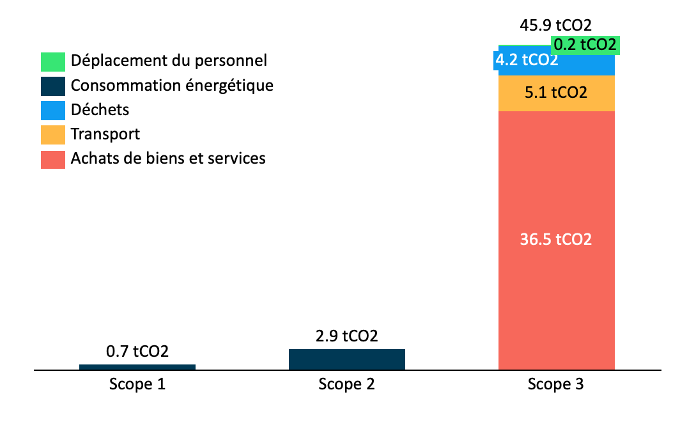
This is the most complex step of your carbon footprint assessment. A scope defines a perimeter within which an organization's or product's greenhouse gas emissions are analyzed. The scopes range from the most restricted, Scope 1, to the most comprehensive, Scope 3.
Scope 1 or direct emissions
These are CO2 emissions directly linked to your company's activity, such as the consumption and use of fuels (gasoline/diesel) and all emissions from so-called stationary sources (your equipment, your buildings, etc.), non-energy processes, and biomass. If your company used oil during the manufacturing process of your product, these greenhouse gas emissions will be accounted for in this scope.
Scope 2 or indirect emissions linked to energy consumption
This scope takes into account your greenhouse gas emissions linked to energy consumption during your production process, whether in the form of heat, cooling, or electricity.
Scope 3 or other indirect emissions
When we talk about Scope 3, we are referring to CO2 emissions that are not part of the product or service production process itself, but rather other stages of its life cycle, such as manufacturing, transport, final use by customers, and end-of-life management (recycling, disposal, etc.). This includes, for example, your purchases of products and services as well as your employees' business travel.
As Scope 3 is the most "comprehensive" in terms of perimeter, it is often the source of the largest quantity of greenhouse gases emitted by your company.
Your company's carbon footprint must therefore meet the following criteria:
- It must cover the first two Scopes, while Scope 3 is currently optional.
- It must provide you with a detailed view of the greenhouse gas emissions produced by your company.
- It must cover as many greenhouse gas emissions as possible to help you identify the greatest number of reduction levers.
- It must succeed in establishing a long-term low-carbon strategy.
A carbon footprint: just for peace of mind, or a competitive advantage?
Ultimately, after reading this article, you may be wondering: "Why bother with a carbon footprint if I'm not required to do it and it doesn't seem to offer any return on investment at first glance?"
Well, because a carbon footprint is proving to be an increasingly key competitive advantage, for the reasons described below:
Meeting your customers' expectations
Having a company that respects its environment is an excellent way to stand out from the competition and generate a positive image. Communicating about your CSR policy is a great way to attract new customers, who are increasingly concerned about the ecological footprint of businesses.
Attracting investors
We now find CSR labels that can be obtained for managing a successful CSR project. Transparency with your investors is essential to gain their trust (no one invests in a company that works against climate goals). Finally, an ambitious CSR strategy will also give you a competitive advantage over your competitors in the long term.
To reduce energy consumption and optimize costs
Conducting a carbon footprint assessment helps you understand where you can save money and consume less gas, electricity, or heating. It can also help you optimize your transport costs!
For our planet
Indeed, if fossil fuel consumption does not decrease by 5% every year and we fail to meet the Paris Agreement targets, the rise in global temperature will exceed 2°C, with potentially dramatic consequences: an increasing number of climate refugees and the extinction of animal species.
Great! But how much does it cost? 💸
This question is so broad that we decided it deserved its own explanatory article 👇
https://www.tennaxia.com/en/blog/bilan-carbone-combien-ca-coute
Thanks for reading to the end of this article! It means we aren't the only ones who want to move in the right direction. 😏
Have a great, low-carbon day.
The Tennaxia Team