
.svg)






A taboo subject just a few months ago, the health crisis led to a surge in remote work in almost all companies, to the point that some of them have decided to make it the norm.
Since it reduces daily commutes, it is naturally seen as an effective way to reduce a company's CO2 emissions.
However, this is not always the case. Indeed, ADEME has just published a very comprehensive report, concluding that remote work could lead to various increases in energy consumption.
Here is a list of best practices to implement in your company to ensure it will reduce the carbon footprint.
1. Understand how your employees commute to work every day
Yes, for this first best practice, we're asking you to do some work.
Because if you want to make remote work more frequent with the goal of reducing emissions, it is first crucial to quantify the carbon impact of your employees' daily commutes.
Indeed, it's important to know that the main positive effect of remote work in terms of CO2 emissions focuses on reducing emissions related to daily commutes. Thus, the whole point of the exercise will be to ensure that the reduction in emissions related to these commutes is greater than the increase in emissions induced by the implementation of remote work.
Therefore, if the majority of your employees commute by car, there's a high chance that remote work will allow you to reduce your carbon footprint.
But if a majority of your employees come to the office on foot, by bike, or by metro, then there's a chance that remote work will increase your emissions.
However, there is one case where these rules may not apply: this is when your employer "adapts" office size based on the number of employees on-site / working remotely. We'll discuss this a bit further down!
2. Create a personalized remote work plan by country
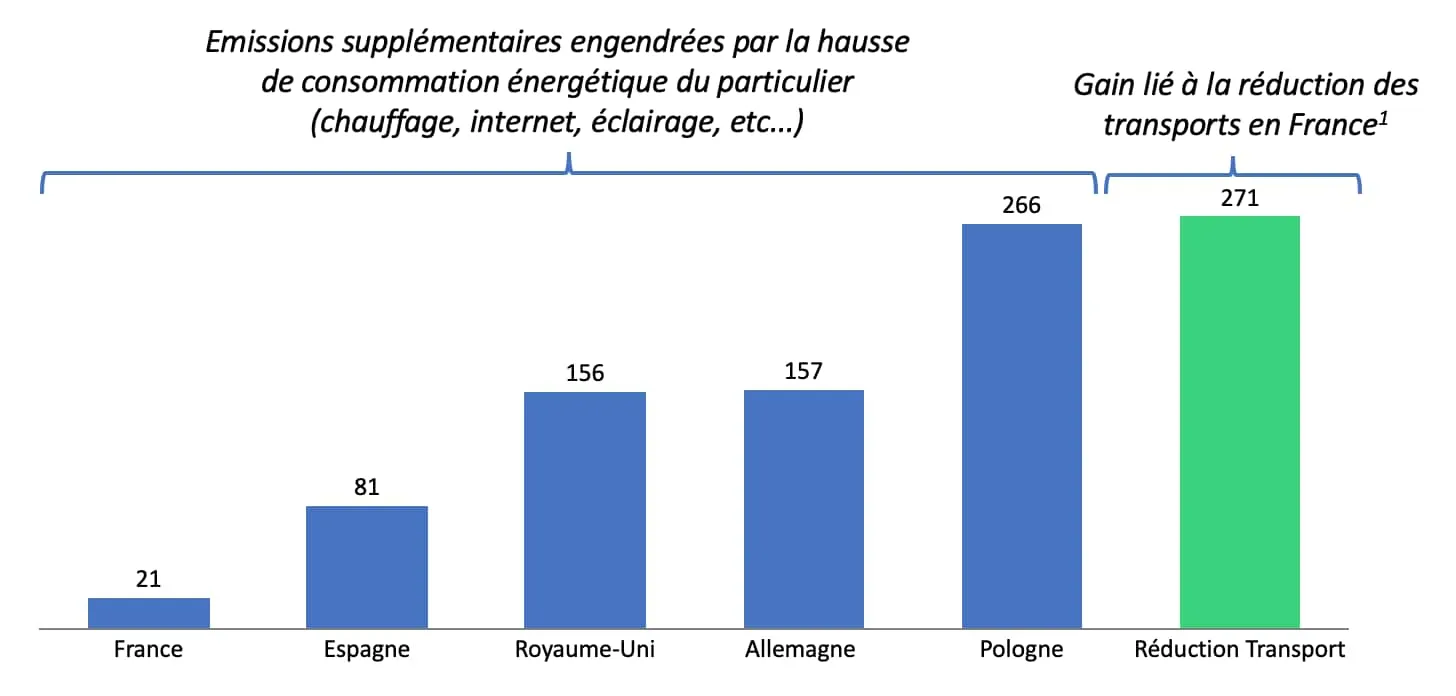
One of the most impactful rebound effects related to remote work is what ADEME calls the "Housing" effect. This refers to the increase in household electricity consumption attributed to the employee's professional activity.
Indeed, working from home will lead to an increase in heating, lighting, internet, electrical equipment, etc. ADEME estimates that remote work results in a 7.5kWh increase in electricity consumption per day.
However, since the carbon mix differs between each country, here is the carbon impact per country of this "rebound effect":
- France: + 20.7kgCO2e per day
- Germany: + 167.1kgCO2 per day
- China: + 278.7kgCO2 per day!
The benefits of remote work on the carbon footprint therefore vary depending on the country you are in.
3. Reduce video usage during video conferencing
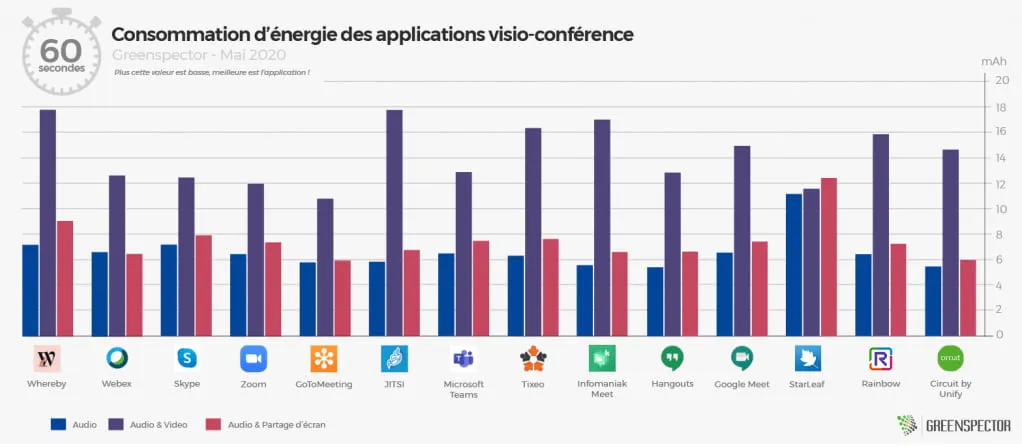
An essential tool for remote work, video conferencing places a high demand on servers that consume energy. They therefore, de facto, emit greenhouse gases.
According to a 2020 study by Thierry Leboucq, one minute of video conferencing emits approximately 1g of CO2.
However, the differences between using video conferencing with and without video are fundamental, as using it without video emits on average 2 to 3 times less CO2 (this depends on the application used).
In summary, for short daily meetings, feel free to turn off your video!
4. Extend the lifespan of your IT equipment or switch to refurbished equipment
To ensure optimal comfort for remote employees, companies did not hesitate to invest in IT equipment.
Indeed, according to a study conducted by BNP Paribas 3 Step IT, 83% of French companies purchased additional equipment during the health crisis. Furthermore, the widespread adoption of remote work will lead to a doubling of certain comfort-related IT equipment (dual monitors, ergonomic chairs...).
To minimize this impact, extending the lifespan of your IT equipment is one of the most effective levers. To do this, you can opt for a systematic repair approach for your systems (several IT providers offer this option) or choose a refurbished IT equipment supplier.
This advice is also valid outside of remote work. 😉
5. Opt for "Flex Office"
By Flex Office, we mean all "on-demand office" type solutions.
If 50% of your employees work remotely, why would you keep 100% of your initial square footage? You could consider reducing your space by 50% and renting the remaining 50% to another company with 50% remote workers.
This type of solution, while still marginal, is nevertheless booming and, according to ADEME, represents the most effective way to maximize the positive effects of remote work.
Its implementation nevertheless requires some effort, as for many companies, it involves a change in premises and culture. Furthermore, it also requires a certain level of organization because the company will need to effectively manage employee schedules and available office space.
There you go! If you manage to implement all of this, you're already doing great. 👏
Don't hesitate to contact us if you have any questions about this article!