
.svg)

.webp)


🔎 Key takeaways
- L'énergie grise, c'est une énergie cachée : C'est la consommation énergétique globale nécessaire pour fabriquer, transporter, utiliser et recycler un produit, représentant en moyenne 2/3 de son impact énergétique total.
- Au cœur de l'éco-conception : Très utilisée dans la construction (20 % de l'empreinte carbone d'un bâtiment) et l'électroménager, elle permet d'évaluer la vraie durabilité d'un bien et de concevoir des produits plus écoresponsables.
- Un indicateur utile mais incomplet : Si elle aide à calculer le cycle de vie, elle s'avère complexe à mesurer sur les produits industriels et oublie certains polluants comme les déchets plastiques ou chimiques.
- Des leviers d'action bien précis : Pour la réduire, la priorité est de fabriquer local, d'employer des matériaux bruts et surtout d'allonger la durée de vie des équipements au lieu de les remplacer.
A concept dating back to the 1960s, at the genesis of life cycle assessment (LCA), embodied energy remains a widely used metric in certain sectors and forms the basis of many environmental impact measurement systems. Sometimes seen as competing with carbon footprint, these two methodologies evolve in parallel and can prove complementary.
So, what is embodied energy? How is it measured? What is its purpose and for whom?
The origin of embodied energy
The term "embodied energy" first appeared in 1972 in the research work of Dr. Ian Boustead. This concept was the subject of several studies in the late 1960s. Faced with waste accumulation and the massive exploitation of natural resources during a period of strong economic growth, several companies began to take an interest in the concept of product life cycles.
One of the first was Coca-Cola, which in 1969 sought to identify less polluting alternatives to its glass bottle. The result, however paradoxical it may seem today, indicated that the plastic bottle consumed much less embodied energy than the glass one. This partly explains the near-universal adoption of this format from the 1990s onwards.
What is embodied energy?
Embodied energy refers to the total amount of primary energy consumed throughout a product's life cycle, from raw material extraction to its end-of-life. It is expressed in kWh.
This concept aims to calculate the overall environmental impact of a product or material.
It therefore exhaustively takes into account raw material extraction, transport, successive transformations, commercialization, commissioning, product use, and finally its recycling or destruction.
It is also known as hidden energy, intrinsic energy (embodied energy in English), or indirect energy in the sense that it is not perceived by the consumer of the product or material. It thus contrasts with operational energy, which is the energy consumed during product use (for example, the fuel you put in your internal combustion car or the heating of a building).
Embodied energy is particularly used in certain sectors such as construction or home appliances. It allows for an assessment of the energy required to produce a building or a machine, but also, subsequently, to estimate when its construction "pays off." That is, when its direct energy consumption has surpassed its embodied energy consumption. According to this methodology, the longer a product's lifespan, the more likely it is to "pay off" in terms of its environmental impact, thereby avoiding energy waste.
Considering this topic seems all the more important given that it is estimated that embodied energy represents, on average, two-thirds of a product's total energy consumption.
Calculating its quantity would therefore allow us, for example, to know whether it is better to buy an electric vehicle new or keep their old petrol car.
Embodied Energy and LCA
The concepts of embodied energy andLCA are interconnected. The term 'embodied energy' emerged during research conducted on product life cycles. However, it was studies on embodied energy that subsequently allowed for the formalization and standardization of life cycle assessments.
Thus the life cycle assessment of a product is a standardized and regulated method for quantifying the embodied energy of a product or service. This concept was first introduced at the Rio Earth Summit in 1992.
This methodology was subsequently addressed by the International Organization for Standardization (ISO), which created new standards, ISO 14040 and 14044, for measuring the LCA of products and services.
Example Use Case: Construction
Embodied energy has become a relatively common metric in the construction sector. It allows for measuring the environmental impact of a building and is the source of many innovations, both in material selection and in the construction process.
A building's intrinsic energy specifically includes:
- The energy used to manufacture building materials.
- The energy used to transport materials to the construction site.
- The energy used to construct the building.
- The energy used to maintain the building.
- The energy used to demolish the building.
Added to this are the transport of workers, the setup of the construction site, etc.
A building, logically having a particularly long lifespan, It is estimated that embodied energy represents on average 20% of the total energy consumed over its lifespan, which still represents a significant portion of its environmental footprint.
Among the possible solutions to reduce this amount of energy are those focusing on materials (sustainable, low environmental impact, local to reduce transport) and those concerning building design (eco-responsible construction practices, energy-efficient buildings).
AFNOR has developed the HQE label for this purpose, aiming to “limit the short- and long-term environmental impacts of a construction or renovation project, while ensuring healthy and comfortable living conditions for occupants.” This label is based on studies of embodied energy in buildings and takes into account, among other criteria, the energy that will be consumed throughout the building's lifespan.
The Limitations of Embodied Energy
While the measurement of embodied energy is supposed to allow for the assessment of a product or service's "global" impact throughout its lifecycle, its focus on energy limits the analysis, as it does not consider other co-impacts on certain environmental indicators.
Pollution, the Great Oversight of Embodied Energy
One of the main limitations of this methodology is thatit omits collateral environmental damage that can be linked to the product's lifecycle.
Thus, it does not account for chemical pollution related to raw material extraction, their transformation, or the end-of-life of products. This is, for example, the case with red mud generated during the aluminum manufacturing process.
The case of Coca-Cola is particularly telling. As we mentioned, their initial analyses in the late 1960s were among the criteria that led them to favor PET bottles, which consumed less embodied energy than their glass predecessors. Unfortunately, this initiative also led them to become the world's leading source of plastic pollution, according to the latest reports from the NGO Break Free From Plastic.
However complete and elaborate it may be, embodied energy is therefore not a sufficient indicator to measure the full environmental impact of a product. Other indicators will need to be added to it to measure the collateral damage generated during the product's lifecycle.
A complex indicator to measure
Considering the entire lifecycle of a product, a building, or a service, embodied energy proves difficult to measure. This is even more true for complex products, composed of a very wide variety of products.
The automobile is a striking example. Thousands of parts, from different origins, themselves composed of materials processed numerous times.
Adding to this complexity is the product's end-of-life. Which components of a complex product can be recycled or reused, and which must be destroyed? Does the end-of-life location have the necessary resources for recycling?
While it's possible to establish an average, the number of criteria to consider makes the results of this analysis relatively uncertain and therefore requires a strict and standardized process, as well as the willingness of all stakeholders involved in a product's lifecycle to act.
How to reduce embodied energy?
As we mentioned, embodied energy accounts for, on average, two-thirds of a product's energy consumption. To reduce our negative environmental impact, it is therefore essential to tackle this issue head-on.
Since the amount of energy consumed is strongly linked to the production of new products, we must therefore completely rethink our consumption patterns. Both in terms of the quantity of products and their production methods.
The goal is therefore to find a way to "make this energy worthwhile." To reduce the share of embodied energy consumption relative to in-use energy consumption over a product's lifespan.
Extend product lifespans
One of the primary solutions for reducing the amount of energy consumed is toincrease product lifespans. Indeed, a functional product will not (or should not) need to be replaced.
Extending product lifespans by combating planned obsolescence or increasing their reparability thus significantly reduces environmental impact.
Then arises the question of whether it's better to replace a product with high in-use energy consumption with a new, more energy-efficient one. The most complex products require a large amount of embodied energy to manufacture, so replacing them with a less energy-intensive product is not always the most suitable solution. Sometimes it's better to maximize the use of the current product.
Reduce energy consumption at the source
The more a product is processed, the more embodied energy it will consume. The further a product comes from, the more embodied energy it will consume.
By favoring raw or at least less processed materials, we significantly reduce the amount of energy consumed during product manufacturing. This is the case, for example, in the construction sector, where flax fiber insulation proves to be much less harmful to the environment than polystyrene.
Similarly, using local products helps eliminate a large portion of a product's embodied energy, which is linked to material transportation.
Embodied Energy and Globalization
The analysis of embodied energy has highlighted certain illusions of decarbonization when studied within a limited scope.
Thus, developed countries have tended in recent decades to export their embodied energy to developing countries.
The relocation of entire sectors of European industry to Asia has led to a de facto relocation of our energy consumption and artificially reduced the official figures for European countries regarding territorial emissions. China has thus become the world's leading exporter of embodied energy.
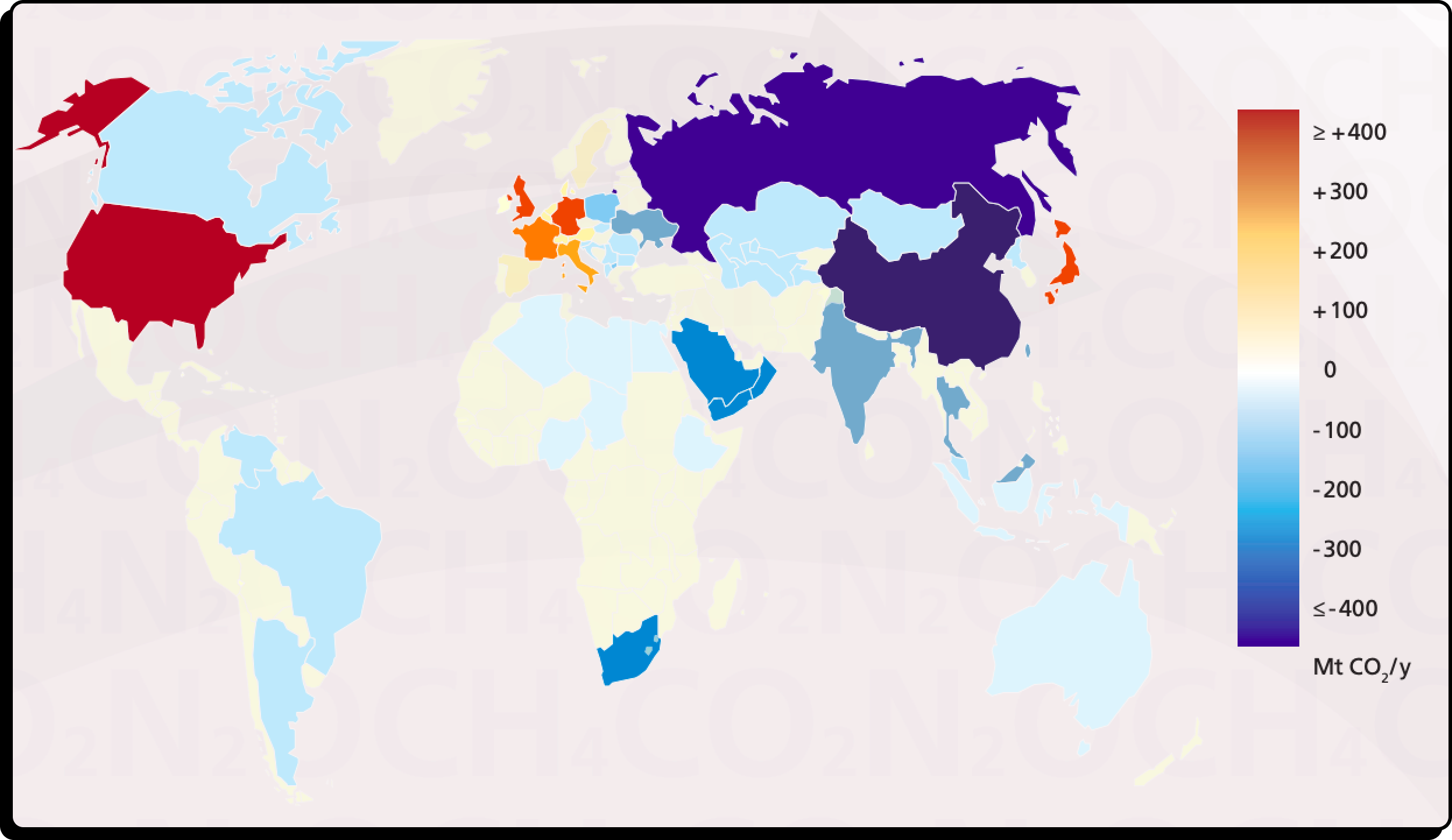
We therefore have a biased view of our efforts regarding carbon emissions. Even as our direct emissions decrease, our embodied energy consumption tends to increase. It increases due to our consumption patterns (more numerous, lower quality products) but also due to the origin of the products we consume, as freight transport heavily impacts the amount of energy required to obtain the product.
Conclusion
While embodied energy remains a valuable indicator for assessing the environmental impact of products and services, its use needs to be supplemented by other tools that allow for a more comprehensive evaluation, taking into account chemical pollution or the degradation of ecosystems.
Reducing our reliance on embodied energy requires concerted action at all levels of society, from product design to our consumption habits, to promote sustainable and environmentally friendly development. Finally, it is essential to scale these actions globally. A comprehensive and collaborative approach is necessary to address these challenges and move towards more responsible resource use. [SEG 2]
Sources:
“Branded 6 - The brand audit report 2023”
- , Break Free from Plastic, 01/02/2024“Embodied energy: what does it mean?”
- , Alexia Lalanne, Choisir.com, 14/09/2020“
- History of LCA”, Eco-design Hub, 04/01/2018“Embodied energy: the hidden energy in everyday products”
- , GEO, 30/01/2017“Imported emissions - The stowaway of global trade”
- , Climate Action Network, Ademe and Citepa, 01/05/2013“Embodied energy of materials and structures”
- , Bio-Tech Guides, Institute for Eco-responsible Design (ICEB) and Île-de-France Regional Energy - Climate Agency (ARENE), 29/11/2012“Embodied energy: an invisible energy to consider”
- , Calculeo