
.svg)







🔎 Key takeaways
Decarbonising industry is no longer a peripheral topic. It now sits at the crossroads of several major issues: regulatory compliance, control of energy costs, competitiveness, customer expectations, pressure from the value chain, and credibility with investors. In this context, the question is no longer about producing yet another assessment, but about building a trajectory that is clear, manageable and actionable.
Energy, the primary lever for transformation
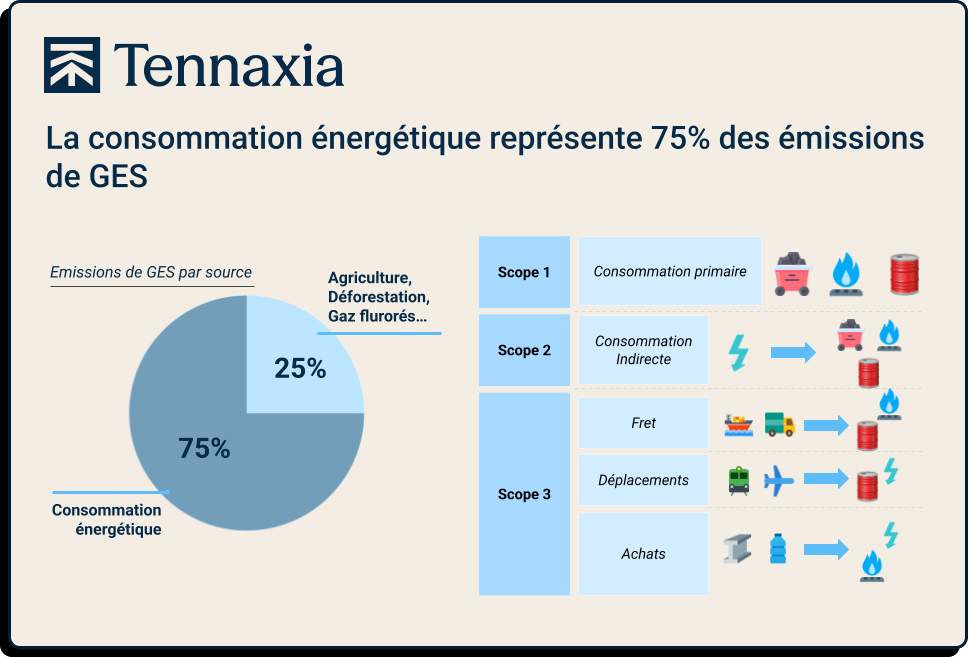
In industry, energy is at the heart of the issue: energy consumption accounts for an average of 75% of greenhouse gas emissions. This fundamentally changes how the topic should be read. Working on decarbonisation is not just about meeting a climate expectation; it means acting on a factor that affects costs, resilience and operational performance all at once.
This reality explains why decarbonisation can no longer be treated as a standalone reporting exercise. It becomes a matter of industrial decision-making, with direct impacts on investment, competitiveness, and the company's ability to demonstrate concrete progress to its stakeholders.
Energy Management System: a regulatory framework that requires a structured approach
The framework has been significantly strengthened. Entities concerned must implement an energy management system where their average annual final energy consumption is equal to or greater than 23.6 GWh. Above 2.75 GWh, they must carry out an energy audit every four years if they have not implemented an energy management system. The action plan must be published in the annual report, and information relating to the implementation of these obligations must be submitted electronically within two months of the system's certification or the completion of the audit.
The compliance timetable sets a clear course. Companies newly subject to the energy management system requirement must have a certified system in place by 11 October 2027 at the latest. Those newly subject to the audit requirement must carry out their first audit by 11 October 2026 at the latest. The average annual consumption used to assess these thresholds corresponds to the average consumption over the previous three calendar years.
The level of operational requirement is also rising. The energy audit and the energy management system must cover at least 80% of the company's final energy consumption, identified by its SIREN number, and the consumption declaration is made on ADEME's dedicated platform. In other words, the approach is moving from minimal compliance to traceable, documented and managed energy management.
The energy audit is no longer just a deliverable
The order of 10 July 2025 reinforces this logic further. The audit must be carried out in accordance with standard NF EN 16247-1:2022, supplemented by standards specific to buildings, processes and transport. Recommendations must be ranked according to payback period, energy-efficiency actions must be clearly identified, and audits carried out in-house must justify the technical resources and skills used.
For industrial companies, this changes the very nature of the topic. The audit is no longer just a document produced to meet an obligation; it becomes a basis for decision-making, a prioritisation tool, and a support for weighing up feasibility, profitability and impact.

Photovoltaic canopies: a concrete example of a requirement turning into a project
The topic of car parks perfectly illustrates this shift. Under the APER law, outdoor car parks of more than 1,500 m² must be fitted, over at least half of their surface area, with canopies incorporating a renewable energy generation process. The law also provides for the possibility of pooling the requirement between adjacent car parks, as well as several exemption cases, in particular for technical, safety, architectural, heritage, environmental or economic constraints.
For existing or authorised car parks within the scope set out by the law, the deadline is set at 1 July 2026 for areas equal to or greater than 10,000 m², and at 1 July 2028 for those between 1,500 m² and 10,000 m². In practice, however, the topic cannot be reduced to a threshold and a date. Account must also be taken of how the eligible area is actually calculated, applicable exclusions, any constraints linked to regulated facilities (ICPE) or the transport of dangerous goods, the conditions for justifying an exemption, and, depending on the case, criteria relating to performance and the resilience of panel supply chains. This is precisely what turns a regulatory requirement into a genuine investment project.
The real challenge: making the carbon footprint comparable over time
Measuring your GHG emissions is a first step. Reliably comparing them over time is another. A carbon footprint assessment can quickly become misleading if the physical scope changes, if emission factors evolve, if the level of detail in the analysis is modified, or if data sources are replaced without a clear methodological framework. The robustness of the baseline therefore matters just as much as the measurement itself.
Building a usable carbon baseline rests on four building blocks. First, getting the right starting assumptions: the right scope, the right capacity for action, the right emission factors, and proper account of uncertainty. Next, defining a methodology for data collection and reliability. Then, governing methodological changes: change of scope, acquisitions, new data sources, changes to emission factors, changes to the accounting method or level of detail. Finally, versioning the data and carrying out rebaselining when necessary.
This discipline changes the value of carbon management. It makes it possible to track emissions by category and by site, to compare several entities against one another, and to obtain a measurement that is genuinely usable, because it is complete, reliable and detailed. Without this framework, the stated trajectory can remain unreadable. With this framework, it becomes manageable.

Measuring is not enough: you also need to simulate, prioritise and govern
A robust decarbonisation trajectory does not rely on measurement alone. It also requires modelling actions, defining the input indicators for simulations, and comparing several scenarios with a dual perspective: carbon impact and financial impact. Only under these conditions can a company prioritise its projects, arbitrate its investments, and avoid action plans that are too generic to be genuinely executed.
The final step is organisational. To move from intention to execution, clear governance must be built, and decision-making power delegated to the entities that actually drive the action. Without operational relays, decarbonisation remains a reporting exercise. With appropriate governance, it becomes a lever for transformation.
From compliance to sustainable performance
What is at stake in industry today is no longer just the ability to meet a regulatory requirement. It is the ability to structure a complete approach: identifying priority energy items, integrating new obligations, ensuring data reliability, building a baseline that is comparable over time, modelling actions, and organising the governance needed to deploy them. Other regulatory levers, from CBAM to the EU ETS, via energy savings certificates (CEE) and the BEGES, further reinforce this management-driven approach.
For industrial companies, the question is therefore no longer whether to decarbonise, but how to turn this requirement into a credible, profitable and sustainable trajectory. This is now where the difference lies between a company that undergoes the transition and one that turns it into a competitive advantage.