
.svg)







🔎 Key takeaways
Greater flexibility: Option to combine solar carports with greening or other renewable energy processes (if production is equivalent).
Threshold: Obligation maintained for all outdoor parking lots of more than 1,500 m².
Extended deadlines (< 10,000 m²): Deferral possible until January 1, 2030 (instead of 2028) subject to a contract signed before June 2027.
Large parking lots (> 10,000 m²): Deadline deferrable until January 1, 2028 with a financial commitment to be made before June 30, 2026.
New rules for installing solar carports that incorporate renewable energy production systems in parking lots: what is changing
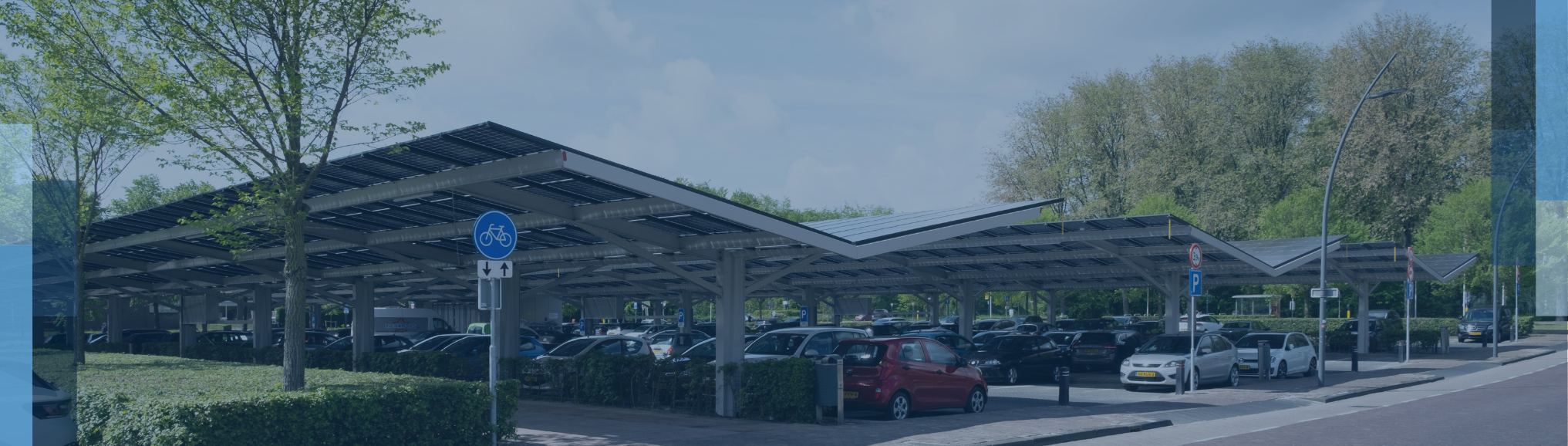
Article 40 of Law No. 2023-175 of March 10, 2023, known as the APER Law, has been amended to provide more flexibility regarding the requirement to equip parking lots with solar canopies that incorporate renewable energy production systems.
The massive deployment of renewable energy is essential to intensify the fight against climate change and reduce dependence on imported energy products, which account for two-thirds of France's energy consumption. It is against this backdrop that the APER Law was adopted in 2023, requiring owners of outdoor parking lots larger than 1,500 m² to equip them with canopies incorporating renewable energy production systems.
However, in response to technical and economic constraints, the legislature introduced new, more flexible procedures via Law No. 2025-1129 of November 26, 2025.
1) New requirements for equipping parking lots with solar canopies incorporating renewable energy production systems
Initially, the APER Law required outdoor parking lots with a surface area exceeding 1,500 m² to install canopies over at least half of their area, with renewable energy production systems integrated into the entire upper surface providing shade.
Now, two new options allow for compliance with this parking lot obligation :
- the installation of hybrid systems, where solar canopies cover at least 35% of half the parking area, combined with green infrastructure that contributes to shading the remaining area. This option allows for the integration of more landscaping and ecological solutions.
- in whole or in part, the installation of a renewable energy production system that does not require solar canopies, provided that the system generates an output equivalent to what would have been produced by solar canopies installed over the unequipped area. This solution opens the door to other technologies or on-site installations ().
Owners can now tailor their strategy by mixing solutions based on site constraints.
Furthermore, an important clarification has been introduced regarding urban planning rules: the application of local urban plans (PLU) cannot be used to prohibit or restrict the installation of such systems.
2) Other changes regarding the conditions for deferring the obligation
Law No. 2025-1129 of November 26, 2025, also amends the conditions for deferring the obligation.
Provisions for deferral to January 1st 2030 (instead of July 1st 2028) have been newly introduced for parking lots with an area of less than 10,000 m² and greater than 1,500 m².
To qualify, the owner must provide proof of a commitment contract with a deposit by June 30, 2027, at the latest, and a purchase order signed before December 31, 2027, for high-performance, resilient photovoltaic panels, with installation scheduled before January 1, 2030. In the event of termination or non-compliance with the commitment contract or purchase order attributable to the photovoltaic panel manufacturer, the parking lot owner must comply with their obligations within eighteen months of the termination or, if this period expires after January 1, 2030, by January 1, 2030, at the latest, or, if this period expires before July 1, 2028, by July 1, 2028.
Regarding parking lots larger than 10,000 m², for which the regulatory deadline is set for July 1st 2026, the terms have been modified once again.
Thus, to be eligible for the deferral to January 1st 2028, the parking lot owner may now provide proof of a commitment contract with a deposit by June 30, 2026 (instead of December 31, 2025) and a purchase order signed before December 31, 2026 (instead of before June 30, 2026) for high-performance, resilient photovoltaic panels, with installation scheduled before January 1, 2028.
Finally, the requirement to display the origin of the installed panels for one year from the start of construction is no longer in effect.
Need to improve the efficiency of your HSE monitoring? Use our HSE regulatory monitoring solution from Tennaxia.