
.svg)



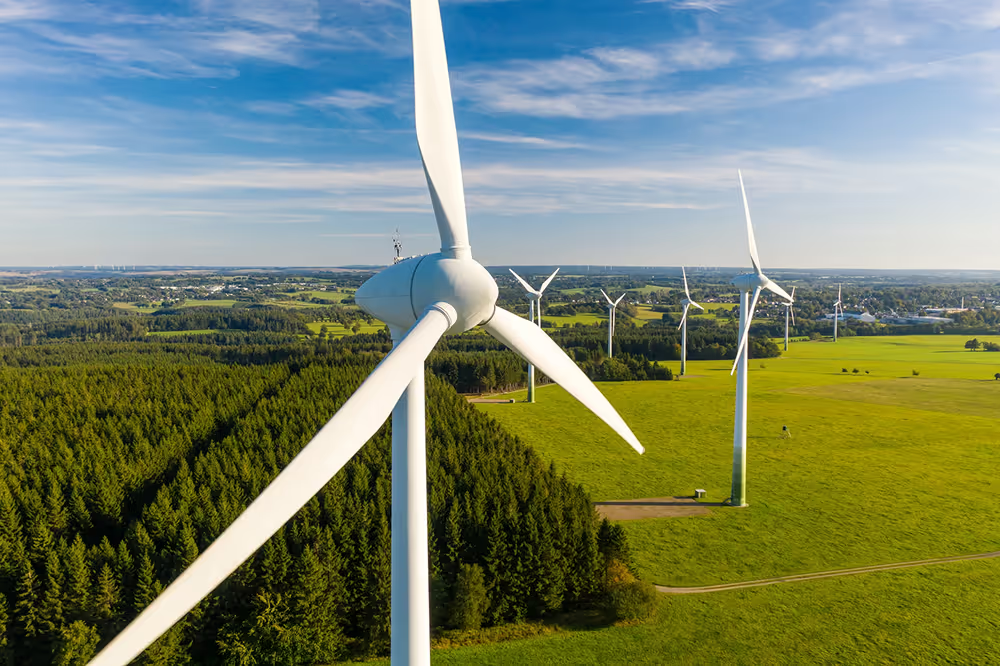


The energy sector, which directly emits nearly a quarter of greenhouse gases in the European Union (WEF) and over three-quarters of indirect emissions (EEA), is the leading emitting sector. This sector encompasses energy production, transformation, and distribution activities.
All economic activities depend on energy, and indeed, it is thanks to access to abundant and low-cost energy that we can easily travel, heat our homes, and produce all kinds of goods.
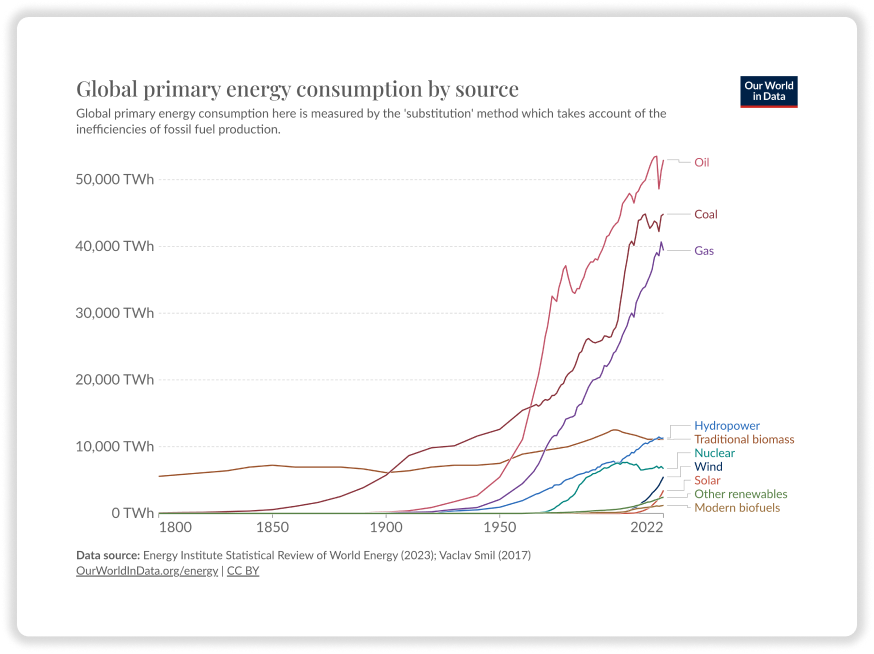
Historically, the global increase in energy consumption has been directly linked to the increase in greenhouse gas emissions: since the second industrial revolution, the growth of activities has relied on increasing energy consumption, predominantly from fossil sources.
While the energy sector is absolutely essential for the functioning of society, what are the decarbonization levers for this sector, which is the primary direct cause of anthropogenic greenhouse gas emissions?
Sector Overview
The energy sector converts "primary" energy sources available in nature (oil, wind, uranium deposits) into "final" energy, ready for consumption (gasoline, electricity), and transports it for distribution to the point of consumption (gas pump, electrical outlet).
Since the second industrial revolution, the consumption of fossil fuels—coal, oil, and gas—has grown almost continuously, which on the one hand enabled the advent of modern society, but on the other hand released an unprecedented quantity of greenhouse gases into the atmosphere.
Energy can be categorized by the sources used:
- fossil fuels such as oil, coal, natural gas
- fissile fuel for nuclear power
- renewable sources like solar or wind energy.
In this regard, while energy consumption has increased 9.5-fold over the past century, this is overwhelmingly due to the consumption of fossil fuels. These still account for more than 70% of the energy mix in the EU. The recent rise of renewable energies has not replaced fossil fuel consumption; instead, it has been added to an ever-growing energy demand.

Main sources of emissions
Considering all energy-related emissions, meaning direct emissions during energy production, but also emissions for other uses (transport, industry), energy-related emissions account for 73% of total global emissions, with 15% of total global emissions coming from transport, 13% from industry and construction, and 13% from electricity and heat production.

Regarding electricity and heat production, the emissions associated with generating this final energy are highly dependent on the electricity mix: a coal-fired power plant produces significantly more carbon-intensive energy than a gas-fired power plant, which in turn is much more carbon-intensive than a nuclear power plant or electricity generated from renewable sources.
As the graph below shows, while in 2021, coal accounted for only 17% of electricity and heat production in the EU, it was responsible for 50% of GHG emissions.

Decarbonization of the energy sector
The European Union has set ambitious greenhouse gas emission reduction targets, even aiming for carbon neutrality by 2050. Since 1990, emissions from the energy sector have indeed fallen by 657 MtCO2e (or -40%), particularly thanks to the evolving energy mix (WEF).
To achieve its objectives, the European Union will need to utilize all the levers at its disposal.
Acting on Energy Demand
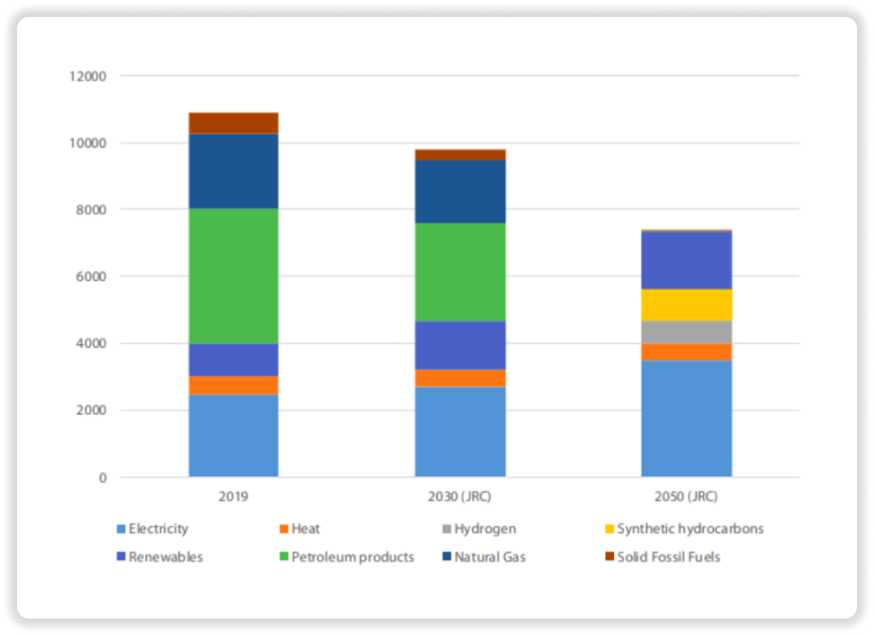
It cannot be stressed enough: “the cleanest energy is the energy not consumed.” The best way to reduce energy-related emissions is to reduce energy consumption. To do this, various levers can be employed:
Energy Conservation
Reducing final energy consumption in all its forms is the primary direct lever for emissions reduction. Efforts are needed both from households and businesses.
This issue has become even more pressing since 2021, as the strong post-Covid energy demand and then the Russian-Ukrainian conflict created significant tensions in the global energy supply. This situation led the European Union to address the issue and seek the best solutions to reduce energy consumption within the old continent.
Energy Efficiency
Efficiency aims to achieve the same performance with lower energy consumption, thanks to technical and technological improvements or an optimized distribution network that reduces energy losses.
Electrification of Uses
By replacing fossil fuel-based energy with electricity for various uses, it is possible to drastically reduce emissions associated with energy consumption (electrification of transport, industrial processes).
The Use of New Energy Sources
In the same vein, another solution is to utilize new energy sources with lower CO2 emissions that can generate the same final energy. This is the case, for example, with geothermal energy for heat production, or hydrogen.
Evolving energy production
Since the industrial era, our societies have developed primarily by relying on energy production linked to the consumption of fossil fuels. These energy sources have many drawbacks: they are not renewable and, above all, they are high emitters of greenhouse gases.
To meet our energy needs, we will therefore have to evolve our energy production methods in the short term.
Moving away from fossil fuel production
Moving away from fossil fuel production involves two things:
- Massive investment in decarbonized energy production
- Not investing in new fossil fuel projects.
The idea of progressively closing current fossil fuel extraction facilities, even before their scheduled end-of-life date, is also regularly discussed.
This remains a relevant topic as several gas and oil companies are still announcing the future exploitation of “climate bombs” or “carbon bombs,” these deposits whose fossil fuel extraction would generate more than one gigaton of CO2 each.
Developing new energy sources
Not all uses can be electrified. Therefore, alternative solutions must be found for energies produced from fossil fuels, which are high emitters of greenhouse gases.
In this context, one solution is to develop the production of biomass-derived fuels (biofuels, biogas), which complement non-dispatchable electricity production.
Reducing emissions at production sites
According to the World Bank, approximately 150 billion cubic meters of natural gas are destroyed annually through flaring, a process carried out during fossil fuel extraction.
This process not only destroys a valuable energy source but also releases enormous amounts of CO2 (275 Mt in 2018, or 0.85% of global emissions) as well as methane, which has a 28 times higher impact than CO2 in terms of global warming. In addition, there is significant air pollution near flaring sites, as well as soil and water resource pollution nearby.
There are various methods to reduce the impact caused by flaring. This includes reducing the production of gas associated with fossil fuel extraction, its reinjection, or its storage in the ground. This gas can also be stored in liquid form for commercialization or used near the production site to generate energy.
Decarbonize End-Use Energy
The third option is to decarbonize end-use energy. This requires rethinking our energy production AND consumption models and investing heavily in these new processes.
Decarbonize Electricity Generation
Electrification of uses is not a panacea. The level of emissions will depend on the source of electricity generation.
For an all-electric system to be viable, electricity from decarbonized sources will need to be produced and therefore develop renewable and biomass production...
Nuclear power, even if its use remains controversial, is also a decarbonized energy source that many countries rely on, with France leading the way.

Transition to a Decarbonized Heat Supply
Heat production for the tertiary and residential sectors accounts for nearly one-fifth of greenhouse gas emissions in France. Half of these still come from fossil fuels. This is therefore a major area for development to reduce our energy sector-related GHG emissions.
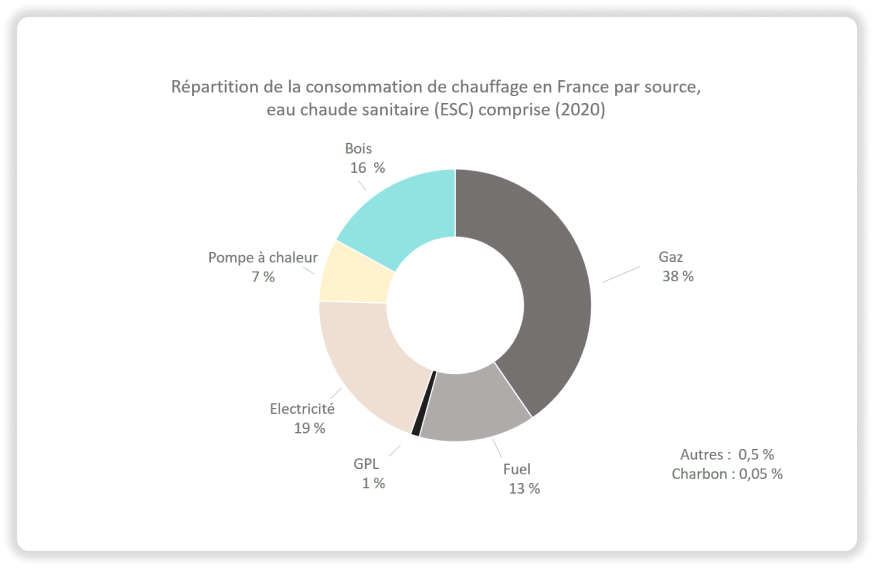
To reduce the share of emissions related to heat production, several solutions are available to us:
- Directing production towards new energy sources (geothermal, hydrogen), including the now famous heat pumps
- Prioritizing supply via decarbonized electricity
- Using biomass from controlled sources
Coordinate efforts to maximize energy efficiency and ensure resilience
An example of this is the development of district heating networks. This involves recovering heat produced by certain industrial sites, known as waste heat, to transport and then utilize it from production areas to end consumers.
These networks can also be used for many other heat sources: geothermal, solar…
Alongside the development of heat networks, infrastructure for heat storage can be implemented. This will help limit reliance on dispatchable fossil fuels.
Massive R&D investments
According to a study by Nathaniel Bullard for Bloomberg, R&D investments by IEA (International Energy Agency) member states in energy production have evolved significantly in recent years, aligning with the sector's decarbonization needs. IEA member countries are now spending the largest R&D budgets ever allocated to the energy sector in the last 50 years.
While R&D spending on nuclear and fossil fuels peaked in the 1980s, today, spending on renewable energy and energy efficiency is attracting increasing funding.
Research and development spending on energy efficiency increased from $2 billion in the early 2000s to $6 billion in 2021. It is now the primary beneficiary of R&D expenditures by IEA member countries.

This development highlights the importance of the energy issue in the current climate change context, which requires rapid decarbonization of this highly greenhouse gas-emitting sector. It's a race that both states and businesses have joined.
Some examples of best practices
ENGIE: Decarbonizing the electricity generation mix
Engie has deployed a strategy aimed at achieving "Net Zero" by 2045, covering scopes 1, 2, and 3 of its emissions. This strategy is intended to be "aligned with the group's vision and strategy." Their goal is to reduce 90% of their total emissions between 2017 and 2045, and then neutralize the remaining 10%.
Regarding Scope 1, ENGIE announced it would cease coal-fired electricity production by 2027 and multiply its installed renewable capacity by 2.6 in 2030 compared to 2020. They also plan to invest in storage and develop the use of green gas.
Aiming to act across their entire value chain, they announced a policy of raising awareness among their consumers and also supporting their suppliers in their transition by helping them conduct carbon assessments and integrate a decarbonization policy so that they are aligned or certified SBTi.
Ørsted: Pivoting the Core Business
Ørsted, formerly a major fossil fuel (gas and oil) producer in Denmark, pivoted to gradually withdraw from fossil fuel activities, which it finally divested completely in 2018. It subsequently invested 26 billion euros in renewable energy production to become today the global leader in offshore wind. (Ørsted)
This complete shift in production model occurred in less than 15 years. While in 2009, 85% of their production relied on fossil fuels, today, 98% of their revenue comes from renewable energy production.
Its goal is to achieve carbon neutrality for Scope 1 and 2 emissions by 2025, and then for Scope 3 by 2040.

Sources:
- “Carbon Bombs: These Fossil Fuel Projects That Condemn Climate Efforts”, Léa Sanchez, Raphaëlle Aubert, Thomas Steffen, Elsa Delmas, Maxime Vaudano and Maxime Ferrer, Le Monde, 31/10/2023
- “Orsted, the story of a forced ecological transition by a Danish energy company”, Anne-François Hivert, Le Monde, 22/10/2021
- “Could our green transformation inspire yours?”, Orsted
- “Everything you need to know about our Net Zero roadmap”, ENGIE
- “Decarbonizing Heat Production”, CEA, 22/04/2022
- “Infographic - How is EU electricity produced and sold?”, European Council
- “EEA greenhouse gases”, European Environment Agency
- “Global Gas Flaring Tracker Report”, The World Bank, 29/03/2023
- “Gas Flaring”, IEA
- “Nuclear Is Out, Hydrogen Is In: Where Countries Put Energy R&D Money”, Nathaniel Bullard, Bloomberg, 09/11/2023