
.svg)




%20(1)%20(1).jpg)


🔎 Key takeaways
- For Groupe Bel, water has become a business continuity imperative, due to its reliance on agricultural raw materials and the increasing exposure of its sites to water stress.
- The group's water footprint is over 90% within Scope 3, which necessitates extending action beyond factories to raw materials and agricultural practices.
- The approach is based on three complementary levers : a structured roadmap, team mobilization, and dedicated tools to integrate water into operational decisions.
- The "internal water price" allows for better investment decisions, by integrating the true value of water, the risks of resource scarcity, and local impacts.
Water resource preservation is no longer just an environmental issue. For companies whose operations depend on agricultural raw materials, industrial sites, and territories exposed to water stress, it becomes a direct business continuity imperative.
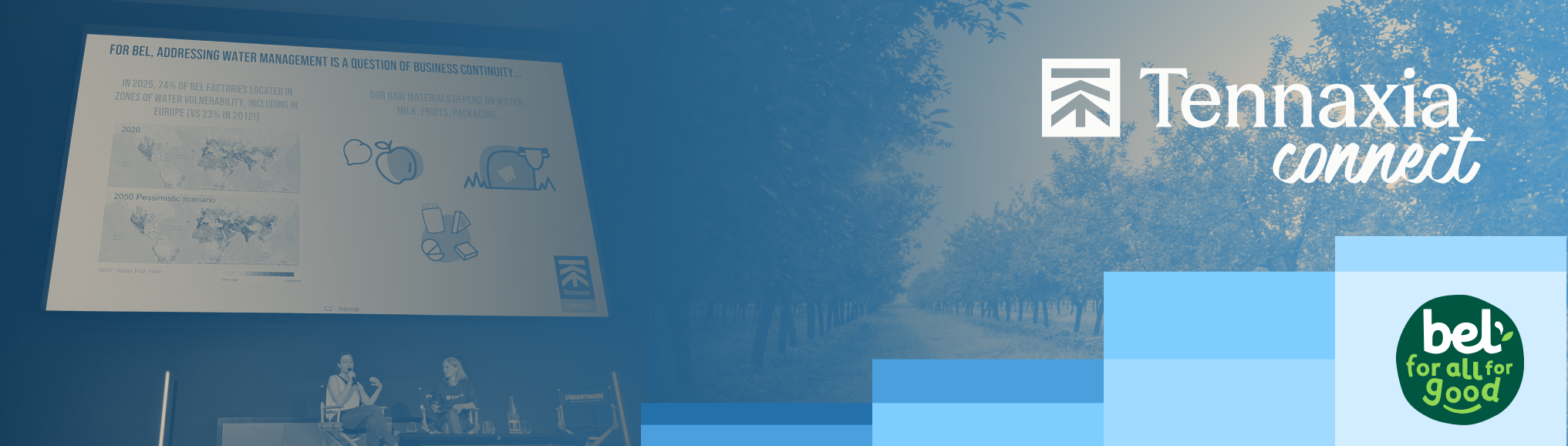
During Tennaxia Connect, held on June 2nd, Flora Schmitlin, Group CSR Climate, Biodiversity & Water Lead at Groupe Bel, shared how the group structures its approach to water. Her presentation highlighted a progressive approach: measuring the footprint, understanding risks, engaging teams, and then integrating the true value of water into operational and industrial decisions.
Water, a resource at the heart of the business model
Flora Schmitlin reiterated at the beginning of her presentation: for Groupe Bel, water management is a matter of business continuity. The group's raw materials directly depend on this resource, whether it's milk, fruits, or even packaging.
This dependence is all the more critical as the exposure of industrial sites to water vulnerability has significantly increased. By 2025, 74% of the group's factories will be located in water-vulnerable areas, including in Europe, compared to 23% in 2012. This trend shows that the issue is not limited to certain geographies historically identified as sensitive. It now also concerns European territories, with potential impacts on operations, supplies, and local relations.
In this context, preserving water is not just about reducing consumption. It's about better understanding where dependencies lie, what risks can affect operations, and how the company can act both at its sites and throughout its value chain.
A water footprint predominantly located in Scope 3
One of the key insights shared by Flora Schmitlin concerns the group's water footprint, assessed in 2023 using a "from farm to fork" approach, based on the EcoInvent database. This analysis shows that Scope 3 accounts for over 90% of the overall water footprint.
This result changes how the issue is approached. Factories remain an essential scope of action, but they do not encompass all the challenges. A large part of the footprint lies within the rest of the value chain, particularly at the raw material and agricultural practice levels.
Flora Schmitlin also highlighted an important difference compared to carbon. For water, there isn't a single indicator that can manage everything. Several dimensions must be considered, particularly quantity and quality.
Regarding quantity, dairy products emerge as the main contributors in absolute terms, while apples show the highest intensity, linked to irrigation practices. Regarding quality, dairy products are also identified as a significant factor, particularly through issues related to manure leakage and nitrate pollution.
This more nuanced understanding helps avoid an overly global approach to the subject. Water must be analyzed based on territories, uses, raw materials, and types of impacts.
An approach being operationalized
To move from measurement to action, Flora Schmitlin presented an approach currently being operationalized at every level of the company. It is based on three main levers.
The first is an ambitious policy, structured around a clear roadmap. The objective is to move towards an approach of preserving and regenerating water resources, from agricultural upstream to the final product.
The second lever concerns employee engagement. The topic of water cannot remain confined to CSR or environmental teams. It must be understood and embraced by all departments. Flora Schmitlin specifically mentioned training and awareness-raising initiatives, as well as the mobilization of 22 internal facilitators.
The third lever focuses on tools. These include the factory water roadmap, the Bel Water Impact Tool, and the internal water price, also known as the "true cost of water." These tools aim to integrate water preservation into daily processes, as close as possible to operational decisions.
This combination of policy, training, and tools reflects a simple idea: to act effectively, it's not enough to have ambition. Teams must be given the means to measure, prioritize, and make decisions.
The "true cost of water" to better guide investment decisions
One of the most impactful points of the presentation focused on the "true cost of water." Flora Schmitlin explained that the prices currently paid by factories do not always reflect the true value of water. They take into account purchase and treatment costs, but not all costs, risks, or negative externalities.
The developed methodology therefore aims to better reflect this true value, in order to guide investment decisions and anticipate resource-related risks. It is based on two principles: a double materiality approach and a local analysis, with a specific price defined for each factory.
This internal price integrates several dimensions. It takes into account the current cost of water, as well as the risk of production losses in case of resource scarcity, and the site's impact on the local ecosystem. The objective is not to create an additional theoretical indicator, but to make visible issues that do not always emerge in traditional financial analyses.
This is precisely what allows for a better assessment of the relevance of certain projects. Flora Schmitlin cited the example of the Hydro project at the Évron site, which aims to reuse water from whey concentration. Thanks to this project, 150,000 m³ of water are expected to be saved annually, representing a quarter of the site's consumption. By integrating the internal water price, the project's return on investment appears much more favorable than in an analysis limited to only purchase and treatment costs.
The example illustrates the concrete role of this tool: to help make industrial decisions by taking into account the resource, associated risks, and local context.
Making water a lever for resilience
The experience shared by Flora Schmitlin shows that water management is becoming a full-fledged management issue. It involves looking beyond direct consumption, integrating the value chain, distinguishing quantity and quality, and taking into account local specificities.
It also involves linking environmental commitments to investment decisions. This is the whole point of the "true cost of water": to provide an economic translation for resource, risk, and impact issues that often remain difficult to integrate into traditional decision-making.
For CSR, HSE, industrial, or purchasing departments, the Bel Group's example reminds us that water can no longer be approached solely as a cost or an environmental performance indicator. It is a strategic, local, and shared resource, whose preservation conditions both the resilience of activities and companies' ability to act responsibly in their territories.