
.svg)








Regarding operating permits and electrical certifications
Following on from the reform introduced by Law No. 2021-1018, known as the "Workplace Health Law," of August 2, 2021, Decree No. 2025-355 of April 18, 2025, was published to optimize medical resources and with the aim of reallocating them to:
- the monitoring of employees assigned to positions presenting a particular risk; and
- primary prevention actions, towards which the missions of occupational health and prevention services were reoriented by the 2021 reform of these services.
Therefore, as of October 1, 2025, this text removes from the list of employees entitled to Enhanced Individual Monitoring (SIR) those workers who may be assigned to a position requiring an operating permit (article R. 4323-56 of the Labor Code) or an electrical certification (article R. 4544-10 of the Labor Code). Instead of SIR, it makes the issuance of operating permits and electrical certifications for live work or operations near bare live parts conditional on holding a five-year certificate attesting to the absence of medical contraindications.
The order of September 26, 2025, specifies the template for these certificates.
Stemming from the reform of Law No. 2016-1088 of August 8, 2016, known as the "Labor Law," Article L. 4624-2 of the Labor Code states that any worker assigned to a position presenting particular risks to their health or safety, or to that of their colleagues or third parties in the immediate work environment, benefits from Enhanced Individual Monitoring (SIR) of their health status. Positions presenting particular risks are listed in Article R. 4624-23 of the Labor Code and include:
- those exposing employees to asbestos, lead, carcinogenic, mutagenic, or reprotoxic agents, biological agents of groups 3 and 4, ionizing radiation, hyperbaric risk, and the risk of falling from a height during scaffolding assembly and disassembly operations;
- those whose assignment is conditional on a specific professional aptitude test, as is the case for workers holding an operating permit and those authorized to perform operations on or near electrical installations;
- Finally, if deemed necessary, the employer may supplement the list of positions in the categories mentioned in I. with positions presenting particular risks, after consulting the relevant physician(s) and the social and economic committee (CSE), if one exists, in coherence with the risk assessment.
Benefiting from SIR notably involves a medical fitness examination prior to assignment to the position (replacing the information and prevention visit), the renewal of this examination at intervals not exceeding 4 years, and interim visits. The objective of this monitoring is to:
- Ensure that the worker is fit for the work position to which the employer intends to assign them, particularly by verifying the compatibility of the position with the worker's health status, in order to prevent any serious risk to their health or safety, or to that of their colleagues or third parties in the immediate work environment;
- Ascertain whether the worker is not suffering from a condition that poses a danger to other workers;
- Propose, if necessary, adaptations to the position or assignment to other positions;
- To inform the worker about the risks of workplace exposures and the necessary medical follow-up;
- To raise the worker's awareness of the prevention measures to be implemented.
Operating Permit
Article R. 4323-56 of the Labor Code states that the operation of certain equipment presenting particular risks, due to their characteristics or purpose, is subject to obtaining an operating permit* issued by the employer. This is the case, for example, for an employee who uses a ride-on self-propelled handling truck or a mobile elevating work platform.
As of October 1, 2025, the provision subjecting workers holding an operating permit to the benefit of a SIR is abolished. However, the validity of this operating permit is now subject to the worker holding a certificate attesting that they do not present any medical contraindications to operating the equipment for which the permit is authorized. This certificate, valid for five years, is issued by the occupational physician following a medical examination they conduct. It must be presented by the worker to the employer, who retains a copy for its entire validity period. A copy is added by the occupational physician to the occupational health medical record.
Annex 1 of the order dated September 26, 2025, thus defines the certificate template applicable to operating permits. *The operating permit is issued following an assessment organized by the head of the establishment, which aims to certify that the worker possesses the aptitude and capacity to operate the equipment for which the permit is being considered. This assessment takes into account the following three elements:
- An aptitude test conducted by the occupational physician;
- A check of the operator's knowledge and skills for the safe operation of the work equipment;
- Knowledge of the premises and instructions to be followed at the usage site(s).
Electrical Authorization
In accordance with Article R. 4544-9 of the Labor Code, operations on or near electrical installations may only be carried out by authorized workers. This authorization is issued by the employer after theoretical and practical training under the conditions set by regulatory means.
Thus, for these workers too, the SIR has been abolished since the 1st October 2025. Henceforth, to perform operations near live bare parts or live work, the employee must hold a certificate issued by the occupational physician attesting that they do not present any medical contraindications to the nature of the operations concerned. This certificate, also valid for five years, is retained by the employer and integrated into the employee's occupational health medical record.
The order dated September 26, 2025, specifies the exact scope of electrical operations for which holding the medical certificate becomes mandatory.
These include:
- Electrical work in the simple or reinforced vicinity of live bare parts;
- Short-duration interventions in the vicinity of live bare parts as defined by the decree of April 7, 2021;
- Live working, explicitly including live cleaning work.
Conversely, the decree excludes the following operations from this scheme:
- isolations;
- tests, measurements, verifications, and operations;
- operations on photovoltaic installations.
It also specifies in Annex 2 the medical certificate template used for electrical authorization.
To clarify these new provisions, the Ministry of Labour and Social Affairs has published in an FAQ (Individual health monitoring of workers, equipment operation, electrical risk: the decree of April 18, 2025 - Questions and answers) the authorizations for which the validity of the authorization is subject to holding a certificate of no medical contraindications:
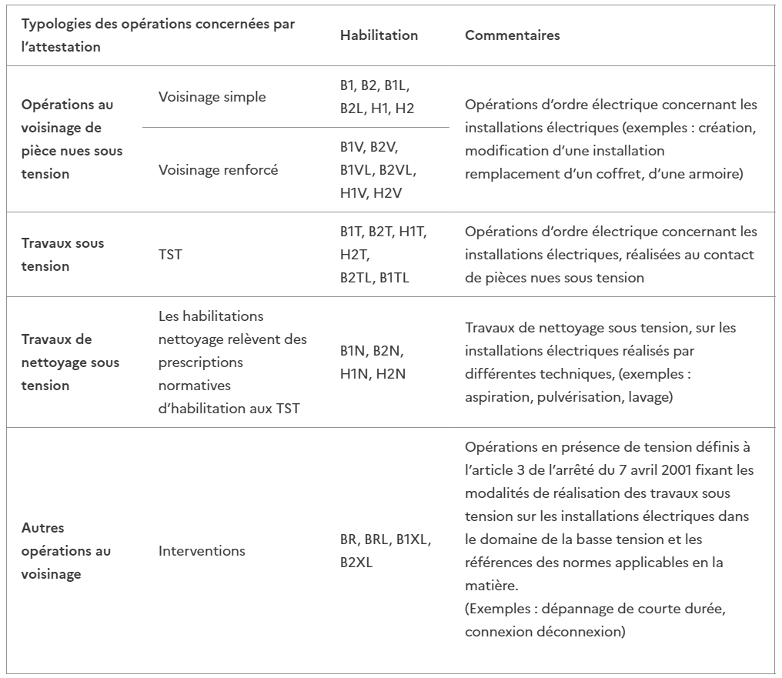
Other electrical authorizations are not subject to holding the said certificate.
Transitional provisions
It is specified that fitness certificates issued under the SIR prior to this decree shall serve as the newly provided certificate for a period of five years from their issuance.
As a reminder, within the framework of an SIR, the fitness certificate follows the pre-employment medical examination and its renewal. It is issued by the occupational physician. This certificate is transmitted to the worker and the employer and added to the individual's occupational health medical record.
Finally, in both cases, the decree stipulates that the employee or employer may refer the matter to the industrial tribunal under the accelerated substantive procedure concerning a refusal to issue a certificate by the occupational physician.