
.svg)







Given that drought episodes are intensifying and extending beyond summer periods, a decree establishes a national framework for implementing more sustainable water resource management within ICPE sites during drought periods.
Note that a memo from July 5, 2023, from the DGPR (General Directorate for Risk Prevention) provides clarifications on the application of this decree.
Who is concerned?
ICPEs subject to authorization or registration whose total annual water withdrawal (*) exceeds 10,000 m3.
Water withdrawal refers to water taken from the supply network (drinking water), potentially from other networks and from the natural environment (surface water or groundwater), excluding withdrawals from the marine environment, rainwater harvesting for reuse, and water derived from raw materials.
Internally reused water is not to be considered.
Any exemptions?
Certain facilities are not subject to action requirements depending on drought levels.
These include:
- facilities necessary for continuous-flow agri-food processing; the production and distribution of electricity and energy from renewable sources; the production of medicines of major therapeutic interest and their active ingredients, or medicines contributing to a public health policy; the collection, sorting, transit, grouping, and treatment of hazardous and non-hazardous waste;
- operators of establishments who have reduced their water withdrawal by more than 20% since January 1, 2018;
- operators of establishments using at least 20% reused water, relative to their total water withdrawal, provided that current health and environmental requirements are met;
- operators of establishments newly authorized or registered since January 1, 2023.
What actions should be taken in case of drought?
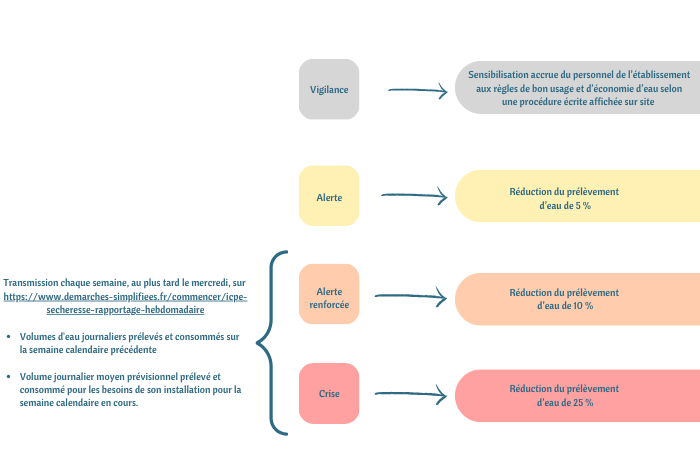
Reduction targets must be met no later than three days after the corresponding severity level is triggered.
Reminder: The Propluvia website lists on a map all water restriction orders department by department and the associated severity levels.
What is the reference volume?
It is the volume to which the reduction is applied.
The reference volume is the average daily water withdrawal. It corresponds to the maximum of:
- the average daily volumes withdrawn calculated over the previous calendar year
- and the average daily volumes withdrawn calculated over the corresponding calendar quarter of the previous year.
This average can be calculated by only considering activity days outside of drought-related restriction periods.
Elements that may not be taken into account
For the calculation of this reference volume, the operator may exclude certain volumes, particularly water uses necessary for:
- the safety and integrity of installations (e.g., cooling of certain equipment such as ovens, glass furnaces, cooling towers);
- fire protection and defense (e.g., legally mandated water reserves, supply to sprinklers and fire department connections),
- potable water supply for certain domestic uses such as staff consumption, restrooms, showers, etc.
Total annual withdrawal ≠ reference volume
The reference volume should not be confused with the total annual withdrawal. The latter corresponds to the submission threshold. Furthermore, the calculation of the reference volume does not take into account certain consumptions. For example, the volume of water uses necessary for safety, among others, must be included in the calculation of the annual withdrawal.
The importance of documenting
The following items must be kept up-to-date and accessible for inspection by classified facilities:
Conclusion
More stringent regulatory provisions (basin orientation decrees, framework decrees, temporary water use restriction decrees, prefectural decrees, etc.) may apply. As a reminder, if a local provision is more stringent, local regulations prevail; conversely, if a local provision is less stringent than the ministerial decree, then the latter prevails.
If your site is an ICPE subject to authorization/registration and you draw more than 1000 m3/year of water, we recommend that you:
- Regularly monitor the drought severity level for your location (e.g., daily during summer);
- If a drought-related severity level is triggered, implement the corresponding actions;
- Prepare the necessary documentation;
- If exempt, ensure you have the necessary supporting documents;
- Anticipate future droughts by studying ways to reduce your water consumption (process changes, adapting your machinery, new water-efficient technologies, etc.).
Photo credit: 86403436 @tanawatpontchour