
.svg)








In the workplace, workers can be exposed to ionizing radiation, particularly through the use of devices emitting such radiation (X-ray quality control, etc.) or sealed (food irradiation, gamma radiography, etc.) or unsealed radioactive sources. The protection of workers against these risks is therefore essential.
A decree dated June 4, 2018 [1] amends the rules for preventing health and safety risks due to ionizing radiation. It thus transposes, in articles R. 4451-1 to R. 4451-135 of the Labor Code, Directive 2013/59/Euratom on radiation protection [2].
As part of this transposition, other provisions have been amended by other decrees: the administrative regime for nuclear activities with the introduction of the registration system, inventory of ionizing radiation sources, protection against malicious acts, radiological emergencies, etc. We will not address these topics in this article.
Rules for protecting workers against risks due to ionizing radiation
Prevention provisions apply whenever workers are likely to be exposed to a risk due to ionizing radiation of natural origin (uranium, radium, radon, etc.) or artificial origin (californium, americium, plutonium, etc.).
In summary, the main obligations for the employer regarding worker protection are:
- Application of general prevention principles: implementation of prevention measures aimed at eliminating or minimizing exposure risks
- Risk assessment resulting from workers' exposure to ionizing radiation (with the help of the radiation protection advisor)
- Performing measurements when the risk assessment concludes that exposure is likely to reach or exceed certain thresholds
- Recording this assessment in the single document and transmitting it, along with the measurement results, to the CSE
- Identification of exposure zones (blue supervised zone, green / orange / red controlled zone, extremities zone, radon zone)
- Signage and access restriction to these areas
- Signage for each source of ionizing radiation
- General coordination of prevention measures when an external company is involved
- Verification of work equipment, sources of ionizing radiation, and workplaces. Initial verifications are carried out by accredited bodies
- Annual report of these verifications to the CSE. Individual assessment of certain workers, particularly those working in identified exposure zones
- Classification of workers into category A or B, with the occupational physician's opinion, based on the likely received dose
- Appropriate information for workers and, for category A and B workers, training renewed every 3 years
- Individual dosimetric monitoring of workers classified in category A and B and those exposed to radon (effective dose likely to exceed 6mSv
- Enhanced individual health monitoring of these workers
- Annual presentation to the CSE of a statistical report on worker exposure monitoring and its evolution
- Implementation of an organization to manage significant events and the exceeding of exposure limit values (ELVs)
- Authorization from the labor inspectorate to exceptionally exceed ELVs
- Organization of radiological emergency situations. Appointment of a radiation protection advisor (see below)
Key changes
Change in the exposure limit value for the lens of the eye
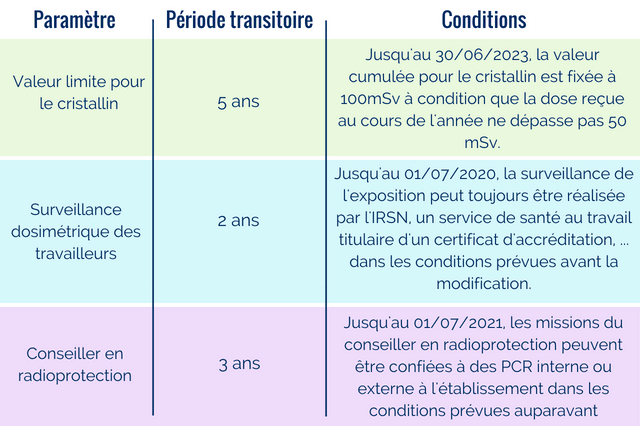
According to IRSN, the lens of the eye is a radiosensitive tissue that can be affected by ionizing radiation and may develop opacities leading to cataracts. The exposure limit value for the lens is reduced to 20 mSv/year (instead of 150 mSv/year) starting July 1, 2023. In the interim, from July 1, 2018, to June 30, 2023, the cumulative value for the lens is set at 100 mSv, provided that the dose received during the year does not exceed 50 mSv.
Note: The Sievert (Sv) is the unit of equivalent dose or effective dose, used to assess exposure to ionizing radiation.
Change in the radon reference level
The reference level for radon activity concentration in the air is set at an annual average of 300 Bq/m3 (compared to 400 Bq/m3 previously). Risk assessment must determine if this level is likely to be exceeded. If this threshold is exceeded despite the prevention measures in place, the employer must communicate the measurement results to the Institute for Radiation Protection and Nuclear Safety (IRSN).
Note: the reference level is defined as the level of activity concentration above which, in a radon exposure situation or a radiological emergency situation, it is deemed inappropriate to allow workers to be exposed to ionizing radiation.
Establishment of the Radiation Protection Advisor role
Employers must now designate a person responsible for advising them on radiation protection, known as the 'radiation protection advisor'. Except for INBs (Basic Nuclear Facilities), two options are available:
- either, as is currently the case, appoint a competent person in radiation protection (PCR); a natural person, an employee of the establishment, holding a recognized training certificate;
- or designate an external advisor to the establishment, referred to as a 'competent radiation protection organization (OCR)'. This organization must then be certified.
Beyond the advisory role concerning worker protection, the responsibilities of the PCR and OCR are extended to include issues of public and environmental protection. Similarly, at the employer's request, they may carry out certain internal technical verifications, previously entrusted to technical inspection bodies approved by the ASN (e.g., general periodic inspections of the installation and work equipment). The radiation protection advisor has access to all workers' dosimetric data, including data covered by medical confidentiality.
Clarifications on risk assessment and workplace measurements
Workstation analysis, as part of risk assessment, was already required, but now, the Labor Code sets out 15 criteria that employers must consider when conducting risk assessments related to ionizing radiation.
Measurement is mandatory if the risk assessment indicates that exposure is likely to exceed one of these levels: 1 mSv/year for the whole body, 15 mSv/year for the lens of the eye, 50 mSv for the extremities of the skin, or 300 Bq/m3 as an annual average in the case of radon exposure.
The results of the risk assessment must be recorded in the single document. They must be kept for 10 years and communicated to the occupational physician and the CSE (Social and Economic Committee) in the same way as the measurement results.
Changes in zoning rules
The principle of supervised zones and controlled zones is maintained with new definitions for these zones based on effective dose: blue supervised zone, green controlled zone, orange controlled zone, red controlled zone, extremity zone, radon zone.
A new concept emerges: the extremity zone. This zone must be delimited when supervised and controlled zones do not adequately manage extremity exposure and ensure compliance with occupational exposure limits.
Replacement of the individual exposure record with an individual assessment
The exposure record is replaced by the individual worker exposure assessment, which must be carried out prior to assignment to a workstation. In addition to the nature of the work, the characteristics of the ionizing radiation to which the worker is likely to be exposed, and the frequency of exposures, this assessment must include:
- the equivalent or effective dose that the worker is likely to receive over the next twelve consecutive months (taking into account potential exposures and foreseeable incidents);
- the effective dose exclusively related to radon that the worker is likely to receive over the consecutive twelve months.
This assessment must, in particular, be recorded by the employer, updated as needed, and be available for consultation for 10 years. It must be accessible to the worker concerned.
Monitoring of individual exposure and access to regulated areas
Workers classified in category A or B, as well as those exposed to radon (effective dose likely to exceed > 6 mSv), must undergo appropriate individual dosimetric monitoring to ensure the traceability of internal and external exposures.
Workers accessing delimited areas must be monitored using appropriate means. Unclassified workers may access a regulated area without dosimetric monitoring, with the exception of orange and red zones, provided that the employer ensures, by appropriate means, that their exposure remains below the dose values leading to classification in category B.
Worker Protection: Enhanced Individual Health Monitoring for Workers Exposed to Radon
Enhanced individual health monitoring for workers is extended to those for whom the effective dose received is likely to exceed 6 mSv forradon exposure.
Retention Period for Occupational Health Medical Records
The occupational health medical record for each worker undergoing enhanced individual monitoring must now be retained until they have reached or would have reached the age of 75 and, in any case, for a period of at least 50 years from the end of the professional activity involving exposure to ionizing radiation.
Entry into force
These provisions come into force on July 1, 2018, with the exception of the dose limit value set for the lens of the eye, which comes into force on July 1, 2023. However, the following transitional provisions are provided:
[1] Decree No. 2018-437 of June 4, 2018, concerning the protection of workers against risks due to ionizing radiation [Official Journal of June 5, 2018]
[2] Council Directive 2013/59/Euratom of 5 December 2013 laying down basic safety standards for protection against the dangers arising from exposure to ionising radiation [Official Journal of the French Republic of 17 January 2014]