.svg)




.png)



Each year, a directive from the Ministry of Ecological Transition defines the national actions for the inspection of classified facilities for environmental protection (ICPE).
The directive of December 23, 2025 defines the priorities for ICPE inspections for the year 2026.
The following key areas regarding inspection priorities can be identified:
Firstly, regarding "ongoing" actions, these remain identical to 2024 and include, among others, the following points:
- Classified facilities policing mission (inspection visits, processing of authorization and registration requests, review of studies submitted by the operator, fight against illegal operations, particularly waste management, proposals to the competent authority for updating regulations, review of cessation of activity files submitted after the 1st June 2022, etc.);
- Other policing missions, both within and outside classified facilities (application of mining regulations and those related to post-mining; control of hazardous equipment and products, other controls: REACH, biocides, hazardous pipelines, refrigerants, inspections related to the implementation of the anti-waste law for a circular economy);
- Integration of technological and health risks (implementation of PPRTs, management of polluted sites and soils, informing operators and stakeholders about regulations and the state of the environment, etc.).
Secondly, systematic actions are adopted, particularly based on the guidelines of ecological planning and lessons learned from observed accident rates:
On the one hand, the following priority systematic actions are planned for 2026:
- Post-Rouen fire action: Verification that operators storing combustible materials in warehouses classified under ICPE heading 1510 are aware of the condition of materials stored within their facilities.
- Continuation of the inter-ministerial "PFAS" action plan: Monitoring the implementation of concrete action plans at each facility to reduce PFAS emissions in aqueous discharges and move towards the elimination of aqueous PFAS discharges.
- Release of industrial land by accelerating the processing of cessation of activity files: The action in 2025 was to identify and categorize files by action priority, then process the highest priority files. The 2026 action continues the processing of files, with completion expected in 2027.
- Prevention of chronic risks: Concerns large combustion plants with a power output greater than or equal to 50 MW: monitoring compliance with some of the best available techniques applicable to these installations: monitoring the type of fuel used in the combustion plant, operating conditions outside normal operating periods, monitoring atmospheric emissions and compliance with applicable monitoring frequencies and emission limit values (ELVs), on-site monitoring of flue gas treatment systems.
- Combating illegal waste trafficking: Targeted actions on end-of-life vehicle (ELV) centers, including inspections of illegal sites that manage waste electrical and electronic equipment (WEEE), ELVs, or batteries, specifically those operating without a valid permit or in violation of ICPE regulations. It also involves enforcing the obligation to contract with an eco-organization or establish an individual system, and promoting the use of Trackdéchets by ELV center operators.
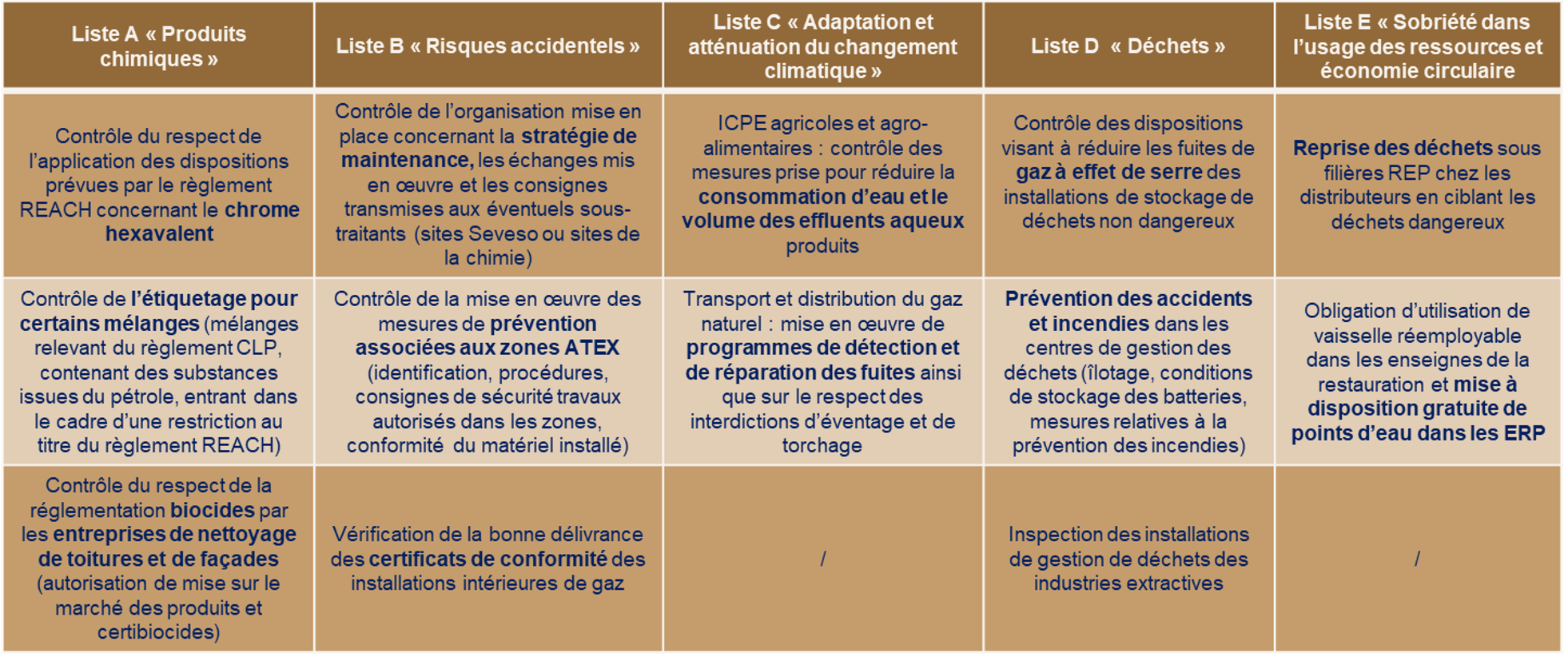
In addition, optional national actions are determined.
Each region must implement one action of their choice from each of the following lists, as well as a regionally-initiated action: