
.svg)








Please note: This article concerns French legislation. The requirements described may not apply in other countries.
Directive (EU) 2015/2193 of 25 November 2015 on the limitation of emissions of certain pollutants into the air from medium combustion plants, known as the European MCP Directive, was to be transposed into French regulations by 20 December 2017 at the latest. Transposition is now expected to be effective by the end of 2018. Here is an overview of the expected changes.
What does the European MCP Directive provide for?
The European MCP Directive targets medium-sized combustion plants with a rated thermal input between 1 and 50 megawatts (MW), operated in industry for industrial heat production, district heating, or electricity generation. It complements the IED Directive, which concerns plants with a rated thermal input of 50 MW or more.
The main change: combustion plants from 1 to 2 MW are now subject to the ICPE regulatory framework and must be registered and declared or authorized before they are commissioned. Their operators must comply with emission limit values (ELVs) for sulfur dioxide (SO2), nitrogen oxides (NOx), and dust, and must regularly monitor emissions of these pollutants as well as carbon monoxide (CO) atmospheric discharges.
In France, this transposition is expected to lead to three major changes: the amendment of the ICPE nomenclature, which should come into force on 20 December 2018; the adaptation of the scope of atmospheric emission controls for boilers provided for by the articles of the Environmental Code; and the modification of the content of registration and environmental authorization files.
Amendment of the ICPE nomenclature: headings 2910, 2770, and 2771
The draft decree removes the authorization regime for plants from 20 to 50 MW consuming fuel (classified under heading 2910-A): they will now be subject to the registration regime.
It now excludes from heading 2910 the activities covered by headings 2931 (internal combustion engines, combustion turbines) and 3110 (combustion of fuels in installations with a total rated thermal input of 50 MW or more). This development makes it possible to distinguish combustion plants regulated under the provisions of the European MCP Directive from those regulated by the provisions of Chapter III of the IED Directive. Its consequence is the elimination of dual classification under heading 2910 and heading 3110.
The thresholds and classification regime for plants consuming products, waste that has ceased to be waste, or certain biomass waste, classified under sub-heading 2910-B, have been modified.
Sub-heading 2910-C, relating to plants consuming exclusively biogas from anaerobic digestion, is deleted. The corresponding plants, which were classified under heading 2781-1, will now be classified under heading 2910-A.
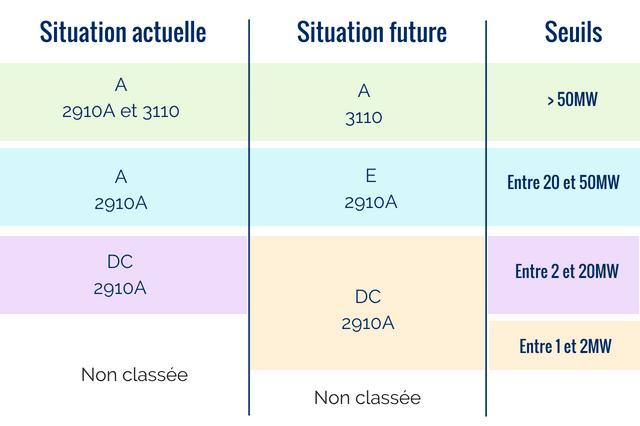
Finally, the draft decree also amends the titles of headings 2770 and 2771 (waste thermal treatment facilities). For these headings, combustion plants that consume only waste meeting the definition of biomass, as defined in heading 2910, are expressly excluded.
Adapting the Environmental Code: scope of atmospheric emission controls for boilers
Following the lowering of the declaration threshold for 2910-A to 1 MW, the draft decree adapts the scope of atmospheric emission controls for boilers provided for by articles R. 224-41-1 to 3 of the Environmental Code. Consequently, boilers with a rated thermal input greater than 400 kW and less than 1 MW, as well as boilers with a rated thermal input greater than or equal to 1 MW and less than 2 MW whose emissions are not periodically monitored under ICPE regulations, are now subject to pollutant emission controls.
Note: the adaptation of the scope of atmospheric emission controls for boilers provided for by the Environmental Code will come into force the day after the decree is published. Existing 1 to 2 MW boilers that are not currently classified as ICPE will be subject to air emission limit values and periodic inspections starting January 1, 2030.
Modification of the content of registration andenvironmental authorization files under the European MCP directive
These amendments provide administrative simplifications, notably the transition from the authorization regime to the registration regime for combustion plants with a capacity between 20 and 50 MW.
The content of the registration file is therefore modified for combustion plants to ensure that the elements required for the greenhouse gas emission allowance trading system and for waste heat recovery (for plants with a capacity greater than 20 MW) can be presented.
Following the exclusion of activities covered by heading 3110 from heading 2910, the draft decree adapts the content of theenvironmental authorization file so that the elements required for waste heat recovery can be presented for certain categories of plants with a capacity greater than 20 MW.
Grandfathering rights: your rights and obligations
These provisions will come into force the day after the decree is published. However, Article L. 513-1 of the Environmental Code grants grandfathering rights to existing facilities newly subject to declaration, registration, or authorization following a change to the ICPE nomenclature.
Thus, the operation of an existing facility may continue without undergoing the administrative declaration, registration, or authorization procedure required by a new heading or a lowered threshold, provided that the following two conditions are met:
- The facility was commissioned in compliance with the previous applicable regulatory regime;
- The operator notified the prefect of the facility's existence no later than one year after the entry into force of the decree amending the nomenclature.
Articles R. 513-1 & 2 of the Environmental Code specify the information to be sent to the Prefect in this context: data identifying the operator, the location of the facility, the nature and volume of the activities carried out, and the heading(s) under which the facility falls. Please note that the prefect may still require the submission of additional documents.
Grandfathering rights do not exempt the facilities concerned from complying with the provisions that normally apply to their activity under their new regulatory regime.