
.svg)








Companies that manufacture certain products are subject to extended producer responsibility (EPR) for managing the waste generated by those products. Let's look back at the principle of EPR and the obligations placed on manufacturers.
The principle of extended producer responsibility
The EPR principle is based on the polluter-pays principle. Under this principle, anyone responsible for placing on the market a product covered by an EPR scheme is responsible for its environmental impact throughout its life cycle.
The person placing this product on the market must then contribute to the prevention and management of the waste generated by this product: this is extended producer responsibility (EPR).
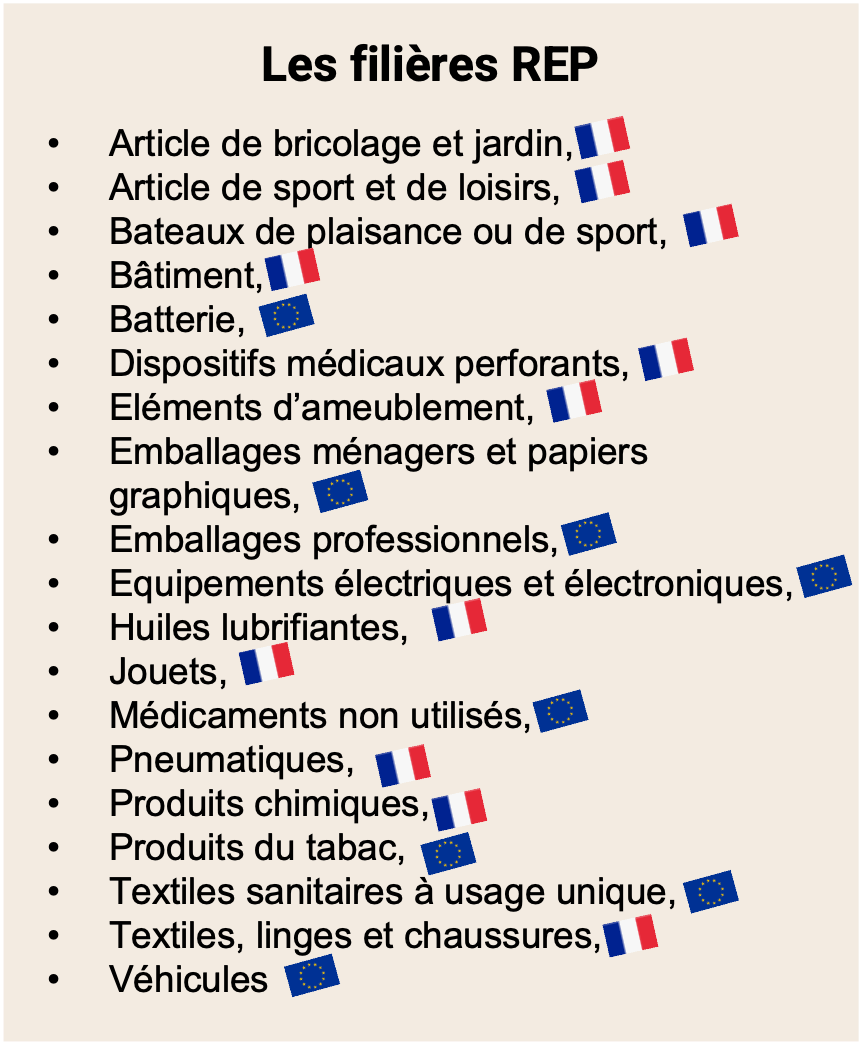
The products covered are grouped into schemes bringing together products from the same family. The household packaging scheme was the first EPR scheme created, in 1993. There are currently 19 schemes in France, but the law of 10 February 2020 on combating waste and promoting the circular economy, known as the AGEC law, provides for the creation of new schemes.
The party responsible for placing products on the market
The Environmental Code defines the “person placing on the market” or “producer” as any individual or legal entity that manufactures or has manufactured a product it makes available on the national market under its own name or brand, or that imports or introduces onto the national market for the first time a product intended to be used within the country.
The manufacturer, importer or distributor of a product covered by an EPR scheme is therefore considered to be the person placing it on the market (or the producer). It is this producer/market-placer who is subject to the obligations arising from EPR.
Obligations arising from extended producer responsibility
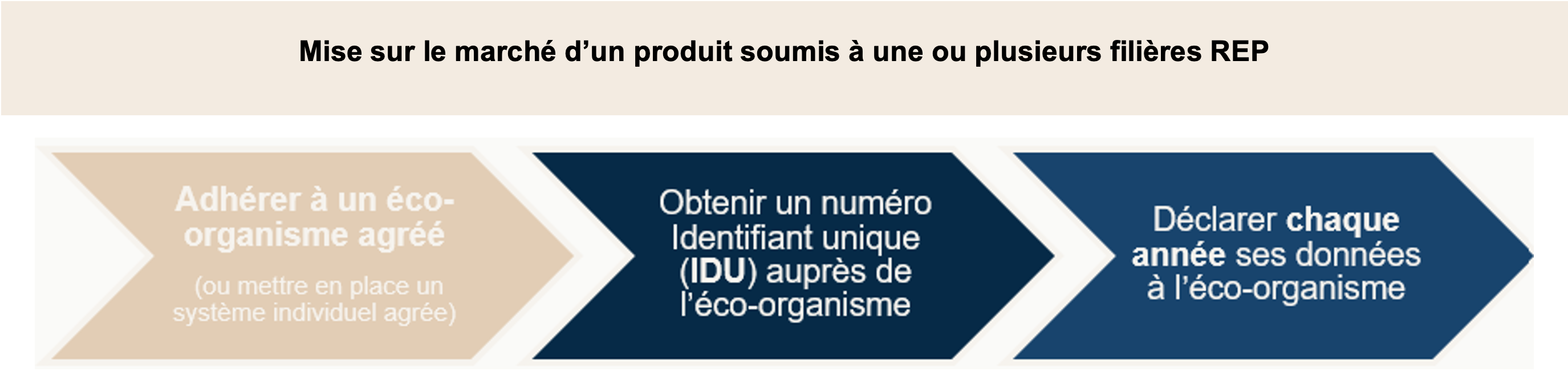
A producer subject to EPR must contribute to the collection and management of waste generated by the products it manufactures. To do this, it:
- sets up an approved individual system (the producer itself manages the collection and recovery of waste from the products it places on the market); or
- joins an approved eco-organisation.
The eco-organisation then takes charge of managing the waste generated by the products, in exchange for a financial contribution from the producer. The amount of the contribution varies according to bonuses and penalties awarded based on the efforts made towards eco-design of the product.
The eco-organisation provides members with a mandatory Unique Identifier Number (IDU) to prove compliance with these obligations.
Note: it is the company (not the individual site) that must join an eco-organisation, so the IDU is issued to the company.
The producer must then declare to the eco-organisation it has joined, each year, the data relating to the design and placing on the market of the products it manufactures.
Going further
The AGEC law and European Regulation (EU) 2025/40 of 19 December 2024 on packaging and packaging waste, known as the “PPWR” regulation, provide for the creation of an EPR scheme dedicated to professional packaging. As a result, anyone who manufactures, imports or distributes, and who makes available for the first time within the European territory, packaging or a packaged product that is not considered household packaging, is subject to this new scheme and must comply with EPR obligations.
The arrangements for setting up this scheme have recently been set out in the Environmental Code. According to an announcement from the Ministry for Ecological Transition, the launch of the scheme in France, initially planned for January 2026, has been postponed to 1st July 2026.
Other schemes, such as those for chewing gum or assistive devices, are due to be created shortly.