
.svg)




.png)



🔎 Key takeaways
Here are the key points of the professional packaging EPR scheme:
- Objective: Achieve reuse and recycling targets by 2030 for the 18 million tonnes of packaging circulating each year.
- Producers: Requirement to join an eco-organisation or have an approved individual system in place before 1 July 2026.
- Holders: New option to hand over waste to an approved eco-organisation, potentially at a lower cost.
Following the extended producer responsibility (EPR) scheme applicable to household packaging, in place since 1992, French regulations, driven by the European Union, now set out the arrangements for the new professional packaging EPR scheme.
18 million tonnes of professional packaging circulate on the French market each year, of which 8 million tonnes of single-use packaging are still placed on the market annually. With the aim of reducing pollution and conserving resources, each of these waste streams will need to meet reuse or recycling targets by 2030. To meet these circularity objectives, and following on from European Regulation 2025/40 of 19 December 2024 on packaging and packaging waste, Decree No. 2025-1081 of 17 November 2025 amends Articles R. 543-42 to R. 543-74 of the Environmental Code, in order to set out the scope of the extended producer responsibility (EPR) scheme for professional packaging.
What's changing for holders of professional packaging:
In addition to the 3 options already available previously:
- carrying out the recovery themselves,
- transferring it by contract to the operator of a recovery facility,
- transferring it by contract to an intermediary carrying out collection, road transport, trading or brokering of waste, with a view to its recovery,
holders of professional packaging can now hand it over to an approved eco-organisation or to a waste management operator that has a contract with an approved eco-organisation for managing professional packaging waste.
Note: This packaging waste may be mixed with other operational waste, but only if this does not affect its capacity to undergo preparation for reuse, recycling or other recovery operations, in accordance with the treatment hierarchy.
What's changing for producers of professional packaging:
Producers of professional packaging must now ensure the management of their packaging waste.
Note: For grouped (= secondary) and sales (= primary) packaging, the producer is the first person to place the packaged product on the market: the person who packages the product, or has the product packaged under their brand, or imports a packaged product. For transport (= tertiary) packaging, the producer is the first person to place the packaging on the market.
Note: a packaging manufacturer is any individual or legal entity that manufactures packaging or a packaged product. Where an individual or legal entity has packaging or a packaged product designed or manufactured under its own name or brand, whether or not another brand is visible on the packaging or the packaged product, that person is considered to be the manufacturer. (Definition taken from the PPWR regulation.)
Producers can meet this obligation:
- either by joining (at company level) an eco-organisation holding approval for the professional packaging scheme before the packaging is first made available on the market, from 1 July 2026;
- or by submitting a request for approval meeting the requirements of the individual system specifications, by 28 February 2026 at the latest for approval by 1 July 2026, or three months before the packaging is first placed on the market if this occurs after 1 July 2026.
Newly excluded from the household and professional packaging EPR schemes are packaging for mineral and synthetic oils, lubricants or industrial oils, governed by the “Lubricating or industrial oils” EPR scheme.
Newly excluded from the professional packaging EPR scheme are:
- packaging for chemical products that may present a significant risk to health and the environment, governed by the “Chemical products” EPR scheme;
- packaging for construction products or materials in the building sector, governed by the “Construction products and materials in the building sector” EPR scheme.
Note: For packaging in the agricultural supply sector, A.D.I.VALOR meets EPR obligations in accordance with an agreement concluded with the minister responsible for the environment before 31 December 2019, for as long as this agreement is renewed.
Which packaging is concerned:
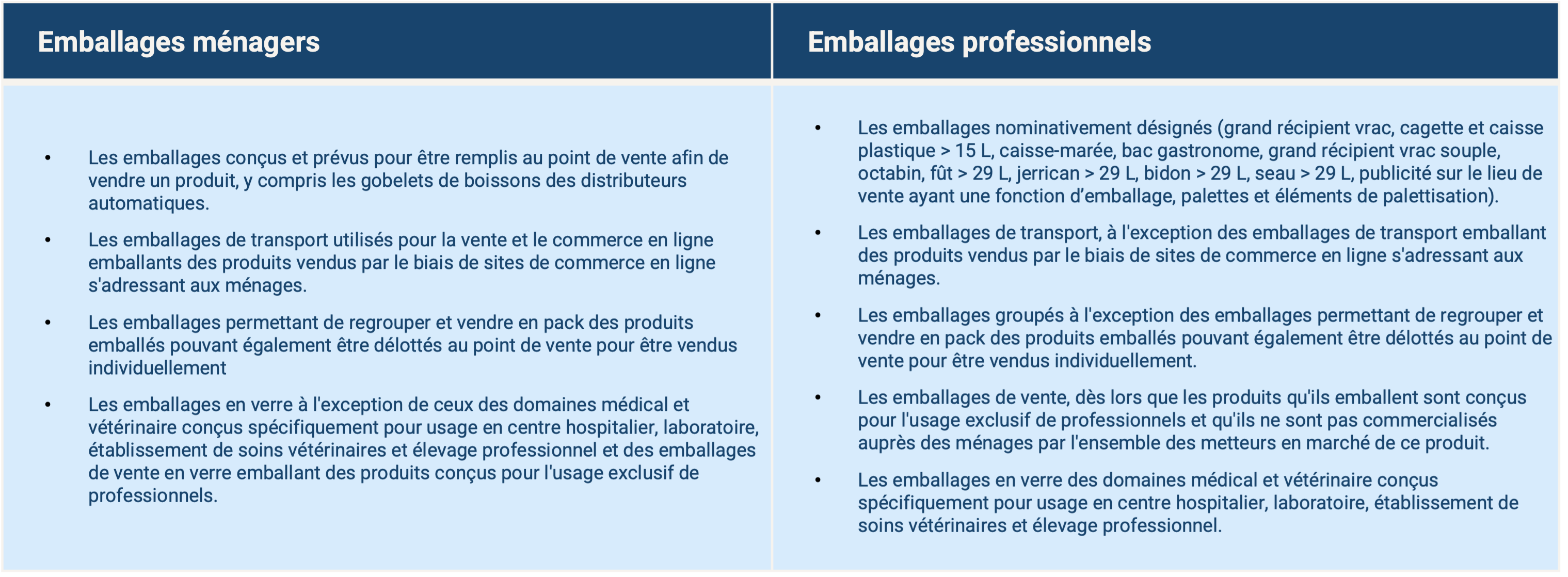
The order of 2 December 2025 on packaging for products used by households and/or professionals sets out the characteristics of professional packaging – i.e. packaging used to market products consumed or used specifically by professionals – as well as household packaging, i.e. packaging for products consumed or used by households.
The following packaging automatically falls into the professional packaging or household packaging categories:
Application conditions:
The initial entry into force was set for 1 January 2026, then postponed to 1st July 2026.
However, contracts linking approved eco-organisations with producers who transferred their EPR obligation to them for packaging used to market products consumed or used by households – including those likely to be so used and those consumed away from home, printed paper items, with the exception of books, issued, including free of charge, by or on behalf of principals, and graphic paper, aimed at end users who generate household and similar waste, in force on 1 January 2026 – continue to have effect until their term.
In addition, the arrangements under which approved eco-organisations operate to take charge of managing catering packaging waste remain governed by the provisions of the Environmental Code applicable to them, in the version in force before 18 November 2025, until they are approved under the professional packaging EPR scheme and, at the latest, until their approval expires.