
.svg)







The universal registration document complements a series of initiatives, spearheaded by integrated reporting and the DPEF. These initiatives are all part of the convergence of financial and non-financial information, aimed at better understanding how companies create and share value—a key factor in the long-term viability of economic players.
Universal registration document: communicating risks more effectively
The universal registration document (URD) has been required since July 21, 2019, for prospectuses subject to approval. It introduces a change in how risks are presented, in accordance with Article 16 of the Prospectus 3 Regulation.
Issuers are encouraged to present their financial and non-financial strategies more clearly. They must now only include risks that are significant and specific to their business in a dedicated risk chapter, covering all risks, including non-financial ones. The selected risks—a maximum of 15 (as per Article 7 of the Prospectus Regulation)—must be prioritized and classified by category and sub-category of risk factors (a maximum of 10). The most significant risk factors must be listed at the beginning of each category. In its assessment, the issuer may use a qualitative scale to specify whether the risk is low, medium, or high.
Toward a comprehensive assessment of corporate performance
In integrated reporting, the correlation between financial capital and manufactured, intellectual, human, social, and environmental capital allows for the capture of value creation over time. This includes the identification of risks—as well as opportunities—which are, by definition, both financial and non-financial. The reciprocity between financial and non-financial factors is the cornerstone of integrated thinking.
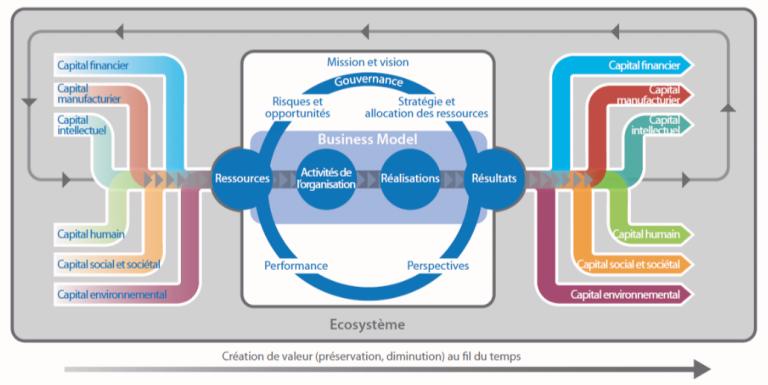
This perspective on financial and non-financial risks allows for a better assessment of a company's long-term prospects.
A sign of the times: in April 2019, the Securities and Exchange Commission indicated that the reporting system should evolve to include information regarding intangible assets such as intellectual property and human capital.
These developments are a step in the right direction. They reflect the growing importance of ESG criteria in evaluating overall corporate performance, particularly to meet investor needs. The goal? "To ensure that companies are taking into account the interests of society, the planet, and all their stakeholders," as noted by Dominic Barton, Chairman of the International Integrated Reporting Council, regarding the evolution of integrated reporting worldwide.
For decades, financial reporting has relied on key performance indicators. The DPEF encourages companies to manage the policies implemented to reduce and avoid identified non-financial risks using KPIs. Many companies have adjusted the frequency of their financial data collection to align with this perspective. This is encouraging. It remains to be seen whether, in the near future, non-financial KPIs will appear on executive committee meeting agendas alongside economic KPIs. When we reach that point, financial and non-financial reporting will have fully and completely converged.
Need help with your ESG reporting? Discover our ESG and CSRD software Tennaxia.
Want to learn more? Check out our article on non-financial reporting.
Photo credit: Vitaly Gariev